

What do you think?
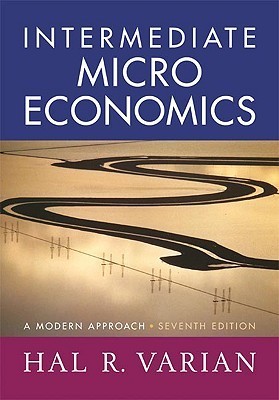
Intermediate Microeconomics: A Modern Approach
The Seventh Edition of Intermediate Microeconomics: A Modern Approach is distinguished by its remarkably up-to-date and rigorous yet accessible analytical approach. Professor Varian’s lucid prose guides students through the fundamentals of microeconomic analysis while emphasizing real-world economic problems and incorporating coverage of the most innovative subjects in the discipline. The Seventh Edition has been carefully updated and revised, adding a wealth of new applications and examples that analyze the important lessons offered by eBay, Google, Verizon, IBM, Microsoft, Bank of America, drug companies, the Yellow Pages, and more.
784 pages, Hardcover
First published January 1, 1987
Ratings & Reviews
Friends & Following
Create a free account to discover what your friends think of this book!
Community Reviews
Displaying 1 - 30 of 51 reviews

April 23, 2011
Varian's Intermediate Microeconomics is a fantastic introduction to microeconomic theory. Particularly in the early phase of my first-year graduate economics course work, I often turned to it to gain intuition. It stands the test of time as a great reference.

June 25, 2018
I told someone I was reading this and he was horrified that Varian doesn't use calculus properly. Bloody neoclassical economists. The models are a fiction and the precision doesn't matter. Skipping calculus is more intuitive anyway.
Introducing model after model became tiring. Ignoring the sketchy chapter on econometrics, there was little to introducing the empirical side of economics. But, Varian makes up for it with the delightful examples.
I started off the textbook loving economics and wishing I could retrain. By about Chapter 23 that had faded (thank god!). I'll stick to my amateur security economics.
Introducing model after model became tiring. Ignoring the sketchy chapter on econometrics, there was little to introducing the empirical side of economics. But, Varian makes up for it with the delightful examples.
I started off the textbook loving economics and wishing I could retrain. By about Chapter 23 that had faded (thank god!). I'll stick to my amateur security economics.

January 31, 2011
One of the few textbooks I have read almost cover-to-cover. Complete with rather horrific economic jokes (like hitfrogs targeting a scorpion's family). Unfortunately, I have to go over the entire thing again, especially the formulae.
November 1, 2020
sika hyvä!!
May 22, 2011
It's an easy and comfortable subject to begin with. The author did a good job explain things in detail. Probably too much detail.

November 3, 2012
Pretty good, even if you start from a low level.

August 24, 2018
This kicked my arse; it was way above my mathematical level when I first encountered it.
February 14, 2020
Good for economic intuition. Bad for the mathematical intuition regarding economics.

July 8, 2025
EXONERE LA MATERIAAA!!!Gracias por todo Varian jajaja

December 27, 2009
Note to self: The most difficult book ever! Main text for Basic Microeconomics course under Prof. Kiyoshi Taniguchi (Ohio State 2001), Fall Term 2003; and Microeconomics course under Prof. Yuichiro Yoshida (Boston College 2001), Winter Term 2004. International Development Program, International University of Japan

Read
October 17, 2023No me lo van a creer pero este libro me hizo llorar todo un día (probablemente fue culpa del eclipse). Tiene una manera única de plasmar el dolor humano. Cada gráfica y el cálculo diferencial me hicieron repensar mi existencia. Realmente un libro exquisito.
MALDITO LIBRO ASQUEROSO LO ODIO LO ODIO LO ODIO
MALDITO LIBRO ASQUEROSO LO ODIO LO ODIO LO ODIO


December 12, 2020
Great introductory book. I read this one as I brushed up on my (introductory) microeconomics 13 years later. It seemed very concise and exhaustive - it's not as math-heavy as Mas-Colell et al., but great for conceptual understanding.
I was impressed about how contemporary the teaching of microeconomics (at least as indicated in this book) has become with multiple pages dedicated to the microeconomic auction models used in e.g. online marketing!
I was impressed about how contemporary the teaching of microeconomics (at least as indicated in this book) has become with multiple pages dedicated to the microeconomic auction models used in e.g. online marketing!
November 13, 2021
Well, this was sort of complex however it left impression for the well-organized content. I think it is ideal for any individual concerned about the economy. Since it is a popular course material it left impression for the fundamental content, despite occasional complexity. Overall, I think it makes an essential material for anyone interested or curious about the economy and how it functions.

August 13, 2012
A good book to read but not for beginners...

December 1, 2012
I will probably have this textbook again but I really do not think it is very clear for people who do not have background in finance.

June 5, 2020
realmente un muy buen manual para cursos de microeconomía. Varian es muy claro con la explicación de conceptos
October 19, 2024
Honestly, this is probably the most frustrating textbook I have ever read (and I'm a bit weird in that I actually like reading textbooks, so...), and I have 2 bachelor's and a master's all in STEM fields, so this isn't an issue that lies with this reader's ability to understand complex ideas. I really had high hopes for this book given the caliber of the authors, and the claim of it being the "gold-standard". Gold standard of what? Poor pedagogy?
Well, why is it so frustrating? It's like the author never had a single proofreader read the book to check for ambiguous, or vaguely worded explanations or definitions. Over and over again, I ran into explanations that have two or more possible interpretations, often this happens in the setup of the discussion so everything that follows is confusing because the author was not careful to make his meaning clear from the start. So you have to expend 4 - 5x more energy (and time) just trying to ascertain what the heck the author meant in the first place so that the following passages can have a coherent meaning, and this can only be deciphered by checking if your working interpretation is consistent with all the statements that follow. And you have to iterate through the possible interpretations until you find one that is consistent with what follows. "Did he mean this? No, no, that wouldn't make sense here. Well maybe he meant this... Or this...?" Like I said, absolutely exhausting. There are even passages where the author sets up new notation and defines it, then uses a different meaning in the following equations, and so there is no consistent interpretation that could make the entire passage coherent, there is an insurmountable inconsistency due to the author switching meanings mid-paragraph.
As Norbert Wiener, the first-class mathematician and founder of cybernetics, said:
“The advantage of a clear statement is that it tends to prevent misunderstandings. But if you are vague, you leave the door wide open to all sorts of misinterpretations, so that by the end of the explanation, the student may well be standing on their head with their feet in the air.”
Ambiguously worded prose, definitions, and explanations are nothing more than unforced errors that destroy the learning experience due to the resulting frustration. There is no excuse for this amount of ambiguity in a textbook whose main edition is in the 10th iteration.
Also, there are quite a few conceptual fallacies in the explanations. Apparently a quantity can be a constant in one part of an explanation but in the next sentence it has to be a (random) variable... Have your cake and eat it too?
The passages are so choppy, most likely due to so many patchwork edits on the many editions over the years. The book needs a serious overhaul by a good editor (and many reviewers), to get the book to a point where ideas are delivered with clarity rather than ambiguity, fluidly rather than spasmodically. I do think a good textbook is buried within, but not as it currently is.
My advice: Don't waste your time and energy; find the "silver-standard" because this "gold-standard" ain't gonna cut it.
Well, why is it so frustrating? It's like the author never had a single proofreader read the book to check for ambiguous, or vaguely worded explanations or definitions. Over and over again, I ran into explanations that have two or more possible interpretations, often this happens in the setup of the discussion so everything that follows is confusing because the author was not careful to make his meaning clear from the start. So you have to expend 4 - 5x more energy (and time) just trying to ascertain what the heck the author meant in the first place so that the following passages can have a coherent meaning, and this can only be deciphered by checking if your working interpretation is consistent with all the statements that follow. And you have to iterate through the possible interpretations until you find one that is consistent with what follows. "Did he mean this? No, no, that wouldn't make sense here. Well maybe he meant this... Or this...?" Like I said, absolutely exhausting. There are even passages where the author sets up new notation and defines it, then uses a different meaning in the following equations, and so there is no consistent interpretation that could make the entire passage coherent, there is an insurmountable inconsistency due to the author switching meanings mid-paragraph.
As Norbert Wiener, the first-class mathematician and founder of cybernetics, said:
“The advantage of a clear statement is that it tends to prevent misunderstandings. But if you are vague, you leave the door wide open to all sorts of misinterpretations, so that by the end of the explanation, the student may well be standing on their head with their feet in the air.”
Ambiguously worded prose, definitions, and explanations are nothing more than unforced errors that destroy the learning experience due to the resulting frustration. There is no excuse for this amount of ambiguity in a textbook whose main edition is in the 10th iteration.
Also, there are quite a few conceptual fallacies in the explanations. Apparently a quantity can be a constant in one part of an explanation but in the next sentence it has to be a (random) variable... Have your cake and eat it too?
The passages are so choppy, most likely due to so many patchwork edits on the many editions over the years. The book needs a serious overhaul by a good editor (and many reviewers), to get the book to a point where ideas are delivered with clarity rather than ambiguity, fluidly rather than spasmodically. I do think a good textbook is buried within, but not as it currently is.
My advice: Don't waste your time and energy; find the "silver-standard" because this "gold-standard" ain't gonna cut it.
October 7, 2017
Excellent intermediate micro textbook! Bought it in addition to my class' official textbook on the recommendation of a friend, and ended up using this supplemental textbook as my main one. Varian truly does know how to make economics interesting. Highly recommend.

February 25, 2019
This is my second book on micro-economics and I truly enjoyed reading it. It is quite easy to understand, all you need is a basic understanding of calculus. This is a must book in your shelf you want to pursue economics.

June 5, 2019
This is really great. Definitely what I would assign if I was teaching intermediate micro. Great analysis of consumer and producer theory. Calculus in the appendix parts so if you have students who know call they can check it out, but also works for students who don’t have calf background.

October 4, 2023
Even though the title says 'Intermediate', it still can serve as an introductory microeconomics textbook. I liked the fact that it had a large number of small chapters and a lot of real life examples. Maybe exercises could have included more numericals.
September 14, 2019
Don not ever read this book, it is to complicated, the writer gone to far away in mathematics, and you won't understand anything if you are a beginner.

January 9, 2020
Well-explained!
A well educative and academic book in Microeconomics for economists.
Recommended!!!
A well educative and academic book in Microeconomics for economists.
Recommended!!!
February 21, 2020
Superb, quite so! , primer to microeconomics. Not much to say beyond that. Almost gets you jonsing to read its bigger brother, Varian's Microeconomic Analysis.

April 14, 2020
Great

April 26, 2020
Super well written!
May 15, 2021
Better than Perloff? But I prefer Macro because none of these weird symbols (and their language) which Varian always uses make any sense 😭

December 20, 2021
The cornerstone of every economics major.
June 7, 2022
the best microeconomics book I have ever read (I read just one)
Displaying 1 - 30 of 51 reviews