

What do you think?

The Allegory of the Cave
Plato’s Allegory of the Cave is one of the most elegant and important metaphors in Western philosophy. It is a dialogue between Plato's brother Glaucon and his mentor Socrates, narrated by the latter, in which Plato elucidates his Theory of Forms.
43 pages, Kindle Edition
First published January 1, 381
About the author
Plato
5,762 books9,109 followersPlato (Greek: Πλάτων), born Aristocles (c. 427 – 348 BC), was an ancient Greek philosopher of the Classical period who is considered a foundational thinker in Western philosophy and an innovator of the written dialogue and dialectic forms. He raised problems for what became all the major areas of both theoretical philosophy and practical philosophy, and was the founder of the Platonic Academy, a philosophical school in Athens where Plato taught the doctrines that would later become known as Platonism.
Plato's most famous contribution is the theory of forms (or ideas), which has been interpreted as advancing a solution to what is now known as the problem of universals. He was decisively influenced by the pre-Socratic thinkers Pythagoras, Heraclitus, and Parmenides, although much of what is known about them is derived from Plato himself.
Along with his teacher Socrates, and Aristotle, his student, Plato is a central figure in the history of philosophy. Plato's entire body of work is believed to have survived intact for over 2,400 years—unlike that of nearly all of his contemporaries. Although their popularity has fluctuated, they have consistently been read and studied through the ages. Through Neoplatonism, he also greatly influenced both Christian and Islamic philosophy. In modern times, Alfred North Whitehead famously said: "the safest general characterization of the European philosophical tradition is that it consists of a series of footnotes to Plato."
Plato's most famous contribution is the theory of forms (or ideas), which has been interpreted as advancing a solution to what is now known as the problem of universals. He was decisively influenced by the pre-Socratic thinkers Pythagoras, Heraclitus, and Parmenides, although much of what is known about them is derived from Plato himself.
Along with his teacher Socrates, and Aristotle, his student, Plato is a central figure in the history of philosophy. Plato's entire body of work is believed to have survived intact for over 2,400 years—unlike that of nearly all of his contemporaries. Although their popularity has fluctuated, they have consistently been read and studied through the ages. Through Neoplatonism, he also greatly influenced both Christian and Islamic philosophy. In modern times, Alfred North Whitehead famously said: "the safest general characterization of the European philosophical tradition is that it consists of a series of footnotes to Plato."
Ratings & Reviews
Friends & Following
Create a free account to discover what your friends think of this book!
Community Reviews
Displaying 1 - 30 of 380 reviews

March 29, 2012
The allegory of the cave takes the form of a conversation between Socrates and Plato's brother Glaucon, in one of Plato's literary works, The Republic, (Volume 7).
Since Socrates never wrote anything down, we know of his teachings mainly through third party accounts. Plato had been one of Socrates' pupils, so it is possible that the allegory could be based on a real conversation that Socrates had.
Plato uses it to illustrate his concept of our ephemeral world as contrasted with his construct of the eternal world of Forms. Plato believed that humans pre-exist in an ideal world of forms before they are born into the physical world of sense perception that we find ourselves in. We cannot perceive the nature of reality through our senses, but our organs of sense perception such as when we see or hear things, nudge our memories of the divine, or ideal world of forms, and so helps us to remember the true nature of existence.
The allegory of the cave involves imagining a group of prisoners chained since birth in a cave in such a way that they can only see the cave wall in front of them. Their only visual perception is that of shadows cast against the cave wall in front of them, cast by objects on a raised walkway between them and a fire burning behind them. Only echoes of voices and sounds reach them. The prisoners mistake the shadows and echoes for reality, because that is all they know.
Socrates, (as a speaker in this dialogue from Plato's work "The Republic"), then posits what would happen if a prisoner were forcibly removed from the cave, and set free in the outside world . This seems to be an allegory for when a person is set free from illusion, and introduced to the "truth". Socrates then describes how such a person would initially feel anger and discomfort at being pulled away from his comfort zone. If he was brought out into the light, his eyes would initially be dazzled, but he would eventually start seeing things for what they really are. (Plato presumably here is referring to his ideal World of Forms, which to him is the "truth". )
Plato (talking as Socrates) then goes on to posit that such an enlightened person would grow to scorn the limited and erroneous conceptions of the people still chained to the wall in the cave, who cannot see the truth, and have to make conclusions about reality based on the shadows that they see.
Plato then has Socrates muse that the other people still in the cave, would think that the enlightened person (presumably a philosopher), has been blinded by the light and, if he (the philosopher) tries to enlighten them, they would reject this, and they might think they need to have him killed.
The latter is interesting since Socrates was indeed put on trial and sentenced to death for "corrupting the mind of the youth" with his philosophical ideas, which espoused an aristocracy rather than a democracy.
Plato explains at the end of the allegory, that he uses fire (such as the fire in the cave) and the sun as a symbol of the source of virtue, wisdom and reality, and therefore the sun is also a reference to God.
So one has to take into account that the allegory refers to more than purely to actual physical objects. Plato's "truth" encompasses the nature of abstract entities such as beauty, virtue or "Good", and the source of "Good", but also philosophical wisdom or knowledge.
If you don't have time to read much of Plato, but wanted to come into contact with some of Socrates's epistemology, book 7 of The Republic is a nice place to start.
The work is written in much easier language than one would expect from such a venerated source of much of what Western philosophical thought was built upon, so give it a go!
You can download it for free at places like Gutenberg.org.
Since Socrates never wrote anything down, we know of his teachings mainly through third party accounts. Plato had been one of Socrates' pupils, so it is possible that the allegory could be based on a real conversation that Socrates had.
Plato uses it to illustrate his concept of our ephemeral world as contrasted with his construct of the eternal world of Forms. Plato believed that humans pre-exist in an ideal world of forms before they are born into the physical world of sense perception that we find ourselves in. We cannot perceive the nature of reality through our senses, but our organs of sense perception such as when we see or hear things, nudge our memories of the divine, or ideal world of forms, and so helps us to remember the true nature of existence.
The allegory of the cave involves imagining a group of prisoners chained since birth in a cave in such a way that they can only see the cave wall in front of them. Their only visual perception is that of shadows cast against the cave wall in front of them, cast by objects on a raised walkway between them and a fire burning behind them. Only echoes of voices and sounds reach them. The prisoners mistake the shadows and echoes for reality, because that is all they know.
Socrates, (as a speaker in this dialogue from Plato's work "The Republic"), then posits what would happen if a prisoner were forcibly removed from the cave, and set free in the outside world . This seems to be an allegory for when a person is set free from illusion, and introduced to the "truth". Socrates then describes how such a person would initially feel anger and discomfort at being pulled away from his comfort zone. If he was brought out into the light, his eyes would initially be dazzled, but he would eventually start seeing things for what they really are. (Plato presumably here is referring to his ideal World of Forms, which to him is the "truth". )
Plato (talking as Socrates) then goes on to posit that such an enlightened person would grow to scorn the limited and erroneous conceptions of the people still chained to the wall in the cave, who cannot see the truth, and have to make conclusions about reality based on the shadows that they see.
Plato then has Socrates muse that the other people still in the cave, would think that the enlightened person (presumably a philosopher), has been blinded by the light and, if he (the philosopher) tries to enlighten them, they would reject this, and they might think they need to have him killed.
The latter is interesting since Socrates was indeed put on trial and sentenced to death for "corrupting the mind of the youth" with his philosophical ideas, which espoused an aristocracy rather than a democracy.
Plato explains at the end of the allegory, that he uses fire (such as the fire in the cave) and the sun as a symbol of the source of virtue, wisdom and reality, and therefore the sun is also a reference to God.
So one has to take into account that the allegory refers to more than purely to actual physical objects. Plato's "truth" encompasses the nature of abstract entities such as beauty, virtue or "Good", and the source of "Good", but also philosophical wisdom or knowledge.
If you don't have time to read much of Plato, but wanted to come into contact with some of Socrates's epistemology, book 7 of The Republic is a nice place to start.
The work is written in much easier language than one would expect from such a venerated source of much of what Western philosophical thought was built upon, so give it a go!
You can download it for free at places like Gutenberg.org.

April 4, 2012
Before there was the Matrix, there was the AoC.

January 12, 2023
"How could they see anything but the shadows if they were never allowed to move their heads?"
Plato, The Allegory of the Cave
Review to follow.
Plato of course, was one of the great philosophers. I became interested in his works through my childhood readings of Cleopatra.
The cave in the story is an allegory, but I don’t want to give away too much by talking about why that is so. Suffice to say it is all about how we consume knowledge And whether we are up to the task of being student of knowledge. It is philosophical and introspective, and I won’t pretend I understood all of it simply because it’s Plato and a lot of it was way too existential for me.
I recommend it. I first read it quite a while ago. I was born with a rather crazy obsession for all things Egypt and Greece.
Since my early years, I have devoured those type of books.
This story is short, not too short, but not at all along. You will probably find yourself reading it in small doses, and perhaps stopping and pondering certain pages.
And because I’m writing this from my phone and my phone is about to run out of charger I must end this review here. Highly recommended.
Plato, The Allegory of the Cave
Review to follow.
Plato of course, was one of the great philosophers. I became interested in his works through my childhood readings of Cleopatra.
The cave in the story is an allegory, but I don’t want to give away too much by talking about why that is so. Suffice to say it is all about how we consume knowledge And whether we are up to the task of being student of knowledge. It is philosophical and introspective, and I won’t pretend I understood all of it simply because it’s Plato and a lot of it was way too existential for me.
I recommend it. I first read it quite a while ago. I was born with a rather crazy obsession for all things Egypt and Greece.
Since my early years, I have devoured those type of books.
This story is short, not too short, but not at all along. You will probably find yourself reading it in small doses, and perhaps stopping and pondering certain pages.
And because I’m writing this from my phone and my phone is about to run out of charger I must end this review here. Highly recommended.

September 3, 2017
I'd forgotten how much I adore Plato. I studied philosophy for my higher education and fell in love. It's been a little while since I read it last, I remember spending weeks worth of lessons discussing, dissecting and debating Plato, very fond memories indeed.
Plato's Allegory of the Cave is a fantastic place to start as it draws upon his ideas of the Realm of Forms and of knowledge being Good. It's also pretty short so there is that.
Plato mostly wrote Dialogues that had Socrates as the narrator. Socrates was Plato's teacher and obviously has a huge impact on Plato's own thoughts.
The Allegory of the cave is a dialogue between Socrates and Glaucon.
I'm not going to go in depth discussing the deeper meaning and what it all means. Philosophy is all about thinking and to be honest, part of the fun (for me at least) is drawing those connections. What I will say is that the imagery used astounds me every time I read it. For me, this Allegory is about the enlightenment of knowledge. Knowledge is a hard thing to attain. You have to be intrigued enough to turn your head and seek it out, ask the questions. It's not an easy thing to accomplish, it can take a while to adjust and it can be painful to see the truth of your situation. But once you attain knowledge, when you get to that higher state of Good. You have to return to being the prisoner in the cave.
And I'm rambling...
Anyway, I've read this text so many times I've lost count. Every time I read it I get something from it. It just goes to show that philosophy is important and relevant. This is still relevant centuries later, it can be used in reference to modern day life. I'm a much bigger fan of ancient philosophy than I am modern. Socrates, Plato and Aristotle are the big three. All of their work stems from the same tree, so to speak. It's always refreshing to read their work and ponder a little. Even better if you can debate and discuss with someone. As Socrates does in this text, ask each other questions, use that grey matter.
I'd recommend everyone read this. Philosophy is as boring as you make it, the more you think, the more it makes sense.
Plato's Allegory of the Cave is a fantastic place to start as it draws upon his ideas of the Realm of Forms and of knowledge being Good. It's also pretty short so there is that.
Plato mostly wrote Dialogues that had Socrates as the narrator. Socrates was Plato's teacher and obviously has a huge impact on Plato's own thoughts.
The Allegory of the cave is a dialogue between Socrates and Glaucon.
I'm not going to go in depth discussing the deeper meaning and what it all means. Philosophy is all about thinking and to be honest, part of the fun (for me at least) is drawing those connections. What I will say is that the imagery used astounds me every time I read it. For me, this Allegory is about the enlightenment of knowledge. Knowledge is a hard thing to attain. You have to be intrigued enough to turn your head and seek it out, ask the questions. It's not an easy thing to accomplish, it can take a while to adjust and it can be painful to see the truth of your situation. But once you attain knowledge, when you get to that higher state of Good. You have to return to being the prisoner in the cave.
And I'm rambling...
Anyway, I've read this text so many times I've lost count. Every time I read it I get something from it. It just goes to show that philosophy is important and relevant. This is still relevant centuries later, it can be used in reference to modern day life. I'm a much bigger fan of ancient philosophy than I am modern. Socrates, Plato and Aristotle are the big three. All of their work stems from the same tree, so to speak. It's always refreshing to read their work and ponder a little. Even better if you can debate and discuss with someone. As Socrates does in this text, ask each other questions, use that grey matter.
I'd recommend everyone read this. Philosophy is as boring as you make it, the more you think, the more it makes sense.

December 23, 2022
i'll write a review abt the dangers of conception, knowledge and belief + believing your perception is right vs liberalism in society based on this. someday.

September 19, 2016
Known also as "myth of the cave", "metaphor of the cave", "parable of the cave", and "Plato's Cave", this is perhaps one of the most famous allegories in history. For those of whom don't know, this is an allegory told in a dialogue between Plato's (427-327 BCE) brother Glaucon and his mentor Socrates (470-399 BCE) recorded by the Greek philosopher Plato in book 7 of his famous work The Republic. It contrasts the effect of education and the lack of it on human nature and on our perspectives and interpretations of our reality.
The allegory describes a group of prisoners who have lived shackled and chained to a wall in a cave for all of their lives, facing a wall. The prisoners watch shadows that are projected on the wall from objects passing in front of a fire on the other side of the objects, and the prisoners give names to these shadows. The shadows are the prisoners' reality of the world. Socrates explains how the philosopher is comparable to the prisoner who is freed from the cave and eventually comes to understand that the shadows on the wall are not reality at all, as the prisoner can understand the true reality, as opposed to the false reality, -the shadows seen by the prisoners. The rest of the prisoners don't even have the urge to leave their shackles or the prison because they know no better life than the one they already have. The prisoners manage to break their bonds one day, and discover that their reality was not what they thought it was.
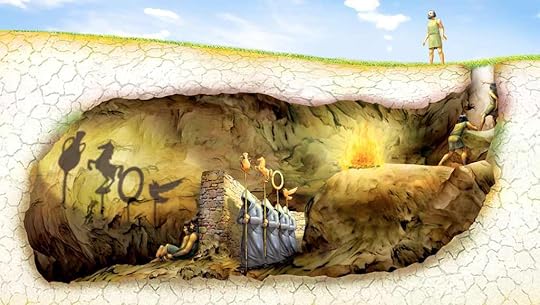
Socrates goes on to explain that if, one were to escape bondage, they would find a world that they couldn't understand. The sun is incomprehensible for a person whom has never seen it. In other words, they would enter another realm or dimension, a place incomprehensible because, it is the source of a higher reality than the one they have previously known for their entire existence. (THINK: The Matrix).
In the context of the Republic, Plato uses this allegory to argue for the existence of the spiritual plain of existence in his Theory of Forms". Plato calls this spiritual realm the "Realm of Forms" aka the "Realm of Ideas" or "Realm of Ideals". Plato's Theory of Forms asserts that the physical realm is only a shadow, or image, of the true reality of the realm of forms. These forms are very much representative of the abstracts ideas that we have of things.
This theory has proven to be very problematic and is therefore all but rejected in more modern philosophy in favor of more naturalistic philosophies. In philosophy, the theory is considered a classical solution to Parmenides. Plato's Theory of Forms can be a bit hard to grasp in any 'real' sense, (see what I did there) but it is an interesting thought provoking exercise.

There are many symbolic icons in the allegory. The sun, fire, and light come to represent truth, wisdom, and virtue. The cave, darkness, and chains represent the the bondage of ignorance. From the emergence from within the cave, being underground, into the sun, it is symbolic of the freedom that the truth, wisdom, and virtue brings. The cave could also be seen as The Greek Underworld. The world above could be made to represent the firmament or the heaven of fire where the Greeks believed the Gods lived above mount olympus.
Personal note:
This is freely available all over the internet in may formats. The Republic, just by virtue of being a work of philosophy, is somewhat intimidating to the novice philosopher or reader. Let me assure you that this allegory in book 7, is easy to read and to understand part that you should really make time for. After all, this work is at the very foundation of Western thought. If you are looking for an interesting, thought-provoking read that introduces some general ideas of philosophy, look no further than book 7.
The allegory describes a group of prisoners who have lived shackled and chained to a wall in a cave for all of their lives, facing a wall. The prisoners watch shadows that are projected on the wall from objects passing in front of a fire on the other side of the objects, and the prisoners give names to these shadows. The shadows are the prisoners' reality of the world. Socrates explains how the philosopher is comparable to the prisoner who is freed from the cave and eventually comes to understand that the shadows on the wall are not reality at all, as the prisoner can understand the true reality, as opposed to the false reality, -the shadows seen by the prisoners. The rest of the prisoners don't even have the urge to leave their shackles or the prison because they know no better life than the one they already have. The prisoners manage to break their bonds one day, and discover that their reality was not what they thought it was.
Socrates goes on to explain that if, one were to escape bondage, they would find a world that they couldn't understand. The sun is incomprehensible for a person whom has never seen it. In other words, they would enter another realm or dimension, a place incomprehensible because, it is the source of a higher reality than the one they have previously known for their entire existence. (THINK: The Matrix).
In the context of the Republic, Plato uses this allegory to argue for the existence of the spiritual plain of existence in his Theory of Forms". Plato calls this spiritual realm the "Realm of Forms" aka the "Realm of Ideas" or "Realm of Ideals". Plato's Theory of Forms asserts that the physical realm is only a shadow, or image, of the true reality of the realm of forms. These forms are very much representative of the abstracts ideas that we have of things.
This theory has proven to be very problematic and is therefore all but rejected in more modern philosophy in favor of more naturalistic philosophies. In philosophy, the theory is considered a classical solution to Parmenides. Plato's Theory of Forms can be a bit hard to grasp in any 'real' sense, (see what I did there) but it is an interesting thought provoking exercise.
There are many symbolic icons in the allegory. The sun, fire, and light come to represent truth, wisdom, and virtue. The cave, darkness, and chains represent the the bondage of ignorance. From the emergence from within the cave, being underground, into the sun, it is symbolic of the freedom that the truth, wisdom, and virtue brings. The cave could also be seen as The Greek Underworld. The world above could be made to represent the firmament or the heaven of fire where the Greeks believed the Gods lived above mount olympus.
Personal note:
This is freely available all over the internet in may formats. The Republic, just by virtue of being a work of philosophy, is somewhat intimidating to the novice philosopher or reader. Let me assure you that this allegory in book 7, is easy to read and to understand part that you should really make time for. After all, this work is at the very foundation of Western thought. If you are looking for an interesting, thought-provoking read that introduces some general ideas of philosophy, look no further than book 7.

October 15, 2018
GOSH! I'm in love with this ❤

December 31, 2025
The allegory is about bringing men who have lived their entire lives deep in a cave out of the ignorance and into the world of enlightenment or knowledge that contradicts everything they thought they knew. The format is a 30 minute conversation directed by Socrates to Plato’s brother, Glaucon. It gets into some deep philosophy packed into 30 minutes. Incredible work written by Plato over 2500 years ago.

September 3, 2023
something about men in caves idk i had to read this for my english lit class

January 31, 2025
im not like totally sure how to rate this because i feel like i didnt absorb much of what i read but i read a summary afterwards and i think its really cool ofihohvsdoadk idk! 4 stars ig

April 8, 2011
This allegory is central to so much Western thought and really struck me when I first encountered it. I remember thinking how brilliant the allegory was, and being driven to never be stuck staring at the shadows.

February 29, 2012
This is about society today. It is not a story about some guy in a cave, or some neanderthal who lived a thousand years ago, or about Greece. This is today. This is now.

July 7, 2012
Good stuff! The meaning behind this allegory is truly enlightening, it's obvious that this story super-duper old, but what's interesting is that you can relate it to any decade or century.

Read
September 30, 2021sos please someone help me

February 23, 2022
I don’t live in a cave. not realistic.

February 4, 2024
I only understood half of this book. Why did I think it was a good idea to start reading old greek philosophy books on a Sunday evening??

September 1, 2012
For many years, I've had a hard time understanding Plato. So much so that I read one of his books and decided to never read him again! Boring! I'm thankful that I didn't stop trying to understand his works. If I had, I would have never read "The Allegory of the Cave" which has so many applications in life.
My ability to apply this allegory to my life has taken on a new level as I strive to understand human nature, truth, and the process we call Life. It is a process isn't it? We can be either moving forward or backward in that process, each person desiring to either improve their life and themselves or not. I believe Plato touches on a sincere truth, one that allows a person to see things as they really are or to stay ignorant.
I've wondered about that person I desire to be verse the person that I am. Am I a prisoner still sitting in the dark, only seeing the shadows of reality? Or, am I on the hill in the sunlight, desperately trying to make sense of my new awareness? Or maybe I'm on the hill in the sunlight fully able to see all of the world, how it works, and the God who formed it? I think I'm still in the sunlight, but grasping at determining the reality of what I see, in fact, I think most of us are in that position. However, what about those who are still in the cave? How do we help them out of the cave if they have no desire to leave?
My ability to apply this allegory to my life has taken on a new level as I strive to understand human nature, truth, and the process we call Life. It is a process isn't it? We can be either moving forward or backward in that process, each person desiring to either improve their life and themselves or not. I believe Plato touches on a sincere truth, one that allows a person to see things as they really are or to stay ignorant.
I've wondered about that person I desire to be verse the person that I am. Am I a prisoner still sitting in the dark, only seeing the shadows of reality? Or, am I on the hill in the sunlight, desperately trying to make sense of my new awareness? Or maybe I'm on the hill in the sunlight fully able to see all of the world, how it works, and the God who formed it? I think I'm still in the sunlight, but grasping at determining the reality of what I see, in fact, I think most of us are in that position. However, what about those who are still in the cave? How do we help them out of the cave if they have no desire to leave?

June 15, 2021
There is a lot packed into this little story. The truth of self, light, and our perception of the world are just a few. I was never much into philosophy type literature, but perhaps it's growing on me. I do enjoy Plato, Socrates, and Aristotle from time to time. This was beautifully written and well worth the read.

Read
January 28, 2023gostei muito do começo. mas do meio pro final, percebi que eu tinha que voltar umas 30 vezes na mesma frase pra tentar entender, e mesmo assim ficava com uma interrogação na cabeça.
como não sou capaz de opinar (e nem vou dizer que é o livro que é ruim, afinal, minha concentração tem andando bem ruim nesses dias), não avaliarei.
fé.
como não sou capaz de opinar (e nem vou dizer que é o livro que é ruim, afinal, minha concentração tem andando bem ruim nesses dias), não avaliarei.
fé.

February 25, 2021
I downloaded The Allegory of the Cave because a book I read recently (The Infinite Mindfield) used the story to illustrate the incompatibility between the version of reality of those who undergone an awakening process and the version of reality of those who have not. People who have left the cave and "seen the light" know that the shadows on the wall are not the ultimate reality and no longer busy themselves with the trivial pursuit of studying the shadows directly. People who have seen the light become intolerant of narrow-minded pursuits where consideration of universal context never comes into play. People who have seen the light become interested in what Plato calls the "first principle." They become dissatisfied with studying things in a circumscribed way and instead pursue inquiry for its value in understanding the nature of the universe. Plato says he has never met a mathematician who was a dialectician (his term for a person whose life devoted to the first principle): “For they too are in error, like the astronomers; they investigate the numbers of the harmonies which are heard, but they never attain to problems—that is to say, they never reach the natural harmonies of number, or reflect why some numbers are harmonious and others not.”
The Allegory of the Cave is described on Wikipedia as a story about "the effect of education and the lack of it on our nature," which while true misses what believe Plato is really writing about: the opening of the third eye. He writes about the importance of studying arithmetic and geometry and astronomy, but the reason for these particular pursuits is that they lead the mind to emulate the sort of universe-focused thinking that occurs when the mind has already seen the light. Arithmetic compels the mind to think about abstract quantities and manipulate them. Geometry "will draw the soul toward the truth." And an eye on the stars encourages an approach to problem-solving that keeps the whole universe in view (“we should employ problems, and let the heavens alone if we would approach the subject in the right way").
These pursuits -- arithmetic, geometry, and astronomy -- are what Plato considers purifying pursuits. Everything ultimately boils down to its effect on the eye of the soul, by which Plato almost undoubtedly means the third eye (Ancient Greeks speculated at great length about it). His interlocutor is incredulous: “I quite admit the difficulty of believing that in every man there is an eye of the soul which, when by other pursuits lost and dimmed, is by these purified and re-illumined; and is more precious far than ten thousand bodily eyes, for by it alone is truth seen." Plato suggests that what the mind busies itself with can have a destructive-interference-like relationship with the ability to see the light -- and thus our ability to understand the universe, become less obscured from our true origins, and live in the harmony that wisdom and virtue provides. It is thus important to cultivate thinking that illuminates this third eye and avoid the sort of thinking that obscures it.
Interestingly, Plato seems to believe that the third eye is open in people who are evil. He says, “the virtue of wisdom more than anything else contains a divine element which always remains, and by this conversion is rendered useful and profitable; or, on the other hand, hurtful and useless. Did you never observe the narrow intelligence flashing from the keen eye of a clever rogue—how eager he is, how clearly his paltry soul sees the way to his end; he is the reverse of blind, but his keen eye-sight is forced into the service of evil, and he is mischievous in proportion to his cleverness?” It's a beautiful description of an evil -- "the narrow intelligence from the keen eye of a clever rogue." As Plato says, the evil person is not blind, but rather his sight has been forced into the service of evil. I have for a long time been interested in understanding the cause of this splitting of clear sight into wisdom or evil. Plato seems to believe the split is the result of some people's sight getting caught on sensual pleasures (eating and drinking, although I would argue there are much more potent pleasures that people get caught on -- in particular, power). The impediments, Plato says, “drag them down and turn the vision of their souls upon the things that are below—if, I say, they had been released from these impediments and turned in the opposite direction, the very same faculty in them would have seen the truth as keenly as they see what their eyes are turned to now.”
Of particular importance to Plato is to make sure that the people in power are those who do not actually want to be in power. If there is in a person a strong desire for political power -- if that is the ultimate aim of a person's life -- then they are likely either unawakened or an evil person. Political unrest occurs when the people in power are those who care a lot about being in power. "And those who govern ought not to be lovers of the task? For, if they are, there will be rival lovers, and they will fight.” Political involvement, instead, is supposed to be a late-life contribution to the community by people who have devoted their lives to the first principle. For these people, their aims are not personal gain but the desire to preserve the sort of community (and education system) that allows for the first principle to be emphasized and the third eye to be opened.
The Allegory of the Cave is described on Wikipedia as a story about "the effect of education and the lack of it on our nature," which while true misses what believe Plato is really writing about: the opening of the third eye. He writes about the importance of studying arithmetic and geometry and astronomy, but the reason for these particular pursuits is that they lead the mind to emulate the sort of universe-focused thinking that occurs when the mind has already seen the light. Arithmetic compels the mind to think about abstract quantities and manipulate them. Geometry "will draw the soul toward the truth." And an eye on the stars encourages an approach to problem-solving that keeps the whole universe in view (“we should employ problems, and let the heavens alone if we would approach the subject in the right way").
These pursuits -- arithmetic, geometry, and astronomy -- are what Plato considers purifying pursuits. Everything ultimately boils down to its effect on the eye of the soul, by which Plato almost undoubtedly means the third eye (Ancient Greeks speculated at great length about it). His interlocutor is incredulous: “I quite admit the difficulty of believing that in every man there is an eye of the soul which, when by other pursuits lost and dimmed, is by these purified and re-illumined; and is more precious far than ten thousand bodily eyes, for by it alone is truth seen." Plato suggests that what the mind busies itself with can have a destructive-interference-like relationship with the ability to see the light -- and thus our ability to understand the universe, become less obscured from our true origins, and live in the harmony that wisdom and virtue provides. It is thus important to cultivate thinking that illuminates this third eye and avoid the sort of thinking that obscures it.
Interestingly, Plato seems to believe that the third eye is open in people who are evil. He says, “the virtue of wisdom more than anything else contains a divine element which always remains, and by this conversion is rendered useful and profitable; or, on the other hand, hurtful and useless. Did you never observe the narrow intelligence flashing from the keen eye of a clever rogue—how eager he is, how clearly his paltry soul sees the way to his end; he is the reverse of blind, but his keen eye-sight is forced into the service of evil, and he is mischievous in proportion to his cleverness?” It's a beautiful description of an evil -- "the narrow intelligence from the keen eye of a clever rogue." As Plato says, the evil person is not blind, but rather his sight has been forced into the service of evil. I have for a long time been interested in understanding the cause of this splitting of clear sight into wisdom or evil. Plato seems to believe the split is the result of some people's sight getting caught on sensual pleasures (eating and drinking, although I would argue there are much more potent pleasures that people get caught on -- in particular, power). The impediments, Plato says, “drag them down and turn the vision of their souls upon the things that are below—if, I say, they had been released from these impediments and turned in the opposite direction, the very same faculty in them would have seen the truth as keenly as they see what their eyes are turned to now.”
Of particular importance to Plato is to make sure that the people in power are those who do not actually want to be in power. If there is in a person a strong desire for political power -- if that is the ultimate aim of a person's life -- then they are likely either unawakened or an evil person. Political unrest occurs when the people in power are those who care a lot about being in power. "And those who govern ought not to be lovers of the task? For, if they are, there will be rival lovers, and they will fight.” Political involvement, instead, is supposed to be a late-life contribution to the community by people who have devoted their lives to the first principle. For these people, their aims are not personal gain but the desire to preserve the sort of community (and education system) that allows for the first principle to be emphasized and the third eye to be opened.

March 5, 2024
Cult classic. Platon i sin girl boss slay era

June 25, 2026
O Mito da Caverna é tecnicamente um excerto da República de Platão. A ideia central é simples e devastadora. Prisioneiros acorrentados numa caverna desde sempre só conhecem sombras. Essas sombras são a realidade para eles. Quando um é libertado e sai para a luz, fica inicialmente cego (a verdade dói). E quando regressa para libertar os outros, eles não acreditam nele e querem matá-lo.
O que me prendeu não foi a alegoria em si, pois já a conhecia, mas sim os detalhes que Platão desenvolve à volta dela. Platão, pela voz de Sócrates, afirma que o poder do aprendizado está presente na alma de todos, “é como um olho que não é capaz de ser girado da escuridão para a luz sem que se gire o corpo inteiro”. Educar não é encher alguém de conhecimento. É ajudá-lo a orientar-se.
E se a educação pode libertar, também pode aprisionar, dependendo de quem a conduz. É aí que entra a segunda ideia que me ficou: “a inteligência ou sabedoria parece pertencer, acima de todas, a uma qualidade mais divina, que nunca perde seu poder, mas que é ou útil e benéfica ou inútil e danosa, dependendo do rumo da sua conversão.”
É precisamente esta tensão que torna este texto desconfortável nas últimas páginas, onde se propõe educar as crianças do zero, separadas dos pais, segundo os valores que o Estado considera corretos. Compreendo o contexto histórico, mas não consigo não reparar na ironia: o mesmo pensador que nos deu a imagem mais poderosa sobre liberdade intelectual termina a propor uma caverna nova (construída por ele).
Vale a leitura e as reflexões que a mesma propõe.
O que me prendeu não foi a alegoria em si, pois já a conhecia, mas sim os detalhes que Platão desenvolve à volta dela. Platão, pela voz de Sócrates, afirma que o poder do aprendizado está presente na alma de todos, “é como um olho que não é capaz de ser girado da escuridão para a luz sem que se gire o corpo inteiro”. Educar não é encher alguém de conhecimento. É ajudá-lo a orientar-se.
E se a educação pode libertar, também pode aprisionar, dependendo de quem a conduz. É aí que entra a segunda ideia que me ficou: “a inteligência ou sabedoria parece pertencer, acima de todas, a uma qualidade mais divina, que nunca perde seu poder, mas que é ou útil e benéfica ou inútil e danosa, dependendo do rumo da sua conversão.”
É precisamente esta tensão que torna este texto desconfortável nas últimas páginas, onde se propõe educar as crianças do zero, separadas dos pais, segundo os valores que o Estado considera corretos. Compreendo o contexto histórico, mas não consigo não reparar na ironia: o mesmo pensador que nos deu a imagem mais poderosa sobre liberdade intelectual termina a propor uma caverna nova (construída por ele).
Vale a leitura e as reflexões que a mesma propõe.

Read
December 30, 2025I remember reading this for the first time on tumblr and feeling like one of the enlighten few people who had escaped the cave in a small town with interests very opposite of my own.
Now as an adult, how do we truly know when we’ve left the cave? Maybe I’ve only wandered from one cavern into another. Instead of a feeling of freedom, this story gives me a resounding wave of empathy for those we perceive to still be satisfied by light shows emitted by the fire.
I’m trying to weigh these feelings with the current anti-intellectual movement we are facing. Access to knowledge is a privilege and it is only through knowledge that you become humbled by how little we really all know.
My issue with academics is the loss of the things that makes our knowledge most valuable; the ability to make the complex simple in pursuit of shared communication and collaboration. It’s exhausting to be met with doubt, contempt, or be written off. I feel that all the time. Yet, what is the purpose of anything if not to enjoy it in company? When we revisit the cave we must do so with a guiding light.
Now as an adult, how do we truly know when we’ve left the cave? Maybe I’ve only wandered from one cavern into another. Instead of a feeling of freedom, this story gives me a resounding wave of empathy for those we perceive to still be satisfied by light shows emitted by the fire.
I’m trying to weigh these feelings with the current anti-intellectual movement we are facing. Access to knowledge is a privilege and it is only through knowledge that you become humbled by how little we really all know.
My issue with academics is the loss of the things that makes our knowledge most valuable; the ability to make the complex simple in pursuit of shared communication and collaboration. It’s exhausting to be met with doubt, contempt, or be written off. I feel that all the time. Yet, what is the purpose of anything if not to enjoy it in company? When we revisit the cave we must do so with a guiding light.

August 28, 2012
A very short, but very important piece. While most would disagree with many implications of a close application of the allegory, it is an unsurpassed gateway to greater thought and metaphysical exploration.

November 8, 2015
This book is an elitist pile of drivel that sadly, seems to be embraced by the vast majority of college academia.
June 23, 2024
Lo leímos en clase de Filosofía y me gustó mucho la historia y analogía, bien ejecutada.

October 10, 2023
I want to go to there

March 27, 2023
Come on, it's Plato. It's really worth reading.

April 23, 2026
The Allegory of the Cave is simple on the surface, but the implications run much deeper.
It explores the idea of gaining knowledge and insight, but what stood out to me most was the responsibility that comes with it. It’s not just about seeing things more clearly, but about what you do after—whether you withdraw, look down on others, or choose to share what you’ve learned.
The idea of returning and trying to help others understand, even when it’s difficult or resisted, felt especially relevant. It turns the focus from individual awareness to collective growth.
Short, but thought-provoking in a way that stays with you.
It explores the idea of gaining knowledge and insight, but what stood out to me most was the responsibility that comes with it. It’s not just about seeing things more clearly, but about what you do after—whether you withdraw, look down on others, or choose to share what you’ve learned.
The idea of returning and trying to help others understand, even when it’s difficult or resisted, felt especially relevant. It turns the focus from individual awareness to collective growth.
Short, but thought-provoking in a way that stays with you.

June 16, 2012
I rate this book by one of my favorite authors so highly because it examines belief in some detail. Belief in and of itself is neutral, but when they either help or hinder the fulfillment of your dreams, then they are either positive or negative, respectively. Beliefs that empower you or allow you, drive you forward, while those that do otherwise, hold you back.
We can take a lesson from this book, that if your beliefs drive you toward your dreams faster, then you should encourage them, entertain them, and enjoy them. They will inspire you and give you the strength to go on even when the obstacles seem insurmountable. They give you the power of confident righteousness, they arm you and give you the courage to go on.
Sadly, however, such beliefs are known to only a few, or are obeyed by so few. The vast majority prefer to wallow in self-restricting beliefs. They allow negative beliefs to build walls around themselves, cutting themselves off from wonders.
The Greek philosopher Plato illustrates this point perfectly in his book “The Allegory of the Cave,” and in it Plato describes a group of people who have been chained in a cave their whole lives, facing a blank wall. Behind them is a great fire which casts their own shadows on that wall before them. Because they know no better, the chained people believe those shadows are real, have form and independent existence.
He suggests that the true philosopher is someone who has freed themselves from their chains, is able to turn around and see the fire, and, through correct reasoning, is able to discern the true nature of the world. This philosopher is not fooled by the shadows, therefore, understanding that they have no independent existence beyond the people whose shadows they are.
As a consequence, I believe, one must ask oneself, therefore, which of our own beliefs serve us, and which hinder us. While one has the power to change one’s life and world for the better, we must also accept responsibility for those things which have hurt us and kept us back. Such beliefs have created mental obstructions which keep us from our true potential, arising as they have from one’s own negativity and ignorance.
They have kept us from seeing the many opportunities that are already there, and that have always been there for the taking. But like those people in Plato’s cave, we have turned ourselves from the light, and believe the shadows of ourselves to be the true nature of the world, believing that they are real and absolute. No one but our self chained us to that dark place in our mind. Only we have done that. Therefore, only we can free our self as do the true philosophers.
Unless we do, we place upon our self such self-restricting beliefs which are very destructive, and which result in idleness and in procrastination. We may not always recognize it as such, however, as we make excuse after excuse to put off till tomorrow what you can start doing right this very moment. Such a powerful message from Plato warrants five stars from me.
We can take a lesson from this book, that if your beliefs drive you toward your dreams faster, then you should encourage them, entertain them, and enjoy them. They will inspire you and give you the strength to go on even when the obstacles seem insurmountable. They give you the power of confident righteousness, they arm you and give you the courage to go on.
Sadly, however, such beliefs are known to only a few, or are obeyed by so few. The vast majority prefer to wallow in self-restricting beliefs. They allow negative beliefs to build walls around themselves, cutting themselves off from wonders.
The Greek philosopher Plato illustrates this point perfectly in his book “The Allegory of the Cave,” and in it Plato describes a group of people who have been chained in a cave their whole lives, facing a blank wall. Behind them is a great fire which casts their own shadows on that wall before them. Because they know no better, the chained people believe those shadows are real, have form and independent existence.
He suggests that the true philosopher is someone who has freed themselves from their chains, is able to turn around and see the fire, and, through correct reasoning, is able to discern the true nature of the world. This philosopher is not fooled by the shadows, therefore, understanding that they have no independent existence beyond the people whose shadows they are.
As a consequence, I believe, one must ask oneself, therefore, which of our own beliefs serve us, and which hinder us. While one has the power to change one’s life and world for the better, we must also accept responsibility for those things which have hurt us and kept us back. Such beliefs have created mental obstructions which keep us from our true potential, arising as they have from one’s own negativity and ignorance.
They have kept us from seeing the many opportunities that are already there, and that have always been there for the taking. But like those people in Plato’s cave, we have turned ourselves from the light, and believe the shadows of ourselves to be the true nature of the world, believing that they are real and absolute. No one but our self chained us to that dark place in our mind. Only we have done that. Therefore, only we can free our self as do the true philosophers.
Unless we do, we place upon our self such self-restricting beliefs which are very destructive, and which result in idleness and in procrastination. We may not always recognize it as such, however, as we make excuse after excuse to put off till tomorrow what you can start doing right this very moment. Such a powerful message from Plato warrants five stars from me.
Displaying 1 - 30 of 380 reviews