Pierre-Auguste Renoir's (1841-1919) timelessly charming paintings still reflect our ideals of happiness, love, and beauty. Derived from our large-format volume, the most comprehensive retrospective of his work published to date, this compact edition examines the personal history and motivation behind the legend. Though he began by painting landscapes in the Impressionist style, Renoir found his true affinity in portraits, after which he abandoned the Impressionists altogether. Though often misunderstood, Renoir remains one of history's most well-loved painters--undoubtedly because his works exude such warmth, tenderness, and good spirit.
In an incisive text tracing the artist's career and stylistic evolution, Gilles N�ret shows how Renoir reinvented the painted female form, with his everyday goddesses and their plump forms, rounded hips and breasts. Renoir's later phase, marked by his return to the simple pleasure of the female nude in his baigneuses series, was his most innovative and stylistically influential, and would inspire such masters as Matisse and Picasso.
With a complete chronology, bibliography, index of works, and brilliant reproductions, as well as photos and sketches illustrating Renoir's life and work, this is the essential work of reference on this enduring master artist.
Gilles Néret (1933 - August 3, 2005) was a French art critic and historian, journalist and curator. He wrote extensively on the history of erotica.
He organized several art retrospectives in Japan and founded the SEIBU museum and the Wildenstein Gallery in Tokyo. He directed art reviews such as L’Oeil and Connaissance des Arts and received the Elie Faure Prize in 1981 for his publications. Since 1992, Néret was an editor for Taschen, for which he has written catalogues raisonnés of the works of Klimt and others, as well as the author of Erotica Universalis.
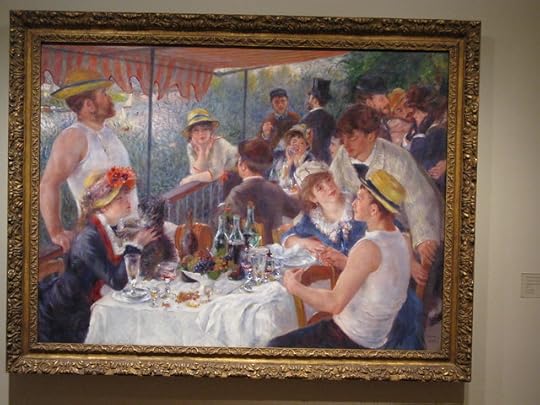
Luncheon of the Boating Party 1881 Phillips Collection, Washington DC
>
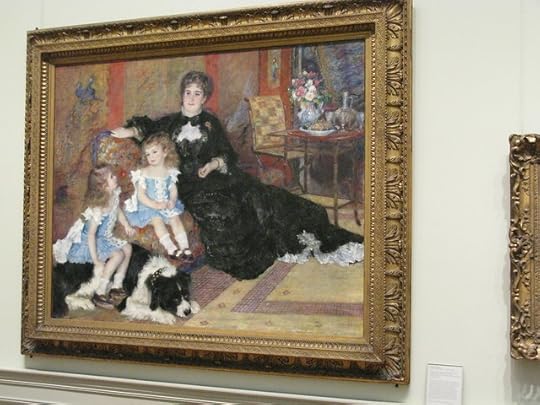
Madame Georges Charpentier and her Children Metropolitan Museum of Art, New York
As the book title indicates Renoir was a contented person. He had none of the torment of Van Gogh or the angst of Gaugin. His paintings exude happiness. The landscapes colourful and serene. His paintings of crowd scenes, whether in cafes or streets or the opera illustrate the joys of humanity gathering together to enjoy life. His nudes show an ease within themselves. And his portraits – more so of children – give off a beautiful radiance.
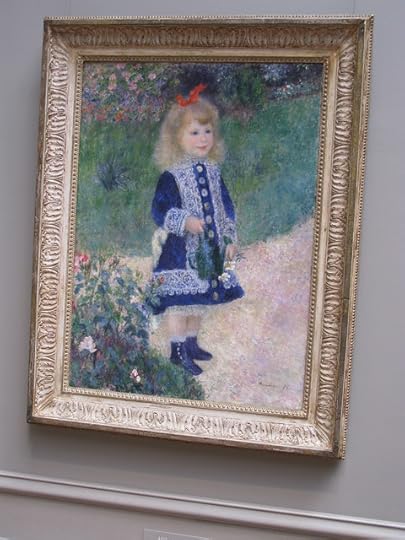
A Girl with Watering Can National Gallery of Art, Washington DC
Young Girl Bathing Metropolitan Museum of Art, New York
Renoir could never stop painting, even in his last years when his hands were afflicted by arthritis and the brush had to be placed in his hands.
This book has many personal commentaries on Renoir (other artists, buyers, and his son Jean Renoir and Auguste Renoir himself). It has many wonderful illustrations of Renoir’s paintings.
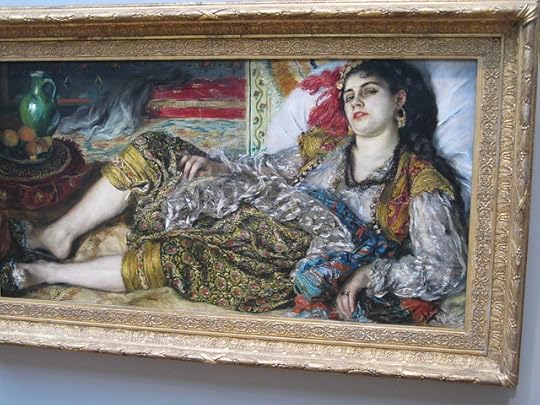
Odalisque National Gallery of Art, Washington DC
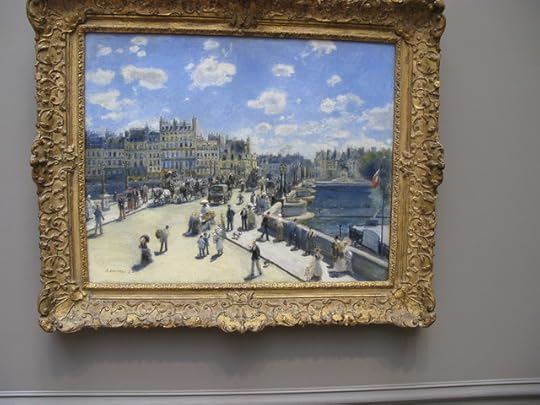
Pont Neuf, Paris National Gallery of Art, Washington DC