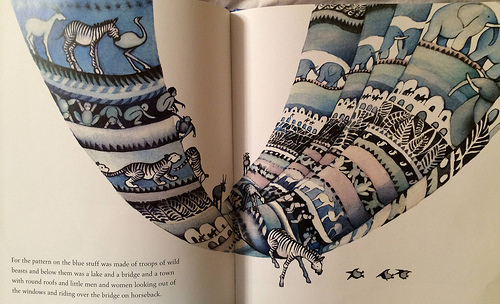
Слоновете пиеха вода; жирафите хрупаха листата на най-високите магнолии; хората, които пресичаха моста, им хвърляха банани, подхвърляха ананаси във въздуха и вкусни златисти кифлички, пълнени със сладко от дюли и рози, защото маймуните ги обожаваха.
Вирджиния Улф (1882 – 1941) е родена под името Аделайн Вирджиния Стивън. Тя е важен представител на модернизма в литературата. Най-известните ѝ творби са романите „Мисис Далауей”, „Към фара” и „Орландо”. Има две истории за деца – „Пердето на бавачката Лъгтън” и „Вдовицата и папагалът”. Втората също е част от поредицата „Детски шедьоври от велики писатели”.
(Adeline) Virginia Woolf was an English novelist and essayist regarded as one of the foremost modernist literary figures of the twentieth century.
During the interwar period, Woolf was a significant figure in London literary society and a member of the Bloomsbury Group. Her most famous works include the novels Mrs. Dalloway (1925), To the Lighthouse (1927), and Orlando (1928), and the book-length essay A Room of One's Own (1929) with its famous dictum, "a woman must have money and a room of her own if she is to write fiction."
I wouldn't generally think of Virginia Woolf writing children's books, but thanks to Manny's review I learned about this one. Woolf apparently wrote it for a niece. It was discovered with the manuscript of Mrs. Dalloway and published in the 1960s.
Nurse Lugton falls asleep while sewing a curtain, and the pattern comes to life (click pictures to enlarge):
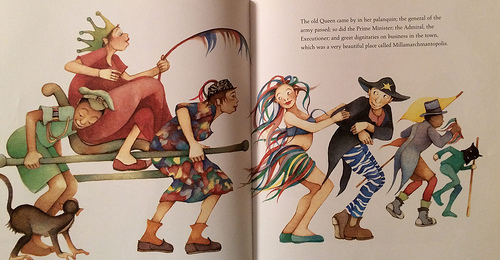
While Lugton sleeps, the people and animals live in a world of their own:
It's sweet and whimsical, with lovely illustrations by Julie Vivas. It's worth tracking down a copy for your budding Woolf fans.
Visiting Pioneer Books again this afternoon (we are still in Australia), I was shown yet another wonderful book I'd never heard of. It turns out that Virginia Woolf wrote a short children's story - according to the book's homepage, it was found in the manuscript of Mrs Dalloway. Julie Vivas, evidently a gifted illustrator, has done the pictures.
It's very recognizably Virginia Woolf, and it's also something that you can easily see an imaginative seven-year-old liking. At least, I'm pretty sure I'd have liked it at that age. But I'm still astonished that I didn't know about it already. Even more incredible, not one of my 1765 friends appears to have read it...
Wonderful magical story about the animals on a curtain coming to life when the seamstress falls asleep. The illustrations are so good that I'm going to buy a couple of copies to give to some nieces and nephews who love animals.
Not great! Purchased for nephew who is 7 days old but honestly I think I’d rather read Woolf’s adult fiction to him. The prose in this isn’t radically different! It just lacks any sort of story and not in the fun Woolfian way. Great illustrations though!
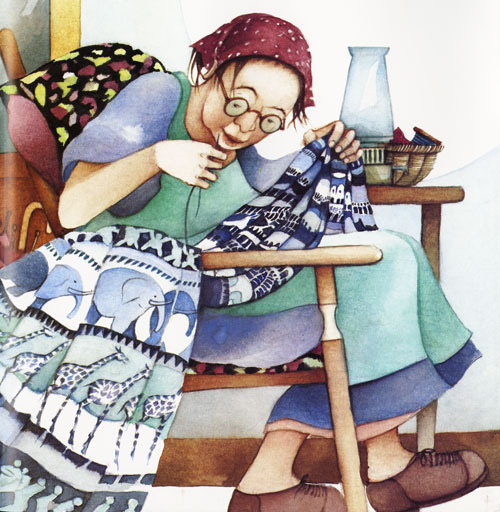
NURSE LUGTON was asleep. She had given one great snore. She had dropped her head; thrust her spectacles up her forehead; and there she sat by the fender with her finger sticking up and a thimble on it; and her needle full of cotton hanging down; and she was snoring, snoring; and on her knees, covering the whole of her apron, was a large piece of figured blue stuff.
Tania was intrigued by this children's book, written by the famous feminist Virginia Woolf, author of countless books and essays, including A Room of One's Own.
It is a cosy and quaint story of an old lady who is knitting a curtain for a friend. Embellished with scenes of exotic animals, the tapastry comes to life as the nurse sleeps.
It feels like this should be more well known, being well written and having a timeless quality to it. 4 stars.
Niania Lugton zasypia podczas szycia zasłony na okno dla pewnego pana. Wtedy zwierzęta uwalniają się z materiału i podążają do wodopoju, nad ludźmi z miasteczka rozpościera się niebo a nad wszystkim góruje potężna twarz olbrzymki, przez którą są uwięzione. Ilustracje Julie Vivas są dosłowne, o wyraźnych konturach i pewnej szorstkości w odbiorze. Na uwagę zasługuje jeden rysunek - ponad egzotyczną oazą, gdzieś zapewne na Bliskim Wschodzie, ponad białymi domkami z kopulastymi dachami, wprost z pól i hałd piachu wyrasta korpus a potem śpiąca twarz kobiety, tworząca masyw górski. Lekki pustynny krajobraz jest tu wyjątkowo mroczny poprzez ciemne kontury w zieleniach i czerniach, sugestywnie oddaje motyw złego zaklęcia rzucony na okoliczną ludność. Książka Woolf dobrze oddaje klimat czasów bliskich autorce i filozofii tworzenia literatury dla dzieci. Autorka jako uważna obserwatorka ówczesnych trendów napisała klasyczną bajkę wpisującą się w gusta powszechnego odbiorcy.
Ето, че и втората от двете детски приказки на Вирджиния Улф видя българско издание, при това какво. В превод на Иглика Василева и с илюстрациите на Свобода Цекова, „Пердето на бавачката Лъгтън” е пълноправно попълнение към поредицата на издателство „Лист” „Детски шедьоври от велики писатели” и прекрасно ще допълни колекциите на читателите, които вече са се насладили на „Вдовицата и папагалът”. Прочетете ревюто на "Книжни Криле": https://knijnikrile.wordpress.com/201...
Title of Book: Nurse Lugton’s Curtain Author: Virginia Woolf Illustrated by: Julie Vivas This book was first published in 1965 but the illustrations by Julie Vivas did not appear with the text until 1991. The story is a simple but enchanting one; Nurse Lugton falls asleep as she sewing a curtain and the animals and people depicted in the pattern on the curtain come alive. The combination of the ordinary with the fantastic makes this an extraordinary book which is enhanced by the wonderful watercolour illustrations by Julie Vivas. The vibrant illustrations incorporates Nurse Lugton into the landscape as she slumbers over the village. While she snores, the animals come alive, nod to each other that she is asleep, and tumble towards the sparkling lake. We see zebras, giraffes, monkeys and antelopes springing alive and happy, long-legged people waving from the windows and coming out to see the wonderful animals. All this time, Nurse Lugton’s thimble shines like a sun. Then a fly buzzes by Nurse Lugton awake and all the animals fall back into the pattern on the curtain as she picks up her needle and continues to sew. This story would appeal to children from age 6 to 9. The simple but fantastic story and its wonderfully vibrant illustrations would capture the imagination of young children. The anticipation of all the animals coming to life on Nurse Lugton’s fifth snore would engage and excite readers. Children may notice that there is a mismatch between the story and the pictures. The story is very English with references to “windsor chairs”, for example. However, there is a wildness about the illustrations by Vivas who is an Australian artist. A very enjoyable read, this book would also be a great stimulus for language development, writing, drama and links well with curriculum areas such as Geography.
NURSE LUGTON'S CURTAIN was recently reviewed, though I can't remember which of the wonderful reviewers I follow actually recommended it! :/ I'm glad I became aware of it though, because it was a pleasure seeing this side of Virginia Woolf.
This imaginative, fantastical story was published posthumously in 1965, having been found among the manuscript pages of her novel MRS. DALLOWAY. It was written for her niece, Ann Stephen, while visiting Virginia.
A middle-aged servant stitches a curtain patterned with animals that come to life whenever she sleeps... That's the story here in a nutshell. Purportedly written for a niece of hers, Virginia Woolf's children's tale is harmless enough but seems unlikely to captivate any young child not related by blood. The accompanying illustrations by Julie Vivas are about the same: inoffensive and unexciting.
I have the 1982 classic hardback edition of Woolf's story. I'd love to see David Weisner do an updated version of this without the text as this one really reads like a precursor to many of his wordless titles we have enjoyed.
What a delightful side of Virginia Woolf was offered to me through this children's story written for her niece. I loved it and I will be sharing it with my own young niece as it needs to be read aloud to a child!
Nurse Lugton's Golden Thimble by Virginia Woolf : the story of a whimsical world that lurks inside the pattern of the drawing-room curtain Nurse Lugton is quietly sewing, then comes alive as she falls asleep .