

What do you think?
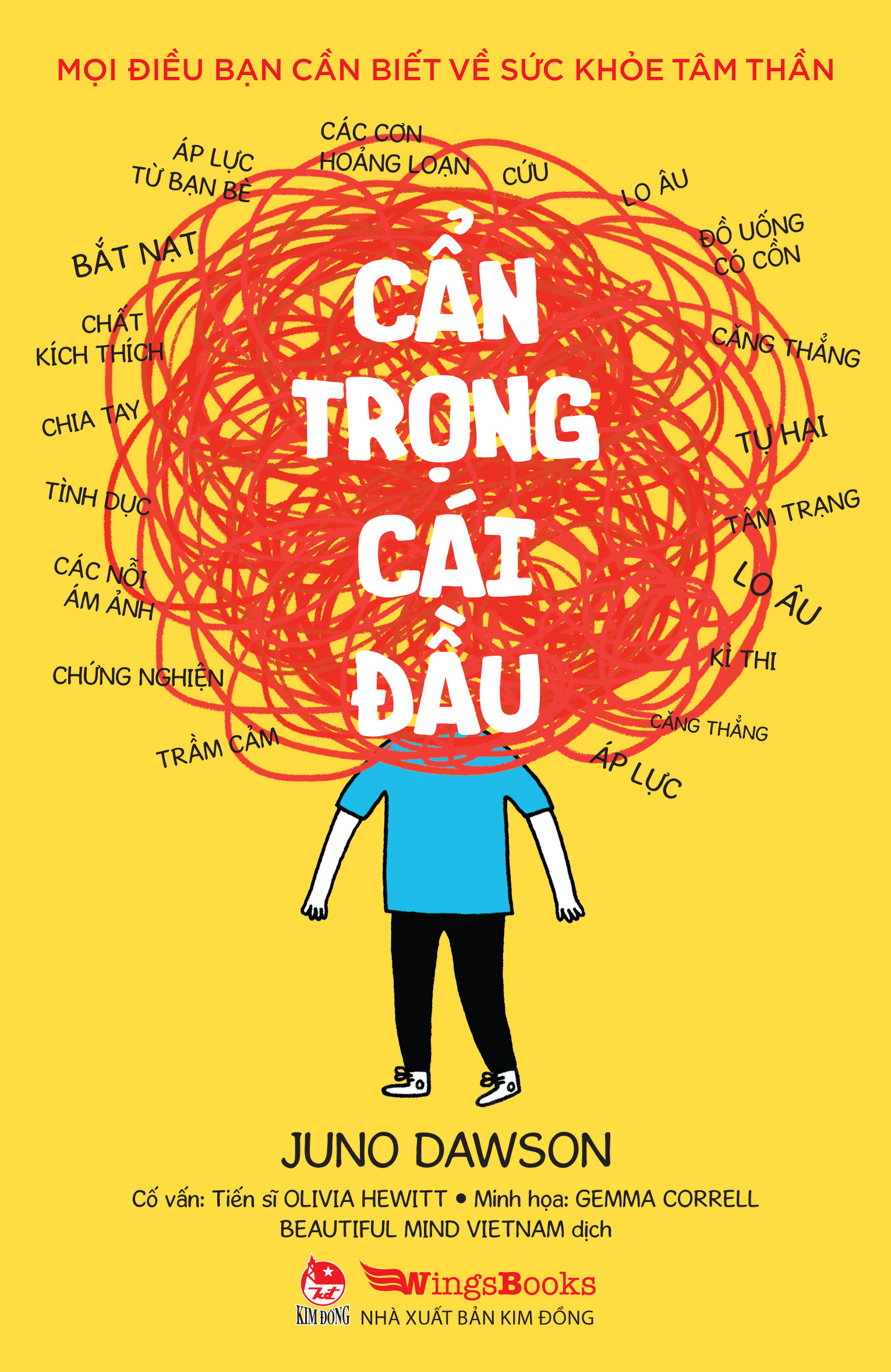
Cẩn trọng cái đầu
Đã bao giờ bạn để ý rằng có một số vấn đề sức khỏe dễ bàn luận hơn những vấn đề còn lại?
Có lẽ vấn đề khó bàn luận nhất là về các rối loạn tâm thần. Nhưng ai mà chẳng có cái đầu, vậy nên ai cũng có sức khỏe tâm thần. Ai trong chúng ta dám nói rằng mình chưa từng gặp căng thẳng, cảm thấy u sầu, lo lắng, tức giận, mệt mỏi hay xúc động?
Trong cuốn cẩm nang dễ hiểu và hữu ích về sức khỏe tâm thần của người trẻ này, tác giả Juno Dawson cùng Tiến sĩ Olivia Hewitt sẽ bàn luận về một loạt các vấn đề – cả nhất thời lẫn dài hạn – cùng những cách thức để đối phó với chúng. Có thể điểm qua một vài chủ đề như lo âu, trầm cảm, chứng nghiện, tự hại và các rối loạn nhân cách. Đi kèm với đó là minh họa dí dỏm của Gemma Correll và những câu chuyện có thật đến từ những người trẻ giống như bạn, chỉ có điều họ đang phải sống chung với các rối loạn tâm thần.
Một ấn phẩm của WINGS BOOKS - Thương hiệu sách trẻ của NXB Kim Đồng.
Có lẽ vấn đề khó bàn luận nhất là về các rối loạn tâm thần. Nhưng ai mà chẳng có cái đầu, vậy nên ai cũng có sức khỏe tâm thần. Ai trong chúng ta dám nói rằng mình chưa từng gặp căng thẳng, cảm thấy u sầu, lo lắng, tức giận, mệt mỏi hay xúc động?
Trong cuốn cẩm nang dễ hiểu và hữu ích về sức khỏe tâm thần của người trẻ này, tác giả Juno Dawson cùng Tiến sĩ Olivia Hewitt sẽ bàn luận về một loạt các vấn đề – cả nhất thời lẫn dài hạn – cùng những cách thức để đối phó với chúng. Có thể điểm qua một vài chủ đề như lo âu, trầm cảm, chứng nghiện, tự hại và các rối loạn nhân cách. Đi kèm với đó là minh họa dí dỏm của Gemma Correll và những câu chuyện có thật đến từ những người trẻ giống như bạn, chỉ có điều họ đang phải sống chung với các rối loạn tâm thần.
Một ấn phẩm của WINGS BOOKS - Thương hiệu sách trẻ của NXB Kim Đồng.
204 pages, Paperback
First published January 7, 2016
Ratings & Reviews
Friends & Following
Create a free account to discover what your friends think of this book!
Community Reviews
Displaying 1 - 30 of 84 reviews

January 23, 2016
The publisher kindly provided me with a free copy in exchange for an honest review.
This is sort of a guide book for mental health for children and young adults, although I personally would recommend it more for kids than young adults because the writing is very simple and many things are broken down to be very simple. However, if you do not know anything about mental health issues to start with, I think this could really be a helpful read, especially if you've been going through a hard time you might find that this book helps you discover what might possibly be wrong with you. It also provides the reader with ways to get help and tries to get people comfortable with mental health issues and explains why it's no different from physical health, which we talk much more openly about. While I personally couldn't get too much out of it for myself anymore - due to being relatively well-informed on the topic and older than the target audience - I would definitely recommend it to younger people, especially children, to get yourself informed.
This is sort of a guide book for mental health for children and young adults, although I personally would recommend it more for kids than young adults because the writing is very simple and many things are broken down to be very simple. However, if you do not know anything about mental health issues to start with, I think this could really be a helpful read, especially if you've been going through a hard time you might find that this book helps you discover what might possibly be wrong with you. It also provides the reader with ways to get help and tries to get people comfortable with mental health issues and explains why it's no different from physical health, which we talk much more openly about. While I personally couldn't get too much out of it for myself anymore - due to being relatively well-informed on the topic and older than the target audience - I would definitely recommend it to younger people, especially children, to get yourself informed.

November 16, 2019
Một cuốn sách đề cập những vấn đề về sức khoẻ tâm thần như các chứng rối loạn lo âu, các chứng rối loạn nhân cách, tự hại và tự sát, việc sử dụng chất kích thích ảnh hưởng tới sức khoẻ tâm thần...
Chính tác giả thừa nhận cuốn sách này không có sứ mệnh là giải quyết các vấn đề tâm lý tâm thần của người đọc. Sách này ra đời với một định hướng: phòng bệnh hơn chữa bệnh, qua việc cung cấp những thông tin cơ bản, dễ hiểu, chọn lọc hướng tới các độc giả phổ thông đông đảo, đặc biệt target tới thanh thiếu niên và phụ huynh. Bên cạnh đó là cách hành văn như tự sự, đối thoại với người đọc cùng với khiếu hài hước được phụ hoạ tranh vẽ sẽ khiến những kiến thức về bệnh lý tâm thần trở nên bớt hàn lâm, bớt khó hiểu hơn với độc giả ngoại đạo. Cũng phải thôi cách tiếp cận này quá hợp lý, chứ nếu không, đọc một mớ chữ nào tên thuốc nào triệu chứng lâm sàng của rối loạn đa nhân cách lưỡng cực phân liệt tùm lum tà la, đọc xong đang từ tỉnh táo mà không chuyển sang hâm hấp rồi hoá khùng thì cũng hơi phí.
Nhờ đọc cuốn sách này mình mới biết thêm những cái mà đó giờ tưởng nên mà hoá ra không nên, ví dụ như mấy cái lời khuyên “ thôi tích cực lên, vui lên” mà nói với người đang mắc bệnh tâm thần hay trầm cảm là fail toàn tập, lý do tại sao đọc sách sách chỉ cho! Hay sự khác biệt giữa cảm xúc tiêu cực nhất thời và bệnh tâm lý. Hay OCD là gì và nó không hề liên quan gì tới cái vụ sống ngăn nắp hay chỉnh bàn ghế lệch hay khung tranh lệch hết, mấy cái đó nó lại liên quan tới một chứng rối loạn hành vi khác cũng được giải thích trong sách luôn. Thêm nữa, tác giả phối hợp cùng một vị tiến sĩ có học vị chuyên ngành tâm lý sẽ trình bày các dấu hiệu / triệu chứng của các vấn đề suy giảm sức khoẻ tâm thần, và đây chính là những thứ cần đọc để biết rồi khi ra ngoài đời thực, dù mình không phải người mắc mấy cái đó mà mình thấy ở người thân, bạn bè mình thì mình sẽ nhanh chóng nhận ra để rồi tham vấn cho những người đó để họ biết đường điều trị CÀNG SỚM CÀNG TỐT.
Một điểm hay ho nữa là cuối các chương hoặc có khi trộn lẫn trong nội dung là các mẩu chuyện tác giả gom góp từ các trường hợp đời thực để miêu tả cho các vấn đề được đề cập trong chương liên quan. Qua những câu chuyện đó phần nào còn phác hoạ được thực trạng không mấy sáng sủa cho sức khoẻ tâm lý thanh thiếu niên không chỉ ở Anh Quốc mà còn ở nhiều các nước châu Âu và cả Hoa Kỳ, những nước phát triển. Lật lại thì vẫn có những cố gắng của y tế phổ thông lẫn học đường đã mang lại những sự TRỢ GIÚP kịp thời và đã cứu vớt bao nhiêu cá nhân đang loay hoay với cuộc đời tràn ngập những lo âu, sợ sệt, bệnh tật trong suy nghĩ và tâm hồn và cả thể chất.
Cuốn này như một cuốn self-help thay vì phiên bản về tiền vè đối nhân xử thế thì đây là phiên bản cho sức khoẻ tinh thần, nhưng đọc cuốn và vui. Cuốn sách dễ đọc, tựa như sách nhập môn để những ai quan tâm về sức khoẻ tâm thần đọc xong có cái nhìn khái quát để nghiên cứu sâu.
Chính tác giả thừa nhận cuốn sách này không có sứ mệnh là giải quyết các vấn đề tâm lý tâm thần của người đọc. Sách này ra đời với một định hướng: phòng bệnh hơn chữa bệnh, qua việc cung cấp những thông tin cơ bản, dễ hiểu, chọn lọc hướng tới các độc giả phổ thông đông đảo, đặc biệt target tới thanh thiếu niên và phụ huynh. Bên cạnh đó là cách hành văn như tự sự, đối thoại với người đọc cùng với khiếu hài hước được phụ hoạ tranh vẽ sẽ khiến những kiến thức về bệnh lý tâm thần trở nên bớt hàn lâm, bớt khó hiểu hơn với độc giả ngoại đạo. Cũng phải thôi cách tiếp cận này quá hợp lý, chứ nếu không, đọc một mớ chữ nào tên thuốc nào triệu chứng lâm sàng của rối loạn đa nhân cách lưỡng cực phân liệt tùm lum tà la, đọc xong đang từ tỉnh táo mà không chuyển sang hâm hấp rồi hoá khùng thì cũng hơi phí.
Nhờ đọc cuốn sách này mình mới biết thêm những cái mà đó giờ tưởng nên mà hoá ra không nên, ví dụ như mấy cái lời khuyên “ thôi tích cực lên, vui lên” mà nói với người đang mắc bệnh tâm thần hay trầm cảm là fail toàn tập, lý do tại sao đọc sách sách chỉ cho! Hay sự khác biệt giữa cảm xúc tiêu cực nhất thời và bệnh tâm lý. Hay OCD là gì và nó không hề liên quan gì tới cái vụ sống ngăn nắp hay chỉnh bàn ghế lệch hay khung tranh lệch hết, mấy cái đó nó lại liên quan tới một chứng rối loạn hành vi khác cũng được giải thích trong sách luôn. Thêm nữa, tác giả phối hợp cùng một vị tiến sĩ có học vị chuyên ngành tâm lý sẽ trình bày các dấu hiệu / triệu chứng của các vấn đề suy giảm sức khoẻ tâm thần, và đây chính là những thứ cần đọc để biết rồi khi ra ngoài đời thực, dù mình không phải người mắc mấy cái đó mà mình thấy ở người thân, bạn bè mình thì mình sẽ nhanh chóng nhận ra để rồi tham vấn cho những người đó để họ biết đường điều trị CÀNG SỚM CÀNG TỐT.
Một điểm hay ho nữa là cuối các chương hoặc có khi trộn lẫn trong nội dung là các mẩu chuyện tác giả gom góp từ các trường hợp đời thực để miêu tả cho các vấn đề được đề cập trong chương liên quan. Qua những câu chuyện đó phần nào còn phác hoạ được thực trạng không mấy sáng sủa cho sức khoẻ tâm lý thanh thiếu niên không chỉ ở Anh Quốc mà còn ở nhiều các nước châu Âu và cả Hoa Kỳ, những nước phát triển. Lật lại thì vẫn có những cố gắng của y tế phổ thông lẫn học đường đã mang lại những sự TRỢ GIÚP kịp thời và đã cứu vớt bao nhiêu cá nhân đang loay hoay với cuộc đời tràn ngập những lo âu, sợ sệt, bệnh tật trong suy nghĩ và tâm hồn và cả thể chất.
Cuốn này như một cuốn self-help thay vì phiên bản về tiền vè đối nhân xử thế thì đây là phiên bản cho sức khoẻ tinh thần, nhưng đọc cuốn và vui. Cuốn sách dễ đọc, tựa như sách nhập môn để những ai quan tâm về sức khoẻ tâm thần đọc xong có cái nhìn khái quát để nghiên cứu sâu.

May 2, 2020
This is a really important book about mental health and related problems like addiction and getting help for young people
There is absolutely nothing wrong with this book. The reason I've given it 3 stars, is because as a 21 year old, with a history and quite a bit of knowledge of mental illness, I didn't gain anything from it.
However, this is definitely the book I would give to my teenager or any teenager I knew because it's very informative, spilt into helpful sections and is written in a really easy to understand/funny way for teenagers
Its also filled with interactive exercises and illustrations to break up the text so it's not too daunting to read.
If I read this when I was a teen it would have helped so much. But I guess, now it's just a bit too late.
Overall, highly recommend if you are or know/have a teenager, whether they are or are not struggling with a mental illness, definitely give them a copy. But for me, in this stage of my life it wasn't helpful but I can see how it would be so helpful for so many
TW: contains real stories and information about a wide range of mental illnesses
There is absolutely nothing wrong with this book. The reason I've given it 3 stars, is because as a 21 year old, with a history and quite a bit of knowledge of mental illness, I didn't gain anything from it.
However, this is definitely the book I would give to my teenager or any teenager I knew because it's very informative, spilt into helpful sections and is written in a really easy to understand/funny way for teenagers
Its also filled with interactive exercises and illustrations to break up the text so it's not too daunting to read.
If I read this when I was a teen it would have helped so much. But I guess, now it's just a bit too late.
Overall, highly recommend if you are or know/have a teenager, whether they are or are not struggling with a mental illness, definitely give them a copy. But for me, in this stage of my life it wasn't helpful but I can see how it would be so helpful for so many
TW: contains real stories and information about a wide range of mental illnesses

September 14, 2017
3.65/5
"Ruhsal sağlık konularında tavsiye veren yazarlara ya da benzer kişilere karşı çok dikkatli olmalısınız. Bu insanların sağlık sorunları yaşamış olmaları hiçbir şey değiştirmez. Örneğin, daha önce benim de dişim ağrıdı diye ağzınızı açıp dişinizde kanal tedavisi uygulamama izin verir misiniz? Ne demek istediğimi anlıyorsunuz değil mi?"
Yorumu için: http://kronikokur.blogspot.com.tr/201...
"Ruhsal sağlık konularında tavsiye veren yazarlara ya da benzer kişilere karşı çok dikkatli olmalısınız. Bu insanların sağlık sorunları yaşamış olmaları hiçbir şey değiştirmez. Örneğin, daha önce benim de dişim ağrıdı diye ağzınızı açıp dişinizde kanal tedavisi uygulamama izin verir misiniz? Ne demek istediğimi anlıyorsunuz değil mi?"
Yorumu için: http://kronikokur.blogspot.com.tr/201...

July 24, 2022
This book deals well with depression and anxiety, reasonably well with eating disorders, and is written in a way that I can see appealing to teenagers.
Where it fell down, for me, was in the second half. The section on drugs and alcohol felt like those school assemblies we used to have, where we were told how uncool drugs were, and how they would damage us and probably kill us. Those assemblies didn't stop anyone from doing drugs. There was very little in the book addressing risk reduction, treatment for addiction, anything that might be useful for someone who was already dealing with addiction. The other bit that kind of threw me was the inclusion of autism in the list of mental illnesses. It wasn't explained properly, there was no mention of the higher risk of things like anxiety and eating disorders when you're autistic, or that sometimes different treatments are needed, nothing to help anyone who is or thinks they might be autistic. And to top it off, it came across very 'everyone is a little autistic'. It just seemed a really odd thing to include.
I had also expected, given that the author is trans, a bit more about mental health when you're a trans teen, but that was another thing mentioned but then glossed over. Coming out was described as pretty much a completely positive thing, with kids being kicked out or abused being a thing of the past, which felt dangerous. Coming out is very personal, and kids need to weigh up the pros and cons of their own situations. There is no shame in waiting until you are independent before coming out.
I can see this being a useful book for a lot of kids, but I'd hesitate to recommend it to anyone trans or autistic.
Where it fell down, for me, was in the second half. The section on drugs and alcohol felt like those school assemblies we used to have, where we were told how uncool drugs were, and how they would damage us and probably kill us. Those assemblies didn't stop anyone from doing drugs. There was very little in the book addressing risk reduction, treatment for addiction, anything that might be useful for someone who was already dealing with addiction. The other bit that kind of threw me was the inclusion of autism in the list of mental illnesses. It wasn't explained properly, there was no mention of the higher risk of things like anxiety and eating disorders when you're autistic, or that sometimes different treatments are needed, nothing to help anyone who is or thinks they might be autistic. And to top it off, it came across very 'everyone is a little autistic'. It just seemed a really odd thing to include.
I had also expected, given that the author is trans, a bit more about mental health when you're a trans teen, but that was another thing mentioned but then glossed over. Coming out was described as pretty much a completely positive thing, with kids being kicked out or abused being a thing of the past, which felt dangerous. Coming out is very personal, and kids need to weigh up the pros and cons of their own situations. There is no shame in waiting until you are independent before coming out.
I can see this being a useful book for a lot of kids, but I'd hesitate to recommend it to anyone trans or autistic.

January 12, 2016
I have been looking forward to reading this book ever since I heard it would be happening a few months ago.
I love Juno's books This Book Is Gay and All Of The Above (published under the name James Dawson, not Juno, don't be confused). I especially loved This Book Is Gay because it includes so many different topics and is as inclusive as possible. AND it teaches you really serious topics in a pretty funny way, sometimes incredibly funny and pun-y. So, when I heard Juno would be writing a book about mental health - which is apart from everything about the LGBTQ* community THE topic society isn't that great at handling it which interests me the most - I was thrilled because I knew it would be interesting and great.
And it was.
Mind Your Head teaches you a lot about many different kinds of mental illnesses. Not just anxiety and depression but many more. It also tells you quite a bit about the medical facts behind mental health and illness (that's the part Dr. Olivia Hewitt had - and she did it really really well) and shows you everything in loads of cute illustrations (by Gemma Correll). You get statistics on how many people are estimated to suffer from mental illnesses (usually UK statistics, but that doesn't mean it's much different in other countries) and gives you LOADS OF TIPS AND HELP AND WEBSITES AND THINGS YOU SHOULD AND COULD DO!
Isn't that great?
Really, like This Book Is Gay is a guide to all things LGBTQ* - from coming out over gay sex to what sexualities actually exist - Mind Your Head is a guide to all the things you should now about mental health. Well, of course there's always more stuff to know and if you care about mental health you can definitely dig way deeper into a certain topic, but this book is a great overview on many many things.
I know I definitely learnt a lot about the different kinds of illnesses that exist and I didn't know much about how many people are affected by them. I also really like the self-help tips and I'm going to try to think of them whenever I'm feeling not so great. There are also a few chapters that help me understand what friends of mine are going through or went through so I can recommend this book not also to people affected by mental illness or who are interested in the topic but also to anyone who knows someone affected.
Often I feel helpless and don't know how to be there for my friends and help them and I still do after reading this book, but I do think that it made me think more and deeper about my friends' problems and I hope I'll go back to re-reading those super interesting chapters when the need occurs and maybe then I'll act a bit smarter / know better what to say.
I'm slightly surprised about how "lightly" the book was written. The topic is very serious and some chapters are incredibly sad, but all in all it's not a sad book or a hard-to-read one. You're not bombarded with weird terms and cheerless facts - at least not if you don't read it in one go - and you can still enjoy reading this book, at least a bit.
All in all I can say I'm really glad I read it and put 30 or so post it notes in it because I'm definitely going to look at it again in the near future and I hope many other people will read it too and learn from it as much as I did.
Well done, Juno (and Olivia and Gemma). Gemma).
I love Juno's books This Book Is Gay and All Of The Above (published under the name James Dawson, not Juno, don't be confused). I especially loved This Book Is Gay because it includes so many different topics and is as inclusive as possible. AND it teaches you really serious topics in a pretty funny way, sometimes incredibly funny and pun-y. So, when I heard Juno would be writing a book about mental health - which is apart from everything about the LGBTQ* community THE topic society isn't that great at handling it which interests me the most - I was thrilled because I knew it would be interesting and great.
And it was.
Mind Your Head teaches you a lot about many different kinds of mental illnesses. Not just anxiety and depression but many more. It also tells you quite a bit about the medical facts behind mental health and illness (that's the part Dr. Olivia Hewitt had - and she did it really really well) and shows you everything in loads of cute illustrations (by Gemma Correll). You get statistics on how many people are estimated to suffer from mental illnesses (usually UK statistics, but that doesn't mean it's much different in other countries) and gives you LOADS OF TIPS AND HELP AND WEBSITES AND THINGS YOU SHOULD AND COULD DO!
Isn't that great?
Really, like This Book Is Gay is a guide to all things LGBTQ* - from coming out over gay sex to what sexualities actually exist - Mind Your Head is a guide to all the things you should now about mental health. Well, of course there's always more stuff to know and if you care about mental health you can definitely dig way deeper into a certain topic, but this book is a great overview on many many things.
I know I definitely learnt a lot about the different kinds of illnesses that exist and I didn't know much about how many people are affected by them. I also really like the self-help tips and I'm going to try to think of them whenever I'm feeling not so great. There are also a few chapters that help me understand what friends of mine are going through or went through so I can recommend this book not also to people affected by mental illness or who are interested in the topic but also to anyone who knows someone affected.
Often I feel helpless and don't know how to be there for my friends and help them and I still do after reading this book, but I do think that it made me think more and deeper about my friends' problems and I hope I'll go back to re-reading those super interesting chapters when the need occurs and maybe then I'll act a bit smarter / know better what to say.
I'm slightly surprised about how "lightly" the book was written. The topic is very serious and some chapters are incredibly sad, but all in all it's not a sad book or a hard-to-read one. You're not bombarded with weird terms and cheerless facts - at least not if you don't read it in one go - and you can still enjoy reading this book, at least a bit.
All in all I can say I'm really glad I read it and put 30 or so post it notes in it because I'm definitely going to look at it again in the near future and I hope many other people will read it too and learn from it as much as I did.
Well done, Juno (and Olivia and Gemma). Gemma).
June 22, 2019
Chúng ta đang sống trong một xã hội mà không chỉ hoạt động mạnh về mặt thể lực mà còn cả về mặt cảm xúc.
Sách phân tích kĩ những nguyên nhân làm cái đầu ta nhức nhối, tại sao ta lo âu và một số lời khuyên từ chuyên gia tâm lý rất bổ ích.
Sách phân tích kĩ những nguyên nhân làm cái đầu ta nhức nhối, tại sao ta lo âu và một số lời khuyên từ chuyên gia tâm lý rất bổ ích.

May 21, 2017
Extremely educational for kids and young adults!

September 4, 2024
Big writing, so easy and quick read.
3.5 stars
I think it was definitely aimed at teenagers, or freshly 18 adults as a lot of the content was about schools, and education. I wish i had read this book in high school I would have felt significantly better about my mental illness.
Its a 4 star because I knew a lot of the information inside, and like I said, it just wasn't aimed at me.
But it isn't a 3 because although I know it, it's always nice to have a reminder I am not the only person in the world struggling, I am not alone and Juno does a fantastic job of bring light to issues that would otherwise be a major taboo subject.
3.5 stars
I think it was definitely aimed at teenagers, or freshly 18 adults as a lot of the content was about schools, and education. I wish i had read this book in high school I would have felt significantly better about my mental illness.
Its a 4 star because I knew a lot of the information inside, and like I said, it just wasn't aimed at me.
But it isn't a 3 because although I know it, it's always nice to have a reminder I am not the only person in the world struggling, I am not alone and Juno does a fantastic job of bring light to issues that would otherwise be a major taboo subject.

May 14, 2021
An excellent guide to mental health for teens. Comprehensive and factual, offering explanations and practical help. Presented with a sense of humour and in a readable style and layout. Includes stories from young people who have experienced mental illness.

September 18, 2021
Ngắn gọn, gần gũi, khái quát đủ các khái niệm mặc dù chưa sâu. Có mấy điểm thích nhất:
1. Physical hay mental illness đều là bệnh và cần phải được quan tâm và chữa trị như nhau. Với hiểu biết không đầy đủ người ta hay đánh đồng mental illness là điên, thần kinh hoặc cho rằng những người có mental illness đang làm quá lên, trong khi mental illness có đủ bệnh khác nhau, dai dẳng và ảnh hưởng lên sức khỏe thể chất.
2. Tác giả cũng chia sẻ nếu muốn có có tinh thần lành mạnh thì người ta cần chủ động thay đổi, không ai có thể giúp hay có trách nhiệm đó cả.
3. Tác giả cũng chia sẻ vấn đề của chính mình để người đọc có thể nhận thấy bất cứ ai cũng gặp những bệnh về tinh thần. Chúng ta đều là người cả.
4. Đọc xong ai cũng có khả năng thấy mình có một vài dấu hiệu, thậm chí tất cả các dấu hiệu (NPD, AvPD, PTSD, SAD, OCD etc.), nhưng nếu thời gian mắc các chứng rối loạn trên không lâu dài, không ảnh hưởng lớn đến các hoạt động hàng ngày (gần như không thể sinh hoạt bình thường từ điều nhỏ nhất) thì chưa thể đánh giá mình có mắc bệnh hay không. Cần phải có sự chẩn đoán chính xác của bác sĩ chuyên môn.
365 ngày mà không căng thẳng, ko lo âu là điều không thể 😂😂😂
1. Physical hay mental illness đều là bệnh và cần phải được quan tâm và chữa trị như nhau. Với hiểu biết không đầy đủ người ta hay đánh đồng mental illness là điên, thần kinh hoặc cho rằng những người có mental illness đang làm quá lên, trong khi mental illness có đủ bệnh khác nhau, dai dẳng và ảnh hưởng lên sức khỏe thể chất.
2. Tác giả cũng chia sẻ nếu muốn có có tinh thần lành mạnh thì người ta cần chủ động thay đổi, không ai có thể giúp hay có trách nhiệm đó cả.
3. Tác giả cũng chia sẻ vấn đề của chính mình để người đọc có thể nhận thấy bất cứ ai cũng gặp những bệnh về tinh thần. Chúng ta đều là người cả.
4. Đọc xong ai cũng có khả năng thấy mình có một vài dấu hiệu, thậm chí tất cả các dấu hiệu (NPD, AvPD, PTSD, SAD, OCD etc.), nhưng nếu thời gian mắc các chứng rối loạn trên không lâu dài, không ảnh hưởng lớn đến các hoạt động hàng ngày (gần như không thể sinh hoạt bình thường từ điều nhỏ nhất) thì chưa thể đánh giá mình có mắc bệnh hay không. Cần phải có sự chẩn đoán chính xác của bác sĩ chuyên môn.
365 ngày mà không căng thẳng, ko lo âu là điều không thể 😂😂😂
June 26, 2016
This book was quite uninformative, more for the typical tumblr-centred young teen who enjoys self-diagnosing than for anyone who is actually looking to overcome or manage a mental illness.
I'd recommend it for parents to buy their kids once they start high school/turn 13.
Whilst I do think that there are only two ways for mental illness to be perceived as serious as physical (to joke about them the same, and to only have them diagnosed by a relevant health professional) the majority of this book was irrelevant quips and poorly-researched points. A waste of an hour.
I'd recommend it for parents to buy their kids once they start high school/turn 13.
Whilst I do think that there are only two ways for mental illness to be perceived as serious as physical (to joke about them the same, and to only have them diagnosed by a relevant health professional) the majority of this book was irrelevant quips and poorly-researched points. A waste of an hour.

Read
January 28, 2016This is a quick but important read. One I don't even feel like I can rate in terms of the GR rating system. It is helpful and informative and I really wish this book had been around when I was a teenager. I applaud Juno Dawson for writing this book, for putting all this information out there for the teenagers who will need it. They might need help and they will find this book that has no judgements, humour and solid, helpful advise from a professional.

June 25, 2016
Excellent guide on mental illness for young reader. Author provides a brief introduction into mental health and describes topics from anxiety to clinical depression. The text is complemented by testimonials of mostly young respondents. I especially liked the part on addictions.
Juno Dawson delivers yet again. Author of This Book Is Gay proves that youth education is truly their forte. Would recommend.
Juno Dawson delivers yet again. Author of This Book Is Gay proves that youth education is truly their forte. Would recommend.

January 20, 2016
Really interesting and informative guide to helping understand issues that involve mental health. Love the combination of Juno Dawson, case studies, illustrations (by Gemma Correll!) and the advice of clinical psychologist Dr Olivia Hewitt. Well put together!

January 9, 2016
Fantastically educational and inspiring!
November 5, 2019
4 sao
Lâu rồi mới có một quyển sách viết về chủ đề y học kiến mình hứng thú đến mức thức đến 3h sáng chỉ để đọc hết nó, và không thể đặt xuống được.
Đa phần nội dung do tác giả Juno Dawson viết, Tiến sĩ Olivia chỉ cung cấp những hiểu biết về tâm lý lâm sàng, những gì liên quan đến y học. Có lẽ vì vậy cuốn sách dễ tiếp cận hơn, mình nghĩ là phù hợp với tất cả mọi người. Cách hành văn của Dawson vừa dí dỏm vừa hài hước, đan cài những câu chuyện thật về những chứng bệnh được nói đến và những hình minh họa trực quan cùng với những bài trắc nghiệm tâm lý cùng cách mà tác giả đưa ra những lời khuyên rất thiết thực không hề sáo rỗng kiểu "Hãy vui lên đi" làm các chứng bệnh tâm lý được thể hiện gần gũi và giúp người có được cái nhìn đa chiều hơn là những định hướng xấu từ truyền thông.
Sức khỏe tâm thần thực tế là một vấn đề cực kỳ quan trọng, không kém gì sức khỏe thể chất nhưng lại không được chú trọng nhiều. Người ta né tránh nói về vấn đề này vì sợ bị cho là kỳ dị, ủy mị, yếu đuối,... cũng do truyền thông định hướng về nó xấu xí khiến cái nhìn của đại bộ phận công chúng sai lệch. Họ nghĩ về bệnh tâm thần qua hình ảnh của Norman Bates trong Psycho (tên sát nhân giết người hàng loạt sát hại phụ nữ đang tắm dưới vòi sen), những nhà thương điên dơ dáy với bệnh nhân la hét bị cột vào chân giường,... Thực tế thì không phải, những rối loạn tâm lý hầu hết tất cả mọi người đã từng mắc phải: trầm cảm, rối loạn lo âu, rối loạn ám ảnh cưỡng chế, tự hại,...
Cô Dawson đề cập đến những vấn đề này với cái nhìn rất gần gũi và thấu hiểu. Bên cạnh đó những lời khuyên cô đưa ra vô cùng thực tế và bạn sẽ dễ dàng đồng cảm, hiểu ra những vấn đề trước đây bạn tự dằn vặt mình thực ra rất bình thường và không đáng để bạn làm vậy. Đọc xong bạn sẽ học được cách yêu thương và tôn trọng bản thân mình hơn, cũng như hiểu và thông cảm với những người xung quanh bạn đang gặp phải những vấn đề tương tự. Từ đó bạn có thể nghĩ ra cách giúp đỡ chính mình hoặc họ, hoặc ít nhất là chấp nhận mình xứng đáng được nhận sự giúp đỡ.
Nếu chỉ xét riêng về mảng y học thì mình sẽ cho 5 sao, mình rất thích cách truyền tải nội dung y học dễ tiếp cận như vậy. Nhưng xét chung về nội dung của cả cuốn sách, nó không phải một cuốn sách xuất sắc có cao trào, có cốt truyện,... kiểu khiến người ta thực sự ấn tượng. Vì vậy mình cho 4 sao.
Lâu rồi mới có một quyển sách viết về chủ đề y học kiến mình hứng thú đến mức thức đến 3h sáng chỉ để đọc hết nó, và không thể đặt xuống được.
Đa phần nội dung do tác giả Juno Dawson viết, Tiến sĩ Olivia chỉ cung cấp những hiểu biết về tâm lý lâm sàng, những gì liên quan đến y học. Có lẽ vì vậy cuốn sách dễ tiếp cận hơn, mình nghĩ là phù hợp với tất cả mọi người. Cách hành văn của Dawson vừa dí dỏm vừa hài hước, đan cài những câu chuyện thật về những chứng bệnh được nói đến và những hình minh họa trực quan cùng với những bài trắc nghiệm tâm lý cùng cách mà tác giả đưa ra những lời khuyên rất thiết thực không hề sáo rỗng kiểu "Hãy vui lên đi" làm các chứng bệnh tâm lý được thể hiện gần gũi và giúp người có được cái nhìn đa chiều hơn là những định hướng xấu từ truyền thông.
Sức khỏe tâm thần thực tế là một vấn đề cực kỳ quan trọng, không kém gì sức khỏe thể chất nhưng lại không được chú trọng nhiều. Người ta né tránh nói về vấn đề này vì sợ bị cho là kỳ dị, ủy mị, yếu đuối,... cũng do truyền thông định hướng về nó xấu xí khiến cái nhìn của đại bộ phận công chúng sai lệch. Họ nghĩ về bệnh tâm thần qua hình ảnh của Norman Bates trong Psycho (tên sát nhân giết người hàng loạt sát hại phụ nữ đang tắm dưới vòi sen), những nhà thương điên dơ dáy với bệnh nhân la hét bị cột vào chân giường,... Thực tế thì không phải, những rối loạn tâm lý hầu hết tất cả mọi người đã từng mắc phải: trầm cảm, rối loạn lo âu, rối loạn ám ảnh cưỡng chế, tự hại,...
Cô Dawson đề cập đến những vấn đề này với cái nhìn rất gần gũi và thấu hiểu. Bên cạnh đó những lời khuyên cô đưa ra vô cùng thực tế và bạn sẽ dễ dàng đồng cảm, hiểu ra những vấn đề trước đây bạn tự dằn vặt mình thực ra rất bình thường và không đáng để bạn làm vậy. Đọc xong bạn sẽ học được cách yêu thương và tôn trọng bản thân mình hơn, cũng như hiểu và thông cảm với những người xung quanh bạn đang gặp phải những vấn đề tương tự. Từ đó bạn có thể nghĩ ra cách giúp đỡ chính mình hoặc họ, hoặc ít nhất là chấp nhận mình xứng đáng được nhận sự giúp đỡ.
Nếu chỉ xét riêng về mảng y học thì mình sẽ cho 5 sao, mình rất thích cách truyền tải nội dung y học dễ tiếp cận như vậy. Nhưng xét chung về nội dung của cả cuốn sách, nó không phải một cuốn sách xuất sắc có cao trào, có cốt truyện,... kiểu khiến người ta thực sự ấn tượng. Vì vậy mình cho 4 sao.
November 16, 2019
Quyển sách mang đến cái nhìn mới về sức khỏe tâm lý và khái quát về các bệnh tâm lý rồi làm thế nào để có thể đối phó và vượt qua chúng. Có lẽ mình mong có thông tin chuyên sâu hơn nên hơi thất vọng vì các bệnh rối loạn chỉ nói qua, khái quát

June 16, 2024
5 stars.
Brilliant! So well written! Simple, clear, witty, yet very informative and being a good supportive tool itself, this book is a must read.
You don't necessarily need to have any struggles or problems, it's just a really good book.
Brilliant! So well written! Simple, clear, witty, yet very informative and being a good supportive tool itself, this book is a must read.
You don't necessarily need to have any struggles or problems, it's just a really good book.

August 11, 2021
Amazing read, albeit aimed for younger readers. Would be incredibly useful for the younger readers needing help re their mental health.

May 2, 2025
Not really what I thought it would be, but more of a detailed variety of mental health behaviours. More aimed for teenagers. Worth a read if you’re interested.

January 26, 2016
This review was originally posted on StrupagSometimes you find a book that you just know you have to read. Juno Dawson's Mind Your Head is one such book for me. In my early 30s I'm not really the target audience for this book, but having tackled mental illness myself for many years I instantly recognised the importance of this book. Having now read it, I can confirm that this is indeed a very important book/resource.
Juno makes it very clear from the start that this isn't a self-help book (something which I personally appreciate). She also states that, despite her first-class honours degree in psychology, she is not a doctor, so she has enlisted the help of her friend Dr Olivia Hewitt, a clinical psychologist, to assist with this book.
From the outset Dawson forewarns us of "triggers" - this is something to be aware of before you start to read. The book covers a huge amount within its 200 or so pages, and so it's unsurprising that this book comes with a trigger-warning. From coping with stress to addiction, depression to personality disorders, self-harm to anxiety, each area is approached in an informative, yet friendly manner. Juno isn't afraid to use humour where appropriate. Likewise, she doesn't shy away from any issue, offering the reader her total honestly. It's this honesty that, I feel, makes this book what it is. It's quite some time since I was a teen but I know that had I read this during that time I would have appreciated the honesty of the adult writer. Heck, I appreciate the honesty now!
Juno understands what her readers want and need. She's not judgemental; she's approachable (I'm not sure that's the word I'm looking for but hopefully you know what I mean) and together with Dr Olivia offers some real insight and useful advice.
As I read I couldn't help but think how important this book will be to so many. I imagined a teenager with no parental support, struggling with depression. This book would be a much needed lifeline to them.
It doesn't claim to have all the answers and it certainly doesn't imply that there will be any miracle cure. However, it does share experiences from fellow sufferers and makes it clear that the reader is not alone in their feelings. It advises of the steps the reader can take - where to turn to, be it online or to a trusted adult, or GP.
As an aside, my husband came home from work the other day to find me reading this book. He told me he'd see Dawson's book This Book Is Gay in the school library that morning. Naturally I was delighted to hear this, and I genuinely believe that this book should also be a fixture within school libraries across the country. It will have a huge impact on thousands of young people and might just save some lives too.
I learned a lot from this book and could really imagine how powerful it would have been during my darkest days. You don't have to be a teen to read it. In fact whether you're a parent, a teacher or a family friend I urge you to read this book.
Juno makes it very clear from the start that this isn't a self-help book (something which I personally appreciate). She also states that, despite her first-class honours degree in psychology, she is not a doctor, so she has enlisted the help of her friend Dr Olivia Hewitt, a clinical psychologist, to assist with this book.
From the outset Dawson forewarns us of "triggers" - this is something to be aware of before you start to read. The book covers a huge amount within its 200 or so pages, and so it's unsurprising that this book comes with a trigger-warning. From coping with stress to addiction, depression to personality disorders, self-harm to anxiety, each area is approached in an informative, yet friendly manner. Juno isn't afraid to use humour where appropriate. Likewise, she doesn't shy away from any issue, offering the reader her total honestly. It's this honesty that, I feel, makes this book what it is. It's quite some time since I was a teen but I know that had I read this during that time I would have appreciated the honesty of the adult writer. Heck, I appreciate the honesty now!
Juno understands what her readers want and need. She's not judgemental; she's approachable (I'm not sure that's the word I'm looking for but hopefully you know what I mean) and together with Dr Olivia offers some real insight and useful advice.
As I read I couldn't help but think how important this book will be to so many. I imagined a teenager with no parental support, struggling with depression. This book would be a much needed lifeline to them.
It doesn't claim to have all the answers and it certainly doesn't imply that there will be any miracle cure. However, it does share experiences from fellow sufferers and makes it clear that the reader is not alone in their feelings. It advises of the steps the reader can take - where to turn to, be it online or to a trusted adult, or GP.
As an aside, my husband came home from work the other day to find me reading this book. He told me he'd see Dawson's book This Book Is Gay in the school library that morning. Naturally I was delighted to hear this, and I genuinely believe that this book should also be a fixture within school libraries across the country. It will have a huge impact on thousands of young people and might just save some lives too.
I learned a lot from this book and could really imagine how powerful it would have been during my darkest days. You don't have to be a teen to read it. In fact whether you're a parent, a teacher or a family friend I urge you to read this book.

January 18, 2016
Genom psykologisk passaparola, Londons samtalsterapeuter emellan, fick jag vetskap om denna boks existens. Trodde att jag skulle tycka att den var fantastisk, men störde mig TBQH på att författaren vill vara så till den grad nere med kidsen, språkligt sett. IDEK why.
To be fair är detta samtidigt en utmärkt introduktion till klinisk psykologi eller en tröstbok för unga angående alla sorters mildare mental ohälsa. Gillar illustrationerna, t.ex. DSM-parodin "Big Fancy Book of Medical Diagnoses".
Rekommenderar istället Matt Haigs 'Reasons to Stay Alive' eller den svenska terapi- och metodgenomgången 'Jag tror jag måste prata med någon'.
To be fair är detta samtidigt en utmärkt introduktion till klinisk psykologi eller en tröstbok för unga angående alla sorters mildare mental ohälsa. Gillar illustrationerna, t.ex. DSM-parodin "Big Fancy Book of Medical Diagnoses".
Rekommenderar istället Matt Haigs 'Reasons to Stay Alive' eller den svenska terapi- och metodgenomgången 'Jag tror jag måste prata med någon'.

August 4, 2019
Rất ít sách nói về sức khoẻ tâm thần một cách dí dỏm, dể đọc và thực tế. Đây là một trong những cuốn mình nghĩ là khá bao quát và hiểu cơ bản về các bệnh tâm lý, tâm thần.
Đi từ những điều cơ bản nhất, những nghiên cứu thống kê đến đi sâu vào từnh loại lo âu, áp lực, tâm thần và cách tự cứu...
Sách dành cho mọi lứa tuổi nhưng theo mình tuổi teen và các bậc phụ huynh có thể nghiên cứu nếu thấy tâm lý của mình/con em mình đang có điều bất ổn.
Đi từ những điều cơ bản nhất, những nghiên cứu thống kê đến đi sâu vào từnh loại lo âu, áp lực, tâm thần và cách tự cứu...
Sách dành cho mọi lứa tuổi nhưng theo mình tuổi teen và các bậc phụ huynh có thể nghiên cứu nếu thấy tâm lý của mình/con em mình đang có điều bất ổn.

October 24, 2015
Really thoughtful. Much needed non fiction for teens.

July 6, 2016
quick, interesting and informative. highly recommend.

November 17, 2016
Written in simple easy to understand language without patronising its targeted audience. Personally Matt Haig's Reasons to stay alive was better, but I'm not the intended audience for this book.

November 11, 2017
--I learnt nothing new. I've googled mental illnesses a bit over the years, read/watched a small number of books/movies related to mental illness, I know a couple people who live with different mental illnesses, and my high school spent at least a half lesson talking about mental illness once so everything in this book is quite repetitive of things I already know (and not in a good way, but more on that later)
--Yes, I knew going into this book that I got it from the children's reference section of my local bookstore, so it's aimed at kids. But wow it really is, I really need to go find myself an adult book somewhere.
--Something that really bugs me: the advice in this book is a whole lot of "speak to your gp/join a support group/seek therapy with a psychologist/psychiatrist/speak to your school nurse/counsellor/check your school/local library for some books on the subject" etc. So I guess the main target market is British kids (since it was written & pub'd there, my point is-) there is no advice for people in third world countries, poor communities, poor families/ who cannot afford seeking a medical professional, paying for medication, schools that do not have nurses/counsellors/libraries, people who come from families/communities that do not take mental illnesses seriously, etc etc etc.
***
--I wrote all of the above when I was about 60 pages into this 200 page book. As I kept reading, this book became more and more frustrating. The advice/words of comfort used can only be applied to people living in first-world countries, or people living considerably privileged lives. All the information given is so summarized and scraping-the-surface that I don't quite recall a description/explanation of something that made me think "wow yep that's great everyone needs to read this". I think the snippets of stories/testimonies from people living with their respective illnesses were my favourite parts, and maybe the "Dr Olivia says..." parts wasn't too bad either (Dr Olivia is a psychologist who throws her 2 cents in every once in a while). There is a very small handful of statistics and information from actual studies conducted, so most of the book feels like it's the author just... *typing things*. Also, and I might just be supersensitive with this, but I felt like the author *wasn't sensitive enough* about these topics. Dawson does state in the beginning of the book that you're not special if you have a (live with a? suffer from? What's the PC term?) mental illness, & she's not going to treat you like you are, which I totally understand, but still, it is a sensitive topic & giving it an air of nonchalance doesn't sit well with me, as a reader.
--Towards the end of the book there was a tiny bit of sympathy towards certain conditions & a few helpful bits of information. Although, the author was super judgemental about people who drink in excess, smoke, & do drugs - & yes I understand that these are terrible things & while I don't do these things myself, reading her opinions gave me an "idgaf about your opinion" attitude, which I imagine most people would feel while reading that- & how are you gonna help people when you sound like you think they're scum?
--Anyway. I'm annoyed. I would still like to read another of Dawson's books "This Book is Gay" & I really really really hope it's better than this one was!
--Yes, I knew going into this book that I got it from the children's reference section of my local bookstore, so it's aimed at kids. But wow it really is, I really need to go find myself an adult book somewhere.
--Something that really bugs me: the advice in this book is a whole lot of "speak to your gp/join a support group/seek therapy with a psychologist/psychiatrist/speak to your school nurse/counsellor/check your school/local library for some books on the subject" etc. So I guess the main target market is British kids (since it was written & pub'd there, my point is-) there is no advice for people in third world countries, poor communities, poor families/ who cannot afford seeking a medical professional, paying for medication, schools that do not have nurses/counsellors/libraries, people who come from families/communities that do not take mental illnesses seriously, etc etc etc.
***
--I wrote all of the above when I was about 60 pages into this 200 page book. As I kept reading, this book became more and more frustrating. The advice/words of comfort used can only be applied to people living in first-world countries, or people living considerably privileged lives. All the information given is so summarized and scraping-the-surface that I don't quite recall a description/explanation of something that made me think "wow yep that's great everyone needs to read this". I think the snippets of stories/testimonies from people living with their respective illnesses were my favourite parts, and maybe the "Dr Olivia says..." parts wasn't too bad either (Dr Olivia is a psychologist who throws her 2 cents in every once in a while). There is a very small handful of statistics and information from actual studies conducted, so most of the book feels like it's the author just... *typing things*. Also, and I might just be supersensitive with this, but I felt like the author *wasn't sensitive enough* about these topics. Dawson does state in the beginning of the book that you're not special if you have a (live with a? suffer from? What's the PC term?) mental illness, & she's not going to treat you like you are, which I totally understand, but still, it is a sensitive topic & giving it an air of nonchalance doesn't sit well with me, as a reader.
--Towards the end of the book there was a tiny bit of sympathy towards certain conditions & a few helpful bits of information. Although, the author was super judgemental about people who drink in excess, smoke, & do drugs - & yes I understand that these are terrible things & while I don't do these things myself, reading her opinions gave me an "idgaf about your opinion" attitude, which I imagine most people would feel while reading that- & how are you gonna help people when you sound like you think they're scum?
--Anyway. I'm annoyed. I would still like to read another of Dawson's books "This Book is Gay" & I really really really hope it's better than this one was!

May 20, 2017
This book is simply incredible.
I do believe that this is definitely not targeted at me, just like Dawson's other success "this book is gay", But I am yet again so unbelievably jealous that this book came into the world after I needed it. I guess I just have to take one for the team on that part, but I am just so deeply amazed that everything I crawled through my teenage years to realize and learn for myself has been put so perfectly into such a short and easy read. This is a book that needs to be in every school and every public library, and it has clear potential not only to drastically save lives, but to prevent issues even occurring in the first place.
As a psychology student, I had not a single complaint about the quality of information presented. not once did I have a moment where I thought "this is overly simplified/incorrect".
Dawson's writing was very frank when came to the subject, offering the perfect tone of humor in conversation, and I really appreciate that.
This is just a book where the benefits are endless. Its so ridiculously simplistic, but it offers the correct amount of information. If a parent was to discover this book in their child's possession, there's a page for advice for parents, which was unexpected for the targeted audience but majorly impressive. A child could read this with mental health issues and understand what help they need and how to receive it, and a child with good mental wellbeing could use this to help them support the people in their lives with mental illness.
Most importantly I believe, this book cleverly normalizes the fact that everyone has good days and bad days, and illnesses come and go. It is honest, but it debrands mental health from all the stigma going around these days. This book is singlehandedly a tool to help a new generation learn and understand mental illness, and I am just so happy that something like this finally exists.
I do believe that this is definitely not targeted at me, just like Dawson's other success "this book is gay", But I am yet again so unbelievably jealous that this book came into the world after I needed it. I guess I just have to take one for the team on that part, but I am just so deeply amazed that everything I crawled through my teenage years to realize and learn for myself has been put so perfectly into such a short and easy read. This is a book that needs to be in every school and every public library, and it has clear potential not only to drastically save lives, but to prevent issues even occurring in the first place.
As a psychology student, I had not a single complaint about the quality of information presented. not once did I have a moment where I thought "this is overly simplified/incorrect".
Dawson's writing was very frank when came to the subject, offering the perfect tone of humor in conversation, and I really appreciate that.
This is just a book where the benefits are endless. Its so ridiculously simplistic, but it offers the correct amount of information. If a parent was to discover this book in their child's possession, there's a page for advice for parents, which was unexpected for the targeted audience but majorly impressive. A child could read this with mental health issues and understand what help they need and how to receive it, and a child with good mental wellbeing could use this to help them support the people in their lives with mental illness.
Most importantly I believe, this book cleverly normalizes the fact that everyone has good days and bad days, and illnesses come and go. It is honest, but it debrands mental health from all the stigma going around these days. This book is singlehandedly a tool to help a new generation learn and understand mental illness, and I am just so happy that something like this finally exists.

September 11, 2018
It certainly was an educational read but the subjects she mentioned were only introduced with a few paragraphs. Nothing was explained in depth. It was easy to read, although I sometimes skipped back to compare a disorder with another one.
I absolutely agree with her that mental illness shouldn’t be a taboo topic. The book is a great start for someone who wants to learn more about mental health. However, you should be prepared to do some research by yourself if you want to know more about a certain topic.
I absolutely agree with her that mental illness shouldn’t be a taboo topic. The book is a great start for someone who wants to learn more about mental health. However, you should be prepared to do some research by yourself if you want to know more about a certain topic.
Displaying 1 - 30 of 84 reviews