Vincenzo Bilof invites you to enter a world of nightmares. Faith has power. It is brandished like a weapon by priests, whose sole mission is to ensure that paradise touches each corner of the Earth. Paradise, however, is an abyss, and those priests serve the ultimate evil. To spread their unholy cause, angelic hosts are exorcised from innocent victims, though there is one young woman - Lana - who has been trained to bring the demonic institution crashing down once and for all. Hell, it turns out, is dark. And cold. The Perverse. The Pious. The Profane.
"We already have Brautigan, Vonnegut, and Russ Meyer but who can claim to be Vincenzo Bilof?" --The Novel Pursuit
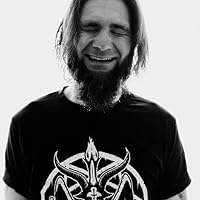
From Detroit, Michigan, Vincenzo Bilof has been called “The Metallica of Poetry” and “The Shakespeare of Gore”. With a body of work that includes gritty, apocalyptic horror (The Zombie Ascension Series), surrealist prose (The Horror Show), and visceral genre satire (Vampire Strippers from Saturn), Bilof’s fiction remains as divisive and controversial as it is original. He likes to think Ezra Pound, T.S. Eliot, and Charles Baudelaire would be proud of his work. More likely, Ed Wood would have been his biggest fan.
During the day, Bilof repairs arcade machines in semi-operational billiards clubs, or he chases his children around the house in between episodes of Teenage Mutant Ninja Turtles. You can check out his blog here: http://vincenzobilof.blogspot.com/
This is a brutal and compulsively readable novel with faith and exorcism at its core. Angels are possessing innocent people. Eventually, the hosts and their possessors go insane. This poses the question of what exactly separates angels from demons. Are God and Satan real, or just constructs to provide guidelines to blind faith?
Lana has been raised by the church and trained to use her angel and her own strengths to fight a battle. There exists a decaying and corrupt castle in a dying town that houses a sect of Satanists. Led by one of the most loathsome characters in horror literature, the head priest of the sect performs tortuous exorcisms. He removes the angels from their hosts to consume their power and murders the hosts with harrowing pain. Father Willard does not believe in anything; he simply acts and yearns for the ultimate experience of the abyss.
Lana has been educated to fight against the evil of the Satanists in order to destroy their legion of iniquity. She is led into battle by the very church that raised her. Many ideas and lives are explored in this story, but it never becomes convoluted. Backstories, Lana's love for the man that betrayed her, monsters, demons and all forms of depravity are laid bare. What comprises evil, and how truly good are the pious? Is belief in anything necessary? In his explorations of what makes both sides tick, the author provides us with a cold, dark place to contemplate while a garden explodes into flames. This is satisfying horror at its darkest.
The Profane is a well-written work of supernatural horror. It’s a fresh take on an exorcism story full of vivid and disturbing imagery and engaging psychological drama. Fans of religious horror stories will especially get a lot of this.
I’m not usually the biggest fan of religious themed stories. Although saying that, I haven’t really read that many, my first sentence being the reason for this. Of the few I have read, they always seem to revolve around the good God-loving guy battling the Lord of Hell, and winning. It all seems a bit predictable.
But I went into this book as a big fan of Vincenzo Bilof’s work, so I was very hopeful of it being something a little bit different. And man, it really was.
We all know the classic possession story; person gets infiltrated by a demon, heroic priest sorts everything out. But this story flips things on its thorn-crowned head. Here, Lana is the owner of a guardian angel who fills her very existence with love and selflessness. Enter the Satanic Priests to forcibly remove this entity and use its powers for their own evil schemes.
Sounds great, right? Oh it is!
I imagine the priests in this book to look like the band Ghost, in their first album incarnation. Pure, Hell-ingrained evil flows through their soulless bodies, as they sacrifice their very existence to serving their one true Lord, Lucifer.
Perhaps one of the main reasons I don’t dig religious stories is my lack of any belief. The whole premise is much less scary than something that, I believe, could happen. But saying that, I find old pictures of demons, of Satanic sacrifice, and devil worship kind of a bit fascinating. It’s why I love my black metal so much! And this book served my evil-seeking mind perfectly.
The writing is top notch, perfectly describing the desolate region of Hell, or the abyss as its called here. Images of maggots and rotting flesh and fires burning were expertly handled and very icky!
The priests live in an old castle with a torture tower appropriately named The Tower of Screams. The girls who they capture to drive the angels out of are kept in squalor, within rows of inhospitable cages housing them until their time is due. Think of the movie Martyrs and you’ll get the idea.
But not only is the castle home to the priests and their ‘subjects’, a legion of demonic monsters prowl the caverns below, the damned, with their harrowing bodies and lust for violence.
The gore on offer is visceral and stomach-churning. The beasts are described in just enough detail for them to remain mysterious and horrific, with the perfect amount left to the imagination. There is one – no, two – monstrosities who are equal parts disgusting and really cool.
The plot shifts back and forward between the present day and the characters’ pasts. Instead of following the story from start to finish, details are teasingly thrown in as the book thunders along. We see Lana not only as the victim she becomes, but the girl she used to be before these tragic events unfolded.
I’ve got this far without mentioning one of the nastiest bastards I’ve ever read about; Father Willard. A sociopathic Hell Priest who only lives to inflict devastating pain upon others. He feels nothing when he torments and kills. He’s a terrible human being, if he could actually be considered human. He’s horrible, but so intriguing. His backstory is related as the book goes on, not that you end up feeling for him, though.
I found myself loving this book more and more as I read on. And even now after finishing it, some of the scenes are ingrained in my memory like a maggot-infested, festering tumour.
You can probably kind of tell that I’m really recommending this book.
Angels, paradise, exorcisms, evil—typically when these elements are associated with the horror genre, it leads to supernatural shenanigans. Bilof eschews this. Instead, he bases his story on what the actual driving force of religion is: faith. It was a cool way of exploring these age old story components and helped cultivate an air of mystery. Coupled with the role reversal involving the idea of exorcism, and Bilof has created a solid foundation for a story.
Excellent diction. Bilof’s word choice makes the mundane interesting and helps to bring the disgusting into vivid detail. Watching him find different ways to describe things was quite entertaining.
The conflicts in The Profane were intriguing enough to keep me moving forwards, the characters engaging to follow even if many of them were horrible people.
The story could be repetitive at times. For instance, some of the conversations with the main antagonist of The Profane seem to exist to reiterate that he feels nothing rather than propelling the story forwards. Some of the sections with Lana and her garden seemed liked they could have been cut, also.
Frequent departures into the past made this novel difficult to get through at times; I personally don’t like this narrative mechanic. However, perseverance was worth it. The employment of this mechanic made sense in the context of the story, and watching the pieces come together by the end is rewarding. Besides, reading something different every now and then is good for the soul.
Sick, twisted, visceral, insane; there are a lot of words I could use to describe this book. Really an excellent and terrifying story. I tore through it so fast and couldn't put it down.
The book opens with a prologue, introducing us to Father Dacius, a priest who is nearing fifty and who has been summoned by his superiors. Through a heated debate, it becomes clear that they are the architects of some grand plan, with Dacius at the centre. He is responsible for recruiting a young woman called Lana for their mission and, even though he knew it would be dangerous, he has only recently discovered the full extent of the harm, both physical and mental, facing Lana. Although the story is merely hinted at in this opening, Bilof utilises his skill with characterisation and great discretion to tantalise the reader. We are immediately hooked, totally invested in these characters, thanks to the compassion we feel for Dacius in his plight and the mystery of what is to happen to Lana.
It doesn’t remain a mystery for long, as the cast of characters quickly expands. The target of Dacius and his superiors is a religious order of Luciferians led by Father Willard, a hell-priest, and Father Michael Ricci, who was once a member of the Catholic priesthood, apprentice to Dacius. They have captured Lana and held her captive, Willard planning to exorcise the angel within her and use its power for evil. The preferred method for this is prolonged and agonising torture, Willard’s speciality. So far, so simple. But this narrative is anything but straightforward. The author has proven more than adept at constructing a multi-layered and absorbing story with so many connections being revealed between characters on both sides.
One of the ways he has achieved this is by using an intricate structure which includes the story as it unfolds interspersed with flashbacks, very short italicised chapters which can be read as diary entries or the inner monologue of Lana, and scenes which take place completely within Lana’s “inner garden”, a meditative state she has been trained to retreat to for refuge. Could the story have been told in a more simplistic A to Z manner? Possibly. But it would have lost much of what makes it work, the continual unravelling and discovery of the relationships. From the first moment Lana and Michael met when she was serving food in the soup kitchen of their destitute town and he was a lost and troubled youth living on the street and running with a dangerous gang, to their blossoming romance. She, abandoned on the doorstep of the monastery home of Dacius, raised in the way of the church by her adoptive father-figure. Then Michael joining the parish, under the direct tutelage of Dacius. Going even further back in time to Willard’s childhood and being found by the grotesque and unsettling Pa.
Pa isn’t the only unsettling aspect of the story; Bilof doesn’t hold back when describing the action, blood, guts, and all. But he wields the more gruesome and bloody descriptions like an artist with a brush or a pencil, sketching them in to give us much needed context for the bigger picture, but never covering the entire canvas in crimson. What he does is never gratuitous, but only serves to further expand the story and the characters. Whether it is the despicable Cardinal Augustus, or the aforementioned Pa, or even Willard as he simultaneously tortures the pure soul of Lana and recounts the terrible circumstances that led him to Pa.
The flourishes Bilof adds to his story don’t begin and end with the bloody descriptive language; the setting is equally bleak. The larger setting is an unnamed town which boomed thanks to the advancements of the industrial age, with factories and smoke stacks in the large industrial park casting a shadow over the town and its inhabitants. But, with the closure of the park and the loss of jobs, the town quickly slumped into a recession, leading to orphaned and forgotten children and parents gone, either permanently or lost to depression. Given the author’s hometown of Detroit, it would be reasonable to speculate about the inspiration for the setting, though this is only conjecture on our part. But it would certainly go some way to explaining his ability to create such a vivid image of the place in our minds, and the accompanying sense of foreboding. Especially as it is only referenced slightly throughout, most of the action itself taking place within the walls of the Luciferian castle. Complete with towers and dungeons, the building should be out of place in the larger setting. But, given the fantastic elements of angels and demons, ravenous creatures from a black abyss and the sorcery wielded by the Cardinal to create an abomination, the gloomy and gothic castle makes for the perfect setting for the story.
Given everything mentioned above, it may seem strange to suggest that this is actually something of a love story. Maybe that isn’t the main theme of the narrative, but it is certainly one of those layers that the author successfully weaves into the story. Through the flashbacks of both Lana and Michael, we see their story from both perspectives, from their first meeting to Michael’s ultimate betrayal and disappointment of Lana. Even though there are hints that they are each not completely over the other, Michael continues to do terrible, heinous things in his role as assistant to Willard, and Lana wrestles with her emotions until the very end. Take away the fantastic elements and this could be the story of any real-life star-crossed teenage lovers. Dacius even fills the role of disapproving parent. It adds another dimension to the story and helps us to relate with the main characters, not an easy feat given the violent nature of the story.
It is a multi-layered story featuring priests both Catholic and Satanic, neither purely good or purely evil. Words and passages often drip from the pages like free-flowing blood from an open vein and the violence smacks the reader in the face, but it always reads like rich, dark poetry. Emotions often run deep throughout the story, especially when Lana recounts her discovery of love and loss of innocence and, in another’s hands, this juxtaposition of disparate elements may not work at all. But, in Bilof’s hands, they blend beautifully to deliver a unique and rewarding reading experience. What at first glance may seem to be a disturbing book that lies somewhere out of your comfort zone demands and deserves the attention of those brave enough to embrace The Profane.