

What do you think?
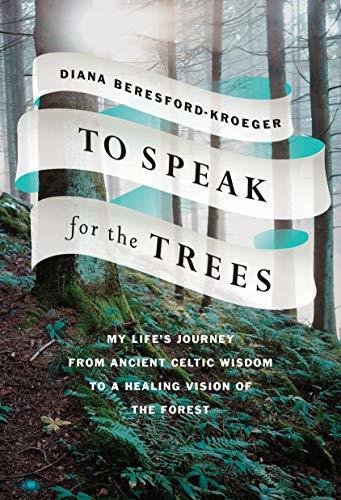
To Speak for the Trees: My Life's Journey from Ancient Celtic Wisdom to a Healing Vision of the Forest
Canadian botanist, biochemist and visionary Diana Beresford-Kroeger's startling insights into the hidden life of trees have already sparked a quiet revolution in how we understand our relationship to forests. Now, in a captivating account of how her life led her to these illuminating and crucial ideas, she shows us how forests can not only heal us but save the planet.When Diana Beresford-Kroeger--whose father was a member of the Anglo-Irish aristocracy and whose mother was an O'Donoghue, one of the stronghold families who carried on the ancient Celtic traditions--was orphaned as a child, she could have been sent to the Magdalene Laundries. Instead, the O'Donoghue elders, most of them scholars and freehold farmers in the Lisheens valley in County Cork, took her under their wing. Diana became the last ward under the Brehon Law. Over the course of three summers, she was taught the ways of the Celtic triad of mind, body and soul. This included the philosophy of healing, the laws of the trees, Brehon wisdom and the Ogham alphabet, all of it rooted in a vision of nature that saw trees and forests as fundamental to human survival and spirituality. Already a precociously gifted scholar, Diana found that her grounding in the ancient ways led her to fresh scientific concepts. Out of that huge and holistic vision have come the observations that put her at the forefront of her the discovery of mother trees at the heart of a forest; the fact that trees are a living library, have a chemical language and communicate in a quantum world; the major idea that trees heal living creatures through the aerosols they release and that they carry a great wealth of natural antibiotics and other healing substances; and, perhaps most significantly, that planting trees can actively regulate the atmosphere and the oceans, and even stabilize our climate. This book is not only the story of a remarkable scientist and her ideas, it harvests all of her powerful knowledge about why trees matter, and why trees are a viable, achievable solution to climate change. Diana eloquently shows us that if we can understand the intricate ways in which the health and welfare of every living creature is connected to the global forest, and strengthen those connections, we will still have time to mend the self-destructive ways that are leading to drastic fires, droughts and floods.
291 pages, Kindle Edition
First published September 1, 2019
About the author
Diana Beresford-Kroeger
18 books208 followersDIANA BERESFORD-KROEGER, a botanist, medical biochemist and self-defined "renegade scientist," brings together ethnobotany, horticulture, spirituality and alternative medicine to reveal a path toward better stewardship of the natural world. Diana's latest book is called The Sweetness of a Simple Life. A precise and poetic writer steeped in Gaelic storytelling traditions gathered from her childhood in Ireland, her previous books include The Global Forest, Arboretum Borealis: A Lifeline of the Planet, Arboretum America: A Philosophy of the Forest, A Garden for Life and a collection of stories, Time Will Tell. In 2010, Diana was inducted as a Wings Worldquest Fellow. The Utne Reader named her one of their Visionaries for 2011. She lives in Ontario, Canada, with her husband, surrounded by her research garden filled with rare and endangered species.
Ratings & Reviews
Friends & Following
Create a free account to discover what your friends think of this book!
Community Reviews
Displaying 1 - 30 of 402 reviews

December 7, 2021
I picked up this book on impulse as I find nature fascinating. I did not know about the author Diana Beresford-Kroeger, and was able to learn about her impactful work from the book and other sources.
The book initially covers her early life with her parents - father being English & mother Irish, both from fairly prosperous families. However, hers was a difficult childhood with her parents separating and later also passing away while she was still in school. While she stayed with her uncle in England, it was her visits to Ireland which inspired her, as she learnt about the Celtic traditions and wisdom, a lot of it associated with nature. Since I had practically no awareness of this, it made for fascinating reading – the practices, the language, places, alphabets etc (including apparently that Sanskrit inspired the Celts to establish a form of writing). Her passion takes her later to the US and Canada, where though she continues to encounter gender discrimination, her career takes shape. She and her husband also establish a farm taking care to put her research to good use in saving trees which in the absence of intervention face extinction.
A lot of traditional wisdom is getting eroded. As the author says, the earth became fit for us since it was rich in greenery which took millions of years to form. Deforestation & the toxins we produce does not bode well for our planet, and each of us can take some simple steps such as at least planting a tree a year. The medicinal value of many local plants is immense (there are various examples of tress & plants she offers including boosting immunity, curing disease etc), and that knowledge is getting lost in the absence of an effort to preserve, as also a general scepticism among the scientific community for traditional knowledge.
The last section has details of a number of trees, much of which I could not identify with since they are not local to India, though a few I would have undoubtedly seen on trips but not paid attention to. The loss of local knowledge, however, is a universal phenomenon which every country now is dealing with.
This is a lovely book. Also, I realize that despite its importance, botanists seem to get far less airtime than they deserve, and we are all losers. While the details are a bit dense in parts, a book I still strongly recommend.
My rating: 4.5 / 5.
Thanks to Netgalley, the publisher and author for a free electronic review copy.
The book initially covers her early life with her parents - father being English & mother Irish, both from fairly prosperous families. However, hers was a difficult childhood with her parents separating and later also passing away while she was still in school. While she stayed with her uncle in England, it was her visits to Ireland which inspired her, as she learnt about the Celtic traditions and wisdom, a lot of it associated with nature. Since I had practically no awareness of this, it made for fascinating reading – the practices, the language, places, alphabets etc (including apparently that Sanskrit inspired the Celts to establish a form of writing). Her passion takes her later to the US and Canada, where though she continues to encounter gender discrimination, her career takes shape. She and her husband also establish a farm taking care to put her research to good use in saving trees which in the absence of intervention face extinction.
A lot of traditional wisdom is getting eroded. As the author says, the earth became fit for us since it was rich in greenery which took millions of years to form. Deforestation & the toxins we produce does not bode well for our planet, and each of us can take some simple steps such as at least planting a tree a year. The medicinal value of many local plants is immense (there are various examples of tress & plants she offers including boosting immunity, curing disease etc), and that knowledge is getting lost in the absence of an effort to preserve, as also a general scepticism among the scientific community for traditional knowledge.
The last section has details of a number of trees, much of which I could not identify with since they are not local to India, though a few I would have undoubtedly seen on trips but not paid attention to. The loss of local knowledge, however, is a universal phenomenon which every country now is dealing with.
This is a lovely book. Also, I realize that despite its importance, botanists seem to get far less airtime than they deserve, and we are all losers. While the details are a bit dense in parts, a book I still strongly recommend.
My rating: 4.5 / 5.
Thanks to Netgalley, the publisher and author for a free electronic review copy.

January 30, 2020
I want to hold this book to my chest and never let it go.
I wish I had the words to explain the emotions I went through reading this book. Awe, inspiration, hope then hopelessness, hope again. It's a deep look into what our trees do for the world and the Celtic wisdom behind many scientific findings about trees. We have to save the trees. We have to. Diana makes this very clear but she does it with passion and perseverance. She doesn't think it's too late, and I believe her. I have never read anything by someone so attuned to nature, and I have to believe the things I read are true.
In another life, I too studied Celtic wisdom of the trees, I'm sure of it.
I wish I had the words to explain the emotions I went through reading this book. Awe, inspiration, hope then hopelessness, hope again. It's a deep look into what our trees do for the world and the Celtic wisdom behind many scientific findings about trees. We have to save the trees. We have to. Diana makes this very clear but she does it with passion and perseverance. She doesn't think it's too late, and I believe her. I have never read anything by someone so attuned to nature, and I have to believe the things I read are true.
In another life, I too studied Celtic wisdom of the trees, I'm sure of it.

November 28, 2019
I wasn’t sure what to expect from this book, To Speak for the Trees: My Life’s Journey from Ancient Celtic Wisdom to a Healing Vision of the Forest by Diana Beresford-Kroeger. After finishing it, I wasn’t disappointed, but I was saddened by the references to the Druid’s lost medicinal formulas and uses of trees. The Penal Years under British rule and their occupation of Ireland destroyed much of Druid culture and knowledge. However, the author, who was schooled as a young girl in the remaining knowledge of the Druid’s Brehon Laws in western Ireland, has combined what she was taught there with her study of trees as a 21st century botanist to create a compelling book of Celtic wisdom. The book includes discussions of forest bathing and a short but detailed chapter on each of the 20 trees of the Celtic Ogham alphabet. Anyone with an interest in Druids, Celts, and Ogham will find the book well-written and interesting. Furthermore, the author believes that if each person alive today were to plant a total of six trees over the course of six years, we could halt the progress of global warming long enough to find a solution to save our planet. She explains her reasoning, and I for one am determined to plant more than my share of trees. 5 stars.

January 26, 2020
Beautifully read part memoir part call for ensuring bio-diversity, part information on the importance and impact of trees.
All in a fascinating look at how folklore and science meet and how darn hard it has been for women to make a mark on science and have that mark acknowledged and listened to.
Definitely one of the best books I've read this year...
All in a fascinating look at how folklore and science meet and how darn hard it has been for women to make a mark on science and have that mark acknowledged and listened to.
Definitely one of the best books I've read this year...

November 13, 2021
“Never waste a minute. The most precious thing you have is your time. Our lives are narrowed by birth and death and in-between lies everything you set yourself to achieve.”
TO SPEAK FOR THE TREES
Thank you, NetGalley, Diana Beresford-Kroeger, and Timber Press for the opportunity to read this book! It was released on October 5th, 2021.
To Speak For The Trees by Diana Beresford-Kroeger is such a unique book. It is part-memoir, part-environmental nonfiction, part-spiritual nonfiction. The author takes us through her life and the trauma that led to her love of trees, the study of Celtic Wisdom, and a mission to save the Earth. Diana Beresford-Kroeger is a botanist and biochemist. She was orphaned at a young age but not before her mother convinced Diana of her insignificance. It would take the love and encouragement of the O’Donoghue family to help her realize her worth and intelligence. She will be taught in the Celtic ways in Brehon Law. She will learn the importance of healing, the law of trees, and the Ogham alphabet.
“The truth was right there, so simple a child could grasp it. Trees were responsible for the most basic necessity of life, the air we breathe. Forests were being cut down across the globe at breathtaking rates-quite literally breathtaking. In destroying them we were destroying our own life-support system. Cutting down the trees was a suicidal act.”
TO SPEAK FOR THE TREES
This book is inspirational but also heartbreaking. During the English occupation, The English destroyed all the Irish forests for the naval ships. A devastating blow that still is affecting Ireland to this day. Readers will feel the author’s heartbreak. She provides statistics about the global deforestation rates and how that is impacting Climate Change. But she also provides hope. If everyone planted a single tree it could have positive effects on Climate Change.
But my absolute favorite part is her praise for the Indigenous Cultures around the world, particularly in North America. The Celtic peoples and Indigenous peoples shared many philosophies regarding nature and protecting it.
“The Indigenous peoples of North America are owed a huge debt. Theirs is a magical continent, an talamh an oige-the land of youth.”
TO SPEAK FOR THE TREES
Overall, a beautiful book and I can’t wait to watch this author’s documentaries! I rate this book 5 out of 5 stars.
TO SPEAK FOR THE TREES
Thank you, NetGalley, Diana Beresford-Kroeger, and Timber Press for the opportunity to read this book! It was released on October 5th, 2021.
To Speak For The Trees by Diana Beresford-Kroeger is such a unique book. It is part-memoir, part-environmental nonfiction, part-spiritual nonfiction. The author takes us through her life and the trauma that led to her love of trees, the study of Celtic Wisdom, and a mission to save the Earth. Diana Beresford-Kroeger is a botanist and biochemist. She was orphaned at a young age but not before her mother convinced Diana of her insignificance. It would take the love and encouragement of the O’Donoghue family to help her realize her worth and intelligence. She will be taught in the Celtic ways in Brehon Law. She will learn the importance of healing, the law of trees, and the Ogham alphabet.
“The truth was right there, so simple a child could grasp it. Trees were responsible for the most basic necessity of life, the air we breathe. Forests were being cut down across the globe at breathtaking rates-quite literally breathtaking. In destroying them we were destroying our own life-support system. Cutting down the trees was a suicidal act.”
TO SPEAK FOR THE TREES
This book is inspirational but also heartbreaking. During the English occupation, The English destroyed all the Irish forests for the naval ships. A devastating blow that still is affecting Ireland to this day. Readers will feel the author’s heartbreak. She provides statistics about the global deforestation rates and how that is impacting Climate Change. But she also provides hope. If everyone planted a single tree it could have positive effects on Climate Change.
But my absolute favorite part is her praise for the Indigenous Cultures around the world, particularly in North America. The Celtic peoples and Indigenous peoples shared many philosophies regarding nature and protecting it.
“The Indigenous peoples of North America are owed a huge debt. Theirs is a magical continent, an talamh an oige-the land of youth.”
TO SPEAK FOR THE TREES
Overall, a beautiful book and I can’t wait to watch this author’s documentaries! I rate this book 5 out of 5 stars.

November 28, 2021
This book was more autobiography/memoir, and I was surprised that it wasn't categorised as such when I initially picked up the review copy to read. I definitely think this book is about 90% autobiography through a life that's pitched as pretty traumatising even though she ends up very friendly with one of her main maltreating caregivers, and about 10% ancient Celtic wisdom and scientific facts about trees, the forest, the soil, fungi etc. I really enjoyed the moments when Beresford-Kroeger shared the wisdom that she was learning, or the simple joy in reading books with her family member Pat (though it was difficult to ignore that he starved her to the point of fainting regularly when she was a child).
Sometimes it felt like this book wasn't entirely sure what it wanted to be, but even so, moving from chapter to chapter was still compelling. The book isn't told in a wholly linear fashion, and sometimes the focus is more on scientific knowledge, and sometimes it's more on Irish/Celtic wisdom. There's a couple of uncomfortable moments of 'white woman saviour' elements happening when the author makes a point of speaking about the land, and an Indigenous person comes up simply to say they agree with her and 'she speaks with us' - but there's no real effort to promote, centre or name Indigenous voices or peoples of the land she's speaking on behalf of.
Beresford-Kroeger's writing style is gentle and easy to read. It's not opaque or dense, and just about anyone can pick this up and enjoy the book. But I do think it needs to be clear that this isn't really a book on Celtic wisdom, it's an autobiography with a few bits and pieces of Celtic knowledge, and a comprehensive section on the Ogham right at the end. The concept of the global bioplan was interesting, though not written with accessibility and disability in mind, and I feel like the subject needs its own book, rather than to be folded into a work that is predominantly an autobiography/memoir.
Sometimes it felt like this book wasn't entirely sure what it wanted to be, but even so, moving from chapter to chapter was still compelling. The book isn't told in a wholly linear fashion, and sometimes the focus is more on scientific knowledge, and sometimes it's more on Irish/Celtic wisdom. There's a couple of uncomfortable moments of 'white woman saviour' elements happening when the author makes a point of speaking about the land, and an Indigenous person comes up simply to say they agree with her and 'she speaks with us' - but there's no real effort to promote, centre or name Indigenous voices or peoples of the land she's speaking on behalf of.
Beresford-Kroeger's writing style is gentle and easy to read. It's not opaque or dense, and just about anyone can pick this up and enjoy the book. But I do think it needs to be clear that this isn't really a book on Celtic wisdom, it's an autobiography with a few bits and pieces of Celtic knowledge, and a comprehensive section on the Ogham right at the end. The concept of the global bioplan was interesting, though not written with accessibility and disability in mind, and I feel like the subject needs its own book, rather than to be folded into a work that is predominantly an autobiography/memoir.
December 7, 2020
Life-changing, fascinating, stunning, moving - so many adjectives to describe the impact of this book. I knew of Diana Beresford-Kroeger and her riveting work through Call of the Forest documentary (link at her website) - she is in the same league as David Attenborough for the strength of message. This memoir brings her work to another level - her training in Celtic and Druidic knowledge and wisdom. How did mankind lose this? Where and when - exactly - did we go off the rails and blithely deforest the planet? She points us to some surviving "saplings" of medicinal knowledge among indigenous people in North America. Let's pay attention to that.
Part One is autobiographical in which she tells of what she learned about trees and the global forest from the elders in Lisheens and in her studies at University College Cork. Pages are rich with passages as clearly written and walloping in impact as the following:
"Plants contain the sucrose version of serotonin as a working molecule. It is a water-soluble compound in, say, a tree. Serotonin is a neuro-generator. By proving that the tryptophan-tryptamine pathways existed in trees, I proved that trees possess all the same chemicals we have in our brains. Trees have the neural ability to listen and think, and they have all the component parts necessary to have a mind or consciousness. That's what I proved: that forests can think and perhaps even dream. This knowledge was new to science. Such connections were not recognized or known a the time. [pg 124]"
Part Two is the Celtic Alphabet of Trees - Ogham (Oh-ham) was totally new to me. Beresford-Kroeger describes and explains the trees and alphabet beautifully. However, it's too bad the publisher didn't add illustrations.
We in Canada are very fortunate that this brilliant scientist and naturalist chose to settle in the Ottawa area with her husband. I would like this country to recognize her with an Order of Canada.
In the meantime let us each plant a native tree.
Part One is autobiographical in which she tells of what she learned about trees and the global forest from the elders in Lisheens and in her studies at University College Cork. Pages are rich with passages as clearly written and walloping in impact as the following:
"Plants contain the sucrose version of serotonin as a working molecule. It is a water-soluble compound in, say, a tree. Serotonin is a neuro-generator. By proving that the tryptophan-tryptamine pathways existed in trees, I proved that trees possess all the same chemicals we have in our brains. Trees have the neural ability to listen and think, and they have all the component parts necessary to have a mind or consciousness. That's what I proved: that forests can think and perhaps even dream. This knowledge was new to science. Such connections were not recognized or known a the time. [pg 124]"
Part Two is the Celtic Alphabet of Trees - Ogham (Oh-ham) was totally new to me. Beresford-Kroeger describes and explains the trees and alphabet beautifully. However, it's too bad the publisher didn't add illustrations.
We in Canada are very fortunate that this brilliant scientist and naturalist chose to settle in the Ottawa area with her husband. I would like this country to recognize her with an Order of Canada.
In the meantime let us each plant a native tree.

January 8, 2023
First, the good stuff.
The last 80 or so pages are a treasure. One by one, the author describes each letter in the ancient Celtic Ogham script. Each symbol is a sacred tree. She describes their ecology, cultural meaning as well as their scientific context. Sacred hawthorn tea, taken for hundreds of years for hearbreak, is used today in cardiac medicine; gorse honey is an antiseptic.
This section is exactly everything I love: folklore, herbalism, celtic stuff, indigenous medicine, and science nerdery. It reminded me of Braiding Sweetgrass-- a beautiful marriage of the sacred and the scientific.
So why such a luke-warm rating, especially for me? (I'm a bit free and easy with the five-star ratings, because generally it takes a really engaging book for me to finish it).
Well, dear Diana's memoir reads more like a curriculum vitae or a grant proposal. "Through my innovative efforts and collaborative research, I was able to secure..." etc etc etc. But still, her research is fascinating. She is, like the title sort of hints, the Lorax. A nerdy, Irish, Canadian, scientific, tree-saving Lorax. But the chapters that describe her adult life have no narrative arc. Just-- "look at all this cool stuff I've done!" And yes! It's cool stuff! But a list of cool stuff you've done does not a memoir make!
But it's the earlier chapters about her childhood that soured me to the book. Did you ever read The Celestine Prophecy? or Mutant Message Down Under? Or, I dunno, Johnathan Livingstone Seagull? There are some books that claim to be true, but feel like lies.
That's the vibe I got.
Like there are some true things, but a lot of wishful thinking, and invented memory to fill in unflattering or confusing gaps.
There are some anecdotes that are so vivid, I am sure they are true stories-- being taught to dip warm fresh eggs in butter to preserve them. Seeing a flock of red-wing blackbirds eating wild rice. Hiding behind the chair after her mother's funeral. Studying in the coat closet at school. Her mother gifting her a box of paints. Showing her uncle the warts on her hand, and him healing them with potato water. Cutting up plant specimins and looking at every part under a microscope. I believed every word of those stories.
But many of the most romantic stories ring false. Not that they are impossible, but just that maybe the author WISHED they had happened this way, so beautifully and unambiguously and clearly. Maybe she WISHED that she had been adopted as the one and only true scion of a lost Celtic valley, and gifted the entirety of ancient celtic plant wisdom in the three summers she spent there with her aunt and uncle, and sent with a celtic women's blessing circle and ceremony complete with a prophecy about who she'd marry. Maybe she wished her aunt had woken her before dawn on Beltane to dance around a fairy alter and bathe her face with clover and watch the sunrise in the shining groove of the ancient stone. Maybe she really had a photographic memory and recited it out loud to the ominous nuns. Maybe her botany professor really did turn his entire work load over to her as a third year botany student, including teaching the third year botany classes.
I dunno. Maybe all those things really happened, and she just had a poor editor who didn't help her capture the vividness of those moments. But reading them, they rang false. Flat. Invented, not experienced.
I feel like memoir needs to be true-- not like a resume is true or a grant proposal is true, but like the things you'd whisper across the pillow to your lover are true. And even if a memoir is not a novel, the main character still needs to grow and change, and have some flaws in order to be sympathetic at all. Dr. Diana's main character has no flaws. She is first only a tragic victim of circumstance, and then a blessed orphan discovered and beloved for her uniqueness, adopted by magical Celtic seers and Canadian medicine women and admiring professors. I feel mean for doubting her! Life is full of crazy nonsense-- I've experienced absolutely fake-sounding stuff, and truth is often too nuts to put into a novel. But batshit-real-life experiences ring true. Invention doesn't. But it's just the vibe I get in the telling.
All in all, it's a cool book, and the information about trees and culture is just WONDERFUL. The reason this book is rubbing me wrong is that it isn't sure what genre it is. It's sciency, but also memoir-y, and also inspiring and spiritual.... Robin Wall Kimmerer braids those disparate strands together gracefully in Braiding sweetgrass. Here, they are awkwardly grafted into one genre-confused book.
The last 80 or so pages are a treasure. One by one, the author describes each letter in the ancient Celtic Ogham script. Each symbol is a sacred tree. She describes their ecology, cultural meaning as well as their scientific context. Sacred hawthorn tea, taken for hundreds of years for hearbreak, is used today in cardiac medicine; gorse honey is an antiseptic.
This section is exactly everything I love: folklore, herbalism, celtic stuff, indigenous medicine, and science nerdery. It reminded me of Braiding Sweetgrass-- a beautiful marriage of the sacred and the scientific.
So why such a luke-warm rating, especially for me? (I'm a bit free and easy with the five-star ratings, because generally it takes a really engaging book for me to finish it).
Well, dear Diana's memoir reads more like a curriculum vitae or a grant proposal. "Through my innovative efforts and collaborative research, I was able to secure..." etc etc etc. But still, her research is fascinating. She is, like the title sort of hints, the Lorax. A nerdy, Irish, Canadian, scientific, tree-saving Lorax. But the chapters that describe her adult life have no narrative arc. Just-- "look at all this cool stuff I've done!" And yes! It's cool stuff! But a list of cool stuff you've done does not a memoir make!
But it's the earlier chapters about her childhood that soured me to the book. Did you ever read The Celestine Prophecy? or Mutant Message Down Under? Or, I dunno, Johnathan Livingstone Seagull? There are some books that claim to be true, but feel like lies.
That's the vibe I got.
Like there are some true things, but a lot of wishful thinking, and invented memory to fill in unflattering or confusing gaps.
There are some anecdotes that are so vivid, I am sure they are true stories-- being taught to dip warm fresh eggs in butter to preserve them. Seeing a flock of red-wing blackbirds eating wild rice. Hiding behind the chair after her mother's funeral. Studying in the coat closet at school. Her mother gifting her a box of paints. Showing her uncle the warts on her hand, and him healing them with potato water. Cutting up plant specimins and looking at every part under a microscope. I believed every word of those stories.
But many of the most romantic stories ring false. Not that they are impossible, but just that maybe the author WISHED they had happened this way, so beautifully and unambiguously and clearly. Maybe she WISHED that she had been adopted as the one and only true scion of a lost Celtic valley, and gifted the entirety of ancient celtic plant wisdom in the three summers she spent there with her aunt and uncle, and sent with a celtic women's blessing circle and ceremony complete with a prophecy about who she'd marry. Maybe she wished her aunt had woken her before dawn on Beltane to dance around a fairy alter and bathe her face with clover and watch the sunrise in the shining groove of the ancient stone. Maybe she really had a photographic memory and recited it out loud to the ominous nuns. Maybe her botany professor really did turn his entire work load over to her as a third year botany student, including teaching the third year botany classes.
I dunno. Maybe all those things really happened, and she just had a poor editor who didn't help her capture the vividness of those moments. But reading them, they rang false. Flat. Invented, not experienced.
I feel like memoir needs to be true-- not like a resume is true or a grant proposal is true, but like the things you'd whisper across the pillow to your lover are true. And even if a memoir is not a novel, the main character still needs to grow and change, and have some flaws in order to be sympathetic at all. Dr. Diana's main character has no flaws. She is first only a tragic victim of circumstance, and then a blessed orphan discovered and beloved for her uniqueness, adopted by magical Celtic seers and Canadian medicine women and admiring professors. I feel mean for doubting her! Life is full of crazy nonsense-- I've experienced absolutely fake-sounding stuff, and truth is often too nuts to put into a novel. But batshit-real-life experiences ring true. Invention doesn't. But it's just the vibe I get in the telling.
All in all, it's a cool book, and the information about trees and culture is just WONDERFUL. The reason this book is rubbing me wrong is that it isn't sure what genre it is. It's sciency, but also memoir-y, and also inspiring and spiritual.... Robin Wall Kimmerer braids those disparate strands together gracefully in Braiding sweetgrass. Here, they are awkwardly grafted into one genre-confused book.

March 15, 2024
I read this book purely because of the Irish Readathon and I am so glad I did, I ended up really enjoying this story even though previously I had no knowledge of the author or her global work to preserve and educate about the world of trees and plants. Diana read the audiobook for this herself, and you can feel her true passion and emotion when she's reading, which I found really heartwarming and lovely to see. I definitely think the audiobook is well worth it, although I wonder if the print version might have had pictures within it, as I feel this is a book which would work well with images as so many varieties of plant are described.
This is mostly a memoir by Diana, and her rather tough start to life, quickly living in a separated family and growing up with a mother who didn't really value her. She is also soon orphaned when both of her parents pass away, and the law has to decide what will happen to her. At first she's almost abandoned and has to fend for herself, but finally she's seen and educated by the last of the Irish Celts living near her family ancestral home.
Due to her unique upbringing Diana is incredibly well-placed to understand the wonder and magic of trees and all of their incredible medicinal and awe-inspiring and innovative powers. She grows up surrounded by those who worship and value trees almost above all else, and her knowledge only grows as she goes on to study as a scientist and to prove and confirm many of the oral stories and properties she was taught about as a child by the Celts.
The book also has a final section about the Celt alphabet and it's fascinating to see what trees have been chosen to represent the written word for this society and why. It's also sad to hear about some varieties and plants which have been eradicated by the human destruction of woods and forests around the world.
Overall I'd recommend this strongly to anyone, and I learned a lot about trees from it. I really want to read some more books on the topic now. 4*s
This is mostly a memoir by Diana, and her rather tough start to life, quickly living in a separated family and growing up with a mother who didn't really value her. She is also soon orphaned when both of her parents pass away, and the law has to decide what will happen to her. At first she's almost abandoned and has to fend for herself, but finally she's seen and educated by the last of the Irish Celts living near her family ancestral home.
Due to her unique upbringing Diana is incredibly well-placed to understand the wonder and magic of trees and all of their incredible medicinal and awe-inspiring and innovative powers. She grows up surrounded by those who worship and value trees almost above all else, and her knowledge only grows as she goes on to study as a scientist and to prove and confirm many of the oral stories and properties she was taught about as a child by the Celts.
The book also has a final section about the Celt alphabet and it's fascinating to see what trees have been chosen to represent the written word for this society and why. It's also sad to hear about some varieties and plants which have been eradicated by the human destruction of woods and forests around the world.
Overall I'd recommend this strongly to anyone, and I learned a lot about trees from it. I really want to read some more books on the topic now. 4*s

March 10, 2024
Part memoir, part science, part ancient cultural heritage, this book provides some very interesting information and a view of the world that is not commonly found in our modern cities and civilization.
Spring has arrived here in Florida and I have been busy preparing my plants for a baking summer ahead as best I can, heaping piles of fallen oak leaves as natural mulch at the feet of as many as possible. These leaves provide nutrients and also retain moisture, of which we are in very short supply. My summer prep and then this book came along to accompany my labors of love, combining my thoughts with my care of my garden.
If only she had included Irish pronunciations for so many Irish terms.
Spring has arrived here in Florida and I have been busy preparing my plants for a baking summer ahead as best I can, heaping piles of fallen oak leaves as natural mulch at the feet of as many as possible. These leaves provide nutrients and also retain moisture, of which we are in very short supply. My summer prep and then this book came along to accompany my labors of love, combining my thoughts with my care of my garden.
If only she had included Irish pronunciations for so many Irish terms.

January 14, 2021
Wow! Memoir, botany, trees, Ogham alphabet. A neighbor handed me this book and it took months for me to pick it up. I finally did so when at a physically low point after surgery, a year of pandemic, and the insurrection at the Capitol in D.C. had left me with no energy for problem novels and who-dun-its.
Diana Beresford-Kroeger is a force of nature. She began as the seemingly shy child of an English lord and an Irish woman of ancient Celtic nobility, a child not wanted by her mother, and not fought for by her father. By age 11, she was orphaned. As a female orphan in Ireland in the 1950s, she might have been sent to live in a place like the Magdalen Laundries, an orphanage run by the Catholic church where girls (orphans or unwed mothers) earned their keep by doing laundry until they reached the age of emancipation (wasn't that just so nice of the Catholic church?), except she was the daughter of a Lord, and the judge feared trouble if he sent her there. The solution was a bachelor uncle, who took her in but didn't provide much in the way of parental support. Her salvation came from relatives in the countryside, where she spent her summers. These country folk decided to give her the ancient Celtic knowledge, imparted by numerous relatives over a period of three summers. They were the first to make her feel valued and loved, and they saved her. She became strong and resilient, and went on to become a scholar.
Her story is infused with Celtic lore, modern science, and the Ogham alphabet, the second oldest written language, after Sanskrit. A whole section of the book, at the end of the memoir, is devoted to explaining each letter of that alphabet. Each letter is tied to a tree or shrub--the forest was sacred to the Celts. She explains how each tree or shrub was used as medicine or food by the ancient Celts, and ties this in with modern botany.
After finishing the book, I watched a couple of YouTube videos: one an interview with a Canadian reporter, and the other, a teach-in with Jane Fonda on her program called Fire Drill Fridays (Jane is still an activist, as we all know). Beresford-Kroeger is gentle, erudite, and a teacher with a lovely lilt in her voice. She is still optimistic about saving the planet. She is my new heroine.
Diana Beresford-Kroeger is a force of nature. She began as the seemingly shy child of an English lord and an Irish woman of ancient Celtic nobility, a child not wanted by her mother, and not fought for by her father. By age 11, she was orphaned. As a female orphan in Ireland in the 1950s, she might have been sent to live in a place like the Magdalen Laundries, an orphanage run by the Catholic church where girls (orphans or unwed mothers) earned their keep by doing laundry until they reached the age of emancipation (wasn't that just so nice of the Catholic church?), except she was the daughter of a Lord, and the judge feared trouble if he sent her there. The solution was a bachelor uncle, who took her in but didn't provide much in the way of parental support. Her salvation came from relatives in the countryside, where she spent her summers. These country folk decided to give her the ancient Celtic knowledge, imparted by numerous relatives over a period of three summers. They were the first to make her feel valued and loved, and they saved her. She became strong and resilient, and went on to become a scholar.
Her story is infused with Celtic lore, modern science, and the Ogham alphabet, the second oldest written language, after Sanskrit. A whole section of the book, at the end of the memoir, is devoted to explaining each letter of that alphabet. Each letter is tied to a tree or shrub--the forest was sacred to the Celts. She explains how each tree or shrub was used as medicine or food by the ancient Celts, and ties this in with modern botany.
After finishing the book, I watched a couple of YouTube videos: one an interview with a Canadian reporter, and the other, a teach-in with Jane Fonda on her program called Fire Drill Fridays (Jane is still an activist, as we all know). Beresford-Kroeger is gentle, erudite, and a teacher with a lovely lilt in her voice. She is still optimistic about saving the planet. She is my new heroine.
September 1, 2020
What a legend. I loved learning about Diana Beresford-Kroeger's life, especially the part when she lived in Ireland and learned about the Brehon laws from her family and community. There is so much wisdom and truth in ancient cultures that we've naturally lost in these modern times, which is why I enjoy reading books like this so much. Nature is magic and sacred and Diana lends a voice to trees and plants that humans like to so often think are soulless because they appear silent (not true!). I am more inspired to plant my own garden and to take part in Diana's Bioplan because we have so much to lose if we continue living this unsustainable lifestyle. I can't wait to read more of her books! And to learn even more!
October 13, 2020
If you loved reading Braiding Sweetgrass this is a wonderful companion.
December 9, 2025
whatever! ok! I don't think science writing translates to other people. maybe you're stupid. the book ended with an alphabet of trees from the ancient Celtic language and I cried. their alphabet was based on fucking trees

June 4, 2021
I enjoyed this book although I'm not as ecstatic as other reviewers. I'd give it 3.5 stars if I could. It was a little confusing to me, the odd mix of ancient Celtic roots with modern science. It felt a little jarring at times as the author would jump between the two at random moments. The overall arc of the narrative was fascinating and I will certainly pick up more of her books. I'm so glad that there are scientists passionate about botany and doing the work of preserving our trees and forests. The author is clearly dedicated to the work and I'm glad she is getting so much attention she can turn to these issues.
One thing that made me sad is that it is a unclear to me how the author, who was entrusted with the wisdom of the ancient Irish Celtic tradition, is living into that responsibility. Obviously she has translated the feeling of the Celtic tradition into her love of trees and nature. But what of the other knowledge that will die with her? Is she passing that on in some way? Is she still connected to the community that raised her? Is there a new interest in these topics in Ireland? There is such a smattering of the ancient traditions in this book that it isn't really intended to preserve the Celtic knowledge itself and it was never directly addressed. It was confusing to me.
I loved the stories of the author hunting down specimens of nearly-extinct trees. It made me happy. Had I taken another course in life, I would be doing that too!
My only other gripe is that the author misrepresents the Celtic world a bit. She suggests that the Celtic world started in ancient Ireland and Scotland and spread out from there, when current scholarship actually indicates the opposite. She also speaks in very general terms about "the Celts" when she is really only talking about Irish-Celtic heritage. There are, of course, many similarities to Celtic traditions in Scotland, Wales, Brittany, and other areas. However, they aren't necessarily all the same. Although I love reading about anything Celtic, particularly to someone who learned directly from the old traditions, this mushiness irked me. Also, despite what other reviewers have said, the Druids are rarely mentioned and this is really about traditional Irish-Celtic everyday life.
The Ogham alphabet in the back of the book is wonderful. I wish there was some consistent structure between the entries, but that's an editing issue, not a writing issue.
One thing that made me sad is that it is a unclear to me how the author, who was entrusted with the wisdom of the ancient Irish Celtic tradition, is living into that responsibility. Obviously she has translated the feeling of the Celtic tradition into her love of trees and nature. But what of the other knowledge that will die with her? Is she passing that on in some way? Is she still connected to the community that raised her? Is there a new interest in these topics in Ireland? There is such a smattering of the ancient traditions in this book that it isn't really intended to preserve the Celtic knowledge itself and it was never directly addressed. It was confusing to me.
I loved the stories of the author hunting down specimens of nearly-extinct trees. It made me happy. Had I taken another course in life, I would be doing that too!
My only other gripe is that the author misrepresents the Celtic world a bit. She suggests that the Celtic world started in ancient Ireland and Scotland and spread out from there, when current scholarship actually indicates the opposite. She also speaks in very general terms about "the Celts" when she is really only talking about Irish-Celtic heritage. There are, of course, many similarities to Celtic traditions in Scotland, Wales, Brittany, and other areas. However, they aren't necessarily all the same. Although I love reading about anything Celtic, particularly to someone who learned directly from the old traditions, this mushiness irked me. Also, despite what other reviewers have said, the Druids are rarely mentioned and this is really about traditional Irish-Celtic everyday life.
The Ogham alphabet in the back of the book is wonderful. I wish there was some consistent structure between the entries, but that's an editing issue, not a writing issue.

December 19, 2021
Give me more women in this world like Diana Beresford-Kroeger.
Her life is fascinating. Her work is fascinating. With the same gentle roar of Jane Goodall, she is the epitome of power and grace.
How can we think that there isn't value—immense value—in every plant on this planet? God help us come to our senses, unwrap ourselves from consumerism and greed and start preserving what we've be given. But, if nothing else, we can follow Beresford-Kroeger's hopeful advice and start planting more trees.
I am obsessed with what I have learned about the Ogham/Celtic Tree Alphabet, enough so that for about two hours I have contemplated dropping my current job and applying for study in Ireland to immerse myself in the language and surround myself with trees. Or maybe just plant every tree she references in a secured, old estate where I can harness the goodness of each of these plants and become a sage in my own right. (I only finished the book two hours ago, so give me another hour to recognize my limitations. But still...)
Her life is fascinating. Her work is fascinating. With the same gentle roar of Jane Goodall, she is the epitome of power and grace.
How can we think that there isn't value—immense value—in every plant on this planet? God help us come to our senses, unwrap ourselves from consumerism and greed and start preserving what we've be given. But, if nothing else, we can follow Beresford-Kroeger's hopeful advice and start planting more trees.
I am obsessed with what I have learned about the Ogham/Celtic Tree Alphabet, enough so that for about two hours I have contemplated dropping my current job and applying for study in Ireland to immerse myself in the language and surround myself with trees. Or maybe just plant every tree she references in a secured, old estate where I can harness the goodness of each of these plants and become a sage in my own right. (I only finished the book two hours ago, so give me another hour to recognize my limitations. But still...)
December 17, 2019
The first part of the book is part biography. We learn how Diana was orphaned and spent her summers in Ireland, where she was taught all about the Druids and the importance of trees. One thing I didn't know, was that the English had razed all the forests in Ireland.
Diana went on to study bio-chemistry and ended up in Canada, where she and her husband bought a farm in Ontario on which they planted many trees that are threatened with extinction.
The second part of the book is a kind of index, where many trees are listed along with their medicinal properties. What is really so fascinating about Diana, is that she able to explain the importance of trees in relation to indigenous teachings back up with her knowledge of bio-chemistry. TVO has a documentary on her that can be accessed on the net: https://www.tvo.org/video/documentari...
It is well worth watching. I understand that PBS is coming out with a three part series on her. Her mission is to communicate the vital importance of trees. I highly recommend all of the above.
Diana went on to study bio-chemistry and ended up in Canada, where she and her husband bought a farm in Ontario on which they planted many trees that are threatened with extinction.
The second part of the book is a kind of index, where many trees are listed along with their medicinal properties. What is really so fascinating about Diana, is that she able to explain the importance of trees in relation to indigenous teachings back up with her knowledge of bio-chemistry. TVO has a documentary on her that can be accessed on the net: https://www.tvo.org/video/documentari...
It is well worth watching. I understand that PBS is coming out with a three part series on her. Her mission is to communicate the vital importance of trees. I highly recommend all of the above.

January 29, 2022
Oh wow! I really enjoyed this one. The first part is the author’s autobiography. I was fascinated by her childhood and the obstacles she (now 77) overcame to become a well-renowned botanist and medical biochemist. Her story is engaging, and I love how she educates without becoming preachy. The second part of her two-part book focuses on The Celtic Alphabet of Trees. It was such a delight to read! She explains the ancient Ohgam script and how each letter relates to a tree that was important in the lives of the ancient Celts.
I listened to the audiobook version of this while reading along with a physical copy of the book. The book was sent to me by the publisher, Timber Press, for an honest review.
I listened to the audiobook version of this while reading along with a physical copy of the book. The book was sent to me by the publisher, Timber Press, for an honest review.
January 24, 2024
I’m obsessed with how this woman’s brain works and her worldview. Total reverence for nature and an appreciation of the spiritual connection we have with it, but also total faith and dedication to science. She’s so smart I could read her forever. Also the Celtic aspect was really interesting and I learned a lot there - somehow I’ve made it through a history major at BC without much Irish history which I’m trying to remedy

September 27, 2021
A moving tribute to the beauty, wonder and the important role trees contribute to our wellbeing and to our planet. Diana Beresford-Kroeger, a world-renowned medical biochemist and botanist shares her wisdom of trees in the scope of science and medicine as well as the ancient spiritual realm from her Celtic ancestors. This is Beresford-Kroeger's autobiography. It chronicles her life from being an orphan to living with her uncle and her upbringing from farmers and scholars in the Lisheens valley in County Cork, who took her under their wing and how she became the last ward under the Brehon Law. In the course of three summers, Beresford-Kroeger was taught the Celtic wisdom, which included the healing, laws of the trees, Brehon wisdom and the Ogham alphabet. The Celtic wisdom is rooted in nature and perceives trees and forests fundamental to human survival and spirituality. Through Beresford-Kroeger's upbringing, she felt like she could be the bridge between ancient knowledge and the modern scientific world. Due to several barriers in her career as a female scientist, she conducted self-guided research in biochemistry and medicinal use in trees from her own backyard laboratory. Through her extensive research and her anecdotal stories, it offers the significance of medicine trees provide, the connectivity in nature, and the essential role trees play in combating carbon problems.
This is an essential read in our current state of climate crisis and how the trees can pave a path to a more sustainable future. Beresford-Kroeger beautifully and respectfully lends a voice for the trees and nature. Her optimism and her drive to save the planet is very hopeful and inspirational. Amidst her traumatic past experience, she uses her knowledge and her energy for positive change. That made her so much more remarkable and respectable. Her knowledge of the trees and the nature surrounding us was very informative and fascinating. The writing was factually scientific yet poetic. I enjoyed the anecdotes surrounding the significance of the trees and Beresford-Kroeger's moments of courage in protecting the truth and her search for near extinct sacred plants. The way she is attuned to nature is phenomenal. She presents us with insights into trees and our relationships to forests, but takes further steps by providing us with a resourceful detail of her global bioplan that would contribute to combating climate change. It is a step to healing and saving our planet. Her perseverance and optimism is a leading example that should awake us to finally take action to save our home. This extraordinary work definitely increased awareness of my surroundings, the connectivity and the appreciation and respect to nature and especially trees for providing so much for our wellbeing.
Thank you to NetGalley and Timber Press for providing this ARC in exchange for an honest review.
This is an essential read in our current state of climate crisis and how the trees can pave a path to a more sustainable future. Beresford-Kroeger beautifully and respectfully lends a voice for the trees and nature. Her optimism and her drive to save the planet is very hopeful and inspirational. Amidst her traumatic past experience, she uses her knowledge and her energy for positive change. That made her so much more remarkable and respectable. Her knowledge of the trees and the nature surrounding us was very informative and fascinating. The writing was factually scientific yet poetic. I enjoyed the anecdotes surrounding the significance of the trees and Beresford-Kroeger's moments of courage in protecting the truth and her search for near extinct sacred plants. The way she is attuned to nature is phenomenal. She presents us with insights into trees and our relationships to forests, but takes further steps by providing us with a resourceful detail of her global bioplan that would contribute to combating climate change. It is a step to healing and saving our planet. Her perseverance and optimism is a leading example that should awake us to finally take action to save our home. This extraordinary work definitely increased awareness of my surroundings, the connectivity and the appreciation and respect to nature and especially trees for providing so much for our wellbeing.
Thank you to NetGalley and Timber Press for providing this ARC in exchange for an honest review.
March 3, 2022
This book was tried it’s best to weave personal biography w/ history, ecology, and biology. The autobiographical sections of this book were the hardest to get through, vague and often repetitive. I wish the author focused more on Celtic mythology, folkways and wisdom. She clearly has the background and a rich knowledge of the culture in a way few people do today. Yet I felt there was much more to be had and she focused more on her own past than on the trees and plants and landscapes of Ireland. There was also a very uncomfortable possibly problematic section on her relationship w/ Indigenous communities when she goes to work and research in Canada. It read as a very “white savior” type of narrative. I straight up rolled my eyes at several points. I don’t believe that was her intention but the way it was written made me feel that way as a reader. I did appreciate all of the Irish Gaelic language and names of the trees and plants. I enjoyed flipping through the Celtic dictionary of plants in the last section. I only wish the author chose to focus more on this aspect of the book. All and all, it was a decent read but there are much better out there. Check out: “Braiding Sweetgrass,” by Robin Wall Kimmerer for an Indigenous perspective on ecology and the natural world and anything by John O’Donohue for all this Celtic spirituality and culture.

October 1, 2021
I would have gone 5 stars, but felt it a bit misleading, as very little Celtic Wisdom is actually shared.
Her parents divorced early and she lives with her uninvolved mother. Both patents come from families of notation, but it hardly gives benefit. When they both die, while she is only in her early teens, she is taken in by an even more unenvolved uncle. But there is salvation! Summers are spent with relatives living remotely on their farm, working the land and keeping the “old ways” alive. Here is where her Celtic Wisdom is instilled (tho not so much to us) by the townspeople and fellow farmers.
Schooling sparks a scientific interest that leads to a college education in biochemistry. Loving the earth and all its offerings, she becomes an eco-warrior, of sorts, and uses her credentials and status to fight for the forests, waterways and inhabitants. Lots of bravo events and one can’t help but admire her dedication. Still, I yearned for some shared Druidic lore. That mostly came in the final section where the Ogham is described and interesting facts about each tree in it given. Worth it for that section alone, tho the preemptive was interesting, as well.
Her parents divorced early and she lives with her uninvolved mother. Both patents come from families of notation, but it hardly gives benefit. When they both die, while she is only in her early teens, she is taken in by an even more unenvolved uncle. But there is salvation! Summers are spent with relatives living remotely on their farm, working the land and keeping the “old ways” alive. Here is where her Celtic Wisdom is instilled (tho not so much to us) by the townspeople and fellow farmers.
Schooling sparks a scientific interest that leads to a college education in biochemistry. Loving the earth and all its offerings, she becomes an eco-warrior, of sorts, and uses her credentials and status to fight for the forests, waterways and inhabitants. Lots of bravo events and one can’t help but admire her dedication. Still, I yearned for some shared Druidic lore. That mostly came in the final section where the Ogham is described and interesting facts about each tree in it given. Worth it for that section alone, tho the preemptive was interesting, as well.

July 25, 2021
An incredible memoir from an Irish-Canadian botanist and climate change activist about her life growing up in Ireland, becoming orphaned and how trees and books gave her hope and meaning. I also really enjoyed her stories about life in academia in Canada and just how hard it was for women scientists to get taken seriously. Lots of anecdotes about her adventures planting, growing and searching for rare species of trees. My favorite was definitely her hanging out of a helicopter in Texas trying to track down what was believed to be the last tree of its kind. An incredible woman with so much wisdom to share! Highly recommended for any lover of trees or fans of nature memoirs like Finding the mother tree and Braiding sweetgrass. Excellent on audio read by the author with her transporting Irish accent.
Favorite quote:
"From my first proper introduction to trees...I was enchanted by them. The trees I knew were the most wonderous and dependable beings in my life and I was eager to meet more of them and learn about each one."
Favorite quote:
"From my first proper introduction to trees...I was enchanted by them. The trees I knew were the most wonderous and dependable beings in my life and I was eager to meet more of them and learn about each one."

September 15, 2020
I liked this book a lot, and I'm glad my reading group chose it. I enjoyed the writing, and especially liked the Ogham section at the end of the book. It has left me wanting to read more by Beresford-Kroeger, certainly, as well as about Druids and about trees and their interconnections with other plants and species. My only disappointment was that I felt like I was waiting quite a while at the beginning (the first half?) for the book to become about trees at all, which is perhaps more due to my expecting the book's focus to be different than anything about the book itself.

March 14, 2021
A fascinating memoir combined with teachings from a lifetime of interdisciplinary learning and research. As I walked through the forest today, I couldn’t help but feel the health and stillness the trees were sharing. This book adds to other recent studies I’ve been reading and listening to, helping me find a wholistic understanding of the world around us and the powerful healing force of nature. The author reads the book with her lovely Irish lilt, which is an added bonus!

June 21, 2021
One of the best books I have read all year, as a non-fiction title. This was an educational read and I would recommend this to anyone. She goes into detail about past ways we look at trees and the way scientist look at forests today. It was more and more detail. The only thing I would have changed is how she laid out the tree alphabet at the end. It was confusing, and I would have preferred a full list on one page either at the start or the end of the book.
June 11, 2022
I wanted to like this book more, and it should have been an easy win since I am already predisposed to like anything to do with Irish traditions and ethnobotany. But unfortunately Diana's auto-hagiography wore on me. I would have preferred if she had focused a bit more on the plants and a little less on how wonderful she is.
August 1, 2024
interesting life story from rural Irish upbringing through to a scientific career
good detail on links between ancient medical treatments and modern understandings
at times the "last of the line of ancient celtic"... felt overdone to me, and some of the pronunciation of Irish terminology jarred with the account of being immersed in Irish culture - might just be my localised and limited knowledge
good detail on links between ancient medical treatments and modern understandings
at times the "last of the line of ancient celtic"... felt overdone to me, and some of the pronunciation of Irish terminology jarred with the account of being immersed in Irish culture - might just be my localised and limited knowledge

January 6, 2024
My favorite quote from this book: “I took a deep breath and first step and both eventually led me to the knowledge that I was capable of things bigger than I imagined.” Also, after reading Braiding Sweetgrass it was very interesting to see similar relationships between humans and nature in a different cultural context.
August 25, 2023
A captivating read and a life well lived. So dedicated to helping us understand our relationship with forests and animals.
Displaying 1 - 30 of 402 reviews