

What do you think?

Kabuki #1-2
Kabuki Omnibus Volume 1
Celebrate 25 years of Kabuki and immerse yourself in the inspiration for Sony's upcoming Kabuki television series!
The origin, the foundation of the story . . . The very beginning of the acclaimed series created by David Mack. This edition collects the first two original Kabuki volumes: Circle of Blood and Dreams in an easy to read trade paper back . . . the perfect book for fans of Mack and Kabuki, and brand-new Kabuki readers!
A young woman code name, "Kabuki" struggles with her identity in near-future Japan. Working as an assassin for a clandestine government body known as "The Noh," Kabuki executes dangerous individuals before they become national-level threats, but when her biological father begins to compromise the agency she works for Kabuki sets out to eliminate him and starts down a difficult path to her own self-discovery.
The origin, the foundation of the story . . . The very beginning of the acclaimed series created by David Mack. This edition collects the first two original Kabuki volumes: Circle of Blood and Dreams in an easy to read trade paper back . . . the perfect book for fans of Mack and Kabuki, and brand-new Kabuki readers!
A young woman code name, "Kabuki" struggles with her identity in near-future Japan. Working as an assassin for a clandestine government body known as "The Noh," Kabuki executes dangerous individuals before they become national-level threats, but when her biological father begins to compromise the agency she works for Kabuki sets out to eliminate him and starts down a difficult path to her own self-discovery.
400 pages, Paperback
First published July 1, 2015
About the author
David W. Mack
506 books222 followersLibrarian Note: There is more than one author in the Goodreads database with this name. See this thread for more information.
David W. Mack is a comic book artist and writer, best known for his creation Kabuki and his work on the Marvel Comics titles Daredevil and Alias
The author of the Star Trek Novels is David Mack
David W. Mack is a comic book artist and writer, best known for his creation Kabuki and his work on the Marvel Comics titles Daredevil and Alias
The author of the Star Trek Novels is David Mack
Ratings & Reviews
Friends & Following
Create a free account to discover what your friends think of this book!
Community Reviews
Displaying 1 - 30 of 46 reviews

January 15, 2020
The story is about a team of female assassins working for a shadowy Japanese government group that takes out criminals. As a warning, there is a LOT of violence towards women and children. The story can be a bit obtuse in places but I didn't find it hard to follow.
The first 2 volumes collected within are in direct juxtaposition to one another. Circle of Blood tells a complete story drawn in black and white. Dreams is in full color, experimental and surreal, using mixed media and painted art. It looks gorgeous but is difficult to read and comprehend.
Circle of Blood: For an indie comic written 25 years ago, this holds up remarkably well. At times, it feels it does want to be The Crow but I like how you can see the art evolve with each issue. It's not a traditionally drawn comic. There is little panel structure. Most pages are intended as full art pieces with poetic language used as narration. In that respect it's influenced by the early Vertigo comic writers. The transfers aren't the best, especially the text when it's white lettering on a black background, it can be difficult to read. But given this was originally published at a now defunct comic company, Caliber Press, that's not surprising.
Dreams: Mack throws us a curveball after Circle of Blood. This is a surreal dream taking place as Kabuki is bleeding out on her mother's grave at the end of Circle of Blood. What story there is, is a bit of an incoherent mess. The text is often drawn into the art making it difficult to even find much less read. Everything about this is experimental. Mack switches to full color for this volume, using mixed media like photos on some pages and on others his first fully painted pages. Really the only reason to get this is to flip through the pretty pictures. There's not much else here.
Received a review copy from Dark Horse and Edelweiss. All thoughts are my own and in no way influenced by the aforementioned.
The first 2 volumes collected within are in direct juxtaposition to one another. Circle of Blood tells a complete story drawn in black and white. Dreams is in full color, experimental and surreal, using mixed media and painted art. It looks gorgeous but is difficult to read and comprehend.
Circle of Blood: For an indie comic written 25 years ago, this holds up remarkably well. At times, it feels it does want to be The Crow but I like how you can see the art evolve with each issue. It's not a traditionally drawn comic. There is little panel structure. Most pages are intended as full art pieces with poetic language used as narration. In that respect it's influenced by the early Vertigo comic writers. The transfers aren't the best, especially the text when it's white lettering on a black background, it can be difficult to read. But given this was originally published at a now defunct comic company, Caliber Press, that's not surprising.
Dreams: Mack throws us a curveball after Circle of Blood. This is a surreal dream taking place as Kabuki is bleeding out on her mother's grave at the end of Circle of Blood. What story there is, is a bit of an incoherent mess. The text is often drawn into the art making it difficult to even find much less read. Everything about this is experimental. Mack switches to full color for this volume, using mixed media like photos on some pages and on others his first fully painted pages. Really the only reason to get this is to flip through the pretty pictures. There's not much else here.
Received a review copy from Dark Horse and Edelweiss. All thoughts are my own and in no way influenced by the aforementioned.
February 4, 2025
Whoa.
If you liked Kill Bill I reckon you’ll dig this.
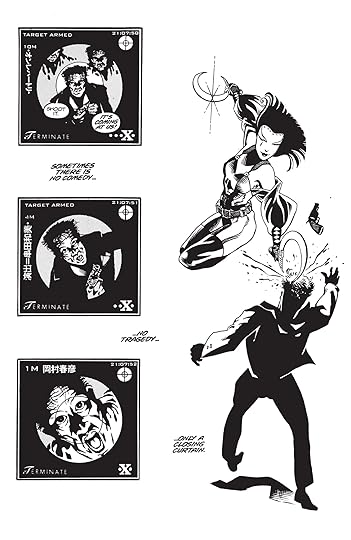
The title character is a pure instrument of assassination at first and later of bloody and well-earned revenge.
Not one for the kiddies, this.
If you liked Kill Bill I reckon you’ll dig this.
The title character is a pure instrument of assassination at first and later of bloody and well-earned revenge.
Not one for the kiddies, this.

May 29, 2020
You can find my review on my blog by clicking here.
Art is a gateway into the mind of a creator. It allows them to express the intangible through a visual medium that is open to interpretation whilst cleverly depending on the viewer's ability to become one with themselves and their emotions. Amongst all the artists in the modern industry today, there is one that has managed to distinguish himself through a unique artistic style: David W. Mack. With a Sony television series currently in the making, this brand-new 25th-anniversary reprint collects the first two complete volumes of the beloved series (Circle of Blood and Dreams), a prologue by creator Brian Michael Bendis, additional notes and cover art from the creator David W. Mack, an afterword by comics legend Jim Steranko, and a commentary by Takashi Hattori.
What is Kabuki Omnibus Vol. 1 about? In Circle of Blood, the story introduces us to an alternate neo-future Japan. While being a law-enforcing television personality, a woman called Kabuki is the face of an underground organization known as "The Noh", an agency that is under the control of the General and responsible of establishing the balance between crime (old Yakuza Lords) and order/politics (legislative bodies). She is also burdened with a desire for revenge upon the Yakuza boss, Ryuchi Kai, who is tied to a terrible tragedy that was bestowed upon her mother. As a member of the deadly assassins that constitute the Circle of the Noh, she thus eliminates targets upon orders from the council while fueling the flame within her that craves to one day face the devil of her nightmares. In Dreams, the story explores the afterlife through memories, hallucinations, and dreams.
Sit down. Relax. Let your mind unwind in search of tranquility and bliss. Unveiling a familiar yet distant universe where peace is a balance maintained through bloodshed, creator David W. Mack presents the origin story of Kabuki by giving us the keys to her past, a past that continues to haunt her to this day while she serves the General, the Circle of the Noh, and the world. Teasing us with snippets of the missions that these assassins of this organization complete routinely, the story continuously circles back to Kabuki as we try and decipher the emotions she revels in by visualizing various memories she possesses of her parents. It is only through the spectacular artwork that her psychological turmoil is truly understood as creator David W. Mack showcases an unexplainable artistic vision that exquisitely captures the soul of the character and her path to self-discovery.
In what can be called an artistic masterpiece, creator David W. Mack extends an invisible hand to the reader to join him on his own journey to exploring the comic book medium. In the first volume titled Circle of Blood, a fully black-and-white artwork is utilized with a completely unconventional structure that demands some acclimating from the reader. Infused with heavy imagery and philosophy, the story constantly revolves around key sequences that are engraved in Kabuki's mind as we embrace various forms of symbolism attached to them and attempt to understand her life story. With this tale dedicated to her departed mother, it is in the second volume titled Dreams that the style changes dramatically with colours splurging out of every page. Whether its the use of paint or real-life photos in a collage, he revitalizes his series with a brand-new identity that simply promises that Kabuki's journey is one to be indulged through the eyes and with our hearts.
It is an audacious and stunning exploration of visual storytelling as it delivers a tragic tale of revenge through a quest for identity.
Yours truly,
Lashaan | Blogger and Book Reviewer
Official blog: https://bookidote.com/

August 31, 2021
“I’ve found my face, but I’m still looking for my mother.”

July 29, 2020
I've been curious about this for a while. This starts at the beginning, when David Mack was about 20. The art and design are inspired and powerful; the writing is quite florid. When the art breaks into full color, the level of artistry is amazing, and story be damned. More is said stylistically throughout. I don't know where this goes from here, but look forward to finding out!

May 8, 2017
So this was really not good. I remember years ago people raving about Kabuki but my overall impression that it was like a college kid once watched a few fighting animes then cobbled together his T&A sketches, mixed in some Dragon Lady cliches, can't forget to add a bunch of rape and horrible abuse of women, and a liberal amount of cultural appropriation until you end up with a near-unreadable mess. Other than nerds with Asian fetishes, I really don't understand what people see in this.
The only reason it got two stars instead of one is because the art of the Dreams story was GORGEOUS. It was so well done and creative and beautiful. But there wasn't really a story there, so much as feelings and impressions mixed with previous Kabuki panels.
The only reason it got two stars instead of one is because the art of the Dreams story was GORGEOUS. It was so well done and creative and beautiful. But there wasn't really a story there, so much as feelings and impressions mixed with previous Kabuki panels.

October 5, 2017
Pure genius. Stunning art, a fantastic and dark world, assassins and fascists and revenge and lots and lots of blood. Coincidentally, I happened to meet David Mack just before finishing this, and just after seeing the ShadowBox Live original stage production of Kabuki in Columbus, OH.

March 29, 2025
This book is comprised of two arcs. The first is about a group of Japanese assassins, and focuses on one codenamed Kabuki. She fights her way through gangsters to take down her half-brother, who has become a mob boss. The paneling and layouts are interesting. The story feels like it's from the 90's. The second story was artsy and poetic, It was very different than the first part and did nothing for me. I might come back to this series later, but I'm not particularly invested to keep reading right now.

November 12, 2024
Art was cool, story is weak and feels appropriative. Really wanted to like this, theres some really beautiful pages but just couldn’t help feeling that this book LOVES itself
Male author shit
Male author shit

October 26, 2020
Volume 1 is a gritty black and white story of a team of assassins. Lots of great story with a surprising amount of restrain. Volume 2 is a lush watercolour story of dreams. A bit harder to follow but visually stunning. A deeper story than I was expecting.

February 27, 2016
David Mack deserves the acclaim he has gotten, and in an age of prestige comics where many authors hype does not outstrip the quality of their output, Mack really does deliver. The first two arcs, Circle of Blood and Dreams, are interesting both in themselves and in contract to one and another. At first, Circle of Blood appears to be an early 1990s Grendel-inspired techno-noir guilty of no small amount of Orientalism. Yet as Mack builds the story, you realize that this is even more nuanced than Matt Wagner's work which it seemed to harken back to and Mack understands Japanese culture much more profoundly than it first appeared. Having lived in Korea and visited Japan myself, there are small details that show hints of understanding beyond exoticism and perhaps significant time spent in Japan. Mack's art and paneling gets better through the several acts of circle of blood, becoming more expressionistic and using chiaroscuro as well as Japanese symbolism to greater and greater effect.
While Circle of Blood moves from a techno-noir to something far more textured and mythic, "Dreams" jumps straight into the world of Kabuki as a dreamscape. The use of watercolors and multi-media as well as purely expressionistic story-telling techniques is particularly effective, especially when contrasted to the prior volume. Yes, Kabuki has sex and violence, but it is a highly accomplished bit of talking popular art to somewhere truly sublime.
While Circle of Blood moves from a techno-noir to something far more textured and mythic, "Dreams" jumps straight into the world of Kabuki as a dreamscape. The use of watercolors and multi-media as well as purely expressionistic story-telling techniques is particularly effective, especially when contrasted to the prior volume. Yes, Kabuki has sex and violence, but it is a highly accomplished bit of talking popular art to somewhere truly sublime.

May 31, 2020
This was a reread, and David Mack’s Kabuki remains my all-time favorite comic book series. Set in an alternate Japan, the larger storyline is of secret government operatives battling corruption. But the real storyline follows Kabuki, exploring how she became who she is, her heritage and family, the horrors and hardships that have shaped her. These stories are so beautifully written and illustrated. The artwork and the words mesh so well, whether in the earlier black and white works, or the later colorful multimedia collages and watercolor paintings. I just love David Mack’s work.

March 22, 2023
Given how little plot progresses across the few Kabuki stories collected in this omnibus, I was rather surprised by how much I enjoyed this. David Mack expertly weaves an interesting tapestry of lore and mythology behind the crime-infested, grimy world of Kabuki. The artwork is gritty and intense, particularly with the sharp contrast created by the black & white issues that comprise the "Circle of Blood" arc. And then Macks switches up to the more recognizable style of painterly craft with some truly gorgeous abstract pieces in "Dreams".
The stories contained in this volume mostly serve to give the reader insight into the tragic life of Kabuki, a girl raised to be an assassin after a series of tramautic events. Kabuki reports to a mysterious cabal of assassins and takes out hits on rival crime families in Japan. The story is quite sparse though, and at time Mack delves into verbose, flowery tangents that I found quite skippable since he wasn't really saying anything all that interesting. But despite the sparseness of the story, I found Kabuki to be a true showcase of sequential storytelling for world-building and character development. The two main stories here don't do a lot to convinve me to keep reading, but Mack's innovative artwork definitely does.
The stories contained in this volume mostly serve to give the reader insight into the tragic life of Kabuki, a girl raised to be an assassin after a series of tramautic events. Kabuki reports to a mysterious cabal of assassins and takes out hits on rival crime families in Japan. The story is quite sparse though, and at time Mack delves into verbose, flowery tangents that I found quite skippable since he wasn't really saying anything all that interesting. But despite the sparseness of the story, I found Kabuki to be a true showcase of sequential storytelling for world-building and character development. The two main stories here don't do a lot to convinve me to keep reading, but Mack's innovative artwork definitely does.

October 24, 2019
This book is a very unique stamp on the comics medium. This specific edition includes the first two story arcs which really shows off David Mack’s progression as a creator.
The first arc, Circle of Blood, is a pretty good comic story. Mack’s eye for unique and impressive layouts is apparent here, but it’s not until the second arc that Mack explores the abstract, mixed media style he’s known for today. This book features several stream of consciousness sections (in both arcs, the second one more so) that feature stunning McKean esque sequences that make your jaw drop, especially in this massive library edition format.
The story is engaging and pretty interesting. It follows Kabuki, an assassin and public icon of a semi-fascist and technologically advanced Japan. It’s a revenge story at heart, but explores themes of identity and lineage. The second is a story of abstract epilogue with similar themes.
Overall, I’d recommend Kabuki to those familiar with Mack’s work or into more experimental comics. It’s a uniquely structured and well made book. This edition is the best way to own it too, lots of extra and oversized art work.
9/10
The first arc, Circle of Blood, is a pretty good comic story. Mack’s eye for unique and impressive layouts is apparent here, but it’s not until the second arc that Mack explores the abstract, mixed media style he’s known for today. This book features several stream of consciousness sections (in both arcs, the second one more so) that feature stunning McKean esque sequences that make your jaw drop, especially in this massive library edition format.
The story is engaging and pretty interesting. It follows Kabuki, an assassin and public icon of a semi-fascist and technologically advanced Japan. It’s a revenge story at heart, but explores themes of identity and lineage. The second is a story of abstract epilogue with similar themes.
Overall, I’d recommend Kabuki to those familiar with Mack’s work or into more experimental comics. It’s a uniquely structured and well made book. This edition is the best way to own it too, lots of extra and oversized art work.
9/10

May 7, 2026
This especial Library Volume is divided in two parts, plus some (lots of) additional content.
Volume 1, 'Circle of Blood' is quite an interesting, albeit a bit stereotypical, story of violence and revenge, with Kabuki as our main character. In a kind of futuristic Japan, factions clash and History and family history take central stage, to keep as entertained in a black and white story that it gets a bit too verbose for my liking.
Volume 2, 'Dreams' is much more conceptual and poetic, with the art, in color this time, being the main focus. And, as such, I found it much less interesting, even if pleasant to look at.
Over all, I can see how this graphic novel and author might have their own cult, but I can't say I am a new adept, and I'm not even sure if I would be interested in reading the next volumes. We'll see...
Volume 1, 'Circle of Blood' is quite an interesting, albeit a bit stereotypical, story of violence and revenge, with Kabuki as our main character. In a kind of futuristic Japan, factions clash and History and family history take central stage, to keep as entertained in a black and white story that it gets a bit too verbose for my liking.
Volume 2, 'Dreams' is much more conceptual and poetic, with the art, in color this time, being the main focus. And, as such, I found it much less interesting, even if pleasant to look at.
Over all, I can see how this graphic novel and author might have their own cult, but I can't say I am a new adept, and I'm not even sure if I would be interested in reading the next volumes. We'll see...

December 14, 2021
Such a beautiful comic book..
The first collection of the four is in BnW the second and the third is in colour (i'm waiting for the 4th)
David Mack in his prologue says that most of this book was written on his mother's bedside before she died and you can see that clearly all over the place in his art and his storyline
Kabuki is native Japanese assasin, she lost her mother when she was very young and she work for a team of nationalist Japanese parastratals.
The first 2 tpb collections that I have read is a lot about her mothers death..
The first collection of the four is in BnW the second and the third is in colour (i'm waiting for the 4th)
David Mack in his prologue says that most of this book was written on his mother's bedside before she died and you can see that clearly all over the place in his art and his storyline
Kabuki is native Japanese assasin, she lost her mother when she was very young and she work for a team of nationalist Japanese parastratals.
The first 2 tpb collections that I have read is a lot about her mothers death..

May 6, 2017
I am very impressed this is David Mack's early work from his early 20s. The story has more nuance and depth than I expected as we follow a woman in a future hi-tech Japan where a cabal of high ranking Japanese keep a balance in society between the government and the mob through a small team of assassins.
I can see why many hold this story in high regard.
I can see why many hold this story in high regard.

August 21, 2017
If there was ever a more perfect comic in the history of time it isn't one I've heard about.
This series delivers exactly what I look for in a comic. This Japanese drama (written and drawn by a Western) starred by a strong female character and formed by stunning art is intense and all-consuming and striking and enlightening.
This series delivers exactly what I look for in a comic. This Japanese drama (written and drawn by a Western) starred by a strong female character and formed by stunning art is intense and all-consuming and striking and enlightening.

February 16, 2021
I had quite a hard time getting into this, and ultimately had to bail after about 150 pages. The stylized violence and convoluted yet vague league of assassins plot just isn't for me. The art was sometimes cool, but that wasn't enough to pique my interest. Life is too short to read books I don't enjoy or learn from.

June 15, 2022
Setting and over all cyber-dystopia meets Japanese tragedy theme is super strong. The art starts slowly, but progressively Mack blossoms into unbelievable beautiful and eerie pics. The dialogue and the pacing of the story lack a bit and maybe go a bit too slow, but I guess that will get better later in the series. A weird and a great one.
June 2, 2026
Beautiful art. Classic revenge tale.
The second book with mixed medium and watercolor and photography/collage is especially striking.
Excited to read the other volumes. How has this story never been adapted? Also crazy to know David Mack wrote and drew this when he was a University student at the age of 21.
The second book with mixed medium and watercolor and photography/collage is especially striking.
Excited to read the other volumes. How has this story never been adapted? Also crazy to know David Mack wrote and drew this when he was a University student at the age of 21.

May 20, 2017
I'd read Kabuki ages ago in bits and pieces but I wanted to reread the work all in one piece. I remember being impressed by David Mack's art but I found in rereading it from the beginning that I was also really impressed with his writing. It's definitely something I would recommend.

December 11, 2017
I enjoyed it, and I know it gets even better (accidentally read Alchemy first). Can see David's work growing quickly in a relatively short span of time/pages. The book itself is a gorgeous tome... make ya buff like David if you can hold his puppy up while reading.
June 12, 2020
basically an artsy 90's bad girl comic but with cyberpunk instead of supernatural elements.
listen I'm no martial artist but having the country's top assassin work exclusively in lingerie seems like an unnecessary handicap. I guess it fits with the theme of rampant porn addiction though.
listen I'm no martial artist but having the country's top assassin work exclusively in lingerie seems like an unnecessary handicap. I guess it fits with the theme of rampant porn addiction though.
December 3, 2021
Eventually gets to telling an interesting sorry. Stunning artwork serves a somewhat cliched tale of female assassins in near future Japan. I agree it’s a work of art - just a little too pretentious for me - not my cup of tea.

November 21, 2023
Beautifully illustrated and plotted out. Kabuki's story feels like I am participatory to a story that I was privileged to participate in.
Its one of the most beautiful sagas I have ever read. The second half of this, aptly titled Requiem, is pure genius.
Its one of the most beautiful sagas I have ever read. The second half of this, aptly titled Requiem, is pure genius.

August 13, 2017
Masterclass. One of the books that defined my relationship with comics.

January 26, 2022
This is the most incredible graphic novel I have ever read.

February 2, 2022
El mejor cómic independiente que he leído en mi vida. Profundo y llegador. Justifica que el cómic sea considerado como obra de arte.
Displaying 1 - 30 of 46 reviews