

What do you think?

HMS Ulysses
The novel that launched the astonishing career of one of the 20th century’s greatest writers of action and suspense – an acclaimed classic of heroism and the sea in World War II. Constant patrols have pushed the crew of the HMS Ulysses beyond the limits of endurance. And now they must be put to sea again, to escort a vital supply convoy heading for Murmansk.
As they head deep into the frozen waters they are faced not only with the fierce arctic weather, but a swarm of airborne attacks, German ships, then the feared U-boats, all hellbent on destroying the convoy.
With each day threatening another sudden attack, and increasing hardships aboard the frozen ship, Ulysses suffers greater damage trying to protect the other vessels. And soon the journey becomes a tense and deadly game of cat and mouse between the crippled cruiser and her silent pursuers.
As they head deep into the frozen waters they are faced not only with the fierce arctic weather, but a swarm of airborne attacks, German ships, then the feared U-boats, all hellbent on destroying the convoy.
With each day threatening another sudden attack, and increasing hardships aboard the frozen ship, Ulysses suffers greater damage trying to protect the other vessels. And soon the journey becomes a tense and deadly game of cat and mouse between the crippled cruiser and her silent pursuers.
468 pages, Paperback
First published January 1, 1955
About the author
Alistair MacLean
344 books1,248 followersAlistair Stuart MacLean (Scottish Gaelic: Alasdair MacGill-Eain), the son of a Scots Minister, was brought up in the Scottish Highlands. In 1941, at the age of eighteen, he joined the Royal Navy; two and a half years spent aboard a cruiser were to give him the background for HMS Ulysses, his first novel, the outstanding documentary novel on the war at sea. After the war he gained an English Honours degree at Glasgow University, and became a schoolmaster. In 1983, he was awarded a D. Litt. from the same university.
Maclean is the author of twenty-nine world bestsellers and recognised as an outstanding writer in his own genre. Many of his titles have been adapted for film - The Guns of the Navarone, The Satan Bug, Force Ten from Navarone, Where Eagles Dare and Bear Island are among the most famous.
Maclean is the author of twenty-nine world bestsellers and recognised as an outstanding writer in his own genre. Many of his titles have been adapted for film - The Guns of the Navarone, The Satan Bug, Force Ten from Navarone, Where Eagles Dare and Bear Island are among the most famous.
Ratings & Reviews
Friends & Following
Create a free account to discover what your friends think of this book!
Community Reviews
Displaying 1 - 30 of 475 reviews

October 28, 2025
HMS Ulysses had been on my to-read list since I joined Goodreads over a decade ago. Having previously enjoyed other MacLean novels, it was time I finally delved into the one that made him famous.
No other book has made me feel this cold and claustrophobic. MacLean draws upon his wartime experiences in the Royal Navy to create a vivid picture of the Arctic Convoys. These perilous convoys, tasked with delivering urgent war materiel to the Soviet Union, were dubbed the worst journey in the world by Winston Churchill. My grandfather was part of them.
The HMS Ulysses crew are exhausted, sleep-deprived and falling apart when they are told they must do another run to Murmansk. They’re soon pummelled with brutal Arctic weather, airborne attacks, German ships and U-Boats. It’s unrelenting and bleak.
“The waves were higher now, their troughs deeper, their shoulders steeper, and the bone-chilling wind lashed the snow into a blinding curtain. A bad night, a sleepless night, both above deck and below, on watch and off.”
I found it challenging to remember characters at first – so many were introduced early – but I gradually came to know them. MacLean makes the reader feel part of the crew and witness to the bravery of men in their darkest moments. Captain Richard Vallery was my favourite – a man succumbing to illness, he was respected by all under his command. I found myself unexpectedly emotional when he insisted on touring every part of his ship.
Another strong character was the HMS Ulysses itself.
“A ghost-ship, almost, a legend. The Ulysses was also a young ship, but she had grown old in the Russian Convoys and on the Arctic patrols.”
There’s such an ominous sense of dread. I’ve never read such incredible descriptions of violent seas – when combined with the bitter cold, it almost makes you feel breathless. The tension and stress was palpable - especially the fear of being trapped below decks on a sinking ship. It’s undeniably authentic with references to many real ships and events.
HMS Ulysses isn’t a book filled with good news. I was impressed at how gritty and realistic it was – there’s no glamourising war. It was both action-packed and depressive in its hopelessness. There were numerous heartbreaking moments. It sometimes reminded me of another 1950s classic, On the Beach. I know images portrayed in this book were real for those who served – MacLean admitted as much, and I know they haunted my grandfather.
“…the burning sea was alive with swimming, struggling men. Not a handful, not even dozens, but literally hundreds, soundlessly screaming, agonisingly dying in the barbarous contrariety of drowning and cremation.”
HMS Ulysses is a memorable read with a powerful ending. It’s a story of endurance, courage, and the human cost of war. Well-deserving of its classic status, it made me wonder how my grandfather ever survived.
“Let’s admit it - fear is a natural thing. You get it in every theatre of war - but nowhere, I suggest, so intense, so continual as in the Arctic Convoys.”
No other book has made me feel this cold and claustrophobic. MacLean draws upon his wartime experiences in the Royal Navy to create a vivid picture of the Arctic Convoys. These perilous convoys, tasked with delivering urgent war materiel to the Soviet Union, were dubbed the worst journey in the world by Winston Churchill. My grandfather was part of them.
The HMS Ulysses crew are exhausted, sleep-deprived and falling apart when they are told they must do another run to Murmansk. They’re soon pummelled with brutal Arctic weather, airborne attacks, German ships and U-Boats. It’s unrelenting and bleak.
“The waves were higher now, their troughs deeper, their shoulders steeper, and the bone-chilling wind lashed the snow into a blinding curtain. A bad night, a sleepless night, both above deck and below, on watch and off.”
I found it challenging to remember characters at first – so many were introduced early – but I gradually came to know them. MacLean makes the reader feel part of the crew and witness to the bravery of men in their darkest moments. Captain Richard Vallery was my favourite – a man succumbing to illness, he was respected by all under his command. I found myself unexpectedly emotional when he insisted on touring every part of his ship.
Another strong character was the HMS Ulysses itself.
“A ghost-ship, almost, a legend. The Ulysses was also a young ship, but she had grown old in the Russian Convoys and on the Arctic patrols.”
There’s such an ominous sense of dread. I’ve never read such incredible descriptions of violent seas – when combined with the bitter cold, it almost makes you feel breathless. The tension and stress was palpable - especially the fear of being trapped below decks on a sinking ship. It’s undeniably authentic with references to many real ships and events.
HMS Ulysses isn’t a book filled with good news. I was impressed at how gritty and realistic it was – there’s no glamourising war. It was both action-packed and depressive in its hopelessness. There were numerous heartbreaking moments. It sometimes reminded me of another 1950s classic, On the Beach. I know images portrayed in this book were real for those who served – MacLean admitted as much, and I know they haunted my grandfather.
“…the burning sea was alive with swimming, struggling men. Not a handful, not even dozens, but literally hundreds, soundlessly screaming, agonisingly dying in the barbarous contrariety of drowning and cremation.”
HMS Ulysses is a memorable read with a powerful ending. It’s a story of endurance, courage, and the human cost of war. Well-deserving of its classic status, it made me wonder how my grandfather ever survived.
“Let’s admit it - fear is a natural thing. You get it in every theatre of war - but nowhere, I suggest, so intense, so continual as in the Arctic Convoys.”

September 6, 2014
I first read this brilliant heart-stopping book years ago many times over and recently bought it again. This is the author's first book and he has written many more excellent sea stories too, but this one stands out for me; much in the way of the novel "The Cruel Sea"
HMS Ulysses is a frigate which is part of the arctic convoy runs during World War II to Murmansk. These convoy runs were fraught with constant danger from the atrocious weather conditions at sea but also from the risk of destruction by Germany’s U-Boats. The dreadful daily conditions are appalling for the men who suffer aboard her and they are physically and emotionally stretched far beyond their human limits. His dramatic descriptions are very powerful. The characters are true to life in conditions where human beings are asked to exhibit personal emotional strength and bravery, a readiness to face everything thrown at them in the most terrifying and heart-stopping conditions with a unity that overcomes all that face them every day and every night too. Suspense fills every drama-filled page. It is an incredibly moving record of the horrors of war, not the glory.
HMS Ulysses is a frigate which is part of the arctic convoy runs during World War II to Murmansk. These convoy runs were fraught with constant danger from the atrocious weather conditions at sea but also from the risk of destruction by Germany’s U-Boats. The dreadful daily conditions are appalling for the men who suffer aboard her and they are physically and emotionally stretched far beyond their human limits. His dramatic descriptions are very powerful. The characters are true to life in conditions where human beings are asked to exhibit personal emotional strength and bravery, a readiness to face everything thrown at them in the most terrifying and heart-stopping conditions with a unity that overcomes all that face them every day and every night too. Suspense fills every drama-filled page. It is an incredibly moving record of the horrors of war, not the glory.

Read
January 9, 2019HMS Ulysses was Alister MacLean's first novel, later he would be famous for such tales as Where Eagles Dare, The Guns of Navarone, and various others, but anyhow before all that after a stint in the Royal Navy during the war he became a school teacher and was labouring away at that trade when he entered a short story writing competition with the then very considerable prize of One hundred pounds. He not only won the money but was invited to write a book and Ulysses was the result in 1955.
The novel tells the story of the flag ship escorting an Arctic convoy to Murmansk during the second world war. We are told that this ship is pretty exceptional, but it becomes clear that for all its engine power and armaments that it is effectively a set of potential death traps riveted together and capable of floating. No spoiler as we are told this almost immediately - we know from the start that there is a war on, also that the Arctic in winter is exceptionally cold, that the crew are exhausted having been escorting convoys for so long that there are more or less dead on their feet, indeed they are so weakened by chronic lack of sleep and living off corned beef sandwiches that TB is rampant. As maybe you have guessed MacLean was aiming for intensity of atmosphere.
As a novel, it does not break the ice, there is hardly any characterisation, nor is there much plot. And there can't be much of either. MacLean short cuts by telling us what his characters are like, and concentrates on intensity of atmosphere and incident. While in The Cruel Sea we follow a crew through most of the war (or over what feels like it), this novel runs over only a few days, but it is action packed like a Jackie Chan film - there is always something going on (or going wrong).
Cruel Sea was written a few years before Ulysses and I could see the latter book, in the finest tradition of the service, as effectively saying 'you think they had it tough in your book, well you ain't seen anything yet!'. At first I felt that Ulysses was the better of the two books the same faults but a tense and compelling read, now that I've finished I am quite content to let them sink to the sea bed. It is exactly like an action film, ie a sugar rush of things happening quickly (in this case as quickly as the slowest vessel in the convoy).
I felt while reading that the novel says something about 1950s Britain, some rationing still going on, the sense of enduring hardship, you just have to keep slogging on, keep your faith in Harold Macmillen and maybe after twenty years you might get a council house with a bathroom and an indoor toilet.
The novel tells the story of the flag ship escorting an Arctic convoy to Murmansk during the second world war. We are told that this ship is pretty exceptional, but it becomes clear that for all its engine power and armaments that it is effectively a set of potential death traps riveted together and capable of floating. No spoiler as we are told this almost immediately - we know from the start that there is a war on, also that the Arctic in winter is exceptionally cold, that the crew are exhausted having been escorting convoys for so long that there are more or less dead on their feet, indeed they are so weakened by chronic lack of sleep and living off corned beef sandwiches that TB is rampant. As maybe you have guessed MacLean was aiming for intensity of atmosphere.
As a novel, it does not break the ice, there is hardly any characterisation, nor is there much plot. And there can't be much of either. MacLean short cuts by telling us what his characters are like, and concentrates on intensity of atmosphere and incident. While in The Cruel Sea we follow a crew through most of the war (or over what feels like it), this novel runs over only a few days, but it is action packed like a Jackie Chan film - there is always something going on (or going wrong).
Cruel Sea was written a few years before Ulysses and I could see the latter book, in the finest tradition of the service, as effectively saying 'you think they had it tough in your book, well you ain't seen anything yet!'. At first I felt that Ulysses was the better of the two books the same faults but a tense and compelling read, now that I've finished I am quite content to let them sink to the sea bed. It is exactly like an action film, ie a sugar rush of things happening quickly (in this case as quickly as the slowest vessel in the convoy).
I felt while reading that the novel says something about 1950s Britain, some rationing still going on, the sense of enduring hardship, you just have to keep slogging on, keep your faith in Harold Macmillen and maybe after twenty years you might get a council house with a bathroom and an indoor toilet.

January 10, 2009
I must have been about 14 when I first read this book and I can remember being blown away by it; it was the best book that I had ever read. I recently found a copy in a second hand bookshop and it was with some trepidation that I began to reread it, afraid that it would not live up to my expectations. I am glad to report that I needed not to worry; the novel was all that I remembered it as being. It is, along with The Cruel Sea and The Cain Mutiny, one of the best explorations of naval warfare in WW11, focusing not only on the battles but also on the effects of the cold, the fear and the danger on the men who sailed in those ships. My uncle was on a ship sunk on an Atlantic convoy and although he was picked up, more dead than alive, he never recovered from the experience. So, I suppose this and books like The Cruel Sea have a special resonance for me.

March 29, 2014
** OLD REVIEW; RESHELVED AS "AVAILABLE FREE" — SEE NOTE BELOW REVIEW **
____________________________________
This was Alistair MacLean's first book, and surprisingly (IMHO) also his best. With MacLean's easy understanding of the military and its technology/jargon, as well as his well-justified "a star is born" reviews, HMS Ulysses was probably the Hunt for Red October of it's day. It lacks the complex plotting of his later thrillers for which he is more famous, and doesn't have one easily identifiable lead character. In total, it's really much closer to Michener's The Bridges at Toki-Ri (which perhaps not coincidentally, was published just two years before Ulysses) than to any of MacLean's other work - and like Bridges, it paints a realistic picture of the randomness and senselessness of war.
Many of MacLean's other books are good-to-sometimes-great yarns and a lot of fun; but with just a few exceptions they are read, enjoyed and then forgotten. But Ulysses is in a whole different league. Unremittingly brutal but beautifully written and deeply felt, this book truly deserves its status as a classic.
___________________________________
___________________________________
NOTE: A copy of this book is available free to any Goodreads friend who is willing to pay for shipping, (or pick up in person, if living in the Northern Virginia/WDC area). If interested and you have my email, just send a note with the word "Goodreads" somewhere in the text or subject, so I can find in a search. If you DON'T have my email, add a comment on this review with YOUR email, and I'll get back to you to set something up. Happy reading!
You can see other books on my "available free to friends" bookshelf (still under construction); meanwhile, here are a few blurry photos with some of the other available titles:
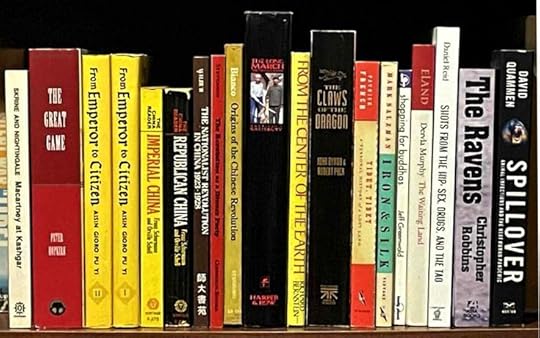
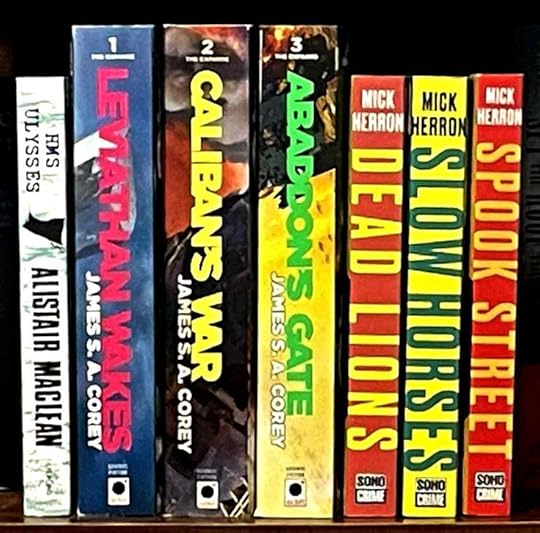
____________________________________
This was Alistair MacLean's first book, and surprisingly (IMHO) also his best. With MacLean's easy understanding of the military and its technology/jargon, as well as his well-justified "a star is born" reviews, HMS Ulysses was probably the Hunt for Red October of it's day. It lacks the complex plotting of his later thrillers for which he is more famous, and doesn't have one easily identifiable lead character. In total, it's really much closer to Michener's The Bridges at Toki-Ri (which perhaps not coincidentally, was published just two years before Ulysses) than to any of MacLean's other work - and like Bridges, it paints a realistic picture of the randomness and senselessness of war.
Many of MacLean's other books are good-to-sometimes-great yarns and a lot of fun; but with just a few exceptions they are read, enjoyed and then forgotten. But Ulysses is in a whole different league. Unremittingly brutal but beautifully written and deeply felt, this book truly deserves its status as a classic.
___________________________________
___________________________________
NOTE: A copy of this book is available free to any Goodreads friend who is willing to pay for shipping, (or pick up in person, if living in the Northern Virginia/WDC area). If interested and you have my email, just send a note with the word "Goodreads" somewhere in the text or subject, so I can find in a search. If you DON'T have my email, add a comment on this review with YOUR email, and I'll get back to you to set something up. Happy reading!
You can see other books on my "available free to friends" bookshelf (still under construction); meanwhile, here are a few blurry photos with some of the other available titles:

Read
December 23, 2014I was excited to read this book, because I used to love Alistair MacLean. But I was also nervous to read this book, because I used to love Alistair MacLean, and what if he wasn’t as good as I remembered? I did enjoy the book, but it took me a while to get into it. I think that’s because the protagonist is the crew as a whole, so it didn’t feel like there was a main character, just a lot of secondary characters. But as with most novels, by the middle, even secondary characters can be compelling and I may have shed a few tears by the end of the story.
The book revolves around the WWII Arctic convoys. The Ulysses had been on Arctic duty for some time as the book begins, and the duty isn’t easy. It’s so rough that they’ve just squashed a slight mutiny. Despite their exhaustion and bad morale, they set out again to escort ships carrying fuel, tanks, and planes to the Soviet Union. Along they way they battle horrid weather, the German navy (surface and underwater fleet), the German air force, and indifference and incompetence from the Royal Navy back in England. They rarely have more than a minute or two of down time before the next crisis emerges, so it’s a good novel for fans of fast-paced, action-packed stories. Many of his other novels have happier endings, so if you prefer happy endings over beautifully tragic books, I’d recommend trying a different one. On the other hand, this one does a good job giving readers a taste of the trials and sacrifices common on assignments like that, giving me a greater appreciation for what WWII Arctic convoys went through. It’s fiction, but I doubt it’s too far off reality.
The book revolves around the WWII Arctic convoys. The Ulysses had been on Arctic duty for some time as the book begins, and the duty isn’t easy. It’s so rough that they’ve just squashed a slight mutiny. Despite their exhaustion and bad morale, they set out again to escort ships carrying fuel, tanks, and planes to the Soviet Union. Along they way they battle horrid weather, the German navy (surface and underwater fleet), the German air force, and indifference and incompetence from the Royal Navy back in England. They rarely have more than a minute or two of down time before the next crisis emerges, so it’s a good novel for fans of fast-paced, action-packed stories. Many of his other novels have happier endings, so if you prefer happy endings over beautifully tragic books, I’d recommend trying a different one. On the other hand, this one does a good job giving readers a taste of the trials and sacrifices common on assignments like that, giving me a greater appreciation for what WWII Arctic convoys went through. It’s fiction, but I doubt it’s too far off reality.

February 26, 2012
HMS Ulysses is a ship badly in need of rest., Having already been on several Arctic runs to Murmansk, she and her borderline mutinous crew are being sent on another high-speed convoy with supplies desperately needed by the Russians. It’s FR 77; the weather is deteriorating, and the Nazis know the convoy is on its way. No rescue ships on this convoy; given what happened to the Stockport and Zafaaran, (both torpedoed with a loss of all hands and many who had been rescued from other ships that had been sunk) it probably wouldn’t make any difference anyway.
MacLean’s nautical descriptions excel at vividness. And the Ulysses must fight its way through one of the worst storms ever recorded and no one understands or describes a warship moving through such an event as MacLean.
The cold was now intense: ice formed in cabins and mess-decks: fresh-water systems froze solid: metal contracted, hatch-covers jammed, door hinges locked in frozen immobility, the oil in the searchlight controls gummed up and made them useless. To keep a watch, especially a watch on the bridge was torture: the first shock of that bitter wind seared the lungs, left a man fighting for breath. . .But the real danger of the ice lay in its weight. A ship, to use technical terms, can be either stiff or tender. If she's stiff, she has a low centre of gravity, rolls easily, but whips back quickly and is extremely stable and safe. If she's tender, with a high centre of gravity, she rolls reluctantly but comes back even more reluctantly, is unstable and unsafe. And if a ship were tender, and hundreds of tons of ice. . .. And then there were the torpedoes...
“"The sea was on fire. Flat, calm, burdened with hundreds of tons of fuel oil, it was a vast carpet of licking, twisting flames. That much, for a second, and that only, Vallery saw: then with heartstopping shock, with physically sickening abruptness, he saw something else again: the burning sea was alive with swimming, struggling men. Not a handful, not even dozens, but literally hundreds, soundlessly screaming, agonizingly dying in the barbarous contrariety of drowning and cremation.
"For a man in the sea, oil is an evil thing. It clogs his movements, burns his eyes, sears his lungs and tears away his stomach in uncontrollable paroxysms of retching; but oil on fire is a hellish thing, death by torture, a slow, shrieking death by drowning, by burning, by asphyxiation-for the flames devour all the life-giving oxygen on the surface of the sea. And not even in the bitter Arctic is there the merciful extinction by cold, for the insulation of an oil-soaked body stretches a dying man on the rack for eternity, carefully prfeserves him for the last excruciating refinement of agony.”
This is not a feel-good book. It’s about as realistic a portrayal of the Murmansk run in mid-winter as one could imagine. Characters you like die. War sucks. The Murmansk run was a killer. It’s based, in part, on the experiences of convoy PQ17. Ripping good story. One Amazon reviewer noted, “Don't read this book unless you plan on leaving a part of yourself in the frigid waters of the North Atlantic.” Impossible to say it better.
MacLean knows whereof he speaks. He saw service in the Royal Navy in the Arctic, Mediterranean and Far East theaters and was, in fact, involved in naval action against the Tirpitz while serving in the Arctic. I believe Ulysses was his first book, appearing in 1955, followed by The Guns of Navarone.
Monsarrat’s The Cruel Sea is perhaps slightly better if less depressing. Another favorite is The Captain by Jan de Hartog (different in tone from MacLean as de Hartog was a pacifist.) A really good non-fiction account is Arctic Convoys 1941-1945 by Richard Woodman. One I just added to my TBR list is Arctic Convoy Pq8: The Story Of Capt Robert Brundle And The Ss Harmatris. A view from the commons sailor side is COXSWAIN IN THE NORTHERN CONVOYS which has been republished on the Internet at http://www.naval-history.net/WW2Memoi.... You can reformat it at readability.com and then send it to your Kindle.
References related to Murmansk Run: http://en.wikipedia.org/wiki/Murmansk...
MacLean’s nautical descriptions excel at vividness. And the Ulysses must fight its way through one of the worst storms ever recorded and no one understands or describes a warship moving through such an event as MacLean.
The cold was now intense: ice formed in cabins and mess-decks: fresh-water systems froze solid: metal contracted, hatch-covers jammed, door hinges locked in frozen immobility, the oil in the searchlight controls gummed up and made them useless. To keep a watch, especially a watch on the bridge was torture: the first shock of that bitter wind seared the lungs, left a man fighting for breath. . .But the real danger of the ice lay in its weight. A ship, to use technical terms, can be either stiff or tender. If she's stiff, she has a low centre of gravity, rolls easily, but whips back quickly and is extremely stable and safe. If she's tender, with a high centre of gravity, she rolls reluctantly but comes back even more reluctantly, is unstable and unsafe. And if a ship were tender, and hundreds of tons of ice. . .. And then there were the torpedoes...
“"The sea was on fire. Flat, calm, burdened with hundreds of tons of fuel oil, it was a vast carpet of licking, twisting flames. That much, for a second, and that only, Vallery saw: then with heartstopping shock, with physically sickening abruptness, he saw something else again: the burning sea was alive with swimming, struggling men. Not a handful, not even dozens, but literally hundreds, soundlessly screaming, agonizingly dying in the barbarous contrariety of drowning and cremation.
"For a man in the sea, oil is an evil thing. It clogs his movements, burns his eyes, sears his lungs and tears away his stomach in uncontrollable paroxysms of retching; but oil on fire is a hellish thing, death by torture, a slow, shrieking death by drowning, by burning, by asphyxiation-for the flames devour all the life-giving oxygen on the surface of the sea. And not even in the bitter Arctic is there the merciful extinction by cold, for the insulation of an oil-soaked body stretches a dying man on the rack for eternity, carefully prfeserves him for the last excruciating refinement of agony.”
This is not a feel-good book. It’s about as realistic a portrayal of the Murmansk run in mid-winter as one could imagine. Characters you like die. War sucks. The Murmansk run was a killer. It’s based, in part, on the experiences of convoy PQ17. Ripping good story. One Amazon reviewer noted, “Don't read this book unless you plan on leaving a part of yourself in the frigid waters of the North Atlantic.” Impossible to say it better.
MacLean knows whereof he speaks. He saw service in the Royal Navy in the Arctic, Mediterranean and Far East theaters and was, in fact, involved in naval action against the Tirpitz while serving in the Arctic. I believe Ulysses was his first book, appearing in 1955, followed by The Guns of Navarone.
Monsarrat’s The Cruel Sea is perhaps slightly better if less depressing. Another favorite is The Captain by Jan de Hartog (different in tone from MacLean as de Hartog was a pacifist.) A really good non-fiction account is Arctic Convoys 1941-1945 by Richard Woodman. One I just added to my TBR list is Arctic Convoy Pq8: The Story Of Capt Robert Brundle And The Ss Harmatris. A view from the commons sailor side is COXSWAIN IN THE NORTHERN CONVOYS which has been republished on the Internet at http://www.naval-history.net/WW2Memoi.... You can reformat it at readability.com and then send it to your Kindle.
References related to Murmansk Run: http://en.wikipedia.org/wiki/Murmansk...

February 13, 2013
Alistair Maclean was on to a winner with his first novel HMS Ulysses portraying the plight of British Navy in the harsh winter conditions during Arctic Convoys which were under constant danger of German U Boats and Warships.
Maclean's writing is so engrossing that you feel that you are there with the crew. You will face their peril, endless nights devoid of sleep and extreme cold. The characters are clearly etched. As the survivor Lt Nicholls points at the end to Admirality " The situation we faced at Arctic is difficult to imagine sitting in the confines of office and I wonder if this really happened"
The crewmembers make the ultimate sacrifice and you will weep at the inhumanity and savagery of war.
The best sea warfare novel. Its a classic which needs to be revered both as an axiom of soldierly conduct and leadership qualities. I have given it 5 rating bcoz GR rating is restricted to this, otherwise this novel deserves a complete 10.
I wish Mr. Spielberg would make a movie on HMS Ulysses some day.
Maclean's writing is so engrossing that you feel that you are there with the crew. You will face their peril, endless nights devoid of sleep and extreme cold. The characters are clearly etched. As the survivor Lt Nicholls points at the end to Admirality " The situation we faced at Arctic is difficult to imagine sitting in the confines of office and I wonder if this really happened"
The crewmembers make the ultimate sacrifice and you will weep at the inhumanity and savagery of war.
The best sea warfare novel. Its a classic which needs to be revered both as an axiom of soldierly conduct and leadership qualities. I have given it 5 rating bcoz GR rating is restricted to this, otherwise this novel deserves a complete 10.
I wish Mr. Spielberg would make a movie on HMS Ulysses some day.

January 14, 2014
Alistair MacLean’s H.M.S. Ulysses is an entertaining tale of the horrors of the Arctic convoys to Russia during World War II. It is simply that – entertaining – while occasionally lapsing into “soap opera.” A back cover blurb states “H.M.S. Ulysses is in the same class as The Cruel Sea.” I disagree. MacLean’s novel is more akin to a Douglas Reeman book, but while Reeman concentrates on action, MacLean concentrates on characters. Neither, as an author of nautical action tales, is in a class with Nicholas Monsarrat. Alistair MacLean’s novel rates just a weak Three Stars.

January 14, 2021
I wish I had the first edition but I have the November 1955 reprint. While I am reading this book I do recognise the story and I am sure that I have read this book before. But those were different times when Alistair MacLean was the action writer that everybody wanted to read. This WW2 story of a ship by the name HMS Ulysses working the convoys from the US to Murmansk to support the Russian fighting machine against the Third Reich by Adolf Hitler, is less of a story of war but a story about men surviving in often extreme surroundings.
When the story starts the eskadron of ships get hit hard by one of the great storms measured since these nature occurences got registered. And this mother of all storms is just the opening third of the book.
The HMS Ulysses is a modern warship and has radar and asdic so makes a logical choice as an escort for convoys to Moermansk in Russia which are meant to keep the Russian war effort against Adolf Hitlers expanding empire going. These convoys were always going to attract the U-boat attention and landbased bombers to stop the supplies from ever reaching Russia.
The ship has more character than some of the characters in the book, it is the main character and her Herculean effort to keep the Nazis at bay. It is an interesting tale from the allied side, even if Das Boot does a far better job of telling it from the submariners side including the human side.
The book tells of the battle of humans against the sea and the Germans and does so very well, albeit that you get little idea of the merchant navy's side which is a shame, perhaps the movie Action in the North Atlantic starring Bogart and the usual suspects gives you a better idea.
That said in combination with reading a book like das Boot this story makes for an interesting tale about the perhaps less glamorous side of the WWII conflict that in the end proves to be a very important operation to stop the Nazis from building a lasting empire.
When the story starts the eskadron of ships get hit hard by one of the great storms measured since these nature occurences got registered. And this mother of all storms is just the opening third of the book.
The HMS Ulysses is a modern warship and has radar and asdic so makes a logical choice as an escort for convoys to Moermansk in Russia which are meant to keep the Russian war effort against Adolf Hitlers expanding empire going. These convoys were always going to attract the U-boat attention and landbased bombers to stop the supplies from ever reaching Russia.
The ship has more character than some of the characters in the book, it is the main character and her Herculean effort to keep the Nazis at bay. It is an interesting tale from the allied side, even if Das Boot does a far better job of telling it from the submariners side including the human side.
The book tells of the battle of humans against the sea and the Germans and does so very well, albeit that you get little idea of the merchant navy's side which is a shame, perhaps the movie Action in the North Atlantic starring Bogart and the usual suspects gives you a better idea.
That said in combination with reading a book like das Boot this story makes for an interesting tale about the perhaps less glamorous side of the WWII conflict that in the end proves to be a very important operation to stop the Nazis from building a lasting empire.
May 31, 2017
Calling this a harrowing tale of war time heroism would be a huge under statement. It does a good job of portraying what life must have been like on one of those arctic convoy runs. As a reader you are worn down by the enormity of what these men had to endure minute by minute, hour by hour. A good read but not an enjoyable one.
August 27, 2007
Witout doubt the best naval war book ever written.

September 20, 2022
A debut novel which either won or was influential in winning its author an award. This book does meet that description.
Written in 1955, it was the debut novel of Scottish author Alistair MacLean. MacLean's experiences in the Royal Navy during World War II provided the background and the Arctic convoys to Murmansk provided the basis for the story, which was written at a publisher's request after MacLean had won a short-story competition the previous year.
Set in WWII in a VERY cold place, the book is somewhat predictable in its content. The Ulysses leads a convoy of cruisers and merchant ships through dangerous waters. There are 23 ships in the beginning, FAR LESS than that by story's end. Much of the book is about bombing, boats sinking and death.
I listened on audible as well and the narration was excellent--- full of emotion and well read.
4 stars
Written in 1955, it was the debut novel of Scottish author Alistair MacLean. MacLean's experiences in the Royal Navy during World War II provided the background and the Arctic convoys to Murmansk provided the basis for the story, which was written at a publisher's request after MacLean had won a short-story competition the previous year.
Set in WWII in a VERY cold place, the book is somewhat predictable in its content. The Ulysses leads a convoy of cruisers and merchant ships through dangerous waters. There are 23 ships in the beginning, FAR LESS than that by story's end. Much of the book is about bombing, boats sinking and death.
I listened on audible as well and the narration was excellent--- full of emotion and well read.
4 stars

March 16, 2015
There is a reason the WWII generation is called the greatest generation and a lot of it is shown in this book.
I haven't read many novels about WWII navy experiences but this one is amazing. The depth of experience
this author has shows that research could not give one the ability to write about how things were at this time
and place in such a detailed, heartfelt level. It is not just the history, the workings of the ships, or the
authority figures power over the lives of lesser beings, but the workings of mens minds and souls.
Required reading. That being said, I want to warn you this is about real life, devastating things happen.
I haven't read many novels about WWII navy experiences but this one is amazing. The depth of experience
this author has shows that research could not give one the ability to write about how things were at this time
and place in such a detailed, heartfelt level. It is not just the history, the workings of the ships, or the
authority figures power over the lives of lesser beings, but the workings of mens minds and souls.
Required reading. That being said, I want to warn you this is about real life, devastating things happen.

October 29, 2025
4-Stars - HMS Ulysses by Alistair MacLean
Audiobook (mp3 files from cassettes): c. 14 Hours
Narrator: Peter Joyce
Read several times c.1958 - 1965
My assessed rating was applied after joining Goodreads.
I read a print copy of this book, or I listened to this audiobook, or both, sometime prior to joining Goodreads in October 2011, and/or before I started writing reviews.
My "Started Reading" and "Finished Reading" Dates are approximate.
Audiobook (mp3 files from cassettes): c. 14 Hours
Narrator: Peter Joyce
Read several times c.1958 - 1965
My assessed rating was applied after joining Goodreads.
I read a print copy of this book, or I listened to this audiobook, or both, sometime prior to joining Goodreads in October 2011, and/or before I started writing reviews.
My "Started Reading" and "Finished Reading" Dates are approximate.

December 7, 2017
It’s revealing when a review starts out with a reference to a different book. In fact, The Cruel Sea by Nicholas Monsarrat remains my favorite novel about life in the Royal Navy during the years that comprised World War II. HMS Ulysses has many of the same elements as Monsarrat’s novel, but Monsarrat practices control over his writing, he knows that magical point where language needs to stop so that the reader’s imagination can complete the imagery and feelings being conveyed. In Ulysses, Alistair MacLean tends to monopolize the reader’s mind. It’s certainly not intolerable, but he does over-describe things to the point where it feels like one’s imagination has been pushed aside.
The action in Ulysses is a bit over the top; as if MacLean is trying to compress the entire variety of wartime experiences into the single mission being chronicled. At times, the action is gripping, but in total it becomes overwhelming to the point of disbelief. For those that enjoy Westerns that feature forever-loaded revolvers and heros that escape death time after time, this story of survival is the naval equivalent of that genre.
As war stories often go, the characters tend to be instruments of the plot. Bad things happen to them, but the feelings of the victims cannot be fully realized because much of their background is missing. To make matters worse, the characters are referred to at different times by one of their many monikers. Their rank, position, the acronym of their position, their last name, nickname, and first name are all used interchangeably, which creates confusion and further distances the reader from the characters.
Overall, HMS Ulysses is not a bad naval war novel. As a first novel, MacLean makes an honest attempt to convey and expand upon his own first-hand experiences aboard the HMS Royalist during WWII. The sincerity comes through and I felt that he was reaching for something greater than his story. The problem with HMS Ulysses may very well be that MacLean reached too far.
The action in Ulysses is a bit over the top; as if MacLean is trying to compress the entire variety of wartime experiences into the single mission being chronicled. At times, the action is gripping, but in total it becomes overwhelming to the point of disbelief. For those that enjoy Westerns that feature forever-loaded revolvers and heros that escape death time after time, this story of survival is the naval equivalent of that genre.
As war stories often go, the characters tend to be instruments of the plot. Bad things happen to them, but the feelings of the victims cannot be fully realized because much of their background is missing. To make matters worse, the characters are referred to at different times by one of their many monikers. Their rank, position, the acronym of their position, their last name, nickname, and first name are all used interchangeably, which creates confusion and further distances the reader from the characters.
Overall, HMS Ulysses is not a bad naval war novel. As a first novel, MacLean makes an honest attempt to convey and expand upon his own first-hand experiences aboard the HMS Royalist during WWII. The sincerity comes through and I felt that he was reaching for something greater than his story. The problem with HMS Ulysses may very well be that MacLean reached too far.

August 22, 2018
Frozen Grim Harrowing.
HMS Ulysses Alistair MacLean. Fiction based account of various real life incidents and amalgamation of several destroyers. Centered around the artic convoy supplying the Russians war materials during world war 2. It leaves me feeling cold. I found it tricky following the characters, mostly a simple story of brutal encounters where men struggled to survive best they could. Being thrown overboard into icy waters death came quick, no lingering death waited for you there. Being blown to bits seemed the best way to go. Surviving a near miss badly wounded the worst. Difficult book to get through harrowing accounts that if it weren't based on true events you'd think fantasy. You can just feel the utter panic at all levels. bravery and cowardice is the difference of being braver 5 minutes longer. Grim reality of the 30 characters portrayed only one survived. Anti war tale, pretty much up there with All Quiet on the western front.
HMS Ulysses Alistair MacLean. Fiction based account of various real life incidents and amalgamation of several destroyers. Centered around the artic convoy supplying the Russians war materials during world war 2. It leaves me feeling cold. I found it tricky following the characters, mostly a simple story of brutal encounters where men struggled to survive best they could. Being thrown overboard into icy waters death came quick, no lingering death waited for you there. Being blown to bits seemed the best way to go. Surviving a near miss badly wounded the worst. Difficult book to get through harrowing accounts that if it weren't based on true events you'd think fantasy. You can just feel the utter panic at all levels. bravery and cowardice is the difference of being braver 5 minutes longer. Grim reality of the 30 characters portrayed only one survived. Anti war tale, pretty much up there with All Quiet on the western front.

October 18, 2023
I decided to retreat from my fantasy world and take a look back in time at some past WWII historical fictions. I have read Alistair Maclean before, but never read his debut novel, "HMS Ulysses." Maclean served on a British cruiser for a time and brings that knowledge to the forefront of this novel of the British convoys of WWII who strived to supply Russia with needed war materials in the fight against the Axis powers. The convoys to Murmansk were among the most dangerous. Over 70 such conveys were made during WWII. The merchant convoys escorted by warships of newer and older vintage, pressed into service, faced the rath of the German Luftwaffe, the German submarine wolf packs, dangerous subzero temperatures and weather above the Artic Circle and even more vicious, the cruel sea.
This is a story of a ship made brave by its sailors. Decisions made by those who command the sea from desks at the Admiralty, the officers who at their peril have to obey and the harsh reality of war.
This is a story of a ship made brave by its sailors. Decisions made by those who command the sea from desks at the Admiralty, the officers who at their peril have to obey and the harsh reality of war.

September 3, 2011
I'm left speechless by this story. A truly amazing story of heroism of men tired beyond belief fighting a war in conditions unbelievable but true. The HMS Ulysses is a Royal Navy cruiser whose crew have recently mutinied and are tasked once again to meet and escort a convoy on the Murmansk run to Russia. The crew is beaten, tired and the Captain is dying. They sail to meet the convoy of merchant ships at Iceland to take over from the warships escorting the convoy from Canada. The result is a fascinating, horrifying, touching story of this voyage; the love of the crew for their ill Captain, his love for them; the many personalities of the crew and the ordeal they must sail through. The story makes me think of my father as he also sailed to Murmansk, something he doesn't tell me much about. I've read this story before, but so long ago. I'm glad I read again.

September 13, 2017
If I had a dollar for every WW II book where the suave protagonist strolls his way through the enemy and completes his mission.. well, I'd be able to afford a much better phone to write this review on.
But HMS Ulysses is not such a book. Infinitely more hard hitting and realistic, the book delves into the practicalities of war and all their facets - strategy and miscalculations, honor and cowardice, wins and losses - and reflects on how ultimately the men (who are often no more than kids) end up paying the price in the horrors of war for the decisions of those holier than thou men cooped up comfortably in the HQs. A gem, even among all of McLean's bestsellers, this is one book that I believe needs to be studied by military everywhere to realize that there is no glory in war - only the sufferings of the innocent, pitted against a faceless enemy.
4.5/5
But HMS Ulysses is not such a book. Infinitely more hard hitting and realistic, the book delves into the practicalities of war and all their facets - strategy and miscalculations, honor and cowardice, wins and losses - and reflects on how ultimately the men (who are often no more than kids) end up paying the price in the horrors of war for the decisions of those holier than thou men cooped up comfortably in the HQs. A gem, even among all of McLean's bestsellers, this is one book that I believe needs to be studied by military everywhere to realize that there is no glory in war - only the sufferings of the innocent, pitted against a faceless enemy.
4.5/5

August 7, 2020
From the year 1941 until the end of World War II, Alistair Maclean served in the Royal Navy with the ranks of Ordinary Seaman, Able Seaman, and Leading Torpedo Operator. This experience served him well when he launched his writing career with his debut novel, “H.M.S. Ulysses” in 1955, considered by many to be his best. Of course, he went on to great acclaim and a distinguished bestseller career despite the fact that he claimed never to have enjoyed writing but did it merely as a source of income.
This novel features the HMS Ulysses, a light cruiser that is among the best armed and fastest ships in the Navy. The story begins in the aftermath of a mutiny born of an overworked and exhausted crew. Senior Navy officers have decided to let her prove herself by sending her out on yet another mission: to escort a critical convoy of 32 ships through the treacherous Arctic Sea to Russian allies in Murmansk. Along the way, they face extreme challenges in the form of unusually harsh Arctic storms, German ships, packs of U-boats, as well as repeated air attacks.
A number of interesting characters populate HMS Ulysses, not the least of which is her Captain, a man suffering the advanced stages of TB but who nevertheless symbolizes the good luck of the ship’s past missions and any hope to survive this one. Few crew members are motivated by concepts such as honor, courage, etc. but rather it is their resilience that pushes them to hero status. There is a fair amount of technical jargon, but MacLean’s prose is filled with vivid descriptions of the harsh environment, the raw feeling of utter loneliness, and the crew’s growing exhaustion and desperation. This is a marvelous depiction of wartime naval operations, and a stunning portrayal of how men can push past the bounds of endurance.
This novel features the HMS Ulysses, a light cruiser that is among the best armed and fastest ships in the Navy. The story begins in the aftermath of a mutiny born of an overworked and exhausted crew. Senior Navy officers have decided to let her prove herself by sending her out on yet another mission: to escort a critical convoy of 32 ships through the treacherous Arctic Sea to Russian allies in Murmansk. Along the way, they face extreme challenges in the form of unusually harsh Arctic storms, German ships, packs of U-boats, as well as repeated air attacks.
A number of interesting characters populate HMS Ulysses, not the least of which is her Captain, a man suffering the advanced stages of TB but who nevertheless symbolizes the good luck of the ship’s past missions and any hope to survive this one. Few crew members are motivated by concepts such as honor, courage, etc. but rather it is their resilience that pushes them to hero status. There is a fair amount of technical jargon, but MacLean’s prose is filled with vivid descriptions of the harsh environment, the raw feeling of utter loneliness, and the crew’s growing exhaustion and desperation. This is a marvelous depiction of wartime naval operations, and a stunning portrayal of how men can push past the bounds of endurance.

December 27, 2017
(From April 2012, previously posted on Amazon)
One of the greatest books ever written.
You may think that's an exaggeration but for me, having read a lot of books of all kinds over the years, it's true. Have you ever read a paragraph, midway through a book, that made you stop? Just stop. Then read it again. And then once more, just because it completely takes your breath away. I never had until I read "HMS Ulysses".
I had never read any Alistair MacLean even though many of his titles were familiar from films. Reader reviews steered me to this book and I will always be glad they did. Rarely can a writer transport you to a time, place and environment you can't possibly imagine, and immerse you in it so fully.
I stand by my title for this review. If you are not convinced, find the passage, "At 2230 Ulysses crossed the Arctic Circle. The monster struck.", then read on for the following page and tell me you don't stop reading and just stare, open-mouthed and with goose bumps for at least a minute or two.
One of the greatest books ever written.
You may think that's an exaggeration but for me, having read a lot of books of all kinds over the years, it's true. Have you ever read a paragraph, midway through a book, that made you stop? Just stop. Then read it again. And then once more, just because it completely takes your breath away. I never had until I read "HMS Ulysses".
I had never read any Alistair MacLean even though many of his titles were familiar from films. Reader reviews steered me to this book and I will always be glad they did. Rarely can a writer transport you to a time, place and environment you can't possibly imagine, and immerse you in it so fully.
I stand by my title for this review. If you are not convinced, find the passage, "At 2230 Ulysses crossed the Arctic Circle. The monster struck.", then read on for the following page and tell me you don't stop reading and just stare, open-mouthed and with goose bumps for at least a minute or two.

September 7, 2016
Astounding how much this book reminded me of Douglas Reeman--one of the latter's weaker efforts. Too drawn out, too psychological; too many "black hat" characters. But as where Reeman always integrated those elements in the plot, many here were tacked on as afterthoughts--e.g., the Rating who sacrifices himself for the ship to atone for a murder that took place before the book starts! And Reeman never killed off so many "white hats."
Still, MacLean knows boats, and served in the "wavy Navy" during WW2, including on the deadly Arctic supply run to Archangel, Russia. Hell on the high seas.
Still, MacLean knows boats, and served in the "wavy Navy" during WW2, including on the deadly Arctic supply run to Archangel, Russia. Hell on the high seas.

February 24, 2023
Alistair MacLean was one of the first authors I shared with my dad. Now 30 years later I found one book from him I had not yet read. I’m probably rounding up because of the connection with my teen years. Early military suspense. Though not his best work still worth a read.
March 26, 2008
AM's best book (that I've read), but sadly overshadowed in popularity by a number of his other novels. A truly fine piece of historical fiction that has warranted several reads on my part.

December 7, 2012
The author describes the H.M.S. Ulysses as "The complete, the perfect fighting machine, man's ultimate, so far, in his attempt to weld science and savagery into an instrument of destruction. The perfect fighting machine---.........". Impressive, but its reputation has been unjustifiably sullied. The story places the reader on board as an observer in this intense telling of a naval story out of World War II. It can be a stressful read. So much so that the reader must look away from time to time and take a deep relaxing breath. The reader follows along as the crew faces: The cruelty of an arctic winter, death and privation, destruction, unrelenting bad weather, blizzards, the worst storm of the war, the roughest seas imaginable, ocean warfare, U-boats, air attacks, constant tension, no relief, one mission after another without letup, numbing intense cold, being stretched past their limits, physical exhaustion, weakness, hunger, snow, ice, hurricane force winds, 24 hr nights, miserable dawns, ice everywhere, chaos, unimaginable fatigue, and all without end. I am late arriving to the party as a reader of this 1955 book. If not better, it is certainly on a par with MacClean's "Guns of Navarone. Thr author writes with authority and his verbal imagery is extraordinary. The reader should come away with an appreciation of the challenges our parents, grandparents, and great grandparents had to face during WWII. So could you have done as well? If you think not, then you had better re-boot or reconfigure. They are us and we are them.

August 12, 2025
Challenging, Stark and Brutal. By far the heaviest novel I have read in a very long time. I gripping as a novel, you simply can't put it down. The characters make this novel, if it weren't for them I would've put it down ages ago. Unlike, MacLean's other War novels this doesn't sugarcoat or even try to hide the hardship, pain and freezing cold of Artic convoy duty. If you want a novel that sobers you up when it comes to Second World War novels this is it. Worth reading, but not at all like MacLean's other novels.
July 6, 2008
My favorite Maclean book. The author vividly portrays the awful conditions and paralyzing fear suffered by sailors in the Arctic seas during the Second World War. His descriptions of the conditions will have you shivering yourself! In my opinion this book ranks with the best of war fiction.

March 12, 2021
Superb read. Definitely up there with The Cruel Sea.

August 3, 2020
A grim tale of heroism on the Murmansk convoys in WWII.
I don't know if this book is generally considered an anti-war novel, but I think it should be if it isn't. I'm not sure if I can say I really enjoyed it, but it certainly is compelling.
There is a scene in the film 'The Cruel Sea' where the corvette's ASDIC operator locates a U-boat that has just sunk a ship in the convoy. The trouble is, the U-boat seems to be right underneath where survivors of the sunken ship are in the sea. The commander of the corvette , played by Jack Hawkins, realises he has to fire depth charges into the water where the sunken ship survivors are, killing them, in order to sink the U-boat as it may sink more ships, and kill more men. I understand this scene is used in philosophy courses to illustrate the 'trolley problem' where one must choose that some must die in order to save more. They fire the depth charges, the survivors are killed, if I remember rightly, the men on the corvette's face look up as the depth charges explode, as if watching the survivors remains flying into the air. They then lose ASDIC contact. Perhaps it was a mistake. Perhaps the U-boat was never there. One of the sailors on the corvette shouts "bloody murderer!" at Jack Hawkins who has a look of horror on his face. Nobody there knows what Jack Hawkins knows, what lead him to the decision to depth charge the struggling survivors in the sea. The ASDIC operator doesn't know there are survivors above where he said the U-Boat is, the sailors manning the guns on the little corvette don't know Jack Hawkins has been told there is a U-Boat underneath the survivors. The survivors don't know why the corvette is sailing straight for them at full speed, and then, firing depth charges at them. Only Jack Hawkins has the crucial information. It looks like he deliberately killed those desperate men rather than take them on board his litttle ship. Well, HMS Ulysses is like that scene, but over and over again. Its horrible.
I've read quite a few war memoirs and war novels, but I think this might be the grimmest.
I don't know if this book is generally considered an anti-war novel, but I think it should be if it isn't. I'm not sure if I can say I really enjoyed it, but it certainly is compelling.
There is a scene in the film 'The Cruel Sea' where the corvette's ASDIC operator locates a U-boat that has just sunk a ship in the convoy. The trouble is, the U-boat seems to be right underneath where survivors of the sunken ship are in the sea. The commander of the corvette , played by Jack Hawkins, realises he has to fire depth charges into the water where the sunken ship survivors are, killing them, in order to sink the U-boat as it may sink more ships, and kill more men. I understand this scene is used in philosophy courses to illustrate the 'trolley problem' where one must choose that some must die in order to save more. They fire the depth charges, the survivors are killed, if I remember rightly, the men on the corvette's face look up as the depth charges explode, as if watching the survivors remains flying into the air. They then lose ASDIC contact. Perhaps it was a mistake. Perhaps the U-boat was never there. One of the sailors on the corvette shouts "bloody murderer!" at Jack Hawkins who has a look of horror on his face. Nobody there knows what Jack Hawkins knows, what lead him to the decision to depth charge the struggling survivors in the sea. The ASDIC operator doesn't know there are survivors above where he said the U-Boat is, the sailors manning the guns on the little corvette don't know Jack Hawkins has been told there is a U-Boat underneath the survivors. The survivors don't know why the corvette is sailing straight for them at full speed, and then, firing depth charges at them. Only Jack Hawkins has the crucial information. It looks like he deliberately killed those desperate men rather than take them on board his litttle ship. Well, HMS Ulysses is like that scene, but over and over again. Its horrible.
I've read quite a few war memoirs and war novels, but I think this might be the grimmest.
Displaying 1 - 30 of 475 reviews