What do you think?
Rate this book


224 pages, Hardcover
First published February 4, 2020
"Yes we are angry, yes we are making a noise about it, and yes, we are hungry for change. We are harpies."

These figures don’t purely provide a comforting link to history, but make for powerful contemporary role models, their struggles, hopes and strength resonate. These fabulous women may be from the darkest past, but they’re leading the charge forward. And Thank goddesses for that.
To ten-year-old me, whose only female superhero was Wonder Woman, these mythological creatures resonated hard. They fought, took revenge, were wild — some of them were even worshipped for it. And it's their quirks, their power, their fallibility that makes them fascinatingly relevant to women today. — Kate Hodges
The way I'm going to review this is an overview statement and then comments on the individual women. Some I knew, some I didn't before coming in. Warriors, Witches, Women is divided up into five overarching sections; Witches, Warriors, Bringers of Misfortune, Elemental Spirits, and Munificent Spirits, each section with its own tagline which is the core of that type. As far as I can tell each section starts with an archetypal woman to introduce some of the key points for example Warriors uses the Greek goddess Artemis. Unlike most books which feel like they are very Eurocentric this barely doubles up on the pantheon's included with the women coming from all over that globe.
The entries are each 4 pages long, a page dedicated to Harriet Lee-Merrion's illustration, three pages of writing by Kate Hodges. Each introductory page the woman's best-known name, culture or pantheon, other names they are known as and a short often humorous overview of them. Also included somewhere in each entry is a quote that Hodges associated with the woman, some are about them directly, others are by modern people. I've read quite a few books on mythology and women in mythology over the years but this is one of the few that is clearly aimed at an adult audience. As such these entries are written slightly differently from some others it covers the way myths can blend and alter through time and as they move through cultures.
Breifly on Harriet Lee-Merrion's illustrations. There are some flaws in the art but most are well interpreted and not pg with boobs out as appropriate (as in the case of Ame-No-Uzume). These illustrations are using simple enough styles and palettes. Perfect for encouraging the focus to be on the text. The most problematic illustration is Madam Brigitte, she is the exact opposite of whitewashed. I would say it's a minor thing but I'm not sure it is. It certainly means the art was done at the same time as or without the text. But either way, it's frustrating. Ma'at piece is a fantastic choice for those who know the basics beyond what is included here. The pose used is how she is presented in tomb carvings, actually, the whole thing feels like a replica of that. One one the best aspects of the art for me was its ability to give me total grabby hands for the outfits for cultures across the spectrum.
I appreciated the diversity of the pantheons, the diversity of the associations, the art and the writing style. While there were things I already knew there was undoubtedly some things included that I had no idea about, like the histories of the women I did know. Hodges does a fantastic job of bringing their stories to life and showing how the ancient in some cases goddesses are still relevant to modern women. These smart entries are accompanied by lovely art by Lee-Merrion. These illustrations are using simple enough styles and palettes. Perfect for encouraging the focus to be on the text. For those with an interest in mythology, it really is worth reading and I would recommend it. I really enjoyed this. The rest of the review will basically be notes I made while reading, something for each of the 50 women.
Witches
- Hecate — Hecate is such a strong start. Some of her history I didn't know such as her ties to Lilith. I also hadn't seen the corruption of her myth from the strong woman to the darker magic we have now.
- Morgan Le Fay — Okay so while I was reading this entry I stumbled on this line "Cistercians were crusaders, dedicated to eradicating heretics. The despised women - some even argued against the existence of a female soul - and used the Arthurian tales as propaganda for the Christian religion." (p.16). Oh Christianity... why? I have a reply to this. "This is what gets to me about some branches of Christianity. They worship Mary as a deity, make a woman one of their key religious figures, but then don't see women as worthy of equality on earth?" (William Edgar, The Coffin Confessor)
- Cirice — Cirice is called independence personified with her love of cats and need for knowledge she really is a Mythical figure for the modern woman.
- Baba Yaga — The illustration for Baba Yaga is wonderful. The splash of colour is perfect. The choice of story is a good one.
- Cassandra — I am a bit surprised Cassandra is here. We all know her negative gift of prophecy but I didn't know it was originally a positive gift removed after she said no to a man (god whatever).
- The Pythia — I really like this entry, it's fascinating. I like the line "Apollo was the musician, the Pythia a lyre and the gas emissions the musical ability (originally by Plutarch, p.33). The gas emissions have been archaeologically proven, which I didn't know. Nor did I know that the Oracle of Delphi had a proper name.
- Berchta — I'd never heard of Berchta but until recently I'd never heard of Krampus they are somewhat related.
- White Buffalo Calf Woman — I'm wondering if there is a little bit of disrespect in this entry. But that is not my call to make. There is a fantastic Cheyenne proverb included "As long as the hearts of our women are high, the nation will live. But should the hearts of our women be on the ground, then all is lost." (p.41). Honestly, I found this entry interesting if only for gender politics involved.
- Rhiannon — I appreciate Rhiannon. Though the right up as a few too many GoT references for my liking.
Warriors
- Artemis — I'm so glad Artemis is in here. Though the angle pursued by Hodges is not what I would have thought. Of note is the concept of virginity. For Artemis virginity meant unmarried rather the modern connotations. There are some characters mentioned as Artemis archetype, not all are obvious Katniss Everdeen, Princess Merida, Daenerys Targaryen and Lisbeth Slander.
- Anath — How had I never heard of Anath? Northwest Semitic goddess of love and war. Worshipped across Egypt and Canaan she is a badass bitch who flipped the script when it comes to gender roles.
- Divoká Šárka — Another woman I'd never heard of but she is my kind of woman, immensely brave and tactical. Also gotta love that the romantic additions have been rubbished because of course they have. Let us have nice things and by nice I mean extremely strong and capable warriors defending their home. Which happens to be an enclave of women.
- Freyja — I adore the art for Freyja. Lee-Merrion has done a brilliant job of illustrating the Norwegian Forest Cats (often the breed ascribed to pulling her chariot). The colour palette used is lovely. What I didn't know is that she is considered to be the last Norse god to be worshipped. She was worshipped, her name called upon during the childbirth process.
- The Furies — I didn't know the individual Furies have names and specialisations. I guess it's logical. Alecto or ' unceasing anger' in charge of moral crimes, driving perpetrators to madness. Megaera or the 'jealous one' punished those who committed adultery. Tisiphone or 'the blood avenger' punished those who committed murder, patricide, homicide and fratricide. (p.66)
- Cihuateteo — I wouldn't be at all surprised if more pantheons have goddesses like the Cihuateteo, goddesses honouring women who died in childbirth. Aztecs viewed labour (as in the act of childbirth) as war. I love that. These are stunning women put in an elevated position.
- Kālī — This is a goddess with so many faces, it can be hard to keep up but it is interesting.
- Yennenga — This is one of the real women included, her story passed through oral tradition. There is a line she reputedly said to her father... 'This field looks like how I feel. Here I am, my ovaries withering and dying, my soul crying out for someone, and you don't care.' (p.78). This said to try and get her father to let her have a balanced life, a life beyond her military prowess. She is a powerful woman, she weaponised every aspect of herself and history has taken notice.
- Jezebel — a good inclusion as an oft-misunderstood and slandered woman. She was so, so much more than is often shown.
Bringers of Misfortune
- Hel — Discussion of Hel as a triple goddess is new to me, as is the physical description. But like so many others her everything has been oversimplified for modern eyes.
- Morrígan — The idea of Morrígan as a template for Goth girls is appealing in some ways her truth doesn't change that. I'd never seen the name of her encompassing parts Badb, Macha and either Annan or Nemain. Annan is much softer than the battle furious Nemain. She has connections to Brigid through Tuatha Dé Danann.
- The Valkyries — This entry makes me want to read the Völsunga saga or at least Brynhildr's story. I never realised just how empowering Norse mythology is to women.
- Pontianak — A Malaysian ghost, I'd never heard of them. Like quite a few of the Asian women included they are still present in culture today, still powerful.
- Baobhan Sith — She is a great choice for the vampire. They are Scottish have a story to tell. I do appreciate the thought of trying to stretch this myth to Star Wars.
- Lilith — Judith Plaskow Goldenberg's idea of Lilith and Eve becoming friends in The Coming of Lilith sounds amazing. I kinda want to see it. They represent the two sides of womanhood it's not something I had ever considered.
- Loviatar — This Finnish goddess is the mother of 'all the plagues and ills in the Northland'. She's a dark goddess, dark almost to the point of irredeemable. She is a smart inclusion for her representation of humanity's resilience.
- Harpies — All I can say to this entry is... YES own the slur.
- Medusa — There was still something here I never knew. Such as her sisters also cursed by Athena, stood by her. Like the Harpies maybe this is a slur we need to own. Medusa is a strong female, she defeated many before Perseus got to her.
- La Llorona — This is a wonderful take on La Llorona. That idea of giving new Mothers a voice to their fears.
- Banshee — Banshee's are potentially another triple, I've never seen that take before. But in many ways, it works. That idea of Banshees as the origin of the British stiff upper lip is great and believable.
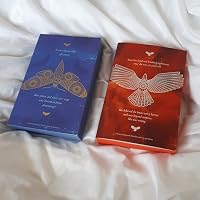
- Futakuchi-Onna — This entry acts as an introduction to the Japanese yōkai, spirits. They are quite adaptable and quite modern feeling. FYI this is the supernatural creature on the back cover (the front is obvious).
Elemental Spirits
- Tiamat — A goddess full of contradictions and relatable pieces. Her balancing act was well described, her ending brutal even if it is a creation myth, maybe, especially for a creation myth.
- Mami Wata — This entry felt a bit odd to me. But that could as much be because I have little interest in what she is relevant to in modern times... that money, money, Instagram-able lifestyle. Also, I've never been a huge fan of African mythos, I just get confused.
- Pele — Oh I like Pele. I think she feels so human with her temperament. I kind of knew of Pele's worship was ongoing, but seeing that confirmed is nice to see. But we do love to see ongoing worship.
- Selkies — I did not know the Selkie myth supported male selkies. It may be logical be mythology is never logical. I like the idea of selkies as a cautionary tale for times gone by. And as a reminder in the modern era for self-care.
- Mari — The art is fantastic, I really want that outfit. Mari is a goddess of the elements, her personality is in line with that and I like it. She is still around today, and not shy, she is happy to be seen in public though she is a chameleon. She feels unusual in the scope of things. For her life under Christianity hasn't been so bad.
- The Lady of Llyn y Fan Fach — This is another myth I'd never heard. A Welsh fairy with links to the Lady of Lake (of Arthurian legend fame). She is a spectacularly interesting woman. She has a lesson to teach the modern woman (and man) about agency, ownership and communication. Her real name is Nelferch, the name she is better known as comes from the lake she called home, Llyn y Fan Fach.
- The Rainbow Serpent — How had it never clicked that the Rainbow Serpent is gender-fluid? I'm not sure how accurate the culture is written about but you know I'm not sure I'm going to fight. Because let's be honest no one outside Australia (or let's be honest even it really) talks about the Indigenous mythos. Most of the language is current and handled with poise. More than I would have expected. The inclusion of the concept of Dreamtime is vital. I had not realised that Aboriginal culture is accepting of genderqueer people.
- Mazu — She is one of the most worshipped deities globally. Based on the real Taiwanese woman Lin Mo-Niang, as is seemingly the norm for many eastern religions. She's the patron goddess of the sea. Her tale is lovely with that necessary touch or trauma.
- Eglė the Queen of Serpents — Eglė is a Lithuanian woman. Eglė has an, as Hodges calls it, Romeo and Juliet type romance with a tree twist (look it gave me Gemma Doyle flashbacks). her story is a tragic one that will find an audience today with women who need it. But it doubles as a great origin myth.
Munificent Spirits
- Tārā — Tārā is varying across Buddism, presenting as a Buddha, bodhisattva and goddess. It explains why she has always been so hard to nail her down when looking her up, trying to figure her out. I never knew what the bodhisattva vow was before, useful information to have. This is possibly the best and most concise explanation I've read of Tārā. Lee-Merrion's art is fantastic with so many of Tārā's guises encircling what I guess is a play on Wisdom Moon.
- Madderakka — This entry is not just about the Sámi goddess Madderakka but her daughters as well Sarakka, Juksakka and Uksakka. A whole circle of women to support women during childbirth. The postnatal care aspect of the myth is possibly unusual for me.
- The Moirai — The iconic triple goddess, the gods that control birth, life and death using thread. I never knew their parentage before, Nyx and Erebus. Nor did I know when The Moirai appeared to a new child, 3 nights after the birth of a child. There is one line that appeals to my nerdy librarian self "They have been dressed in rags and dishevelled, but they were meticulous administrators." (p.185)
- Brigid — Brigid has an interesting aka Mary of Gael, it's so different to others. Her story just takes a turn from slight normal to slight body horror then a swerve into queer. And in a lesbian relationship and still sainted well, played my lady, well played. So, compassionate doctor, iconoclast, equal, equal right advocate, lesbian, bishop, resister of conventional lifestyles, it's this woman who is being reclaimed as an icon by modern women." (p.189). Yes, Brigid is an icon is only right.
- Erzulie Dantor and Erzulie Freda — This entry asks readers to chose where they fall between strong (female) proctor of women or almost powerful uber-feminine. Dantor is the adopted patron saint of queer women. Protector of women and children, especially those facing domestic violence. She is steely and fearless a fighter and a single mother. She is still so relevant today given the prevalence of domestic violence and well obviously queer women. Freda is bi, super (super) girly, and fu**ing fantastic. She uses what could be used as her feminine wiles to get what she wants, lovers and the finer things in life. As odd as it may sound she has some aspects in common with the Virgin Mary. Freda has is the guardian spirit of gay men.
- Bona Dea — I'd never heard of the Roman Bona Dea. She was worshipped and served by only female initiates, virtually heard of. Her associations are not known for certain but at best guess they were fertility, virginity and healing. Her entirely female focus even at the festival level feels so unusual.
- Ame-No-Uzume — This story needs to be read to be believed. It just made me smile. Ame-No-Uzume is a motivator, someone we all need and all wish we could be.
- Inanna — Her best also known as Ishtar, that is how I've always known her. She was the Mesopotamian goddess of sexual love and war, and I mean I know what pantheon she is from but how very Norse of her. Inanna's priests were to say the least a lot... would you like some BDSM with your worship? That said there is no denying it suits her.
- Ma'at — This is a wonderful entry, with a beautiful piece of art. I knew about the weighing of the heart but not so much that it was her laws they were measuring against. Like what changes the weight of the heart. Actually, I'm not sure I knew Ma'at was female.
- Liễu Hạnh — Princess Liễu Hạnh who has been elevated to godhood has another title, a title that I found kinda amusing Mã Hoàng Công Chúa (Golden Princess to Whom Sacrifices Are Made as to the God of War). If this doesn't say so, so much about her as a woman then nothing does.
- Maman Brigitte — As previous stated I love this illustration. I have total grabby hands over the outfit. What can I say the lady has style and serves as a reminder that not all good girls wear white. "These guardians of the dead have a strong look. They dress steampunk style — she favours, a low-cut Victorian-style, black-and-purple dress and veil, he sports a distinctive top hat frock coat and dark glasses, his neck is hung with heavy jewellery and crosses and his face painted like a skull." (p.215-6) The he of the quote is Baron Samedi, Brigette's partner in all things. Maman Brigitte is a brilliant last entry. She is an evolution of a previous goddess, Brigid. A survivor, a fighter like the people but she still retains the ability to guide and heal in ways passed down through ancestral knowledge.
Drink and dance and laugh and lie,
Love, the reeling midnight through,
For tomorrow we shall die!
(But, alas, we never do.) — Dorothy Parker
A representative gif: