Elections aren't just important – they are revealing. They tell us things about who we are and how we behave. Written by leading political experts, Sex, Lies and Politics reveals what really makes us tick.
At once funny, revealing and shocking, it covers everything you need to know about the voters and their quirks, foibles and sexual secrets, including when they lie (often to themselves), how they are swayed by tribal loyalties (even when judging cats and celebrities), and why you should keep quiet about your Brexit vote when moving house…
Combining brand-new essays with fully updated pieces from the acclaimed Sex, Lies and the Ballot Box and More Sex, Lies and the Ballot Box, this witty and thought-provoking collection is a guaranteed conversation starter. If you want to discover which party's voters have the wildest private lives, read on.
As Cecily says below - the below update does need a little bit of an update.
Everyone was wrong! Specifically, people who were paid large amounts of hard cash to find out what the British public's opinion was were ALL completely wrong, over a period of around six months right up to polling day itself.
There's being wrong and there's being completely and utterly wrong.
Here's what the polls said before polling day on Thursday :
Actual result was : Conservatives: 36.9 Labour: 30.5%
Fallout : three party leaders resigned on one day. Very remarkable.
****************
Just a little update from your crazed political blogger here on Goodreads. Oh my, Election Day tomorrow in the Disunited Kingdom.
Our Parliament is to be hung!
No, not from a street-lamp, as some would like.
It means that no party will get a majority. The biggest party (Conservative) will fail to get a majority in the lovely House of Commons, even if they are joined again in coalition by Nick ("I slept with 40 women") Clegg's Liberal Democrats, who are to face a roasting by the public because they said they would not vote for tuition fees and then they did, the bastards.
That leaves the Labour Party led by Ed (Don't call me Scarface, my name is) Miliband. They will get fewer seats and fewer votes but will be able to scrape together an anti-Conservative gang of sorts to freeze out David (Call me Dave) Cameron.
This election has been rightly called an Ugly Baby Competition, because frankly, the British public Hate all these politicians with a deadly hatred. They are only still alive because we have such tough gun control laws.
But Labour will only be able to form a government with the help of the Scottish Nationalists, who hate Labour, but hate the Conservatives EVEN MORE. And Ed hates the Scot Nats back!
It's just like some marriages I have heard of.
Anyway, in 24 hours it all kicks off. It will be one sleepless night for little me.
**************
Churchill :
The best argument against democracy is a five-minute conversation with the average voter.
What is democracy?
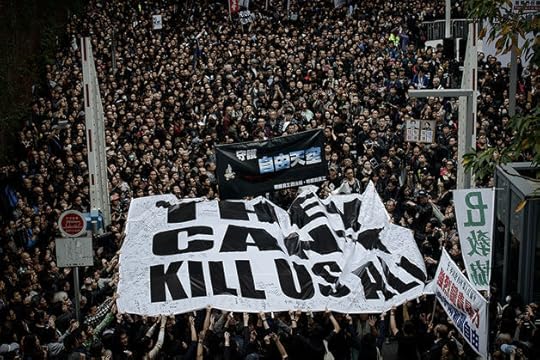
The September Umbrella Movement protests in Hong Kong were all about democracy. There’s an election for Chief Executive (=President of Hong Kong) coming up in 2017. Okay, an election, that’s good, right? Well, not if a government-appointed committee hand-picks the candidates who are allowed to run in the election. You might think that in Hong Kong, democracy is a façade. Wool is being pulled. Can’t trust them Commies. Never could. They’re only going to have elections when the result’s already known.
But one moment.
In America, the jest goes, every four years the people are given a free choice between two millionaires. Maybe you don’t have to personally be a millionaire (like Obama wasn’t, I think) but you have to be able to make friends with millionaires, because you can’t run for Prez unless you have a ton of money, and this cuts out 99% of all known Americans.
So, in Hong Kong you can’t run for prez unless you’re endorsed by the Chinese Communist party, and in America you can’t run for prez unless you’re endorsed by a bunch of very rich people.
Hmmm. So that’s the candidates, what about the policies? Absurdly, policies which the party you don’t like designs to be popular with the public will be attacked as “populist”, meaning that any policy designed to be popular must be insane or dangerous or just completely wrong. The message is : beware of any politician coming up with policies the people like. But seriously, policies send all but hard-core geeks to sleep, so they're left to some inner coterie inside the self-selecting parties to cobble together. And so in the democratic west we get our candidates and our policies from a narrow elite. This is democracy.
Unsurprisingly, our British political elite is scorned, disliked and often out and out hated. We’re used to Americans having paranoid thoughts about Washington, but Britain is developing a similar loathing for Westminster. In 1948 the two main parties were voted for by over 95% of electors. Next year the same two parties will be lucky to get 60%.
What is democracy? Churchill said it was the worst form of government, “except for all those other forms that have been tried from time to time." Is democracy where the public dispiritedly allows a self-selecting elite to gather all power into its own hands, which paternalistically claims to be working feverishly for the greater good whilst blatantly feathering their own nests? Is democracy where successive profound disappointments engender a terminal sleepwalking weariness in the people, coating our spiritual landscape in a defensive kneejerk cynicism which turns into conspiracy-theorism at the edges, edges which every day eat further into the soft white centre of politics?
“I’m telling you, it was a big bird, with great big wings, like this”
A SERIES OF BLINDINGLY OBVIOUS OBSERVATIONS ENLIVENED VERY OCCASIONALLY BY THE UNEXPECTED
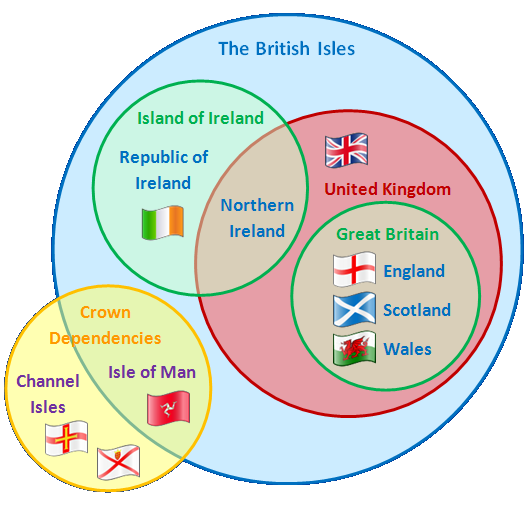
This is the UK :
It's easy, really.
This book is about the UK.
Among the many things I learned from this book that astonished me were that people tell political pollsters anything that comes into their pretty heads, that they hold contradictory opinions at the same time, that they’re just plain fickle, that they are surprisingly loyal, that they lie about whether they vote at all or who for, that you can’t trust them as far as you could collectively throw them, and that you could fill Wembley stadium three times over with the crazy shit they believe. Well, who would have thought it? There was I thinking that the British public like nothing better than poring over page 37 of the Conservative Party’s manifesto for the election to the European parliament, and earnestly debating fishing quotas with their partners. I was so wrong.
Everyone knows that Americans tend to think that Paris is situated slightly to the west of New York and that the rest of Europe is about where China really is, but British people think that around 20% of government spending goes on foreign aid (it’s really around 1%), that 30% of the population are immigrants (it’s 13%), and that a quarter of all benefits are fraudulently claimed (it’s really 0.7%). But this book makes a startlingly zen-like observation – the British public is both wrong and right about politics, both stupid and wise. Individually, we’re trivial idiots; collectively, we’re almost never wrong.
Amongst the things I actually did learn here was that all this chat about the internet recalibrating democracy is just chat, in terms of voting it has changed nothing; and that there’s a built-in bias against the Conservatives in the way British constituencies are organized. This one was odd – it takes a lot more votes to elect each Conservative MP. This is because people are moving from the urban areas to the leafy suburbs, i.e. from Labour territory to Conservative territory, all the time in their upward striving. As Conservative governments improve the people’s life chances they at the same time make it harder for themselves to get re-elected. I liked that!
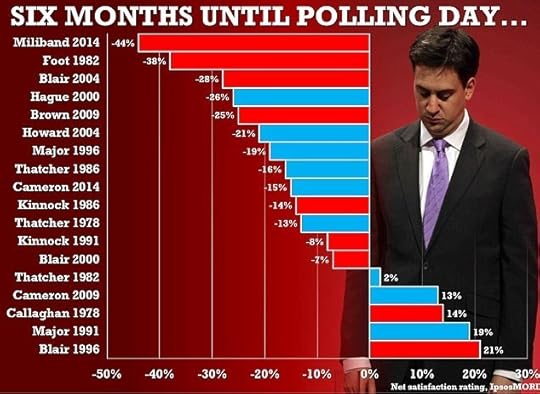
(Poor old Ed Miliband! The all time most unpopular Labour leader ever. The good news is that his party is much more popular than he is. David Cameron has the opposite problem. Now, if we could only persuade Mr Cameron to defect to Labour.... )
However, this is also true:
At the last election in 2010 nearly 45% of the poorest fifth of the population did not vote, compared to only 20% of the richest fifth.
Not good!
THE ETHNIC VOTE
I will end with something not in the book. There’s a chapter on ethnic minority voting. In Britain, as in the USA, ethnic votes go solidly to the non-Conservative party, i.e. Labour. In USA, it’s the Democrats. I remember the BBC interviewing this Hispanic guy in Miami during Obama’s first election. “You, know,” he said, “Hispanic people are natural Republicans. The Republicans believe in small business, and we are all small businessmen; they believe in family values, and we are very strong on family values. They don’t want any gun control, and we don’t want any gun control. They hate abortion, and we hate abortion. But we all vote Democrat.” “Why is that?” asked the BBC man. “Well, you see, the Republicans don’t think we should be here in the first place.”
The idea is a good one - to get 50 sets of political scientist and 'expert' to produce short four-page summaries of their research as a reference point for those interested in how democracy works.
However, we are probably told more about contemporary late capitalist democracy by the fact that a trite 51st contribution has been added on sex and politics to help with the title and the sales.
In fact, the whole is not going to be particularly enlightening except for political nerds and perhaps for professional manipulators without the time or energy to go and search out the relevant papers.
It confirms, of course, that British democracy is a pretty ramshackle business in which a huge class of parasites seeks to manipulate their favoured ones into power but we knew that anyway.
The contributions strike this reader as academically sound if uninspiring. Once or twice we find normative positions creeping in, as they do, by the academic back door - mostly liberal-left.
What more is there to say. We are expected to accept this political system as the 'least worst' option on offer. Clearly large numbers of people can get just as excited about it as trainspotters can about their hobby.
Personally, I don't think this is good enough. The total system, at the end of the day, is a huge circus designed merely to give gloss and guide to a bureaucratic State that still holds all the reserve power.
In that context, there are few insights in the book that really matter although the discussion on reducing the voting age to 16 made me think again about the complexities and fairness to the kids.
Similarly, the 'bourgeois' nature of ethnic candidates in British Elections should (but won't) raise questions about class and the con-trick perpetrated on the masses by left-wing identity politics.
Yes, the book is informative but in a confirmatory way to anyone with eyes to see and ears to hear the political process as we see and hear it every day. Maybe that, in itself, is useful.
I wil be giving my copy to a political activist friend of mine and leaving it to him to do the dirty work from now on. Activists will, I am sure, find useful nuggets in the book.
Meanwhile, the format could be used to good effect in covering more substantive issues - class, gender, ethnicity, media conduct, the nature of the State and then latest research in 'real' science.
I will not lie awake at night expecting a publisher to deliver what is really needed - political education on substantive issues related to actual policy rather than the fluff involved in fooling large numbers of people into participating in a spectacle that does very little for them.
There’s a saying in market research – if something’s interesting, it’s wrong. Sex, Lies And The Ballot Box, a collection of short essays on polling and electoral science published in the run-up to the 2015 UK election, goes some way to prove it. It’s impeccably sourced, written by experts, and packed with relevant data. In other words, it’s hardly ever wrong. But a lot of the time it’s not quite as interesting as it wants to be, either.
The book’s main value is in deflating received wisdom and myths. No, party members aren’t more extreme than ‘ordinary voters’. No, the Iraq War didn’t create a “crisis of faith” in the politics of a generation. No, well-funded parties can’t buy elections (in Britain at least). And no, Twitter activism and memes don’t move the electoral needle.
Instead, it underlines how little what matters in politics changes – even if the fortunes of parties swing wildly. Human contact, in the form of constituency work, matters. A likeable leader matters. The economy – or at least people’s personal sense of optimism – matters.
There are few really startling findings in Cowley and Ford’s book. If you’re the kind of person who likes to damp down an excitable friend’s wild assertions with a well-placed “Actually….” you’ll find plenty of ammo. But it’s full of conversation-stoppers, not –starters.
This is a book jam packed with short chapters explaining political research that has been undertaken ( mostly in the UK ) around why people vote the way they do.
I'm a bit of a political geek and quite enjoyed this book but found it quite a long haul owing to the short and choppy nature of the chapters, just I was getting involved in a particular element and chapter it would come to a halt.
This book was published in 2019 prior to the UK general election of that year and so much has changed in the political landscape of the UK and the world ( and of course the dreaded COVID) that some of this work will inevitably feel a little obsolete now but it is a considerable work of research and within it I found many interesting nuggets
This book serves as an excellent introduction to the academic literature surrounding British elections. There's been some good attempts to try to sex the material up - hence the title. There are a few stellar chapters, especially John Curtice (the BBC's election guru) on the methodology of exit polling. If you're already a politics geek, you'll find little here that'll surprise you (e.g. votes at 16 don't work) but it'd certainly serve as a great introduction to the field for someone considering studying Politics at undergraduate level.
Overall, it's just a bit too dry... This feels like an unfair criticism but it's taken me about three months of on-off reading to get through. I suppose that should not be hugely surprising when you consider they're a diverse group of academics. Some write well, some are even funny, but it is still a bit of a slog to read. I say this both as a former student of one of the editors of the book, and a political obsessive.
If you want to know more about British elections. Buy it. But prepare to work at it.
Between a three and four stars. Gone with four because I have no interest in politics. Any political book that can make me read it deserves four stars. The title is a bit tacky but it made me pick the book up. The book is divided into 51 short (4-5 pages) sections. Each section covers a slightly different topic eg how important is grass roots campaigning, who votes UKIP, etc. The shortness means that sometimes things are covered quite superficially but it also means each section can be read quickly and if the topic turns out to be boring you’ll be past it soon. One thing struck me. This book has a number of sections where it states voters use heuristics, basically shortcuts, to decide who to vote for. This is always described as voters being very rational and sensible. I’m not sure that many of the books about how humans make decisions would necessarily agree.
A fun light-hearted read into assumptions about politics. From the problems of polling, to the kinks of voters (yes that is right, though a bit dated), the book is one the easiest to read British politics books out there. This isn't the sort of book that you could quote in an essay mind you. It has further reading and graphs, making it easier to read on the subject. The sort of politics book that is easy bedtime reading.
This is exactly what popular writing by experts should look like, fun, informative and a great read. I read it on a long holiday and the bite-sized nature of the chapters made it easy to dip in and out during spare half hours on various forms of transport.
Really interesting and informative book of essays on British electoral politics. Written in 2014 it's dated somewhat given how much has changed over the last few years but still a worthwhile read!
This started out as an interesting book, and it's probably worth a read if you're into polling.
There are two problems with it though: 1. The chapters are too short. Very little of meaning is imparted in the 1000 word chapters, and the quantity of them therefore means there's lots of repetition. 2. It's a book by academics, for academics. Which means if you aren't academic, you're going to find what normal people usually find when reading academic work: an obsession with process over outcome.
I'll pick up on point 2 because it is what renders this book unhelpful to the majority of people. We are told, for example, that polling is very reliable because it only gets the total vote share off by a couple of % usually. So therefore we shouldn't mind that the results were disastrously wrong in 2015, 2016, and 2020. As usual with academic works, they completely fail to address the actual point - it doesn't matter that you were 98% technically correct, you got the answer wrong which is the only thing that matters!
This glaring issue is not even approached, which renders the analysis pointless in my view
Forget the main title; it’s the subtitle that describes what the book is about. Fifty one authors present brief analyses of different facets of UK elections and, if you don’t get glassy-eyed with their not-unreasonable usage of statistics to back up their arguments, the whole makes reasonably good reading. The book serves to illustrate how extraordinarily complex and multi-facetted the subject of elections and maintaining a working democracy is. We get a look at such subjects as turn-out, last minute shifts, myths of various sorts, quirks and anomalies of our voting system, as well as a view of public opinion and social attitudes around Britain according to social background, education, gender, religion, origin, age, financial circumstances, and so-on. Quite a lot of what is said seems common sense but there are a few surprises, and nothing is simple. The continuing rigid and almost absolute sectarianism in Northern Ireland may not be surprising but it is depressing (the observed gradual decline in turn-out is almost a relief). Inevitably the first-past-the post voting system comes under scrutiny, as does voters’ inherent individual unreliability, luckily amortised when accounted collectively. However, it’s all rather a lot to retain, and instead of wasting their time conjuring up a lurid and irrelevant title the editors could have attempted some form of summary.
A good pre-election read: 50 short chapters by political scientists of various kinds about aspects of British voting patterns, electoral politics and so on. Solidly evidence-based, there was only - to my mind - one duff chapter: the one about reducing voting age which seemed polemical rather than analytical.
like a good box of biscuits, this covered all bases. i enjoyed how you can enjoy a chapter as complete within itself, leaving you rather satisfied with the large amount of information it covers. but you can also benefit from a copious stream of information which builds nicely to form the book.
surprisingly good in places, although very uneven. Some of the political psychology pieces are downright disgusting. And then there is very little from the left. But still, an eye-opener