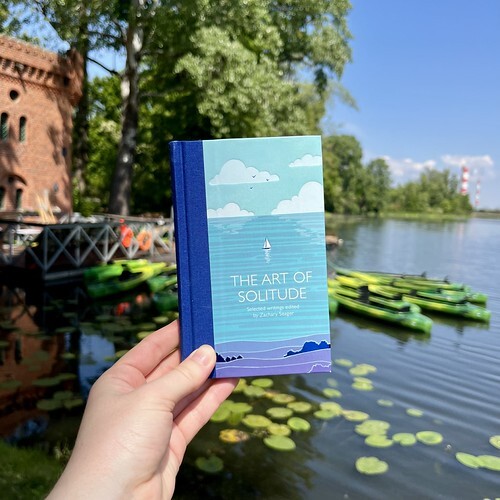
In a world where we’re more connected than ever, why is it that we’re also more lonely? Dip into this anthology of classic writing to reclaim the pleasure of your own company.
Part of the Macmillan Collector’s Library, a series of stunning, clothbound, pocket-sized classics with gold-foiled edges and ribbon markers. These beautiful books make perfect gifts or a treat for any book lover. This edition is edited and introduced by writer and academic, Zachary Seager.
The Art of Solitude shows some of the myriad ways in which people throughout history have understood their experiences of the solitary life, or have counselled others to benefit from solitude. It contains poetry, essays, autobiographical pieces and short stories from writers such as Virginia Woolf, Edgar Allen Poe, Emily Dickinson and Ralph Walso Emerson. These diverse works can teach us how to think in freedom, how to enjoy a profound inner life and how best to cope with the fact that, as the novelist Joseph Conrad put it, we live, as we dream―alone. Above all, they show how we might truly connect with ourselves and, in the process, how we can meaningfully connect with those around us, including the earth itself. Looked at in this way, solitude is always focused both outward and inward, towards the self and towards the world. The cure for loneliness is, in the end, the art of solitude.
I thought this was a lovely collection of solitude essays and poems, and I am happy to say it got me back into the rhythm of more philosophical pieces of writing. Very fun read, that gives you a lot to think about. If I had one observation, it would be that I was slightly disappointed with the choices for female figures’ excerpts. I thought Dickinson and Woolf were a very nice touch, but frankly, the texts of Stanton and Meynell were quite dry and not providing much insight into what solitude means. I believe for these excerpts the editor could have made better choices, but of course, that’s a personal preference. All in all, I recommend this collection if you are looking for more food for thought art pieces!
I found this book upsetting at first. Because the first few essays had this vibe where an older intellectual man with no dependents chooses to go into the woods to live alone and write philosophical texts about how elevating solitude is, as one can be free in peace and quiet, connect with nature, ruminate and reflect about the more complex questions of meaning, morals, etc.
And here am I, a mom of a toddler in a city, desperately lonely, so lonely I could howl, but there's neither peace nor quiet as he jumps on my head while wielding several loud musical toys at once. There's no freedom when you need to take care of others' needs, there's no connecting with nature when you need to make sure a little human doesn't jump into a waterfall, and there's definitely no elevated reflection happening when you sing "the wheels on the bus" for the fifth time in a row. So it rubbed me the wrong way; it felt like a bad joke, like mockery. Of course, you can be all high-minded and ascetic and romanticise solitude when you have no obligations. But that says more about your privileges than it does about the experience of solitude or loneliness itself.
But then there was an essay, also by a classic author, that addressed this romanticization of solitude, explaining how different personality types seek solitude for different reasons and how their motivations aren't really that noble. At the end, there was a passage by Virginia Woolf about women's experiences (I think it was an excerpt from A Room of One's Own), which was a balm to my hurt soul.
So even though we started off on the wrong foot, I eventually warmed up to this essay collection and found the reading experience rewarding. I also liked the style and tone of writing, as I rarely read philosophical essays, so it was a bit of a throwback to university years.
Phenomenal, diverse and small enough to fit into your pocket. Relatable despite the oceans of time and space that divide you and the author. Great way to get an introduction into classic writers and find the ones you resonate with, without being overwhelmed. Self-Reliance by Emerson is a must-read before you die.
I started my reading challenge with this book and ended it with it. There were a couple passages that interested me, especially the first one, but most of them were quite boring to me. It took me 6 months to finish this book.
A gem of a book. A selection of essays by writers, artists, philosophers, thinkers etc on the power of solitude. It's the kind of book that will always be on my bedside table and to which I will return again and again.
A really good, thought-provoking collection of musings on solitude and society. Self-Reliance by Ralph Waldo Emerson and The Solitude of Self by Elizabeth Cady Stanton stood out in particular.
Sentiments may be timeless, but syntax is not, and the majority of the entries in this collection are so dated as to be largely irrelevant/unhelpful to the contemporary reader. Yes, I know that many of them are "classics" - but I came to this collection looking for concise insights that were expressed in clear prose, not turgid rodomontades from an era where proper Nouns were capitalized. The fault here lays solely with the editor who chose the pieces - reflections on solitude need not all be from the 21st Century, but it would have been a lot easier to wade through this book if fewer of them had been from the 17th and 18th (also, some of the pieces are really only tenuously connected to "solitude" at best, and could be more accurately described as reflections on how to be a person, not on how to be alone).
(Written on the 29th of July 2022 on my Insta) Finished this lovely little book yesterday. It's an incredibly interesting read, you can see the look on solitude by different authors and you will likely find one and think 'I see it that way too'. It's a book I'd definitely recommend to anyone due to the wide range of writing styles. So yeah, if anyone has wandered about this one and you chance upon my post, you have one more person saying to read it ^^.
Reading this book was not as fluid as I expected. I managed to connect with several essays, but it was also difficult for me to connect 100% with other essays. However, at the end of each one, solitude is once again a powerful individual desire to be with oneself, and in the end, those who enjoy it turn out to be privileged.
This is a mixed bag; it's got Ralph Waldo Emerson ranting and Thoreau poncing about, but it also has Virginia Woolf and Edgar Allan Poe so it all evens out, I guess.