Jump to ratings and reviews
Rate this book
Rate this book
Maurice de l’Hostal, entrato molto giovane al servizio di un alto funzionario di Stato come segretario particolare, il conte Octave, viene da questi coinvolto nel tentativo di riconquista della moglie Honorine che, resasi colpevole di adulterio, se n’è andata di casa e vive da anni in solitudine, mantenendosi fabbricando fiori artificiali. Il giovane Maurice affitta una casa adiacente a quella di Honorine e fa di tutto per convincerla a tornare dal marito. Inconsciamente innamorato della donna però, per restare fedele alla parola data al conte, abbandona la Francia iniziando la carriera diplomatica.

244 pages, Kindle Edition

First published January 1, 1843

11 people are currently reading
312 people want to read

About the author

Honoré de Balzac

9,590 books4,404 followers
French writer Honoré de Balzac (born Honoré Balzac), a founder of the realist school of fiction, portrayed the panorama of society in a body of works, known collectively as La comédie humaine .

Honoré de Balzac authored 19th-century novels and plays. After the fall of Napoléon in 1815, his magnum opus, a sequence of almost a hundred novels and plays, entitled, presents life in the years.

Due to keen observation of fine detail and unfiltered representation, European literature regards Balzac. He features renowned multifaceted, even complex, morally ambiguous, full lesser characters. Character well imbues inanimate objects; the city of Paris, a backdrop, takes on many qualities. He influenced many famous authors, including the novelists Marcel Proust, Émile Zola, Charles John Huffam Dickens, Gustave Flaubert, Henry James, and Jack Kerouac as well as important philosophers, such as Friedrich Engels. Many works of Balzac, made into films, continue to inspire.

An enthusiastic reader and independent thinker as a child, Balzac adapted with trouble to the teaching style of his grammar. His willful nature caused trouble throughout his life and frustrated his ambitions to succeed in the world of business. Balzac finished, and people then apprenticed him as a legal clerk, but after wearying of banal routine, he turned his back on law. He attempted a publisher, printer, businessman, critic, and politician before and during his career. He failed in these efforts From his own experience, he reflects life difficulties and includes scenes.

Possibly due to his intense schedule and from health problems, Balzac suffered throughout his life. Financial and personal drama often strained his relationship with his family, and he lost more than one friend over critical reviews. In 1850, he married Ewelina Hańska, his longtime paramour; five months later, he passed away.

Ratings & Reviews

What do you think?
Rate this book

Friends & Following

Create a free account to discover what your friends think of this book!

Community Reviews

5 stars
43 (17%)
4 stars
93 (38%)
3 stars
80 (33%)
2 stars
22 (9%)
1 star
2 (<1%)
Displaying 1 - 26 of 26 reviews
Profile Image for Myriam V.
112 reviews74 followers
November 4, 2022
Hace unos años me divertía leyendo los mismos libros que los personajes de mis lecturas. Llegué a Solo de Strindberg a través de Cărtărescu y he aquí un protagonista que pasa diez años leyendo La Comedia Humana de Balzac, fue demasiado para mí y claudiqué. Pero un Balzac cada tanto no hace mal, incluso se siente bien. Voy leyendo cinco, me faltan menos de noventa. Mi preferido es Ilusiones perdidas y el que menos me gustó es, justamente, Honorina.
Honorina ha caído en desgracia por ser infiel al conde Octavio. Honorina no es un personaje que uno pueda querer o detestar pero me resultaron densos sus discursos. Escuchémosla:
“Una soltera, cuando cae, es una flor que han arrancado de su tallo; pero una casada es una flor que han hollado con los pies. Usted es floricultor, y bien sabe que no es posible enderezar un tallo, reanimar el color marchito, volver a hacer circular la savia por los delicados tubos de una flor. Todo el poder o fuerza negativa de ella depende de su perfecta rectitud. Si algún botánico supiese dar vida a una flor marchita, sería igual a Dios. Sólo Dios puede rejuvenecer moralmente. Bebo la amarga copa de la expiación, pero expiar no es borrar”.

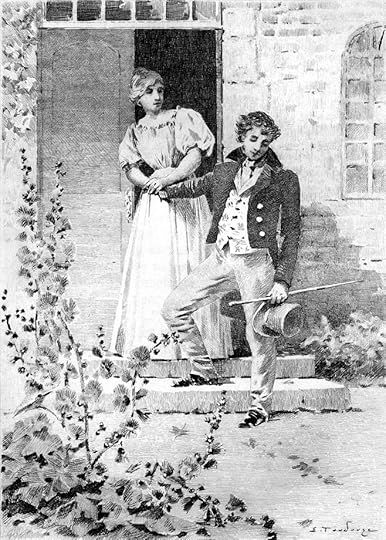
El melodrama de Honorina y el conde lo relata Mauricio, que ha sido confidente de ambos. Al final este narrador se transforma en un personaje que brilla por su mesura, o lo que parece mesura por contraste con los otros, porque tiene sus excentricidades también, cuenta: “La mujer aniquilada, casi muerta, y pecadora, me parecía sublime”, cuestión de gustos. Y se dice de él que era el vivo retrato de Lord Byron, no tenía condiciones para pasar desapercibido, no tenía condiciones para no despertar pasiones.
Es una obra amena que incluye discusiones sobre la concepción jurídica, moral y religiosa del adulterio y sobre el lugar de la mujer, pero en forma sucinta ya que es una novela breve. Integra, dentro de La Comedia humana, el grupo de novelas titulado “Escenas de la vida privada”. La disfruté aunque me resultó difícil no leerla con mi mirada del presente.
Profile Image for Elizabeth (Alaska).
1,585 reviews556 followers
August 26, 2019
A small group of adults is sitting around chatting when the question arises: If a woman is unfaithful, is it the man's or the woman's fault? One of the men then tells the story of Honorine, how he came to know her and her story.

It never ceases to amaze me how authors have insight into the human condition, one which they themselves have not experienced. When Balzac penned this story, he had not yet been married. His biography attributes at least two affairs with women already married. Can an outsider understand marriage? Two quotes from Honorine: "A young bride is like a plucked flower; but a guilty wife is like a flower that had been walked over." and "Marriage is based on esteem, on sacrifices on both sides; ..."

Balzac chose to have one of his characters tell this story, at best of novella length. I think it would have been better had he spent more time with it and let it develop as a novel. But Balzac was always short of money and perhaps he just needed to get this written and out the door so he could pay some bills. Still, it has reminded me of why I like reading him and that I need/want to look at some more titles and work them into reading him again. If this crosses the 3-/4-star line, it just barely does so, but that might be because I have read others by him that surpass it.

Profile Image for Bettie.
9,976 reviews5 followers
May 22, 2015
Important part of Pereira Maintains


HUZZAH! - Gutenberg has it in English!

If the French have as great an aversion for travelling as the English
have a propensity for it, both English and French have perhaps
sufficient reasons.


bleurgh - this doesn't compute in anyway to a modern audience. We have (hopefully) gone past caring about nationalistic diatribes.
This entire review has been hidden because of spoilers.
Profile Image for Classic reverie.
1,865 reviews
June 29, 2021
First and foremost, I love this cover art on this paperback edition and it is so pleasing to see a review with a beautiful front, but I read a Delphi collection of Balzac's works which the below synopsis is from.

"This 1843 novella concerns the common tale of a wife trapped in a loveless marriage, which is approached in an original manner. The narrative introduces Maurice, a Consul living in the Mediterranean town of Genes, who has married Onorina the daughter of the only wealthy man in town. When they are having a dinner party with guests from Paris, Maurice begins to recount some of his history, revealing surprising secrets."


It took me a little while to get really interested in Balzac's Honorine but when a certain point came I had to finish though I was a bit tired. I came away feeling melancholy because a happy ending was not in store for this married couple. I blame both for the situation which caused this extremely sad ending. If they both could have viewed life differently, not expecting so much from each other but an understanding that life is not perfect even in marriage. I take it back I blame her a bit more. Can someone make themselves feel something that is not there? No, but a different kind of feeling can be instead of the storybook romance which can bring respect and love when the couple is kind to each other.

As I read this I kept thinking of Balzac's A Daughter of Eve because circumstances with young innocent wives and older husbands but one has a happy ending and another sad.


Story in short- Maurice tries to help bring happiness to his friend Octave by befriending his estranged wife.


💢💢💢💢💢💢💢💢💢💢💢💢💢💢💢💢💢💢💢💢💢💢💢💢💢💢💢💢💢💢💢💢💢💢💢💢💢💢💢💢💢💢💢💢💢💢💢💢💢💢💢💢💢💢💢💢💢💢💢💢💢💢💢💢💢💢💢💢💢💢💢💢💢💢💢💢💢💢💢💢💢💢💢💢💢💢💢💢💢💢💢💢💢💢💢💢💢💢 SPOILER ALERT💢💢💢💢💢💢💢💢💢💢💢💢💢💢💢💢💢💢💢💢💢💢💢💢💢💢💢💢💢💢💢💢💢💢💢💢💢💢💢💢💢💢💢💢💢💢💢💢💢💢💢💢💢💢💢💢💢💢💢💢💢💢💢💢💢💢💢💢💢💢💢💢💢💢💢💢💢💢💢💢💢💢💢💢

Honorine thinks that she kindly fooled her husband that she loved him but it seemed he sensed it, especially after her illness. Her heart expected too much especially after her lover abandoned her, the count was very understanding and kind. It seemed like Honorine might have loved Maurice but though he started feeling love, his friend's happiness is all.

I wonder if her being happy with her husband would have happened if she did not meet Maurice?

When looking for the passages on Lord Byron's Manfred, I re read a fair amount of the start which becomes clearer after one reads the story. Maurice was in love with Honorine which kept him from marrying but he did not think she was in love with him, perhaps he wished it. Maurice decides to marry after he hears of returning home to her husband and a child being born. Maurice has married a beautiful rich woman but his heart thinks of Honorie but I am sure he loves his wife.

"BAUVAN (Comte Octave de), statesman and French magistrate. Born in 1787. When twenty-six he married Honorine, a beautiful young heiress who had been reared carefully at the home of his parents, M. and Mme. de Bauvan, whose ward she was. Two or three years afterwards she left the conjugal roof, to the infinite despair of the comte, who gave himself over entirely to winning her back again. At the end of several years he succeeded in getting her to return to him through pity, but she died soon after this reconciliation, leaving one son born of their reunion. The Comte de Bauvan, completely broken, set out for Italy about 1836. He had two residences at Paris, one on rue Payenne, an heirloom, the other on Faubourg Saint-Honore, which was the scene of the domestic reunion. Honorine. In 1830, the Comte de Bauvan, then president of the Court of Cassation, with MM. de Granville and de Serizy, tried to save Lucien de Rubempre from a criminal judgment, and, after the suicide of that unhappy man, he followed his remains to the grave. Scenes from a Courtesan’s life. "

"BAUVAN (Comtesse Honorine de), wife of the preceding. Born in 1794. Married at nineteen to the Comte Octave de Bauvan. After having abandoned her husband, she was in turn, while expecting a child, abandoned by her lover, some eighteen months later. She then lived a very retired life in the rue Saint-Maur, yet all the time being under the secret surveillance of the Comte de Bauvan who paid exorbitant prices for the artificial flowers which she made. She thus derived from him a rather large part of the sustenance which she believed she owed only to her own efforts. She died, reunited to her husband, shortly after the Revolution of July, 1830. Honorine de Bauvan lost her child born out of wedlock, and she always mourned it. During her years of toilsome exile in the Parisian faubourg, she came in contact successively with Marie Gobain, Jean-Jules Popinot, Felix Gaudissart, Maurice de l’Hostal and Abbe Loraux.Honorine"

"HOSTAL (Maurice de l’), born in 1802; living physical portrait of Byron; nephew and like an adopted son of Abbe Loraux. He became, at Marais, in rue Payenne, the secretary and afterwards the confidant of Octave de Bauvan. Was acquainted with Honorine de Bauvan on rue Saint-Maur-Popincourt and all but fell in love with her. Turned diplomat, left France, married the Italian, Onorina Pedrotti, and became head of a family. While consul to Genoa, about 1836, he again met Octave de Bauvan, then a widower and near his end, who entrusted his son to him. M. de l’Hostal once entertained Claude Vignon, Leon de Lora and Felicite des Touches, to whom he related the marital troubles of the Bauvans. Honorine. "


I find this story extremely sad, why she married because she thought so but it seemed like the real thought of love was not something she thought about but that it was a duty. There is no happiness here because they both know that the love is not there and the husband is fooled for awhile but with her illness he figures it out. Maurice is the counsel telling his story from his youth. Desplain is the doctor of choice throughout. Maurice is young and has lost his parents but has an uncle who is part of the church and lives with him, studying and being guided by him. His uncle finds a good position of a secretary to Count Octave. He is unable to find out the mystery of this sad but not unhappy man, until his uncle and some other hard working gentlemen come for dinner and the subject of women is discussed. At that time the secret of his sadness is told, that his wife had left him. Count Serizy is there and his marriage is still rocky at that point. He was the main character in A Start in Life. Octave finally tells Maurice his troubles of his marriage to a young girl that his mother helped rear. She was too young and he gave her too much freedom but instead of A Daughter of Eve's outcome where the husband helps his wife she her love being placed unworthy, Honorine finds love and leaves her husband but the lover does not like poverty and leaves her and the baby which dies 7 months later. Maurice is telling this story years later to friends in Italy where he is a consol and has married a wealthy girl, he has her leave the room and she obeys him but after the story is told we find out she heard some of it.
The Count has been helping his abandoned wife and gives her the best of everything without her knowing his helping her. The baby dies and finds out that her husband has sent her a letter which she refuses and she moves so he will not know but he does because he has the servants as his helpers. She makes flowers which she thinks she earns her money but he helps her unknown. He has told all that his wife's ship must have wrecked so to make her look better. He loves her and wants her back at any terms but she refuses to listen so he devises Maurice to try to gain her confidence by being a neighbor that likes flowers and is touched. He also tells of a marriage to a beautiful girl so he is not tempted by his wife's beauty. Maurice becomes her friend and tried to see why she will not return to her husband and finds out she feels beneath him after her actions and that she has lived the lover though he abandoned her and she does not love her husband like that. She likes her peace but a letter is sent to her from her husband after she is told about him giving her all but she does not want to leave her solitude though after reading this letter he knows he has a chance. She does not know Maurice was his secretary but after hearing about her story he can not marry the girl promised because he feels that Honorine will find he was an accomplice. He is to go to abroad for an appointment and later he marries. He hears from Honorine after she has returned back to her husband which was not right away probably she was not ready or maybe she loved Maurice. It is apparent that the friendship they developed she sensed there was love and she wanted him to know that she was unhappy though she had a baby. She felt that she was doing all for her husband and do so willingly but lost herself and her sadness inside. She wants him to be the guardian of the baby because he cares for her and it was not clear to him but she loved Maurice. Octave saw that he was happier before because his wife is sad and he sees this. He not knowing about his wife wanting Maurice to be guardian too. He takes an appointment and will not live long either..Maurice even if he knew she loved him would not claim her but it might give him joy and his feelings for his wife may or may not be the same he feels for Honorine. She would not have gone with Maurice but they might have been friends which is the reason though he did not know she loved him, he knew it would not be good for the marriage.
Profile Image for Hannah.
307 reviews7 followers
July 23, 2016
A difficult one from a modern perspective as it's dealing with a couple who would just be divorced today. Nevertheless, I think it makes an interesting point about the position of women in the period. Honorine longs to live independently and earn her own money but she is hopelessly naive, encouraged by her husband who secretly finances her because he can't let her go. The situation for both of them is pretty hopeless. The story is told delicately.
1,167 reviews35 followers
January 3, 2021
Can anybody really have even been as naive as Honorine? Or as stupid as Octave? Doubtful, but this is Balzac. I felt sorry for the narrator's wife.
Profile Image for Armin.
1,211 reviews35 followers
June 12, 2020
Wenn das Pflichtbewusstsein einen das Lebensglück kostet und die Frau des Lebens in einen von Ärzten inszenierten Freitod treibt, darum geht es in dieser paradoxen Erzählung. Bis zur Pointe habe ich vor allem Balzacs herrlichen Erzählstil bewundert, während mich die Geschichte um einen jungen Aufsteiger und einen düsteren Ehrenmann, der nicht von der Frau lassen kann, die ihn verlassen hat und nie mehr sehen will, eher mäßig interessiert hat. Zahlreiche personelle Querverbindungen zu anderen unglücklich verheirateten Ehrenmännern, deren Doppelleben in A second Home, Glanz und Elend (Grandville) oder Abhängigkeit von der Dauertreulosen in A Start in Life (Sérizy) thematisiert wurden, schufen zunächst größeren Anreiz zum Weiterlesen.
Aber was für eine (tragische) Pointe.
Profile Image for Jacinthe.
4 reviews
April 12, 2025
Ce Balzac est très intéressant car il explore le thème du mariage et de la féminité d'une façon assez moderne (pour l'époque attention) : un mari éperdument amoureux se fait quitter par sa femme Honorine. Pour lui éviter toute honte et tout problème juridique il décide de la cacher et de l'entretenir sans qu'elle le sache. Elle vit donc plusieurs années indépendante et découvre les joies du célibat XD Ce livre de Balzac est assez étonnant et différent des autres, il vaut le coup
Profile Image for Jaime Fernández Garrido.
423 reviews21 followers
September 22, 2024
La vigésima escena de "La comedia humana" nos trae de vuelta a algunos de los personajes de Beatriz, aunque en este caso son simples visitantes en una mansión en la que les van a contar la historia de un hombre casado con una jovencita que le abandona por otro que le desata toda la pasión que su primer marido no le provocaba.

Si en el final de la anterior escena el protagonista reniega de París, esta arranca con una declaración de amor, aunque es cierto que no sólo a la capital, sino a todo el país. Para Balzac es normal que los ingleses quieran viajar a toda costa porque "en cualquier sitio pueden encontrarse cosas mejores que en Inglaterra", mientras que considera normal que los franceses sientan repugnancia por los viajes, porque Francia lo tiene todo: "la vida intelectual, la actividad de pensamiento, el talento de la conversación y el aticismo (que es algo así como la delicadeza y elegancia de escritores y oradores)".

En ese marco de pasión desatada por Francia, "Honorina" se presenta como una obra donde el amor está por encima de todo, incluso del rechazo de la persona amada, a la que se protege sin que se llegue a enterar, de la manera más solidaria posible.

A pesar de la obvia calidad de Balzac esta es una de las escenas más pesadas de leer, porque no incluye sus chispeantes diálogos ni apenas ese intercambio de cartas que siempre funciona tan bien. Es un bloque de texto prácticamente sin puntos aparte y que al final tampoco nos conduce mucho más allá del conde enamorado y de la mujer que no le quiere ni por asomo.
Profile Image for Lisa.
3,809 reviews491 followers
September 5, 2014
In the course of this book, Balzac mentions Michelangelo's Day and Night: I looked it up to see what he was on about (http://1.bp.blogspot.com/-sfB9h840-2M...) and, well, yes, it is peculiar.
And here's the Hotel Carnavalet which I recognised from Balzac's description as the Museum Carnavalet in Paris: http://en.wikipedia.org/wiki/Carnaval...

As to the story, this is one of those stubborn-adherence-to-a-strange-concept-of-nobility efforts. The Comte's wife was married too young, foolishly fell in love with a cad but - back in Paris and living in comfortable seclusion by her husband though she doesn't know he pays for it all - she still loves the bounder and can't/won't contemplate reconciliation even though the husband goes through any number of hoops to achieve it.

Still, it's cleverly done.
1,378 reviews56 followers
November 4, 2025
Le narrateur est consul à Gênes, et, lors d’une soirée en compagnie de Camille Maupin (que l’on retrouve ici), il raconte l’aventure suivante : jeune homme, il fut placé chez le comte Octave (on ne saura jamais son nom). Ce comte Octave a vu sa femme s’enfuir avec son amant, avoir un enfant de lui qui décèdera quelques mois plus tard. Mais le comte Octave est toujours amoureux et épie Honorine (telle est son prénom) dans sa nouvelle vie. On dirait aujourd’hui qu’il la sponsorise : il achète ses création de fleuriste au-delà du prix, paye ses gens et son logement. Sans qu’Honorine ne s’en doute.

Le narrateur va intervenir auprès de la dame pour plaider la cause de son patron. Celle-ci fera son devoir d’épouse mais restera à pleurer son premier enfant.

J’ai eu de la peine pour cette jeune femme en pleine dépression (dirions-nous de nos jours) et qui n’aime plus celui qui l’aime encore éperdument.

J’ai souri chaque fois qu’il était question de la chambre bleue et blanche d’Honorine.

Une nouvelle pleine de fleurs, également. Les fleurs qu’elle ne peut déposer sur la tombe de son bébé pour l’honorer ?

Une citation : Le Monde qui dément la loi et dans ses fêtes, et ses usages, et ses plaisirs, est plus sévère que le Code et l’Eglise. (p.419)

https://www.alexmotamots.fr/la-comedi...
Profile Image for Giovi.
41 reviews1 follower
September 15, 2025
Posso solo dire che mi emoziona la figura femminile che decide con coraggio di essere libera di vivere con verità i suoi sentimenti...nell'ottocento, poi! Un po' come Anna Karenina. Peccato che tristemente soccombano.
Profile Image for Sonia MM.
296 reviews4 followers
July 15, 2020
Historia de un adulterio con final tortuoso contado por un tercer personaje.
Profile Image for myriam kisfaludi.
342 reviews1 follower
December 5, 2023
Toujours aussi bien écrit. L'argument est étonnant et donne une toute autre direction aux relations de couple.
Profile Image for Luthien Mucciante.
7 reviews
November 11, 2024
"Non mi piangete: è così tanto che sono morta, se san Bernardo ha avuto ragione a dire che non c'è più vita dove non c'è più amore"
Profile Image for Laura.
7,137 reviews608 followers
August 13, 2016
The original French text is available at La Bibliothèque électronique du Québec.

Free download available at Project Gutenberg.


Opening lines:
Si les Français ont autant de répugnance que les Anglais ont de propension pour les voyages, peut-être les Français et les Anglais ont-ils raison de part et d'autre.


Scènes de la vie privée :
3* La maison du Chat-qui-pelote (1830)
3* Le bal de Sceaux (1830)
3* La Bourse (1830)
4* La Vendetta (1830)
3* Madame Firmiani (1832)
3* Une Double Famille (1830)
4* La paix du ménage (1830)
3* La Fausse Maîtresse (1842)
3* Étude de femme (1830)
4* Albert Savarus (1842)
4* Mémoires de Deux Jeunes Mariées (1841)
3* Le Colonel Chabert (1844, first published as La transaction, 1832)
4* Une fille d'Eve (1839)
3* La Femme Abandonee (1833)
4* La Grenadière (1832)
3* Le Message (1833)
3* Gobeseck (1830)
3* Autre Etude de Femme (1839-1842)
4* La Femme de Trente Ans (1834)
4* Le Contrat de Marriage (1835)
3* La Messe de L'Athee (1832)
4* La Grande Bretèche (1832)
2* Honorine (1843)

Profile Image for Mike.
1,441 reviews58 followers
April 16, 2015
Perhaps the greatest Wing Man tale ever written. The story-within-a-story-within-a-story offers a complex way of understanding audience, as we see Honorie through the eyes of a not-so-objective voice who must play so many roles to obtain the "truth" that he ultimately suppresses the own truth in his heart. It's not a top-tier Balzac, but it does make for an enjoyable enough read.
Profile Image for Steve Gordon.
374 reviews13 followers
Read
July 29, 2011
A shaky start, as a lot of his stories tend to start, but once ol' Honore hits his stride, the language is as beautiful as ever.
Profile Image for Yamilet Motte.
47 reviews1 follower
April 19, 2013
Aunque puede parecer anticuado, me gustó leer lo que Balzac planteó respecto a la libertad de la mujer en un mundo patriarcal, la presión social y el arrepentimiento.
Profile Image for Eve.
27 reviews
March 14, 2015
Clever and beautifully written! Well done Mr. Balzac!
Profile Image for Song.
287 reviews527 followers
December 10, 2017
爱情没有理由也不讲究因果。局中人痴迷,局外人因为帮忙而入局,也就成了局中人。
Displaying 1 - 26 of 26 reviews

Can't find what you're looking for?

Get help and learn more about the design.