

What do you think?

The Heartsick Diaspora and other stories
Acutely observed, wry and playful, her debut collection celebrates people who are torn between cultures and juggling a fragmented sense of self.
Five writers form a writing support group but the dynamics shift when a young, handsome Asian writer joins them; three Singaporean daughters welcome their mother on her first visit to London and quarrel over steamboat; a Chinese woman raps about being a Tiger Mother; an elderly Chinese woman recognizes that it isn’t the race that estranges, but the inability to tell the truth; an ethnic writer takes on Eastern mythology in a metaphoric quest to understand the anxiety of Western literary influence. Filled with humourous and heartening short stories, this anthology is a time capsule of how identities evolve and change with the times and places.
Five writers form a writing support group but the dynamics shift when a young, handsome Asian writer joins them; three Singaporean daughters welcome their mother on her first visit to London and quarrel over steamboat; a Chinese woman raps about being a Tiger Mother; an elderly Chinese woman recognizes that it isn’t the race that estranges, but the inability to tell the truth; an ethnic writer takes on Eastern mythology in a metaphoric quest to understand the anxiety of Western literary influence. Filled with humourous and heartening short stories, this anthology is a time capsule of how identities evolve and change with the times and places.
240 pages, Paperback
First published October 1, 2019
Ratings & Reviews
Friends & Following
Create a free account to discover what your friends think of this book!
Community Reviews
Displaying 1 - 30 of 39 reviews

May 7, 2020
'The Heartsick Diaspora' by Elaine Chiew is a collection of fourteen short stories. They were written in a ten year span, and each of them is beautifully sculpted, and most of them cover unique themes. The stories explore the lives of Singaporeans, many of whom belong to the Singaporean diaspora and have migrated across the world. The stories are mostly set in Singapore, London and New York. There are all kinds of Singaporean characters featured in the book – some of them are glamorous and play it cool and others are maids and construction workers. There are stories which focus on Singaporean history and they are fascinating to read. There is one ghost story too, which was one of my favourites (at one point the ghost says "Feed me, or you die", to which the narrator replies "That not even scary. What kind of ghost are you?" I couldn't stop laughing when I read that 😁) and there is another story which is a modern take on mythology which was quite fascinating. Some of the stories are about food – there is a beautiful description of tomato and how it is cooked, which was one of my favourite passages from the book. Elaine Chiew has edited a book on food fiction and her stories with a food theme are some of the most beautiful in the book.
The stories in the book touch on many aspects of Singaporean culture – the relationship between parents and children, the importance of being filial and the lengths to which people will go to do that, love (there is a beautiful story set during the Japanese occupation in which two people bond over food), migration and its complexities, friendships between women which cross ethnic lines and the beauty and complexity of such friendships, Tiger moms, how immigrant women worked hard in construction in the '60s to help build the country, the beauty of Singaporean art – these and other themes are explored beautifully in the book. There is even one story, which is a kind of meta fiction, because it takes some of the other stories under its wing. I loved all the stories in the book. Each one was beautiful in its own way.
I loved 'The Heartsick Diaspora'. Elaine Chiew's prose is beautiful and is a pleasure to read. I highlighted many beautiful passages in the book. I think this is the first book by a Singaporean author that I have read, and I think I can say that this introduction to Singaporean literature has been spectacular. I can't wait to read Elaine Chiew's next book.
Have you read 'The Heartsick Diaspora'? What do you think about it?
The stories in the book touch on many aspects of Singaporean culture – the relationship between parents and children, the importance of being filial and the lengths to which people will go to do that, love (there is a beautiful story set during the Japanese occupation in which two people bond over food), migration and its complexities, friendships between women which cross ethnic lines and the beauty and complexity of such friendships, Tiger moms, how immigrant women worked hard in construction in the '60s to help build the country, the beauty of Singaporean art – these and other themes are explored beautifully in the book. There is even one story, which is a kind of meta fiction, because it takes some of the other stories under its wing. I loved all the stories in the book. Each one was beautiful in its own way.
I loved 'The Heartsick Diaspora'. Elaine Chiew's prose is beautiful and is a pleasure to read. I highlighted many beautiful passages in the book. I think this is the first book by a Singaporean author that I have read, and I think I can say that this introduction to Singaporean literature has been spectacular. I can't wait to read Elaine Chiew's next book.
Have you read 'The Heartsick Diaspora'? What do you think about it?

August 4, 2020
Gifted by Myriad Editions
The Heartsick Diaspora is a collection of 14 short stories set across New York, London and Singapore, over multiple time frames. Most of the characters are subsets (Malaysian/ Singaporean) of a subset (Chinese heritage) of a subset (Asian) and these culminate their diasporic experiences.
Chiew is a bold and experimental author. In this collection whose stories were written over the span of 10 years, we see this in full display. She switches the themes of the stories, the experiences, age, sexuality of the characters and even the mode of narration of the stories. Some were written in first person, others in second person. There is even a story (Chinese Almanac) where she briefly shifts between a first person and third person narrative and not many author can write with so much freedom to experiment.
The heterogeneity of these stories of course shoots down the Western notion that “Asian faces are implacable, austere, not easily distinguishable” by using ‘faces’ as analogy for the characters’ experiences. Interestingly, “faces” as in “honor” (re: to save face) also came up a number of times in some of the stories like Mapping Three Lived Through a Red Rooster Chamber Pot and Love, Nude.
I enjoyed how many of the characters spoke in Singlish, a hybrid that is similar to Yorubanglish (Yorùbá + English) so that even when I didn’t understand some of the phrases, I felt like I did because I could relate.
The most outstanding feature of this book is Chiew’s punctuation usage!
I have not read any book that made such unconventional use of punctuation marks!
I’m talking about colons, semicolons, exclamation marks, hyphens, brackets, question marks, quotation marks— even italics!
Definitely recommend; a collection that’s worth every second you dedicate to it.
The Heartsick Diaspora is a collection of 14 short stories set across New York, London and Singapore, over multiple time frames. Most of the characters are subsets (Malaysian/ Singaporean) of a subset (Chinese heritage) of a subset (Asian) and these culminate their diasporic experiences.
Chiew is a bold and experimental author. In this collection whose stories were written over the span of 10 years, we see this in full display. She switches the themes of the stories, the experiences, age, sexuality of the characters and even the mode of narration of the stories. Some were written in first person, others in second person. There is even a story (Chinese Almanac) where she briefly shifts between a first person and third person narrative and not many author can write with so much freedom to experiment.
The heterogeneity of these stories of course shoots down the Western notion that “Asian faces are implacable, austere, not easily distinguishable” by using ‘faces’ as analogy for the characters’ experiences. Interestingly, “faces” as in “honor” (re: to save face) also came up a number of times in some of the stories like Mapping Three Lived Through a Red Rooster Chamber Pot and Love, Nude.
I enjoyed how many of the characters spoke in Singlish, a hybrid that is similar to Yorubanglish (Yorùbá + English) so that even when I didn’t understand some of the phrases, I felt like I did because I could relate.
The most outstanding feature of this book is Chiew’s punctuation usage!
I have not read any book that made such unconventional use of punctuation marks!
I’m talking about colons, semicolons, exclamation marks, hyphens, brackets, question marks, quotation marks— even italics!
Definitely recommend; a collection that’s worth every second you dedicate to it.

December 1, 2019
Right after I bought this book both my book club and the publisher had review copies for grabs. Guess the universe really wants me to read THE HEARTSICK DIASPORA, a short story collection by Elaine Chiew. It’s been high on my TBR ever since I saw her bio. My heart went DA-DUM, COULD SHE BE A KINDRED SPIRIT? There are a number of Chinese Malaysian writers who’ve published internationally (hi Tash Aw! hi Tan Twan Eng! hi Shirley Geok-lin Lim, my first idol! hi Zen Cho! hi Yangsze Choo!), but I don’t think I’ve come across any who’ve left for the West AND chosen to return to Asia. I feel a special affinity for returnees. Elaine lives in Singapore now, close enough lah. Singapore is also a former home of mine, the place where I first studied the term “cultural schizophrenia,” and remains close to my heart.
Anyway, the book. The stories aren’t all what I expected. I mean, with a title like Heartsick Diaspora, I was kind of expecting/dreading cultural conflict, mother-daughter angst, ghosts etc. on an Amy Tan scale (sorry Amy, you’ll always be my go-to diaspora Chinese writer for comparison). But while these elements are present, there’s a refreshing spin on them. The difficult mother in “Run of the Molars” shouts in Hokkien and passive aggressively asks for white bread during steamboat, which made me snort/cringe. “Rap of the Tiger Mother” features an Asian mom who raps when stressed, and I was all, oh no is this an Asian writer appropriating Black culture, until I realized the author is aware and intentional in what she is doing. I love the titular story about the relationship between five Asian writers who are writing short stories—and their stories are the very ones in this collection, a very meta element I found hilarious, especially when they argue over them. Our one ghost story, “A Thoroughly Modern Ghost of Other Origin,” is joyfully absurd and pokes fun at Singapore’s Chinese-Malay-Indian-Other racial framework.
One story was a DNF for me (Garuda went over my head) but overall I really enjoyed this collection.
Anyway, the book. The stories aren’t all what I expected. I mean, with a title like Heartsick Diaspora, I was kind of expecting/dreading cultural conflict, mother-daughter angst, ghosts etc. on an Amy Tan scale (sorry Amy, you’ll always be my go-to diaspora Chinese writer for comparison). But while these elements are present, there’s a refreshing spin on them. The difficult mother in “Run of the Molars” shouts in Hokkien and passive aggressively asks for white bread during steamboat, which made me snort/cringe. “Rap of the Tiger Mother” features an Asian mom who raps when stressed, and I was all, oh no is this an Asian writer appropriating Black culture, until I realized the author is aware and intentional in what she is doing. I love the titular story about the relationship between five Asian writers who are writing short stories—and their stories are the very ones in this collection, a very meta element I found hilarious, especially when they argue over them. Our one ghost story, “A Thoroughly Modern Ghost of Other Origin,” is joyfully absurd and pokes fun at Singapore’s Chinese-Malay-Indian-Other racial framework.
One story was a DNF for me (Garuda went over my head) but overall I really enjoyed this collection.

December 11, 2019
Curiosity level: esp for the Singaporean / Malaysian diaspora
.
“Asian peoples have colourful ghosts.”
.
In “A Thoroughly Modern Ghost of Other Origin”, read about the dark humor of a boy who’s able to see ghosts; he meets a gothic hungry ghost for the first time 👻 A slightly uptight Chinese chef gets served a side of accidental revenge... and then some... in “Chronicles of a Culinary Poseur”. For those who’d like something raunchy, “Love, Nude” is about a man who wants to paint a girl in her birthday suit but doesn’t want to engage physically with her..., as well as the story that earned the book’s title, “The Heartsick Diaspora”—featuring a group of writers getting distracted by a handsome new addition to their club!
.
I was surprised at how different her short stories were from each other! Felt like a different writer for each story—is that genius and empathy combined? The stories are full of ingenuity and heart (you can tell how she affectionately uses dialectical phases and other quirks Malaysians or Singaporeans would truly appreciate)
.
I’d definitely feel homesick reading this if I’d been away from Singapore for a long time. Or not. It’s still pretty good either way!
.
“Asian peoples have colourful ghosts.”
.
In “A Thoroughly Modern Ghost of Other Origin”, read about the dark humor of a boy who’s able to see ghosts; he meets a gothic hungry ghost for the first time 👻 A slightly uptight Chinese chef gets served a side of accidental revenge... and then some... in “Chronicles of a Culinary Poseur”. For those who’d like something raunchy, “Love, Nude” is about a man who wants to paint a girl in her birthday suit but doesn’t want to engage physically with her..., as well as the story that earned the book’s title, “The Heartsick Diaspora”—featuring a group of writers getting distracted by a handsome new addition to their club!
.
I was surprised at how different her short stories were from each other! Felt like a different writer for each story—is that genius and empathy combined? The stories are full of ingenuity and heart (you can tell how she affectionately uses dialectical phases and other quirks Malaysians or Singaporeans would truly appreciate)
.
I’d definitely feel homesick reading this if I’d been away from Singapore for a long time. Or not. It’s still pretty good either way!

February 6, 2020
I read The Heartsick Diaspora one short story at a session, pacing myself - it is ill-advised to rush so rich a meal. And like any banquet, there are courses which appeal more than others, though they all fit - there are no stories that do not belong at this table. Food is definitely a central theme - the most obvious, perhaps.
The collection starts with The Coffin Maker, and the wooing by the contents of a tiffin carrier, the cooking and delivery unseen. But the background is the darkness of an occupation, one of the only occassions in which the protagonist is home, though the effect of that occupation makes that a less than comforting location.
And that is the second theme - finding your place in the world when you're not quite sure where you belong. Stories take place in London, in New York, in Florida. Any identity the characters carve out for themselves is questioned by the locals, assumptions made, even the diaspora themselves weigh Singapore and Malaysia against (often 'better') mainland China, and the roles the characters play are often of lowly status - nannies and waitresses. Languages are half understood, motives and customs equally vague, the gap between generations is a unfathomable chasm. Even the ghosts are not sure where they belong.
The collection is solid throughout, and ends, as it begins, with a period piece - a couple of them, actually. It's a strong finish with the heady seduction of Love, Nude, and then the final wrapping up with a tale of the samsui women which is also a story that hints at (though wisely doesn't deliver) a going home.
It is not as serious as perhaps I make it sound. The cover, after all, depicts a slice of toast held between chopsticks. There is humour here, and lightness of touch, as well as that struggle to belong. (which is existential, rather than life threatening).
Enjoy, and don't forget your fortune cookie. (Always believe a Chinese fortune cookie)
The collection starts with The Coffin Maker, and the wooing by the contents of a tiffin carrier, the cooking and delivery unseen. But the background is the darkness of an occupation, one of the only occassions in which the protagonist is home, though the effect of that occupation makes that a less than comforting location.
And that is the second theme - finding your place in the world when you're not quite sure where you belong. Stories take place in London, in New York, in Florida. Any identity the characters carve out for themselves is questioned by the locals, assumptions made, even the diaspora themselves weigh Singapore and Malaysia against (often 'better') mainland China, and the roles the characters play are often of lowly status - nannies and waitresses. Languages are half understood, motives and customs equally vague, the gap between generations is a unfathomable chasm. Even the ghosts are not sure where they belong.
The collection is solid throughout, and ends, as it begins, with a period piece - a couple of them, actually. It's a strong finish with the heady seduction of Love, Nude, and then the final wrapping up with a tale of the samsui women which is also a story that hints at (though wisely doesn't deliver) a going home.
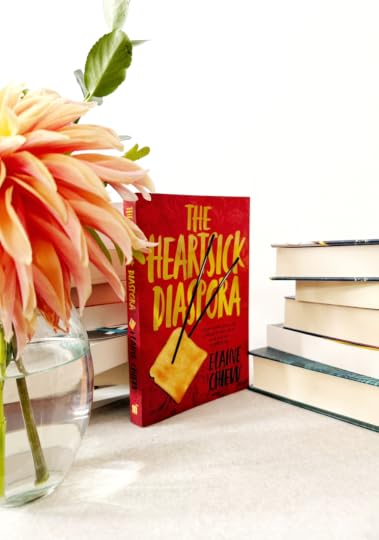
It is not as serious as perhaps I make it sound. The cover, after all, depicts a slice of toast held between chopsticks. There is humour here, and lightness of touch, as well as that struggle to belong. (which is existential, rather than life threatening).
Enjoy, and don't forget your fortune cookie. (Always believe a Chinese fortune cookie)

January 4, 2020
I discovered Chiew's writing many years ago when she won the Bridport Prize with 'Face,' which I loved, and is included here. One thing that appeals to me about this collection is the variety in terms of theme and story structure. 'Confessions of an Irresolute Ethnic Writer' is a piece that I particularly like due to its richness in terms of language and humour. 'The Heartsick Diaspora and other stories' is a collection that should be read and re-read as the nuances of each story can not be picked up in a single reading.

April 17, 2020
The Heartsick Diaspora is a collection of short stories that focuses on exploring the Singaporean and Malaysian Chinese diaspora in cities around the world. The book covers themes of culture, identity, social divisions, family, loss and more.
⠀⠀⠀⠀⠀⠀⠀⠀⠀
Each individual story had strong themes and a good storyline which made for a strong overall collection. The stories were also set across a range of time periods from WWII to more present day which I really liked. I think sometimes short story collections can be dominated by one or two more interesting stories, however, for the most part I found all of these stories to be moving and well-written.
⠀⠀⠀⠀⠀⠀⠀⠀⠀
Personal favourites were The Coffin Maker and Rap of the Tiger Mother. In The Coffin Maker one man searches for his sister who has been taken as a comfort woman during WWII. In this story, he talks about the loss of his sister, but also about finding love. This is a clever story that looks at history, colonial relationships, love and family in more subtle ways. In the Tiger Mother, this is all about one single mum's experience of raising her son and the battle between mothers to ensure their child is seen as the best in the school. This one had more humour to it as it explored ideas of motherhood, and attitudes to education and schooling.
⠀⠀⠀⠀⠀⠀⠀⠀⠀
Overall I really enjoyed these short stories as they felt lyrical, emotive and I felt deeply absorbed in each setting despite how short they were.
⠀⠀⠀⠀⠀⠀⠀⠀⠀
Each individual story had strong themes and a good storyline which made for a strong overall collection. The stories were also set across a range of time periods from WWII to more present day which I really liked. I think sometimes short story collections can be dominated by one or two more interesting stories, however, for the most part I found all of these stories to be moving and well-written.
⠀⠀⠀⠀⠀⠀⠀⠀⠀
Personal favourites were The Coffin Maker and Rap of the Tiger Mother. In The Coffin Maker one man searches for his sister who has been taken as a comfort woman during WWII. In this story, he talks about the loss of his sister, but also about finding love. This is a clever story that looks at history, colonial relationships, love and family in more subtle ways. In the Tiger Mother, this is all about one single mum's experience of raising her son and the battle between mothers to ensure their child is seen as the best in the school. This one had more humour to it as it explored ideas of motherhood, and attitudes to education and schooling.
⠀⠀⠀⠀⠀⠀⠀⠀⠀
Overall I really enjoyed these short stories as they felt lyrical, emotive and I felt deeply absorbed in each setting despite how short they were.

September 24, 2023
Populated by characters who are luminously and unapologetically themselves despite, amidst, and because of the occasional uncertainties about who they are and where they stand, this perceptively and exquisitely nuanced collection is a glorious acceptance-themed feast for the soul. Diversity-championing, skilfully written and intellectually stimulating short stories make up this gourmet collection, leaving the reader feeling thoroughly well fed. Indeed, these stories join forces to create the literary equivalent of an unforgettable fine dining experience.
The Heartsick Diaspora: And Other Stories will certainly not be my last Elaine Chiew book.
The Heartsick Diaspora: And Other Stories will certainly not be my last Elaine Chiew book.

August 7, 2020
Such an amazing collection of stories, a variety of voices and span across different eras- from settings in the Japanese occupation to present day. And what’s just so good is she does not overplay the ethnic flavor but captures the characters’ memories and longings and cultural nuances and weaves that into the storyline.
Will be looking out for more of her works.
I wud rate this 3.5 stars
Will be looking out for more of her works.
I wud rate this 3.5 stars
April 15, 2021
My introduction to Elaine Chiew’s writing was her energetic standout contribution to 2015’s Unthology 7. The Heartsick Diaspora begins in a more restrained register with the quietly spooky The Coffin Maker, but then we are back in familiar territory.
The following paragraph is from Run of the Molars, the second story of the collection:
‘Lily gasped, ‘Mother!’ This–this was family. Her mother’s face became as white as marzipan, the old acne scars like the tiny craters of fried egg white in a sizzling pan, but she sat resplendent even so, grinding her molars together, and Lily thought how indecipherable and contradictory one’s parents were–a shrouding mystery of details and autobiography and era and culture. What was random was trying to catch understanding from this morass. The understanding here was as circumstantial as accidental negligence. For a spectral moment though, Lily thought she glimpsed a pipkin of pain skating through her mother’s features.’
It’s not just the vigour of this writing that makes it typical of Chiew but its observational acuity and the measured flitting between reflection and the declarative. Not to mention the use of food, of course. This book sees these elements employed in a series of extended riffs on the various politics of identity which, by turn, invigorate and enthral.
A word here too for the running order of this collection. The two stories that appear at the centre of the collection are very different. I don’t think it’s too much of a stretch to suggest the pointed fabulousness of Confessions of an Irresolute Ethnic Writer is reminiscent of Angela Carter’s The Bloody Chamber, whilst the The Heartsick Diaspora itself allows for the sophisticated meta-use of characters that appeared in earlier stories, without compromising its own effectiveness. Both stories break up the rhythm of the collection and force the reader to start again with the second half of the book. And as such contribute enormously to a treatment of Chiew’s work that does it entirely appropriate justice.
The following paragraph is from Run of the Molars, the second story of the collection:
‘Lily gasped, ‘Mother!’ This–this was family. Her mother’s face became as white as marzipan, the old acne scars like the tiny craters of fried egg white in a sizzling pan, but she sat resplendent even so, grinding her molars together, and Lily thought how indecipherable and contradictory one’s parents were–a shrouding mystery of details and autobiography and era and culture. What was random was trying to catch understanding from this morass. The understanding here was as circumstantial as accidental negligence. For a spectral moment though, Lily thought she glimpsed a pipkin of pain skating through her mother’s features.’
It’s not just the vigour of this writing that makes it typical of Chiew but its observational acuity and the measured flitting between reflection and the declarative. Not to mention the use of food, of course. This book sees these elements employed in a series of extended riffs on the various politics of identity which, by turn, invigorate and enthral.
A word here too for the running order of this collection. The two stories that appear at the centre of the collection are very different. I don’t think it’s too much of a stretch to suggest the pointed fabulousness of Confessions of an Irresolute Ethnic Writer is reminiscent of Angela Carter’s The Bloody Chamber, whilst the The Heartsick Diaspora itself allows for the sophisticated meta-use of characters that appeared in earlier stories, without compromising its own effectiveness. Both stories break up the rhythm of the collection and force the reader to start again with the second half of the book. And as such contribute enormously to a treatment of Chiew’s work that does it entirely appropriate justice.

December 18, 2020
‘The Heartsick Diaspora’, published by Myriad in January 2020 is my ‘best read’ of the year, possibly my ‘best read’ of several years. This is a stunningly good first collection of short stories by Elaine Chiew that includes two stories that have won first and second prizes in the Bridport competition.
A short story collection that has been years in the making can reflect a profundity of thought, an acuity observation and a breadth of life experience on the part of the writer that is lacking from many novels. And that’s certainly the case here.
If you’re not familiar with the geo-political history of South East Asia – I wasn’t – at least read the Wikipedia entry on Singapore to orientate yourself before you start. The book opens with a poignant and understated story alluding obliquely to the misfortune of the ‘comfort women’ forced into sex slavery by the Japanese during their occupation of Singapore between 1942 and 1945. It closes with an account of the lives of the Samsui women, migrants from mainland China who worked in the construction industry in Singapore between the 1920s and the 1940s, and who through their labour, helped to turn it into the cutting edge city it is today.
In between these two are stories set in London and New York, cities that are home to the Singaporean and Malaysian Chinese diasporas. Chiew’s terrain is the intersectionality of migrancy and ethnicity and, in this respect, she has every angle covered.
‘The Coffin Maker’ is about power, how things work when you’re a member of an ethnic minority community at the mercy of an incoming oppressor. A woman is obliged to leave home; the same woman returns home. Who can tell what awful torment she has endured in the meantime. Only through signs and coded actions of the characters can we begin to imagine.
‘Rap of the Tiger Mother’ is about the desire to fit in. An anxious Asian incomer to London competes with other yummy mummies, all desperate for their child to excel educationally and in their artistic and sporting accomplishments. The protagonist expresses her tension through the medium of rap. In the end, she must decide between ambition and her child’s well-being.
‘The Run of the Molars’ and ‘Face’ explore how, through the passage of time and physical separation, the older generation and their migrant children become emotionally, culturally and linguistically estranged from one another. In both these stories, things fall apart when a parent from the ‘old country’ arrives in London to visit her offspring. In ‘The Run of the Molars’ a Singaporean Chinese mother visits her three daughters following the death of her husband. She is determined to find fault with everything and fails to appreciate anything about her daughters’ new environment. In ‘Face’, a Chinese Malaysian mother tries, and fails, to bridge the cultural chasm between herself and her snippy, American-born Chinese daughter-in-law and her son. In both cases, the parent has a desperate need to be understood. In ‘Run of the Molars’, the mother longs for her daughters to appreciate how a traumatic event from the early years of her marriage has affected her whole life but she can’t express herself without antagonising them. In ‘Face’, the mother is dealing with encroaching health problems, and feels ‘like a suitcase of discarded things’. After a series of undermining episodes, all she wants is to go home. But the altered attitudes and changed lifestyles of the ‘migrant generation’ mean that communication is well-nigh impossible and that the young couple are unable to ‘hear’ her.
These are sad, painful stories which barely have an emotional resolution. In ‘Run of the Molars’ there is some limited rapprochement between the mother and Lily, the daughter who most resembles her, when a lifetime of bitter sniping gives way to a moment of insight and empathy. ‘Face’ eloquently depicts the struggle to get others to listen to you at the point where your mind begins to fracture and when the thing you most desire is the thing you are least able to have.
Language, of course is an important aspect of communication. Part of the frustration in ‘Run of the Molars’ stems from the fact that Lily, is losing her grasp of her mother tongue. Although she ‘once spoke Hokkien fluently, after all this time the language had receded to the back of her throat, and she found disconnect between what she wanted to say and the accurate Hokkien words for it.’
In ‘Chinese Almanac’ where two migrant generations are part of the same North American household, communication is still an issue. There are important issues to be discussed. The parents’ marriage is falling apart and their offspring (not sure which gender) is trying to declare that s/he’s gay, but it’s not just that different members of the family have different customs and different belief systems, but that father and grown-up child don’t share a common language. ‘This is how we’ve always communicated,’ says the child, ‘in two languages that don’t have a common root,’ and ‘I want to talk to him in our cross-intentioned languages, but I don’t know how.’ Ironically, ‘Never say anything important with words,’ is the motto in the Chinese fortune cookie that concludes the story.
Other stories tackle other aspects of what it means to be an immigrant. ‘Florida Rednecks Love Moo Goo Gai Pan’ is about being female and trying to survive in the environment of a sleazy Florida restaurant surrounded by sexual predators of all ethnic persuasions. ‘Friends of the Kookaburra’ tells of the troubled relationship between two women, one Malaysian, one white American, where a friendship between apparent equals turns out to be something else with a dynamic based on race. ‘The Chinese Nanny’ is a razor-sharp account of the painful efforts of a third-generation Malaysian Chinese nanny working in London to appear authentically Chinese while, at the same time, dependably British. This story pulls no punches about how the white British middle classes view others.
‘The Heartsick Diaspora’, the title story about an ethnic minority writers’ group that meets in a café in Notting Hill, provides a structural device that cleverly threads together a number of the stories in the collection. This tale, in the form of a playlet, provides a platform for examining not just how the British view people of other ethnic backgrounds: ‘It wasn’t long before we got into what it feels like to be Malaysian or Singaporean in the UK – you’re a subset (Malaysian/Singaporean) of a subset (Chinese) of a subset (Asian) – and on a fair-weather day, the English assume you’re a tourist.’
But ethnic minority people have their own hierarchies too, and this is a point that’s made in ‘Chinese Almanac’: ‘Mrs Poon and Mom were tight buddies, since their Chinese quotient or pedigree was more questionable than [that of their other friends].’ The case is firmly made: everyone is capable of prejudice based on ethnicity and some of us inflict inferiority on ourselves because of it.
There are no easy rides here. The characters in Chiew’s stories are smart, uncertain, brittle, needy, insecure, vulnerable, ambitious, resilient, sassy, anxious and aggressive and don’t always come out of situations ‘on the up’. They are also hard-working, giving more to society than society gives to them.
The messages delivered are tough ones. These stories depict many aspects of racism from the microaggressions of everyday life listed in ‘The Heartsick Diaspora’ to the brutal racial assault experienced by the elderly Malaysian woman in ‘Face’ which has a devastating long-term effect on her. The writer touches on reverse racism and even that bizarre phenomenon where a white person demonstrates a form of cultural superiority by accumulating trophy friends with diverse skin tones like ‘notches on [a] belt’. – ‘Friends of the Kookaburra’
What we’re left with is the overwhelming impression of how wearing it is to be a migrant: ‘People lose little pieces of themselves all the time in America,’ says the first person narrator in ‘Florida Rednecks Love Moo Goo Gai Pan’; ‘Every day there are social interactions, minute as each individual episode goes, but cumulatively they begin to absorb into your tissue. Little razors handed to you every day,’ says Chandra in the ‘The Heartsick Diaspora’.
Characters have their skills devalued. A father has a degree in Mathematics but ends up working in a Chinese supermarket. A son has a degree from MIT, ‘but here [in the UK] is just another computer geek’. They may have several languages at their disposal, whereas the host community has just one. And they may be acutely aware of how they’re looked down on, as in ‘The Chinese Nanny’, where Su Chin is astute enough to catch her employer’s negative implications from ‘the verbal undercarriage, the things one didn’t say to someone of a different race’. Despite all of this, the migrant must maintain his or her confidence to be able to survive.
‘Slipping between borders, it’s what EPs [Ethnic People] like us do,’ says Chandra in ‘The Heartsick Diaspora’. ‘What a hodgepodge people are,’ she concludes, ‘what willy wonkas, what bricoloeur and collage we hide within ourselves, identities super-imposed upon one another like composite negatives.’ Yet, she adds. ‘we sometimes choose to surround ourselves with bars.’ While birds fly freely, people cage themselves and each other.
Chiew is a sure-footed writer, writing perceptively about a complex issue. Her stories cover a lot of ground and require close attention, but nothing in them is superfluous. Her range of subject matter is impressive, and the contexts in which her characters operate – whether a cordon bleu restaurant in a fashionable part of New York, or a run-down tenement in Singapore – are all rendered with absolute authenticity.
It wasn’t immediately obvious to me how a couple of the stories fitted within the overall collection. Nevertheless, one of these, ‘Confessions of an Irresolute Ethnic Writer’, deserves a special mention. This extraordinary reworking of a Hindu-Buddhist myth repaid the effort I had to invest to get to grips with it. It is a bold statement that those of us who do ‘slip between borders’, who have multiple cultural sources to draw upon have something valuable to say and deserve a voice. That’s a point that agents and publishers should not ignore.
This book is highly recommended.
A short story collection that has been years in the making can reflect a profundity of thought, an acuity observation and a breadth of life experience on the part of the writer that is lacking from many novels. And that’s certainly the case here.
If you’re not familiar with the geo-political history of South East Asia – I wasn’t – at least read the Wikipedia entry on Singapore to orientate yourself before you start. The book opens with a poignant and understated story alluding obliquely to the misfortune of the ‘comfort women’ forced into sex slavery by the Japanese during their occupation of Singapore between 1942 and 1945. It closes with an account of the lives of the Samsui women, migrants from mainland China who worked in the construction industry in Singapore between the 1920s and the 1940s, and who through their labour, helped to turn it into the cutting edge city it is today.
In between these two are stories set in London and New York, cities that are home to the Singaporean and Malaysian Chinese diasporas. Chiew’s terrain is the intersectionality of migrancy and ethnicity and, in this respect, she has every angle covered.
‘The Coffin Maker’ is about power, how things work when you’re a member of an ethnic minority community at the mercy of an incoming oppressor. A woman is obliged to leave home; the same woman returns home. Who can tell what awful torment she has endured in the meantime. Only through signs and coded actions of the characters can we begin to imagine.
‘Rap of the Tiger Mother’ is about the desire to fit in. An anxious Asian incomer to London competes with other yummy mummies, all desperate for their child to excel educationally and in their artistic and sporting accomplishments. The protagonist expresses her tension through the medium of rap. In the end, she must decide between ambition and her child’s well-being.
‘The Run of the Molars’ and ‘Face’ explore how, through the passage of time and physical separation, the older generation and their migrant children become emotionally, culturally and linguistically estranged from one another. In both these stories, things fall apart when a parent from the ‘old country’ arrives in London to visit her offspring. In ‘The Run of the Molars’ a Singaporean Chinese mother visits her three daughters following the death of her husband. She is determined to find fault with everything and fails to appreciate anything about her daughters’ new environment. In ‘Face’, a Chinese Malaysian mother tries, and fails, to bridge the cultural chasm between herself and her snippy, American-born Chinese daughter-in-law and her son. In both cases, the parent has a desperate need to be understood. In ‘Run of the Molars’, the mother longs for her daughters to appreciate how a traumatic event from the early years of her marriage has affected her whole life but she can’t express herself without antagonising them. In ‘Face’, the mother is dealing with encroaching health problems, and feels ‘like a suitcase of discarded things’. After a series of undermining episodes, all she wants is to go home. But the altered attitudes and changed lifestyles of the ‘migrant generation’ mean that communication is well-nigh impossible and that the young couple are unable to ‘hear’ her.
These are sad, painful stories which barely have an emotional resolution. In ‘Run of the Molars’ there is some limited rapprochement between the mother and Lily, the daughter who most resembles her, when a lifetime of bitter sniping gives way to a moment of insight and empathy. ‘Face’ eloquently depicts the struggle to get others to listen to you at the point where your mind begins to fracture and when the thing you most desire is the thing you are least able to have.
Language, of course is an important aspect of communication. Part of the frustration in ‘Run of the Molars’ stems from the fact that Lily, is losing her grasp of her mother tongue. Although she ‘once spoke Hokkien fluently, after all this time the language had receded to the back of her throat, and she found disconnect between what she wanted to say and the accurate Hokkien words for it.’
In ‘Chinese Almanac’ where two migrant generations are part of the same North American household, communication is still an issue. There are important issues to be discussed. The parents’ marriage is falling apart and their offspring (not sure which gender) is trying to declare that s/he’s gay, but it’s not just that different members of the family have different customs and different belief systems, but that father and grown-up child don’t share a common language. ‘This is how we’ve always communicated,’ says the child, ‘in two languages that don’t have a common root,’ and ‘I want to talk to him in our cross-intentioned languages, but I don’t know how.’ Ironically, ‘Never say anything important with words,’ is the motto in the Chinese fortune cookie that concludes the story.
Other stories tackle other aspects of what it means to be an immigrant. ‘Florida Rednecks Love Moo Goo Gai Pan’ is about being female and trying to survive in the environment of a sleazy Florida restaurant surrounded by sexual predators of all ethnic persuasions. ‘Friends of the Kookaburra’ tells of the troubled relationship between two women, one Malaysian, one white American, where a friendship between apparent equals turns out to be something else with a dynamic based on race. ‘The Chinese Nanny’ is a razor-sharp account of the painful efforts of a third-generation Malaysian Chinese nanny working in London to appear authentically Chinese while, at the same time, dependably British. This story pulls no punches about how the white British middle classes view others.
‘The Heartsick Diaspora’, the title story about an ethnic minority writers’ group that meets in a café in Notting Hill, provides a structural device that cleverly threads together a number of the stories in the collection. This tale, in the form of a playlet, provides a platform for examining not just how the British view people of other ethnic backgrounds: ‘It wasn’t long before we got into what it feels like to be Malaysian or Singaporean in the UK – you’re a subset (Malaysian/Singaporean) of a subset (Chinese) of a subset (Asian) – and on a fair-weather day, the English assume you’re a tourist.’
But ethnic minority people have their own hierarchies too, and this is a point that’s made in ‘Chinese Almanac’: ‘Mrs Poon and Mom were tight buddies, since their Chinese quotient or pedigree was more questionable than [that of their other friends].’ The case is firmly made: everyone is capable of prejudice based on ethnicity and some of us inflict inferiority on ourselves because of it.
There are no easy rides here. The characters in Chiew’s stories are smart, uncertain, brittle, needy, insecure, vulnerable, ambitious, resilient, sassy, anxious and aggressive and don’t always come out of situations ‘on the up’. They are also hard-working, giving more to society than society gives to them.
The messages delivered are tough ones. These stories depict many aspects of racism from the microaggressions of everyday life listed in ‘The Heartsick Diaspora’ to the brutal racial assault experienced by the elderly Malaysian woman in ‘Face’ which has a devastating long-term effect on her. The writer touches on reverse racism and even that bizarre phenomenon where a white person demonstrates a form of cultural superiority by accumulating trophy friends with diverse skin tones like ‘notches on [a] belt’. – ‘Friends of the Kookaburra’
What we’re left with is the overwhelming impression of how wearing it is to be a migrant: ‘People lose little pieces of themselves all the time in America,’ says the first person narrator in ‘Florida Rednecks Love Moo Goo Gai Pan’; ‘Every day there are social interactions, minute as each individual episode goes, but cumulatively they begin to absorb into your tissue. Little razors handed to you every day,’ says Chandra in the ‘The Heartsick Diaspora’.
Characters have their skills devalued. A father has a degree in Mathematics but ends up working in a Chinese supermarket. A son has a degree from MIT, ‘but here [in the UK] is just another computer geek’. They may have several languages at their disposal, whereas the host community has just one. And they may be acutely aware of how they’re looked down on, as in ‘The Chinese Nanny’, where Su Chin is astute enough to catch her employer’s negative implications from ‘the verbal undercarriage, the things one didn’t say to someone of a different race’. Despite all of this, the migrant must maintain his or her confidence to be able to survive.
‘Slipping between borders, it’s what EPs [Ethnic People] like us do,’ says Chandra in ‘The Heartsick Diaspora’. ‘What a hodgepodge people are,’ she concludes, ‘what willy wonkas, what bricoloeur and collage we hide within ourselves, identities super-imposed upon one another like composite negatives.’ Yet, she adds. ‘we sometimes choose to surround ourselves with bars.’ While birds fly freely, people cage themselves and each other.
Chiew is a sure-footed writer, writing perceptively about a complex issue. Her stories cover a lot of ground and require close attention, but nothing in them is superfluous. Her range of subject matter is impressive, and the contexts in which her characters operate – whether a cordon bleu restaurant in a fashionable part of New York, or a run-down tenement in Singapore – are all rendered with absolute authenticity.
It wasn’t immediately obvious to me how a couple of the stories fitted within the overall collection. Nevertheless, one of these, ‘Confessions of an Irresolute Ethnic Writer’, deserves a special mention. This extraordinary reworking of a Hindu-Buddhist myth repaid the effort I had to invest to get to grips with it. It is a bold statement that those of us who do ‘slip between borders’, who have multiple cultural sources to draw upon have something valuable to say and deserve a voice. That’s a point that agents and publishers should not ignore.
This book is highly recommended.
May 1, 2020
As a Malaysian Chinese migrant to the ‘West’, I very much looked forward to reading The Heartsick Diaspora, to identify with the characters. And it doesn’t disappoint. I see so much of myself in these pages: in the mother trying hard to fit in at the school gates, even though I’m not bringing up a child in Belgravia. In the nanny who remains silent about being ’not really from China’ when faced with snide comments about colonial nationals. In the intergenerational tensions of mother-from-homeland visits, parental expectations and familial pressures so well captured in words unsaid and emotions unarticulated. In the just-returned-to-the-homeland film producer reflecting about rootlessness and where home is for ‘hybrid people’ with ‘fluid identities that spill beyond boundaries’.
There’s so much I love about this book. The varied voices of the stories, each so different yet so rich with the lived experiences of the Singaporean and Malaysian Chinese. The Cantonese, Mandarin, Hokkien, Malay and Manglish/Singlish that swirl throughout, transporting me back to South East Asia. The food references, which had me craving for both the taste and the notion of ham jim baeng, 7- Eleven slushie (yes, the neon blue one) and cut guava from a roadside stall. Elaine Chiew writes with such wit and humour, but with a deftness that never compromises the poignancy of the migrant experience, of being caught between the cultures and expectations of one’s homeland and the assumptions and freedoms of the adopted one. This is a book of short stories that linger and leave me wanting more. I can't wait to read more from the author.
There’s so much I love about this book. The varied voices of the stories, each so different yet so rich with the lived experiences of the Singaporean and Malaysian Chinese. The Cantonese, Mandarin, Hokkien, Malay and Manglish/Singlish that swirl throughout, transporting me back to South East Asia. The food references, which had me craving for both the taste and the notion of ham jim baeng, 7- Eleven slushie (yes, the neon blue one) and cut guava from a roadside stall. Elaine Chiew writes with such wit and humour, but with a deftness that never compromises the poignancy of the migrant experience, of being caught between the cultures and expectations of one’s homeland and the assumptions and freedoms of the adopted one. This is a book of short stories that linger and leave me wanting more. I can't wait to read more from the author.
April 14, 2020
I very much enjoyed Elaine's stories, she really has learned her craft well. Having lived in 3 different countries in my life, I find her depiction of the alienation that strikes one (in so many different ways) from living a different culture to be masterful. I loved her attempt at depicting inter-generational alientation (between the reader and the character) by her use or rap. A writer to watch as she develops into a "must read" author.
February 16, 2020
I read this book while visiting Singapore and LOVED it! It's incredibly well written, smart, nuanced, hilarious, and yes-heartbreaking, and also informative to someone who is an outsider like me. The kaleidoscope of characters and viewpoints really captures and expresses the sense of how complex identity can be, a central theme here. Her voice is intelligent, measured, patient, reflective, rich. And the stories really stay with you, I find myself remembering gorgeous moments in different stories long after finishing them. I saved the title story to read last as it echoes some of the other stories which is fun to recognize. But the last story is especially lovely as an ending to the collection. (roots vs routes!) Look forward to more work from this terrific writer!

March 20, 2020
Very clever wide-ranging collection by an award-winning short story writer Elaine Chiew.
Having been following Elaine's flash fiction online for years it is a joy to devour her first published collection including the Bridport award-winning stories. Her writing and scope always amaze me.
Having been following Elaine's flash fiction online for years it is a joy to devour her first published collection including the Bridport award-winning stories. Her writing and scope always amaze me.

January 26, 2020
Full review of the ARC: https://jessicabooksblog.wordpress.co...

February 22, 2020
A little patchy: some of these stories are in an unconvincing voice, but some are absolute gems.

November 21, 2020
"This is how a Chinese person becomes invisible, not because she is rubbed out by society or the racial elements in it, but because her face is no longer familiar to her loved ones"
Thanks to Times Reads for sending a review copy of The Heartsick Diaspora to me! This is a collection of 14 short stories which are all full of Malaysian and Singaporean flavors. This is my first short story read and I truly enjoyed it as each story brings out unique and different values/messages revolving around the Asian / Chinese culture.
Through this collection of short stories, the author examines the social commentaries of Asians/Chinese, the concept of cultural superiority, the cultural Western/Asian dynamic, the non-confrontational stance taken by Asians (especially in a family setting), the typical dynamics of a Chinese family as well as the search for one's identity or roots in a foreign country. As a Malaysian Chinese myself, I enjoy reading the cultural and mythological references in these stories and they are very relatable to me. I feel so proud when the author imparted the dialects, the use of Malaysian slang in conversations (for example, the use of "-lah" and "-lor"), and the Chinese rituals/superstitions and beliefs throughout the stories. This showcased the unique and distinctive Malaysian (as well as Singaporean) Chinese culture in the international arena.
My favorite stories in this collection would be Face (this to me is really a heart-aching story), The Heartsick Diaspora (this one is brilliant, clever, and witty!), Chinese Almanac, and The Chinese Nanny (this story perhaps glaringly showcased the social stigmas associated with Chinese and Asians). But as a whole, the stories herein are very personal, humorous, and moving. A minor shortcoming would be that certain stories ended loosely without an impactful punch. Nevertheless, this debut collection of short stories is a 4/5 star rating to me, and I would highly recommend this as Elaine Chiew's talent deserves more recognition!
Thanks to Times Reads for sending a review copy of The Heartsick Diaspora to me! This is a collection of 14 short stories which are all full of Malaysian and Singaporean flavors. This is my first short story read and I truly enjoyed it as each story brings out unique and different values/messages revolving around the Asian / Chinese culture.
Through this collection of short stories, the author examines the social commentaries of Asians/Chinese, the concept of cultural superiority, the cultural Western/Asian dynamic, the non-confrontational stance taken by Asians (especially in a family setting), the typical dynamics of a Chinese family as well as the search for one's identity or roots in a foreign country. As a Malaysian Chinese myself, I enjoy reading the cultural and mythological references in these stories and they are very relatable to me. I feel so proud when the author imparted the dialects, the use of Malaysian slang in conversations (for example, the use of "-lah" and "-lor"), and the Chinese rituals/superstitions and beliefs throughout the stories. This showcased the unique and distinctive Malaysian (as well as Singaporean) Chinese culture in the international arena.
My favorite stories in this collection would be Face (this to me is really a heart-aching story), The Heartsick Diaspora (this one is brilliant, clever, and witty!), Chinese Almanac, and The Chinese Nanny (this story perhaps glaringly showcased the social stigmas associated with Chinese and Asians). But as a whole, the stories herein are very personal, humorous, and moving. A minor shortcoming would be that certain stories ended loosely without an impactful punch. Nevertheless, this debut collection of short stories is a 4/5 star rating to me, and I would highly recommend this as Elaine Chiew's talent deserves more recognition!

December 14, 2019
Disclaimer: I received this book from Times Read in exchange for my honest review.
Diaspora. The dispersion or spread of any people from their original homeland. Indeed this book is as advertised. A collection of tales of Asian Chinese mostly from Singapore (Author born in Malaysia but now residing in Singapore). 14 stories in all. Sadly, I only liked a few.
"Chronicles of a Culinary Poser" was interesting because I could relate to it. A Culinary Chef with her own restaurant who wanted the New York Times star-review glory but could only do with someone else fronting as the executive chef. Because who would believe an Asian be able to cook up French cuisine at its best?
"A Thoroughly Modern Ghost of Other Origin" made me laugh. Learned about Chinese ghost. Malay ghost too. Add in an Indian ghost somewhere. It's a story of how a young libidinous boy who can see the dead. And you'll think what does libido and ghosts got to do with each other.
The rest was either too surreal, too far fetched or is just too much for me. Asian living in kwai loh countries. Asian with lack of self esteem. Asian with identity crisis. Asian being divided between roots and upbringing. There are take-aways in each of the short stories but somehow, to me, it just fell short. I just couldn't connect with "Rap of a Tiger Mother", "Face" and "The Chinese Nanny" amongst others, which had motherhood as its gist. I did like how some of the stories actually mentioned the other characters from the other stories - like prequels as such.
I hate stories with hanging endings. Stories which supposedly makes one thing and ponder. Most of the ones here are so. But instead of making me wonder, it made felt that I had wasted my time instead.
This book is now available at all major bookstores nationwide.
Diaspora. The dispersion or spread of any people from their original homeland. Indeed this book is as advertised. A collection of tales of Asian Chinese mostly from Singapore (Author born in Malaysia but now residing in Singapore). 14 stories in all. Sadly, I only liked a few.
"Chronicles of a Culinary Poser" was interesting because I could relate to it. A Culinary Chef with her own restaurant who wanted the New York Times star-review glory but could only do with someone else fronting as the executive chef. Because who would believe an Asian be able to cook up French cuisine at its best?
"A Thoroughly Modern Ghost of Other Origin" made me laugh. Learned about Chinese ghost. Malay ghost too. Add in an Indian ghost somewhere. It's a story of how a young libidinous boy who can see the dead. And you'll think what does libido and ghosts got to do with each other.
The rest was either too surreal, too far fetched or is just too much for me. Asian living in kwai loh countries. Asian with lack of self esteem. Asian with identity crisis. Asian being divided between roots and upbringing. There are take-aways in each of the short stories but somehow, to me, it just fell short. I just couldn't connect with "Rap of a Tiger Mother", "Face" and "The Chinese Nanny" amongst others, which had motherhood as its gist. I did like how some of the stories actually mentioned the other characters from the other stories - like prequels as such.
I hate stories with hanging endings. Stories which supposedly makes one thing and ponder. Most of the ones here are so. But instead of making me wonder, it made felt that I had wasted my time instead.
This book is now available at all major bookstores nationwide.
August 18, 2024
Elaine Chiew hails from Malaysia and has spent time in Singapore, the United States, and the United Kingdom, and her short story collection The Heartsick Diaspora has the ring of true experience.
The book could be part of a masterclass on award-winning writing. In the collection, Chiew demonstrates a striking eye for detail and in the fresh ideas she brings to the collection.
Here's an example from Chronicles of a Culinary Poseur, where a Chinese woman is asked to make moo goo gai pan while working as a French chef:
The "heartsick" in the title can count as its own content warning. Dissatisfaction, suffering, illness, death, disappointment can easily be found in its pages, to the point that I'm not sure I can say I enjoyed the book.
I would definitely recommend it to fans of Singaporean/Malaysian literary fiction.
Disclaimer: I am reading and reviewing this book in appreciation of the time the author spent/will spend in a session with our writing group. That said, all opinions are my own.
The book could be part of a masterclass on award-winning writing. In the collection, Chiew demonstrates a striking eye for detail and in the fresh ideas she brings to the collection.
Here's an example from Chronicles of a Culinary Poseur, where a Chinese woman is asked to make moo goo gai pan while working as a French chef:
Kara adjusted her toque, then caved. Fine, moo goo gai pan it was, that simple dish of chicken stir-fried with mushrooms. But she was going to Frenchify the hell out of it. Kara had cremini, chanterelle, morel, shitake and even wood-ear in her dry goods pantry. A wild mushroom medley risotto style, and sitting in pride of place would be a square slab of chicken cooked three ways—poached, lightly smoked, and then skin deep-fried for crunch. The smokiness of chicken augmenting the woodsy taste of mushrooms. Served in a balsamic-garlicky glaze. Perfect. The mushrooms, luckily, had been prepped earlier and were ready.
The "heartsick" in the title can count as its own content warning. Dissatisfaction, suffering, illness, death, disappointment can easily be found in its pages, to the point that I'm not sure I can say I enjoyed the book.
I would definitely recommend it to fans of Singaporean/Malaysian literary fiction.
Disclaimer: I am reading and reviewing this book in appreciation of the time the author spent/will spend in a session with our writing group. That said, all opinions are my own.
May 8, 2026
What stayed with me is how these stories capture the small performances people construct while moving between cultures, languages, and expectations. Again and again, characters are caught translating themselves in ways that are funny on the surface but quietly exhausting underneath. The collection’s humor works precisely because it is so closely tied to discomfort, misunderstanding, and the fear of becoming unreadable to others.
I especially appreciated the variety of narrative situations, from literary circles to family dinners to mythic reimaginings, all connected by the recurring tension between self invention and inherited identity. The steamboat argument during the mother’s London visit and the story of the writer wrestling with Western literary influence both reveal how cultural belonging can become fragmented even within intimate spaces. The collection also uses wit strategically, allowing moments of emotional recognition to arrive sideways rather than through overt sentiment.
This will reward readers who enjoy short fiction attentive to diaspora, performance, and social awkwardness without flattening those experiences into a single narrative about identity. By the end, the stories feel less interested in resolving cultural tension than in revealing how people learn to live inside it.
I especially appreciated the variety of narrative situations, from literary circles to family dinners to mythic reimaginings, all connected by the recurring tension between self invention and inherited identity. The steamboat argument during the mother’s London visit and the story of the writer wrestling with Western literary influence both reveal how cultural belonging can become fragmented even within intimate spaces. The collection also uses wit strategically, allowing moments of emotional recognition to arrive sideways rather than through overt sentiment.
This will reward readers who enjoy short fiction attentive to diaspora, performance, and social awkwardness without flattening those experiences into a single narrative about identity. By the end, the stories feel less interested in resolving cultural tension than in revealing how people learn to live inside it.

January 28, 2026
I just finished Heartsick Diaspora, and it took me longer to get through than usual—not because it wasn’t compelling, but because the stories vary so much in tone and style. Some are long-winded, full of history, and a bit technical, which made them harder for me to connect with. But the others? Absolutely unforgettable.
A few of the stories are “sweet as honey” and will stay with me forever. The writing is rich, evocative, and full of culture, capturing immigrant experiences in ways that are both relatable and heart-wrenching. Some moments hit so close to home that I found myself thinking about them long after I closed the book.
I have to admit, the Chinese nanny story was almost unbearable—it really gagged me. But that’s part of the book’s power: it doesn’t shy away from discomfort or difficult truths. Even the stories that are challenging to read feel important and thought-provoking.
Overall, Heartsick Diaspora is beautifully written, deeply human, and incredibly moving. It’s not a book you breeze through, but one that makes you pause, reflect, and sometimes ache. A powerful read for anyone interested in stories about family, migration, and the quiet complexities of love and loss.
A few of the stories are “sweet as honey” and will stay with me forever. The writing is rich, evocative, and full of culture, capturing immigrant experiences in ways that are both relatable and heart-wrenching. Some moments hit so close to home that I found myself thinking about them long after I closed the book.
I have to admit, the Chinese nanny story was almost unbearable—it really gagged me. But that’s part of the book’s power: it doesn’t shy away from discomfort or difficult truths. Even the stories that are challenging to read feel important and thought-provoking.
Overall, Heartsick Diaspora is beautifully written, deeply human, and incredibly moving. It’s not a book you breeze through, but one that makes you pause, reflect, and sometimes ache. A powerful read for anyone interested in stories about family, migration, and the quiet complexities of love and loss.

September 14, 2026
WORLD
#fromourbookshelves
The lyrical storytelling brings Asian lives and tradition into colourful focus.
There are fourteen stories in this anthology and the first one titled The Coffin Maker is set in Singapore. It melds the due process of finding the right wood for a coffin and the story of a comfort woman. Each page is infused with food, and the aromas of the delicate dishes emanate from the pages. In Run of the Molars, the story of mothers and daughters is set in London.
Several stories are set in the USA and I particularly enjoyed Chronicles of a Culinary Poseur. It forms a real insight into how it feels to be torn between different cultures, always juggling, learning and adapting. There are Tiger Mothers and a story of the samsui women, who are Singapore's thrifty, hardworking construction workers.
These stories are eye-openingly entertaining and thought-provoking and swirls of beautiful dishes accompany the very competent storytelling.
#fromourbookshelves
The lyrical storytelling brings Asian lives and tradition into colourful focus.
There are fourteen stories in this anthology and the first one titled The Coffin Maker is set in Singapore. It melds the due process of finding the right wood for a coffin and the story of a comfort woman. Each page is infused with food, and the aromas of the delicate dishes emanate from the pages. In Run of the Molars, the story of mothers and daughters is set in London.
Several stories are set in the USA and I particularly enjoyed Chronicles of a Culinary Poseur. It forms a real insight into how it feels to be torn between different cultures, always juggling, learning and adapting. There are Tiger Mothers and a story of the samsui women, who are Singapore's thrifty, hardworking construction workers.
These stories are eye-openingly entertaining and thought-provoking and swirls of beautiful dishes accompany the very competent storytelling.
February 25, 2022
I am thoroughly enjoying reading the short stories by Elaine Chiew. Each is highly visual, dramatic, love the 'rap' bits especially in 'Rap of the Tiger Mother' although I must confess not to be a huge fan of rap. The first story, the 'Coffin Maker' blew me away. Great handling of dialogue and acute observation of the human nature. I recommend this book if you like short stories with themes of mother-daughter relationship, coming to terms with the loss of cultural values, Singaporean humour. And more.

February 11, 2023
This book was absolutely amazing, I binged the second half of it in one sitting on my aunts bean bag. Elaine Chiew brings such a real and raw insight into what it’s like being Asian. I was particularly touched by the stories that featured characters of mixed heritage, as I am Filipino/Chinese. My favourite story out of them all would have to be Love, Nude. I felt this book took out my heart and displayed all my inner most thoughts and managed to put them into words. It’s unique and creative and not afraid to try something different. Just splendid.
July 29, 2025
Witty, sharp, and excellently crafted writing. The collection as a whole showcases the author's versatility and range both across subject and style, from the colloquial to the esoteric, from a coffin-maker's dalliance during the Japanese occupation to a modern-day chef's hijinks at a fine dining establishment. It was thoroughly enjoyable and often thought-provoking. As with many short story collections, some of them worked better than others for me.

August 17, 2021
The Heartsick Diaspora takes us through our full range of emotions, reliving the heart-breaking tales of comfort women taken captive in Singapore by the Japanese army during WW2 and then lifting us through the rap songs of a mother coping with competitive school parents.
There is something in the book for everyone, or dare I say, there is something in this book for everyone in us.
There is something in the book for everyone, or dare I say, there is something in this book for everyone in us.

September 5, 2022
Enjoyable short stories about Singaporean and Malaysian Chinese people who live around the world or in Singapore. Mostly modern settings, but also some historical passages about Japanese comfort women and samsui women. There were a couple of too-strange stories for me but most were engaging. I resonate with the ideas of detachment from home and family and finding one's identity abroad.

June 18, 2025
This took me a lot longer than expected to read. I found it difficult to connect to some characters within the short stories, especially the final story. I have no idea what happened! Other stories really touched me. I wanted to enjoy this book more than I did. But I do like how this book shines light on the complexity of cultures. 2.5 ⭐s
September 2, 2020
Enjoyed reading this book. It explored the various emotional and mental processes that an individual goes through when they are outside their “home” as they try to fit in, make a living or simply exist. The writing style varies in the different chapters and thus keeps the reader interested.
Displaying 1 - 30 of 39 reviews