Sold as a bond servant to Dom Twee, an artist's agent in Amsterdam, Lenoir is forced to flee with his master to Antwerp, where he becomes a popular actor in an Italian Commedia del Arte troupe and offers pointed observations on European civilization
Ken Greenhall was born in Detroit in 1928, the son of immigrants from England. He graduated from high school at age 15, worked at a record store for a time, and was drafted into the military, serving in Germany. He earned his degree from Wayne State University and moved to New York, where he worked as an editor of reference books, first on the staff of the Encyclopedia Americana and later for the New Columbia Encyclopedia. Greenhall had a longtime interest in the supernatural and took leave from his job to write his first novel, Elizabeth (1976), a tale of witchcraft published under his mother’s maiden name, Jessica Hamilton. Several more novels followed, including Hell Hound (1977), which was published abroad as Baxter and adapted for a critically acclaimed 1989 French film under that title. Greenhall died in 2014.
If you're reading this so-called review, you are different from many of the people around you: you are a reader. Apparently, reading for pleasure is declining; it has increasingly become a niche activity. Your niche does not make you better, but it does make you different. You are, in this particular way, outside of the mainstream - despite how well you may blend in with that stream. Pleased to know you, brother or sister outsider! The criminally underread Ken Greenhall is solely concerned with illustrating the outsider perspective. You should read him. He gets you.
Except for this excellent historical novel, Greenhall is primarily known - if he is known at all - for writing quasi-horror. His outsiders are either quirky mystery-solvers (Childgrave, Deathchain) or psychopaths (Hell Hound, Elizabeth, The Companion). No matter the health of their mental state, all of his narrators hold the mainstream world and its denizens at arm's length. These narrators often comment ironically on the bizarrely boring behavior patterns of normies; depending on the book, they then will shrug and ignore them, or easily manipulate them, or scornfully reject them, or sometimes just kill them.
Lenoir is another of Greenhall's outsiders: a black man in 17th century Europe, first a slave to art dealer/swindler Mr. Twee, then a freedman able to travel on his own. And travel he does - but still saddled with the friendly, gay, utterly amoral, extremely self-interested Twee, who has treated the enslaved and then freed Lenoir as, basically, his friend. Lenoir, an artist's model and occasional practitioner of juju (white magic only though!), starts in Amsterdam, travels briefly with an actor's troupe to Rotterdam, and ends the novel in Antwerp. The book is less about adventure and more about a fish out of water who wouldn't go back to his first home even if he could (despite his longing for it, and for his children); it is about a black outsider looking at the strange world of white Europeans, consciously and continuously rejecting being a part of that world, but still of it, still in it. Much to his frequent wonder, or amusement, or confusion, or chagrin. As the saying goes, white people are crazy.
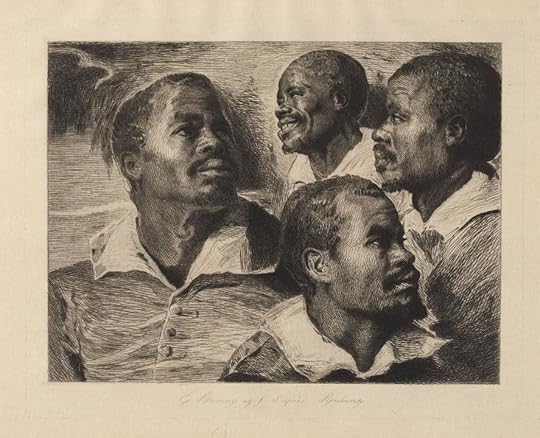
Although a fictional creation, Lenoir himself is based on actual person: the model for Rubens' Four Studies of the Head of a Black Man (1883).
The story is both lightly comic and deeply melancholy. As always with Greenhall, the prose is superb. Despite this being a historical novel, this is not a lush portrait of a fascinating era in Europe. The details are often there, but this is a rather stripped-down and streamlined narrative, as detached and distant as Lenoir himself - but as thoughtful and as soulful as well. Despite two extremely tragic murders, the book is also highly amusing. Lenoir both understands and misunderstands the people around him regularly: he sees the heart of them, but often can't fathom why they must do the things they do. The novel is a study of an outsider who sighs rather than shouts at life and its fortunes and catastrophes. Sometimes that's all a person can do.
The premise behind Ken Greenhall's "Lenoir" is a fascinating one. The truism that every picture contains a story (or a picture is worth a thousand words) is usually just an offhand remark, tossed out on a tour of an art gallery. Ken Greenhall has taken this natural curiosity and used it as the grist for his story about the subject of Peter Paul Rubens' "Four Studies of a Head of a Moor" (also sometimes called "Four Studies of a Head of a Negro").
The book's eponymous hero, Lenoir, is an African slave held in bondage in the possession of a man of some ill-repute named Twee. Mr. Twee has amassed considerable debts, necessitating the sale of Lenoir as forfeit, which sets the protagonist on his path across 17th century Europe. He's not quite a Picaro (even though his favorite book is "Don Quixote" and he sees a lot of himself in the hapless knight) and the book's tone is more reflective than action-packed, though there are some haunting scenes here and there.
"Lenoir" unfolds in short bursts, as dialogues between the African man far from home and the strange assortment of pale people (and at least one other African) he comes across. The book does a good job of imagining what it must have been like to go from Yoruba concepts of religion, society, and warfare, to the complex and chaotic milieu of Western Europe in flux. How does someone who believes in juju and the making of dolls of their enemies understand ecumenical distinctions between Calvinists and Catholics, for instance? It's these kinds of questions, whose answers are unveiled in one subtle scene after another, that keep the book consistently readable. An original, elegiac and imaginative look at the intersection between the fine art world and that "peculiar institution" of human beings owning one-another, which was and unfortunately remains a reality for lots of people around the world. Recommended.
A difference of cultures offers some interesting insights in this tale of slave who gains his freedom. Lenoir, who is still a slave at the start of this tale, eventually gains his freedom in a roundabout way. Although he views the European world of the 1500s as strange and confusing at times, he also feels he could no longer return to his former life in Africa. He is a man who does not really fit in anywhere, but his indomitable spirit keeps him going. Sometimes he appears wise beyond his years, but at other times he can be somewhat naïve. This is a story of many contrasts that serve to illuminate the time period it describes.
A nice cross-cultural voice of the main character. Looking at the cover art by Rubens, you can better see the character. That is how the author conceived the book.
I really wanted to like this as much as his other work that Valancourt has available, but to be honest I found it quite boring. The odd moments of detached observation from Lenoir made it interesting in spots. But I can't say I recommend this sadly. Hell Hound, Elizabeth, and Childgrave are excellent however.