

What do you think?
Action Research
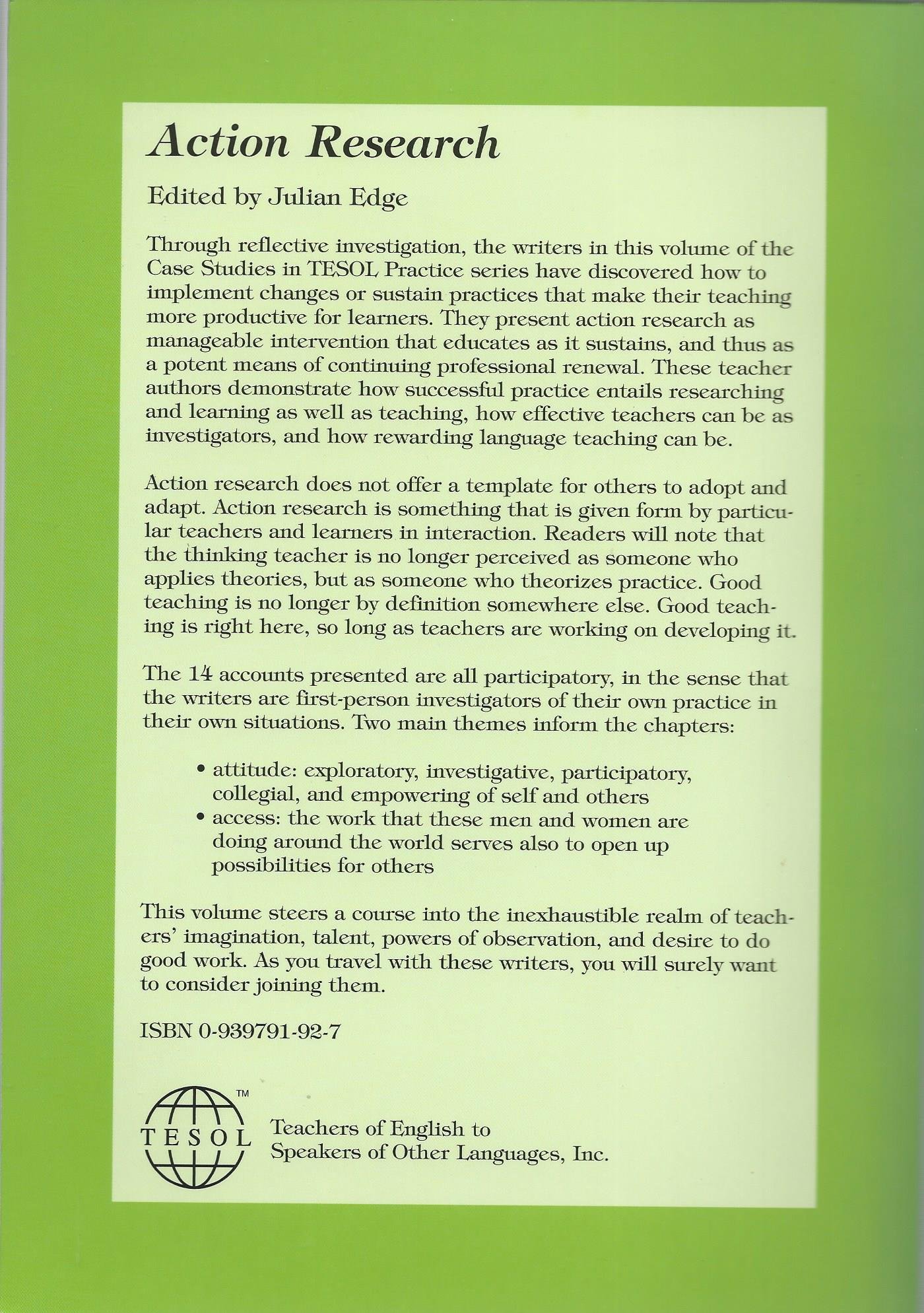
Through reflective investigation, the writers in this volume of the Case Studies in TESOL Practice series have discovered how to implement changes or sustain practices that make their teaching more productive for learners. They present action research as manageable intervention that educates as it sustains, and thus as a potent means of continuing professional renewal. These teacher authors demonstrate how successful practice entails researching and learning as well as teaching, how effective teachers can be as investigators, and how rewarding language teaching can be. Action research does not offer a template for others to adopt and adapt. Action research is something that is given form by particular teachers and learners in interaction. Readers will note that the thinking teacher is no longer perceived as someone who applies theories, but as someone who theorizes practice. Good teaching is right here, so long as teachers are working on developing it. The 14 accounts presented are all participatory, in the sense that the writers are first-person investigators of their own practice in their own situations. Two main themes inform the attitude (exploratory, investigative, participatory, collegial, and empowering of self and others) and access (the work that these men and women are doing around the world serves also to open up possibilities for others).. This volume steers a course into the inexhaustible realm of teachers' imagination, talent, powers of observation, and desire to do good work. As you travel with these writers, you will surely want to consider joining them.
206 pages, Paperback
First published December 1, 2000
About the author
Julian Edge
25 books6 followersI have been involved in teaching English to speakers of other languages (TESOL) since 1969, with an increasing engagement in teacher education in that field. I am fascinated by the interaction between personal development and professional development, and by how individual development is best achieved in social interaction. That is very much the focus of my 2002 book, Continuing Cooperative Development. Mind you, I also love a good story, and I find that my writing has moved more and more away from academic prose towards the sharing of experience and the shared attempt to make sense of it. In my 2011 book, The Reflexive Teacher Educator, I use re-interpretations of the myths of Icarus and Narcissus, as well as snippets from my own mental cowboy movie, to sketch a picture of TESOL teacher education as I have shaped my version of it, and it has shaped my working life. If you find that any of this resonates with you, you can contact me at julian.edge@manchester.ac.uk
Ratings & Reviews
Friends & Following
Create a free account to discover what your friends think of this book!
Community Reviews
No one has reviewed this book yet.