Idées Noires de Franquin, le spirituel papa de Gaston Lagaffe et du Marsupilami nous révèle une nouvelle facette de ce merveilleux dessinateur mis au service d'un humour féroce, summum d'humour noir. Franquin démasque les visages hideux de notre barbarie civilisée : le nucléaire, la peine de mort, la guerre : celle des généraux, celle des marchands de canons, celle des troufions, la Troisième Mondiale et autres gentillesses du même tonneau. Et ses extraordinaires dessins sont aussi noirs que ses idées. En hommage à ce si célèbre dessinateur, Fluide Glacial a décidé de réunir pour la première fois les deux tomes des Idées Noires parus successivement en 1981 et 1984.
6.5/10 In the late 70's master Belgian cartoonist André Franquin goes into depression. To exorcise his personal ghosts, or maybe dive into them, he starts a series of black and white one-pagers full of nihilistic violent dark humour. These 'black ideas' - I guess better translated as dark thoughts - appeared first in magazines, then were published in two French albums, both collected in this volume.
Franquin's art shines here, making this volume from a visual perspective one of the most exquisite comic book that I have ever seen. Franquin's style is the epitome of French-Belgian humorous comics: slouching gummy hyper-cartoonish characters, with thin long legs and prominent noses. Normally, his art is colourful and gentle. On the opposite, here everything is rendered with violent, yet detailed, touches of total black. The ink seems to bleed over the white pages, turning his usual cartoonish people into shadowy figures that move over scary backgrounds.
The problematic part of the book is the tone of Fanquin's humour. Most of the gags contained in this work are not 'dark humour' in the common sense of the expression, namely comedy that touches obscure themes of life and death yet retaining the usual witty clever structure that good humour requires. Nope. Here there is not much cleverness or wittiness at play. These short stories are nothing but brutal bitter whiplashes. Some look like desperate exercises in pure evil, probably created to heal something in the author's mind. A guy eaten by a flock of seagulls on a lonely beach. Aliens kidnapping a cyclist to eat him. Drivers running down ravines. Explosions of meat, blood and guts all over the place. You know, funny things like that. These are the best moments of the book. Other pages are more trivial j'accuse against the ugly side of human society: hunters shooting in their own face, arm dealers blowing up with their own weapons, judges condemned to death penalty for condemning to the death penalty (the strips appeared when France was definitely abolishing the capital punishment), and similarly. And if on one side I do relate with Franquin on the political points he is trying to make, on the other I wish that these gags were constructed in a more sophisticated way. I am torn in rating this book. The art is great, and some of the one-pagers have in their depressive bitterness a certain fascinating degree of poetry. But too many of them are not supported by decent comedic ideas. Anyway, like it or not, this remains an interesting experiment in the history of comics.
“No todos los genios son autoindulgentes”. Así titula Dolmen el fragmento de la entrevista de Franquin con Numa Sadoul en 1985 que cierra este tebeo. Una a una, van repasando todas las ideas negras y la valoración que hacen es un poco desoladora: en esta falló el gag, en aquella el dibujo, una viñeta confusa, …
Está muy bien ese grado de perfeccionismo, y aunque algún gag puede que haya envejecido un poco mal, para mí sigue siendo un portento a nivel de dibujo y uno de los mejores trabajos de Franquin.
There's no denying that André Franquin, together with Tove Jansson, is one of my all time favourite artists. This has been made obvious in many reviews and articles that I have written throughout the years. I grew up with his Spirou and Gaston and thought that Franquin's vivid line was the very best in all comics, and still do.
In Sweden, we don't get much European comics translated anymore, so it was with great delight that I threw myself at this beautiful collection of Franquin's Idées Noire. I have of course read these comics before, but never treated with such great care as here. This book is oversized, hardcover, with great reproduction and an insightful preface by historian and translator Björn Wahlberg. And the Swedish texts were done by Göran Ribe, a meticulous and well read translator, who manages to get everything flowing in Swedish.
All-in-all, I'm impressed, both with the production of this book, and of course by the incredible black and white comics that Franquin produced at the end of hs career. Yes he seems to have been rather depressed and/or cynical about the world while writing and drawing them, and the outlook is often pretty bleak, but there is a sense of humanity, of defiance against an oppressive system that makes them not only readable, but enjoyable.
So, a five out of five is almost not enough, from my perspective. A great book, that I will cherish and reread as often as I can.
Franquin, o autor que, não tendo criado o Spirou, foi responsável por grande parte da sua mitologia, também tinha o seu lado negro. O seu traço foi evoluindo, desde as primeiras aventuras do paquete de hotel que assinou até, duas décadas mais tarde, ter abandonado a série, deixando-a órfã do seu verdadeiro "criador" (e que nunca mais recuperou a vivacidade e o brilhantismo deste período).
Os seus desenhos tornaram-se cada vez mais plásticos, caminhando progressivamente para fora do estilo da linha clara tão caro à BD franco-belga e criando o estilo que seria tão ligado a Franquin, em que o humor ganha uma nova dimensão através da ilustração.
Essa vertente é explorada ao máximo nestas ideias negras, curtas histórias pontuadas por um humor muito ácido e adulto, tão distante e tão próxima (na sátira) do conteúdo das aventuras de Spirou criadas por Franquin.
Um livro que demonstra, mais uma vez, a versatilidade de um dos grandes autores da história da BD e, arrisco-me a dizer, um dos maiores humoristas do século XX.
I am familiar with Franquin regarding Spirou & Fantasio, Gomer Goof, and Marsupilami. But this is my first exposure to his "dark thoughts" comics from the 1960s and into the early 1980s. What a markedly different tone and style from those earlier comics! Some of the pieces in Die Laughing aren't as impactful as the others, but there are some that truly stand out for their grim perspective. But the collection, as a whole, stands up over time, in that the cartoons aren't really dated in their targets or subject matter.
1. War. Franquin directly attacks generals, weapons manufacturers, and politicians who buy those weapons.
2. Animal cruelty. This even extent to hunting which he also seemed to despise. Sorry my hunter friends…
3. Nuclear energy. Probably crystallizing some segment of public fear at a time when France was making its transition to nuclear energy (no idea if Belgium underwent the same transition… but it’s pretty close geographically…) I can see it, when your neighbor starts installing large nuclear reactors, you are bound to get a little nervous about it. It's not like the fallout will wait for its passport before crossing the borders!
4. Death Penalty. All the way back to the guillotine, includes a hilarious strip of an old guy yelling down at a large group of death penalty protestors from a window at the top of a building… until the window falls on his head and chop his neck!
5.Capitalism. Numerous gags making fun of fat cats hurting others to get ahead.
So yeah, Franquin poking holes at the absurdity of it all, not a feel-good book by any means, and depressingly just about all the gags still work today. When facing absurdity what are your options? Quit, revolt or live in denial, I suppose
Franquin adds another, laugh at it, even if it's not funny. I can get behind that.
(I want to take a second to thank Andre Franquin, whose Spirou and Gaston Lagaffe did so much to nurture not only my love of comics, but also of reading in general...)
Though my knowledge of Franquin's works was not that vast (and as far as I am concerned, most Frenchie comics are devoid of good humor or aesthetic appeal... yep, and I am from Europe), seeing that Fantagraphics had the intent of releasing this in English, I decided that it should be something noteworthy and had to be acquired. Guess what, buying this was a really, really good idea. While Franquin's cartoony drawings were pretty nice in color, washing them with black made this tiny book a masterpiece of technique. The expressions and postures of the characters are made more remarkable and lively by the simple black/white contrast. As for the humor, this would be a top recommendation for Maakies lovers like me. Still, there are enough differences between Franquin's and Millionaire's approach, for both employ a fair share of violence and absurdity, but more often than not, behind the veil of cynicism and depictions of ridiculously elaborate demises, there can be felt the voice of a sensitive, peaceful, nature-loving and teary-eyed Franquin, less hermetic than the alienated or incurably egocentric discourse and behavior that Uncle Gabby and Drinky Crow adopt most of the time. A stone cold classic of European cartooning.
Je connais cette bande dessinée depuis 30 ans. J'en apprécie les gags depuis autant de temps. Pourtant, aujourd'hui, je reconnais toute la toxicité qu'il y a au cynisme, à la dépression profonde, que montre Franquin là-dedans. Parce que chaque planche se termine formidablement mal (sauf la dernière). En fait, je pourrai prendre n'importe quel fait divers contemporain, et il y aurait une planche appropriée (mais triste, terriblement triste). A lire les jours de ciel bleu, ou si vous n'avez plus rien à perdre.
This is one of the most cynical books ever written. The stories are either depressing Kafkaesque allegories about the eternal struggle of man against the world in which everything wants to kill each other, or bleak snapshots of the morally corrupt society we live in, or blunt black comedy. It's not suitable for everyone's taste, but cynical misanthropes will love it. Not recommended for idealists.
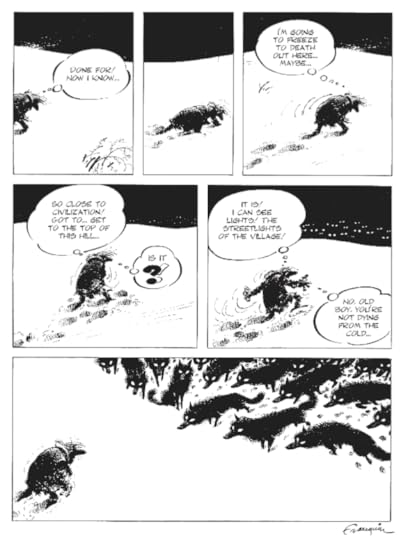
Finally got to read this again after 20 years. Franquin's dark thoughts probably works best if you're familiar with his other work, especially Gaston, whose humour it strips down to the darkest, grimiest despair. This is a comedian who, for the most part, is sick of telling jokes. The satire in Idées is blunt as fuck, and the punchlines don't offer any release; instead Franquin settles for describing a black-and-white cynical world where the only way anybody wins is that the people he doesn't like (hunters, politicians, military, businessmen, etc) may occasionally get a taste of their own medicine. This is a world in which the government's solution to a plague is to order more hearses, where solar flares are explained as the sun throwing up in embarrassment of us, where the welcoming lights of a faraway village turn out to be the eyes of wolves, and where the last two survivors after a nuclear war try to start a fire by smashing two handgrenades together.
Une BD sombre et étonnante au dessin Gaston Lagaffe.
Etonnante parce que souvent, on cherche l'humour : un strip consiste seulement dans le dépeçage d'un mec par une volée de mouettes, un autre à des monstres qui embarquent un cycliste fatigué pour le bouffer. La plupart des gags sont franchement faciles et la chute souvent décevante ne semble être que le passage obligé de cases qui vise d'abord à dénoncer. 40ans plus tôt les cibles sont les mêmes qu'aujourd'hui : les politiques, l'armée, les curés, les chasseurs, la corrida, mais aussi de façon plus surprenante, le nucléaire, voir le progrès tout court (gag des mouches) Il se dégage du bouquin un surprenant gout de réactionnaire, de c'était mieux avant. La satyre est aussi d'une outrance, d'un populisme et d'une mauvaise foi auquels je ne m'attendais pas.
Au final trop peu de gags sont suffisamment travaillés et ils sont trop évidents et attendus pour faire rire mais certains font mouches comme "l’incivique" qui gaspille 20litres d’essence pour s’immoler.
C'est incisif, méchant, rosse avec les êtres violents (en particulier les chasseurs et les militaires… j'adore!). Absolument superbe! Cela fait mouche à chaque fois, cela souligne les incohérences de notre société. Franquin avait vraiment un talent merveilleux qui manque actuellement.
Zwartkijken... I have two books, which were later compiled into this integral album. These are morbid jokes for adults, not intended for children who might enjoy his other books. Recommended to all who like wry smiles...
Terrible et hilarant. Un chef d'oeuvre d'humour noir, qui n'a pas pris une ride. Je me l'étais offert pour mon anniversaire. Bravo bravo bravo et 1000 et un mercis à moi!
Großartig! Awesome! Although it's from the late 80s, the topics are still up-to-date and the stories reflect current news! Brilliant (and very critical) black humor!!!
Dieses Review bezieht sich auf die deutsche Neuauflage als Sonderedition anlässlich des 100. Geburtstags von André Franquin. Diese erschien unter der ISBN 3551798397 und dem Titel "Schwarze Gedanken" im Carlsen Verlag.
»Der Titel sagt alles« steht auf der Rückseite des Buchs. Und tatsächlich könnte ich es dabei bewenden lassen. Am Anfang des Buchs ist ein kurzes Interview mit dem Künstler (in einer Zusammenstellung aus unterschiedlichen Interviews von 1977 bis 1980 aus dem Jahre 2016) abgedruckt, in dem er sagt, dass die »Schwarzen Gedanken« den Leser zum Lachen bringen sollen. Und zwar mit boshaften und zuweilen bösartigen Humor. Und in der Tat sind die gezeigten Comics heftig böse.
Die »Schwarzen Gedanken« kamen Franquin ab 1977, die zuerst einzeln als Magazinbeilage erschienen. Er zeichnete die Gedanken bis zum Jahre 1982. In dieser Gesamtausgabe finden sich alle Comics dieser Serie, chronologisch aufbereitet und in zwei Teilen. Zusätzlich hat der Carlsen Verlag diese Gesamtausgabe in einem großformatigen Hardcover herausgebracht, so dass der Leser die Details besser wahrnehmen kann.
Wer den Künstler kennt, wird wissen, dass er sehr detailreich zeichnet. Seine »Schwarzen Gedanken« hat er durchgehend in Schwarz-Weiß gezeichnet, so dass manchmal eine Seite recht geschwärzt ausschaut. Der Leser muss teilweise genauer hinschauen, um innerhalb der Details zu erkennen, worum es gerade geht. Der Gag selbst hingegen ist meist eindeutig zu erkennen.
Fazit Franquin deutet in seinen Comics die Pointe seines schwarzen Humors nicht nur an, sondern zeigt sie auch, wodurch dieser Comic recht brutal daherkommt. Es ist in der Tat so, dass viele Comics sehr, sehr böse sind. Der Leser muss für die brutalen Pointen gewappnet sein, damit er am derben Humor teilhaben kann.
Jeg tror det var Nemi-bladene som introduserte meg til Franquin og hans Sorte Sider (Idées Noires) som tenåring. Jeg vet folk anbefaler lesere å gjøre seg kjent med hans mer lystige verker som Viggo (Gaston), Spiralis (Marsupilami) og Sprint (Spirou) for å virkelig sette pris på hvor sorte hans sorte tanker er i kontrast, men den kullsvarte humoren fascinerte og appelerte til meg helt uten kontekst den gangen. Jeg hadde aldri sett så elegant utformede vitsestriper med så kullsvart humor før. Innvoller spruter, jorden eksploderer, menn dingler i galgeløkker, alt utført i stilren belgisk monokromatisk tegneseriestil. Tørre og kyniske punchliner om korrupsjon, kapitalisme, forurensning, undertrykkelse, (veldig mange om) jegere, hvor poenget er like mye hvor absurd det hele er som hvor nyttesløst det er at mennesker ikke kan forstå hvorhen det går med verden.
Blir det litt vel tenåringsaktig og ensforming når man setter seg ned og leser hele samlingen i ett? Ja, det må være lov å si det. Den norske oversettelsen er ikke dårlig heller, men bærer litt preg av den norske siderompa oversettertradisjonen for tegneserier der figurer heter sånt som Gunnar Karlsen og alle snakker med en blanding av pent Oslomål anno 1938 og brei slang. Lydeffektene er fremdeles skrevet på fransk, som jeg ikke har en spesiell mening om annet enn at jeg definitivt la merke til det.
Jeg liker fremdeles Franquin's strek og bitre, oppgitte vitser -- men den som fikk meg til å le mest var en detalj i starten av en side der en prest holder opp et kors, for så å svinge det rundt mens han lager flylyder i neste rute. Det er godt med litt avveksling også.
Schwarze Gedanken heißt der Titel, ist aber ziemlich untertrieben, bitterböse Gedanken träfe es eher. Zu Beginn des Buches ist ein kurzes zusammengestelltes Interview mit Franquin abgedruckt, in dem er offenbart, dass seine kleinen Geschichten den Leser zum Lachen bringen sollen, und das schafft er mit seinem schonungslosen und mitunter bösartigem Humor. In dieser Gesamtausgabe finden sich alle Comics dieser Reihe und sind angenehm zu lesen, denn der Carlsen-Verlag hat dieser Jubiläumsedition eine großformatige Hardcover-Ausgabe gespendet. Trotz der detailreichen Zeichnungen muss man als Leser teilweise genauer hinschauen, um zu erkennen, worum es gerade geht, wobei der Clou am Schluss dennoch meist eindeutig zu verstehen ist. Nicht nur optisch ziemlich schwarz, der innewohnende Humor selbst ist pechrabenschwarz. Auch wenn diese Kurzgeschichten schon älter sind, so haben einige davon den Bezug zu heute nicht verloren und sind aktueller denn je, besonders was Kriege und Corona betrifft. Manches ändert sich anscheinend nie... Es ist in der Tat so, dass viele Comics sehr, sehr böse sind. Man sollte schon einen Sinn für solch derben Humor haben und nicht gerade zart besaitet sein.
Reseña: http://www.fabulantes.com/2016/11/ide... "Lo más descorazonador de estas Ideas negras es que muchos, cuando no todos, los excesos y comportamientos que denuncia siguen vigentes actualmente. Incluso la mala praxis política, o el miedo a las dictaduras más sanguinarias, colean aún hoy en este mundo al borde del colapso. Leer Ideas negras es contemplar la actualidad, desnuda de de todas sus distracciones acarameladas o de la épica prefabricada desde los medios. No hay memes felices de cachorritos felinos: en su lugar, el planeta vomita asqueado (en una tira sobre sacrificios humanos aztecas). El destino del hombre queda reflejado en la historieta final, una especie de anverso sin esperanza del colofón a las aventuras de Calvin y Hobbes, en la que un sonriente muchacho profiere un enérgico “¡Vamos! Quien me quiera que me siga“, y es acompañado por un solitario buitre. Para Franquin, la humanidad es pura carroña."
The dark humor is absolutely funny but jarring in it's brutal honesty about the level of scumbaggery and doofusishness that the worst and dumbest of humans have attained.
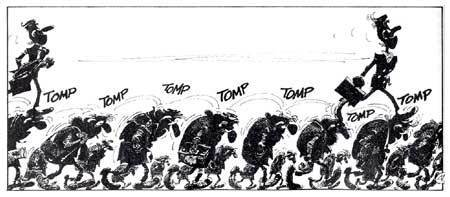
Yet surprisingly, within the category of laughs, the art is the stud of the package. He does the goofy looking people for the effect but does so flawlessly along with everything else in the panels as long as you take the time to look at it closely and appreciate it. ->Standouts: 1. His ever changing signatures, which correspond to the theme above with panache. 2. His lines of movement out in surrounding space that allow you to precisely picture the entire range of actions going on with all the constituents the whole way down to how the hands are shifting!
Dit is de reden waarom de strip als medium is uitgevonden. Franquin onthoofdt in dit boek elke frustratie die de mensheid hem heeft bezorgd met een slordige streek van zijn gitzwarte pen. Onverschillige militairen, natuurvernietigers, corrupte politiekers en meedogenloze kapitalisten krijgen elk op hun beurt een koekje van eigen deeg. En daarnaast valt hier en daar ook wel een bijkomend onschuldig slachtoffer. De tekeningen zijn prachtig en de verhaaltjes variëren van bijtende maatschappijkritiek tot puur absurdisme. Het is vaak die tweede categorie die er het meest uitspringt. Al bij al een toonbeeld van creativiteit en expressie. En dat alles van de tekenaar die mij via zijn Marsupilami als kind voor het eerst enthousiasmeerde voor de kunst van het striptekenen.
Ce n'est pas un hasard si certaines planches des idées noires de Franquin figurent dans le musée de la BD à Bruxelles, logé dans un bâtiment de Victor Horta. Une galerie lui est d'ailleurs spécialement dédiée. Un langage principalement visuel, où les mots viennent confirmer l'horreur grinçante. Franquin en veut aux chasseurs, aux capitaines d'industries qui rognent sur la qualité, aux pollueurs, aux médiocres, aux ignares, aux cupides, aux militaires. C'est un grand massacre organisé à coups de tronçonneuses et de grenades. Une revanche grâce à l'art. Car il vaut mieux en rire qu'en pleurer.
Ich könnte auch 4 Sterne vergeben. Einer der berüchtigsten Bände der Comic-Geschichte. Der sonst so heitere Cartoonist und Comic-Zeichner geriet in eine Depression. Aber er konnte nicht vom Zeichnen lassen. Das hielt ihn vielleicht am Leben. Aber seine Gedankenwelt war tiefschwarz geworden. Nihilister schwarzer Humor. Da bleibt einem schon mal das Lachen im Halse stecken. Eine Seite, eine "Geschichte", die die schlimmste Wendung nimmt. Und das natürlich in schwarz und weiß. Und eine Geschichte reicht pro Tag. Sonst nisten sich Franquins Dämonen länger im eigenen Kopf ein.
André Franquin's spiral into depression lent towards the creation of some of the great comic strips of the '70s. The pages are filled with nihilistic gags, all dark and subdued but surprisingly funny at times. Franquin's meticulous yet gritty linework is splendid to see unfold, and he was able to play with sequential flow so creatively that his strips should be taught in classrooms. There isn't much more to add here, since Franquin's work should be experienced with just the slightest bit of context in mind.
Ouin… la « meilleure B.D. de tous les temps »… on repassera. Il s’agit d’une suite de courtes histoires calquées sur un même procédé narratif répété jusqu’à l’usure. Par exemple : des hommes d’affaires s’élèvent dans les airs à bord de leur avion et discutent avec suffisance de la manière dont ils ont révolutionné l’industrie du boulon grâce à la mondialisation, alors même qu’ils sont en train de perdre un moteur en plein vol. I guess que ça devait être drôle et surprenant dans les années 80…?