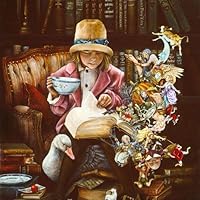
No devoted reader of Beverley Nichols will want to be without Garden Open Tomorrow . The sequel to his famous Garden Open Today (with its open invitation to readers everywhere to come see his garden for themselves), this is his final garden book and the summation of a long career spent enjoying and writing about gardens. Being Beverley Nichols, however, he cannot confine himself to a narrow discussion of gardening for long and provides entertaining asides on cats - including a hilarious critique of feline "ballet" performances - psychic phenomena, and the use of plants to commit murder.
John Beverley Nichols (born September 9, 1898 in Bower Ashton, Bristol, died September 15, 1983 in Kingston, London), was an English writer, playwright, actor, novelist and composer. He went to school at Marlborough College, and went to Balliol College, Oxford University, and was President of the Oxford Union and editor of Isis.
Between his first novel, Prelude, published in 1920, and Twilight in 1982, he wrote more than 60 books and plays on topics such as travel, politics, religion, cats, novels, mysteries, and children's stories, authoring six novels, five detective mysteries, four children's stories, six plays, and no fewer than six autobiographies.
Nichols is perhaps best remembered as a writer for Woman's Own and for his gardening books, the first of which Down the Garden Path, was illustrated — as were many of his books — by Rex Whistler. This bestseller — which has had 32 editions and has been in print almost continuously since 1932 — was the first of his trilogy about Allways, his Tudor thatched cottage in Glatton, Cambridgeshire. A later trilogy written between 1951 and 1956 documents his travails renovating Merry Hall (Meadowstream), a Georgian manor house in Agates Lane, Ashtead, Surrey, where Nichols lived from 1946 to 1956. These books often feature his gifted but laconic gardener "Oldfield". Nichols's final trilogy is referred to as "The Sudbrook Trilogy" (1963–1969) and concerns his late 18th-century attached cottage at Ham, (near Richmond), Surrey.
Nichols was a prolific author who wrote on a wide range of topics. He ghostwrote Dame Nellie Melba’s "autobiography" Memories and Melodies (1925), and in 1966 he wrote A Case of Human Bondage about the marriage and divorce of William Somerset Maugham and Gwendoline Maud Syrie Barnardo, which was highly critical of Maugham. Father Figure, which appeared in 1972 and in which he described how he had tried to murder his alcoholic and abusive father, caused a great uproar and several people asked for his prosecution. His autobiographies usually feature Arthur R. Gaskin who was Nichols’ manservant from 1924 until Gaskin's death from cirrhosis in 1966. Nichols made one appearance on film - in 1931 he appeared in Glamour, directed by Seymour Hicks and Harry Hughes, playing the part of the Hon. Richard Wells.
Nichols' long-term partner was Cyril Butcher. He died in 1983 from complications after a fall.
I love this book so much that I tried to make it last as long as I could. I had several of his other memoirs and think that he was a genius, but for some reason put off reading his gardening memoirs. I am absolutely not a gardener, so I imagined that reading an entire book that someone else wrote about gardening would be boring. I could not have been more wrong! This was a delightful book! I think the man could have written an entire book about paint drying and made it seem like the most fascinating thing ever! This book is actually a sequel to “Garden Open Today” which I am going to find a copy of now as a birthday present to myself.
There never really was much practical gardening information in Beverly Nichols horticulture books, and even when he tries, as in this one, things are a bit sketchy. What’s fun is his turn of a phrase. He’s the only writer horticultural author I know who comes across a bit bitchy. His works really are fun to read, but not very practical today.
The last of Nichols' garden books, this one is in the style of Garden Open Today>, which means it is more directly about planting and growing things than it is about Nichols' own experiences and his goofy neighbors. Nevertheless, this book is filled with interesting and lovely descriptions of plants and gardens.
... all great gardeners... are also great ramblers; they spend the happiest and most significant days of their lives prowling and poking about and going round in circles. The pattern made by their footsteps is of infinite complexity and would probably make little sense to any but a devoted gardener, but by and large it is a pattern of happiness.
Sadly, this isn't one of my favorite books by Nichols. I'd rate it between 3.5 and 4 stars. There are times when his stories are wonderful, but then there are times when he over-described plants/flowers and the book dragged horribly for me.
Another brilliant book by Mr Nichols . For any one with a garden or plants or cats a must read. This is more in detail about the plants and soil but wonderful .
I really enjoy Nichols and his attitude toward gardening, which is a highly stylized one. I have no idea what most of the plants he talks about are, but it scarcely matters. He is an accomplished writer with a good sense of wry humor and a perfectionist as regards all his domestic surroundings.
His love of the garden—and distrust of many of his neighbors—comes through. He's gay and does not come out in the books. This was made a big deal of when I posted about him on Garden Rant, but I don't see why.
Nichols is a witty writer and can write more beautiful prose about a flower than anyone I've read. But I enjoy his books about redoing his homes more than this book. I think it is because at times it was too much detail about a single plant. However, his writing style is one of my favorites so I still get enjoyment from what others might find to be tedious.