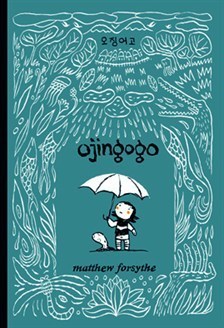
Ojingogo is an illustrated, wordless dreamscape of abstracts and events. The otherworldly pantomime about a girl, her squid, and the creatures and calamities they experience together, is inspired by Forsythe's time spent as an ex-pat living in South Korea.
Matthew Forsythe is an author and illustrator living in Los Angeles.
His first book, Pokko and the Drum, won the Charlotte Zolotow Honor for picture book writing and his second book, MINA, was a Governor General Awards finalist.
He was also a designer on several animated shows including Adventure Time, The Midnight Gospel and the Oscar-nominated film, Robin Robin.
Utterly surreal and slightly abstract, Ojingogo is, to me, exactly what a graphic novel should be: A story told not only in exactly the right visual exchange, but told in the only way possible. This book could not have been represented by words without becoming trite. It is a testament to the power of the graphic novel to convey, succinctly,that which cannot and should not be conveyed by writing. In the words of Depeche Mode: "Words are very unnecessary, they can only do harm".
Many will complain about the book because it bucks narrative conventions on linearity and language, but those exact factors are what makes it genius. The basic message, if there can be said to be one is that things grow larger and become menacing, things grow smaller and become friendly, and cameras tend to make both those things happen. Also good is the fact that the protag is both young and female and yet not once is she made inept or unable because of these things. Also, the squid is one of my favorite creations in a long while. HIGHLY recommended.
Ok, this is supposed to be the swedish edition of the book, but I got a different cover on mine:
I'm not quite sure if I fully understand what the illustrator want to tell us with this story. There is a causal connection between different events that lead to another. And a girl? trying to rescue her camera that have been taken by some "bad guys" and she ended up with a octopus as her companion to reach her quest. But I still don't get it...the meaning is too deep to understand. That extra story at the end were as confusing as the story, don't bother to read it.
This story were just not my cup of tea. The best thing with this book were the profile of the author (every book/manga usually have it at the end). Instead of words, he used his illustration to show us his story and that was more understandable than the story itself LOL
Takes about an hour to read, kind of hard to follow but that might just be because I'm really bad at reading books without words, the art was adorable and the story line was very fantastical, good for all ages
Sure it was nominated for two Eisners but my third star is dependent on the fun and interesting art with well executed choreography within all the antics..
I'll say it: Dream stories are almost always LAZY because they don't have to take any path in particular so how's the reader supposed to follow them? They expect voyeuristic reading because they're so vague and confusing- too personal to elicit any common thread.
I'll also call out those who pretend they get these types in order to seem deep and intuitive. They get just as little as me even if they think otherwise.
There are no words here, but it's very beautiful, bizarre and fantastical graphic novel. The sense of scale is particularly wonderful and I adore the style of the drawings. I wish there was an overarching narrative but I appreciate that this is, in its nature, an abstract collection of interactions in this world.
A young girl, a squid and various creatures on a dream-like journey, borrowing from Eastern myths and really well illustrated. Being nearly silent, it's a quick read, and it doesn't really add up to much, but it's very charming and excellently drawn.
i get that korean was the inspiration for the nonsense language he chose to depict for the various noises the characters make. it's still offensive to make approximations of a real language for the sake of othering or opaqueness in the story.
A mostly wordless graphic novel set in a surrealistic world (think Jim Woodring's Frank, but much more family friendly). A girl with a camera is possibly the central character, but we follow other creatures (a squid, a giant furred biped, some tiny robotic beings) as well, especially as they change size. Forsythe appears particularly interested in how a size change transforms something from a monster (or benevolent god-like entity) into a small pet or irritant. It's a book with nice scratchy detailed linework and a lot to ponder.
Ojingogo is just your average, run of the mill story about a young girl, her pet squid, and a camera stolen by an Octopus which eventually returns as a giant man eating machine.
I think that’s what happened, anyway, it’s really hard to say. This book left me absolutely confused and bewildered, and this is coming from a guy whose favourite film is Mulholland Drive by David Lynch. At least Lynch stories have dialogue. I mean, I get that we’re entering abstract territory here, but this was just a little too straight from the subconscious for me to handle.
I’m trying to find a way to summarize the plot of this graphic novel, and it’s literally the most difficult task I’ve ever faced in my life. My dreams have a tighter narrative structure than what I endured in Ojingogo. To be fair, I think the point of the story is that it is a dream, but again, I’m not sure. So, essentially, girl lives under water? on the moon? and is out taking pictures one day when her camera is kidnapped by a mean Octopus (I say kidnaped because her camera is a very sweet little creature, with its tiny little arms and legs). Our protagonist, a stout little anime girl, seems to be physically capable of battling monsters, and is ferociously protective of her gear, but fails to save the camera nonetheless. At least, I think this is what is happening, but who can really tell?
Anyway, from there, I’m totally lost. Every panel seems to segue to some other completely random event, spawning more and more strange creatures, some of which appear huge relative to our protagonist, but they are immediately dwarfed by the even huger insects that swoop in to carry them away. There are also a bunch of little two dimensional square guys that run around, and at one point, they tie down the much larger and vicious cube monster, which I suppose is a good thing? Then some little Mummy like creatures appear from out of nowhere with over-sized cutlery, and they unsuccessfully attempt to eat the girl as she sleeps. They even brought a giant salt shaker for the feast!
Aside from the intentionally inscrutable plot, I did enjoy the playfulness of the simple black and white illustrations. The characters themselves are undeniably charming, originally strange, and incredibly imaginative. Without words to guide you towards any possibly point the creator is attempting to make, I found myself interpreting the illustrations of the funny little creatures in my own way, and perhaps, that is the point. But again, I have no idea, really.
Somehow, this was nominated for Eisner awards in 2004 and 2006. I’ll give it 3 stars, only because I can’t give it 2.5 on the Goodreads scale, and I did enjoy the illustrations, regardless if the “story” left me slightly perplexed for an afternoon.
This book might not be ideal for kids under 13, not because it’s offensive in any way, but I just don’t think that they would find it very amusing or interesting. I’d definitely recommend this book to the nearest hipster, though.
Gorgeous without being lavish, complicated without becoming opaque, playful without losing its sense of drama: what a delightful book this is. Across the play of size & perspective (Jonathan Swift's most famous scene gets a shoutout here) weaves a story about loss and recovery, complete with dramatic foils, a marvellously composed villain, and a compelling young heroine.
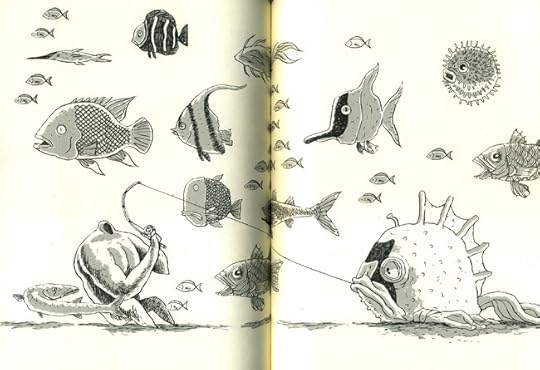
Just look at the kind of spread Forsythe is capable of:
Okay -- I don't know what to rate this because I had trouble reading/following it but the pictures were very cute! I think that the language in the book is supposed to be made up? It looks a bit like Korean, but I think the point is for it to be more like "The Arrival" or something where it is a nonsense language? I don't know. I guess I just didn't really understand it, but the characters would be adorable on a poster or t-shirt...
I love Matthew Forsythe's illustrations and this is a great tale of adventure (mostly word free), with a bit of fantastic surrealism thrown in. Unfortunately, this was originally published as a webcomic and when it got bound, some of the larger, glorious illustrations, got sucked into the spine. So you lose a bit of the feel in this binding, which is just so sad. I hope that if there are other bindings, they treat Forsythe's illustrations with the care they deserve.
In this simple yet highly unique graphic novel, Matt Forsythe's web-comic is displayed for readers. The design, wonderful illustrations and narrative of Ojingogo can capture the attention of a person who does not typically enjoy graphic novels. I read through this in one sitting and was interested until the very last page. It was truly a fun and entertaining way to pass a little bit of time.
Short review more for notes than anything else: a completely wordless story drawing on Asian influences. Fantastic illustrations and a story that has to be "read" a couple of times to see what was missed the first go round. Now if I can just find a copy of this book for a reasonable price
Always a huge fan of whimsical artwork. The story was difficult to follow on first read. It is one that needs a second or third read to be re-savoured. The lack of dialogue means we're taking interpretation from images, which requires some thought.
It is a slightly confusing, but sweetly illustrated book. There is no text, but that didn't stop it from being interesting. I think I read it twice because it only took ten minutes.