

What do you think?

Booker T. Washington #1
Booker T. Washington: The Making of a Black Leader, 1856-1901
A model biography, superbly researched and written . . . sure to (become) the last word on this stage of Washington's career for many years to come (History).
400 pages, Paperback
First published January 1, 1972
About the author
Louis R. Harlan
19 books2 followersLouis Rudolph Harlan was an American historian and academic whose two-volume biography of African-American educator and social leader Booker T. Washington was awarded the 1973 Bancroft Prize for the first volume as well as the 1984 Bancroft Prize and Pulitzer Prize for the second volume.
Ratings & Reviews
Friends & Following
Create a free account to discover what your friends think of this book!
Community Reviews
Displaying 1 - 5 of 5 reviews

June 15, 2010
This book convinced me of Washington’s admirable qualities as a struggling youth, and reinforced my contempt for the leadership he exercised in maturity. I cannot help but respect the hardscrabble Horatio Alger triumph, the struggle up from slavery and salt mining to education and worldly power; but Washington’s possession of that power was contingent upon his flattery of white elites, his sugarcoating of labor relations in the “New” South and industrial North, and, most egregiously, his impassioned alacrity in selling blacks a bogus plan for making it in the Gilded Age.
The Civil War years saw not only the defeat of states’ rights, but the centralization of banking, the standardization of currency, and the emergence of a modern industrial powerhouse. In Bernard DeVoto’s ever-applicable line, America was in the process of becoming something it had not been. The rules of the game were changing:
Booker T. Washington, nine years old at emancipation, was one such bastard of the West. He was clothed in New Englanders’ charitable cast-offs and educated to their political economy just as it was becoming irrelevant and mendacious cant. After a boyhood in slavery, adolescence in West Virginia mines, snatching a little book-leaning when and where he could, Washington arrived at the Hampton Institute. Hampton was bastion of the postwar missionary efforts of New Englanders out to initiate the ex-bondsmen of the shoeless South into a Puritan culture of honest Christian toil (when in the 1870s Hampton took to educating Native Americans, Washington would serve as vice-principal of the captured braves being taught farming). Hampton’s president, Samuel Chapman Armstrong—good tripartite New England name—was the Hawaii-born son of missionaries and a former general of Massachusetts volunteers in the late war who scheduled military drill and white glove inspections among Hampton’s regular classes. Washington was educated in the antebellum Yankee culture Henry Adams describes, one of agriculture and handiwork, of dour thrift, anxious cleanliness, and a grimly dogmatic optimism. The economic ideas Washington was taught—a “worldly asceticism,” Max Weber called it—assumed the inevitable prosperity of the hardworking and uncomplaining; and by extension the superior virtuousness of the rich, the moral weakness of the poor, and the roguery of labor agitators who would tamper with a natural distribution of rewards.
That classic American self-reliance, psychology over sociology, which Washington imbibed and then prescribed to fellow blacks, grew out of the rural and small town milieu of the antebellum North—a world of small workshops and prosperous yeomen, in which a high degree of social mobility could be assumed, large corporations were rare, markets local and industry decentralized, and wage earning a youthful phase before one accumulated sufficient capital to buy one’s own farm or open one’s own workshop. But the old Puritan beliefs were far behind the high-powered industrial economy that arose in the 1850s and exploded under the federal government’s need to equip, supply and transport what was by 1865 the world’s largest land army and largest navy (immediately after accepting Lee’s surrender, Grant says he “determined to return to Washington at once, with a view to putting a stop to the purchase of supplies”—to yank war contractors off the public teat). The postwar economy was one in which vast fortunes were just as likely to be the fruit of speculative cunning, political skullduggery, shoddy war goods or land grants to railroads as of honest toil and patient virtue; in which concentrated corporate wealth grew from mammoth factories worked by a tenement-housed urban proletariat, a low-skilled, socially static mudsill class of blacks, recent immigrants, and dispossessed small farmers; it was also an economy in which labor was purposely degraded and endangered to maximize the profits of bosses.
Ideology always lags behind conditions. And the old Puritan political economy was additionally tenacious because it had always defined the national experiment for many Americans, and because it had recently experienced its ideological-propaganda apotheosis, as cornerstone of the Republican Party ideology that had elected Lincoln and mobilized and sustained Northern society through the world’s first industrialized total war. The socially mobile wage earner-turned-entrepreneur was a cultic figure for Republicans, and the “dignity of free labor” a rallying cry of their revolution against the “Slave Power.” Lincoln and others had forcefully contrasted the enterprising, egalitarian North with the feudal and hierarchal South; had galvanized Northern sentiment against the slave-owners by raising the specter of slavery in the West. If Northerners didn’t wake up, Republicans bellowed from the stump, then the idle, dueling, harem-keeping planters would lord over the promised lands of the territories where God intended Everyman to have his bountiful homestead—and the empire of liberty would decline into yet another dreary master-slave despotism—and America’s world-enlightening flame would gutter out.
So, before I start reviewing Free Soil, Free Labor, Free Men, instead of the book at hand—though I love it when concurrent readings reveal one another; I would have been more snidely dismissive of Washington’s economic ideas if Foner hadn’t taught me their ideological centrality to the age—I should wrap things up by saying that the idea of every laborer as a nascent capitalist, of clean living and hard work meeting no structural obstacle on the way to wealth, though compromised by the actual conditions of the Gilded Age, grew from the oldest American feelings, defined the creed of the party that had lately saved the country, justified (while falsifying) the economic status quo, and served as a humility-counseling hand-me-down for restive Have-Nots like Indians and immigrants and blacks; plus, it’s not total bullshit. Sounds like a durable ideology to me! (That the political success of free labor ideology should justify the degradation of labor is, of course, a delicious irony.) And indeed, it endures today, when our banking system resembles that of a prelapsarian New England village even less than it did in the 1870s.
Washington’s famous antagonist W.E.B. Du Bois was a native New Englander and a graduate of 1890s Harvard, so his education wasn’t any more Marxian than Washington’s. Du Bois, however, was never one to leave assumptions unexamined for too long. His later opposition to Washington’s counsel to blacks to embrace diligent agricultural and industrial labor before higher education and political agitation stemmed from a realization that the old Yankee self-reliance didn’t fit the real economy, in particular the economic straits of blacks, who were purposefully kept in the lowest wage jobs. Du Bois’s Department of Labor-sponsored studies of blacks in the American economy, and his pioneering urban fieldwork enshrined in The Philadelphia Negro (1900), found that color prejudice, in the form of housing restrictions, shitty schools and explicit exclusion from high-skilled industrial trades, presented an often insurmountable barrier to black economic emergence from Northern ghettos. Add racially-motivated proletarianization-ghettoization in the North to the de facto slavery of Southern sharecropping and the convict-lease system (blacks without sharecropping contracts could be arrested as vagrants, and their prison labor leased to factories like the massive Birmingham, Ala. works of Carnegie’s U.S. Steel), and you have a situation in which Washington’s gospel of the irresistibility of patient toil amounts to a cruel joke. And Washington’s resignation of civil rights agitation was transparently ridiculous: how were Southern blacks to bargain for living wages, purchase and protect property, and negotiate fair prices for their crops from positions of legal and civic nonentity?
So why did Washington peddle bullshit? Power. Washington was an ex-slave, distrusted whites, and would tell them what they wanted to hear if that got him the power he wanted. The success of his Tuskegee Institute, and by extension his eminence as Head Negro In Charge, depended on the good will of Southern whites and the patronage of northern robber barons. Harlan describes him as a virtuoso declaimer of the canting platitudes in which the justice and divine fairness of Gilded Age capitalism were proclaimed. Du Bois had greater intellectual integrity, a philosophic calling, and—let’s be real—the naiveté and arrogance of a pampered prodigy whose childhood, while poor, simply couldn’t match Washington’s for sheer disillusioning squalor. Du Bois took up sociology thinking that by scientifically establishing the truth about American society, honors and gratitude would flow his way (Washington was never so naïve). But the wealthy interests whose philanthropies funded American higher education in those days did not want to hear what he had to say, did not want to hear that the poorest Americans were often poor not because of moral weakness or loose living or “dependent natures,” but because of structural discouragements and caste barriers built into the supposedly meritocratic system. Du Bois’s prickly adult manner owes something to bitterness at being sidelined at the brilliant outset of his career.
Washington was something of a rube, full of folksy “wisdom” and barnyard quips, his highest reach of refinement the smug proclamation of Mrs. Bridge maxims about keeping your boots clean and collars pressed, garlanded with perfunctory classical allusions and the dialect-heavy “darkey” jokes his white audiences always loved. The nineteenth century’s motivational lyricism, its poetry of management, is no more readable than ours. Du Bois, with his broad culture, ever-evolving interests and multi-disciplinary achievements in economic history, sociology, fiction and autobiography, and his sheer dynamic grapple with the American scene, is more fun to read about (Harlan is an excellent historian, but this book is boring). There’s a great moment in Levering Lewis’s biography (of Du Bois) in which Du Bois and Washington pay court to Andrew Carnegie. Waiting in the anteroom, Washington turned to Du Bois and gravely inquired if he had read Carnegie’s recent book—a book Carnegie was particularly proud of and would expect to hear praised in the course of the meeting. Du Bois looked at Washington as if he were crazy, it having never occurred to him that a ghostwritten CEO memoir merited inclusion in his rarefied regime of classical economics and German literature—even if its “author” controlled desperately needed funds. You gotta love that!
Washington is a relic, a majority group-chosen “minority group boss”—
—but I think blacks must reckon with him. He’s a particularly vivid and accessible instance of the slave mentality—of the slave as an emotionally opaque yes-man, not a rebellious funk badass of the inspiriting but all-too-rare Frederick Douglass type. Washington’s frozen acceptance of personal insult, his burying of hurt in some secret chamber, his willingness to tell the enemies of his people whatever they wanted to hear—these were the survival strategies of most blacks through most of American history. Our confident self-actualization should not obscure how we used to figure in American life: humoring grins, ghostly hearts.
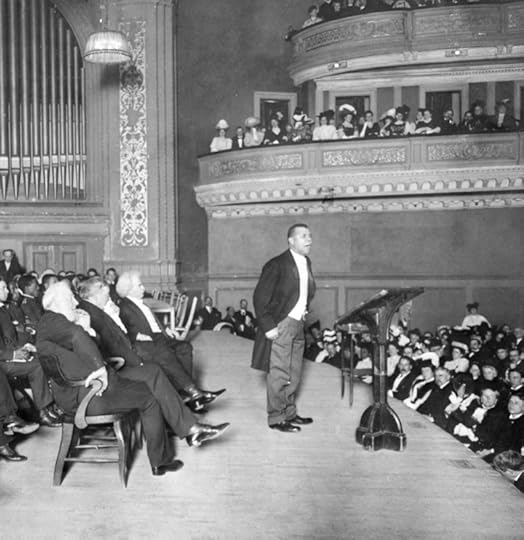
The Civil War years saw not only the defeat of states’ rights, but the centralization of banking, the standardization of currency, and the emergence of a modern industrial powerhouse. In Bernard DeVoto’s ever-applicable line, America was in the process of becoming something it had not been. The rules of the game were changing:
Society in America was always trying, almost as blindly as an earthworm, to realize and understand itself; to catch up with its own head, and to twist about in search of its tail. Society offered the profile of a long, straggling caravan, stretching loosely toward the prairies, its few score of leaders far in advance and its millions of immigrants, negroes and Indians far in the rear, somewhere in archaic time…One could divine pretty nearly where the force lay, since the last ten years [the 1860s:] had given to the great mechanical energies—coal, iron, steam—a distinct superiority in power over the old industrial elements—agriculture, handiwork, and learning...(Henry Adams)
Jay Gould is the mightiest disaster which has ever befallen this country. People had desired money before his day, but he taught them to fall down and worship it. They had respected men of means before his day, but along with this respect was joined the respect due to the character and industry which had accumulated it. But Jay Gould taught the entire nation to make a god of the money and the man, no matter how the money may have been accumulated.(Mark Twain)
The whites who administered Native American subjugation claimed to be recruiting the Indians to join them in a truer, more coherent worldview—but whether it was about spirituality and the afterlife, the role of women, the nature of glaciers, the age of the world, or the theory of evolution, these white Victorians were in a world topsy-turvy with change, uncertainty and controversy. Deference was paid to Christianity and honest agricultural toil, but more than few questioned the former, and most, as the gold rushes, confidence men, and lionized millionaires proved, would gladly escape the latter. So the attempt to make Indians into Christian agriculturists was akin to those contemporary efforts whereby charities send cast-off clothing to impoverished regions: the Indians were being handed a system that was worn out...(Rebecca Solnit)
Booker T. Washington, nine years old at emancipation, was one such bastard of the West. He was clothed in New Englanders’ charitable cast-offs and educated to their political economy just as it was becoming irrelevant and mendacious cant. After a boyhood in slavery, adolescence in West Virginia mines, snatching a little book-leaning when and where he could, Washington arrived at the Hampton Institute. Hampton was bastion of the postwar missionary efforts of New Englanders out to initiate the ex-bondsmen of the shoeless South into a Puritan culture of honest Christian toil (when in the 1870s Hampton took to educating Native Americans, Washington would serve as vice-principal of the captured braves being taught farming). Hampton’s president, Samuel Chapman Armstrong—good tripartite New England name—was the Hawaii-born son of missionaries and a former general of Massachusetts volunteers in the late war who scheduled military drill and white glove inspections among Hampton’s regular classes. Washington was educated in the antebellum Yankee culture Henry Adams describes, one of agriculture and handiwork, of dour thrift, anxious cleanliness, and a grimly dogmatic optimism. The economic ideas Washington was taught—a “worldly asceticism,” Max Weber called it—assumed the inevitable prosperity of the hardworking and uncomplaining; and by extension the superior virtuousness of the rich, the moral weakness of the poor, and the roguery of labor agitators who would tamper with a natural distribution of rewards.
That classic American self-reliance, psychology over sociology, which Washington imbibed and then prescribed to fellow blacks, grew out of the rural and small town milieu of the antebellum North—a world of small workshops and prosperous yeomen, in which a high degree of social mobility could be assumed, large corporations were rare, markets local and industry decentralized, and wage earning a youthful phase before one accumulated sufficient capital to buy one’s own farm or open one’s own workshop. But the old Puritan beliefs were far behind the high-powered industrial economy that arose in the 1850s and exploded under the federal government’s need to equip, supply and transport what was by 1865 the world’s largest land army and largest navy (immediately after accepting Lee’s surrender, Grant says he “determined to return to Washington at once, with a view to putting a stop to the purchase of supplies”—to yank war contractors off the public teat). The postwar economy was one in which vast fortunes were just as likely to be the fruit of speculative cunning, political skullduggery, shoddy war goods or land grants to railroads as of honest toil and patient virtue; in which concentrated corporate wealth grew from mammoth factories worked by a tenement-housed urban proletariat, a low-skilled, socially static mudsill class of blacks, recent immigrants, and dispossessed small farmers; it was also an economy in which labor was purposely degraded and endangered to maximize the profits of bosses.
Ideology always lags behind conditions. And the old Puritan political economy was additionally tenacious because it had always defined the national experiment for many Americans, and because it had recently experienced its ideological-propaganda apotheosis, as cornerstone of the Republican Party ideology that had elected Lincoln and mobilized and sustained Northern society through the world’s first industrialized total war. The socially mobile wage earner-turned-entrepreneur was a cultic figure for Republicans, and the “dignity of free labor” a rallying cry of their revolution against the “Slave Power.” Lincoln and others had forcefully contrasted the enterprising, egalitarian North with the feudal and hierarchal South; had galvanized Northern sentiment against the slave-owners by raising the specter of slavery in the West. If Northerners didn’t wake up, Republicans bellowed from the stump, then the idle, dueling, harem-keeping planters would lord over the promised lands of the territories where God intended Everyman to have his bountiful homestead—and the empire of liberty would decline into yet another dreary master-slave despotism—and America’s world-enlightening flame would gutter out.
So, before I start reviewing Free Soil, Free Labor, Free Men, instead of the book at hand—though I love it when concurrent readings reveal one another; I would have been more snidely dismissive of Washington’s economic ideas if Foner hadn’t taught me their ideological centrality to the age—I should wrap things up by saying that the idea of every laborer as a nascent capitalist, of clean living and hard work meeting no structural obstacle on the way to wealth, though compromised by the actual conditions of the Gilded Age, grew from the oldest American feelings, defined the creed of the party that had lately saved the country, justified (while falsifying) the economic status quo, and served as a humility-counseling hand-me-down for restive Have-Nots like Indians and immigrants and blacks; plus, it’s not total bullshit. Sounds like a durable ideology to me! (That the political success of free labor ideology should justify the degradation of labor is, of course, a delicious irony.) And indeed, it endures today, when our banking system resembles that of a prelapsarian New England village even less than it did in the 1870s.
Washington’s famous antagonist W.E.B. Du Bois was a native New Englander and a graduate of 1890s Harvard, so his education wasn’t any more Marxian than Washington’s. Du Bois, however, was never one to leave assumptions unexamined for too long. His later opposition to Washington’s counsel to blacks to embrace diligent agricultural and industrial labor before higher education and political agitation stemmed from a realization that the old Yankee self-reliance didn’t fit the real economy, in particular the economic straits of blacks, who were purposefully kept in the lowest wage jobs. Du Bois’s Department of Labor-sponsored studies of blacks in the American economy, and his pioneering urban fieldwork enshrined in The Philadelphia Negro (1900), found that color prejudice, in the form of housing restrictions, shitty schools and explicit exclusion from high-skilled industrial trades, presented an often insurmountable barrier to black economic emergence from Northern ghettos. Add racially-motivated proletarianization-ghettoization in the North to the de facto slavery of Southern sharecropping and the convict-lease system (blacks without sharecropping contracts could be arrested as vagrants, and their prison labor leased to factories like the massive Birmingham, Ala. works of Carnegie’s U.S. Steel), and you have a situation in which Washington’s gospel of the irresistibility of patient toil amounts to a cruel joke. And Washington’s resignation of civil rights agitation was transparently ridiculous: how were Southern blacks to bargain for living wages, purchase and protect property, and negotiate fair prices for their crops from positions of legal and civic nonentity?
So why did Washington peddle bullshit? Power. Washington was an ex-slave, distrusted whites, and would tell them what they wanted to hear if that got him the power he wanted. The success of his Tuskegee Institute, and by extension his eminence as Head Negro In Charge, depended on the good will of Southern whites and the patronage of northern robber barons. Harlan describes him as a virtuoso declaimer of the canting platitudes in which the justice and divine fairness of Gilded Age capitalism were proclaimed. Du Bois had greater intellectual integrity, a philosophic calling, and—let’s be real—the naiveté and arrogance of a pampered prodigy whose childhood, while poor, simply couldn’t match Washington’s for sheer disillusioning squalor. Du Bois took up sociology thinking that by scientifically establishing the truth about American society, honors and gratitude would flow his way (Washington was never so naïve). But the wealthy interests whose philanthropies funded American higher education in those days did not want to hear what he had to say, did not want to hear that the poorest Americans were often poor not because of moral weakness or loose living or “dependent natures,” but because of structural discouragements and caste barriers built into the supposedly meritocratic system. Du Bois’s prickly adult manner owes something to bitterness at being sidelined at the brilliant outset of his career.
Washington was something of a rube, full of folksy “wisdom” and barnyard quips, his highest reach of refinement the smug proclamation of Mrs. Bridge maxims about keeping your boots clean and collars pressed, garlanded with perfunctory classical allusions and the dialect-heavy “darkey” jokes his white audiences always loved. The nineteenth century’s motivational lyricism, its poetry of management, is no more readable than ours. Du Bois, with his broad culture, ever-evolving interests and multi-disciplinary achievements in economic history, sociology, fiction and autobiography, and his sheer dynamic grapple with the American scene, is more fun to read about (Harlan is an excellent historian, but this book is boring). There’s a great moment in Levering Lewis’s biography (of Du Bois) in which Du Bois and Washington pay court to Andrew Carnegie. Waiting in the anteroom, Washington turned to Du Bois and gravely inquired if he had read Carnegie’s recent book—a book Carnegie was particularly proud of and would expect to hear praised in the course of the meeting. Du Bois looked at Washington as if he were crazy, it having never occurred to him that a ghostwritten CEO memoir merited inclusion in his rarefied regime of classical economics and German literature—even if its “author” controlled desperately needed funds. You gotta love that!
Washington is a relic, a majority group-chosen “minority group boss”—
...blacks had virtually nothing to do with making Washington a black leader. The death of Frederick Douglass only a few months before the Atlanta Address not only left a vacuum for someone to fill, but marked the end of an era in which the old fighter for human rights had personified the aspirations of the race. But it was white people who chose Washington to give the address, and white people’s acclaim that established him as the negro of the hour. Southern conservatives in charge of the Atlanta Exposition choose Booker Washington rather than any one of a dozen Negroes at least as prominent, because they regarded him as a “safe” Negro counselor, one whom they wanted to encourage, and his speeches in Atlanta in 1893 and before the Congressional committee in 1894 were reassurances of his conservatism. The Southerners sought a black man who would symbolize that Reconstruction was over, and one they could consider an ally against not only the old Yankee enemy but the Southern Populist and labor organizer. They wanted a black spokesman who could reassure them against the renewal of black competition and racial strife. And Northern whites as well were in search of a black leader who could give them a rest from the eternal race problem. They, too, were ready to declare an end to the Civil War and Reconstruction, and sought an intersectional truce. They were ready for an alliance of Northern and Southern capital and for political alliances across sectional lines. Booker T. Washington’s racial Compromise of 1895, as August Meier notes, “expressed Negro accommodation to the social conditions implicit in the earlier Compromise of 1877.” As often in his career, Washington’s rise coincided with a setback of his race.
—but I think blacks must reckon with him. He’s a particularly vivid and accessible instance of the slave mentality—of the slave as an emotionally opaque yes-man, not a rebellious funk badass of the inspiriting but all-too-rare Frederick Douglass type. Washington’s frozen acceptance of personal insult, his burying of hurt in some secret chamber, his willingness to tell the enemies of his people whatever they wanted to hear—these were the survival strategies of most blacks through most of American history. Our confident self-actualization should not obscure how we used to figure in American life: humoring grins, ghostly hearts.

July 14, 2024
This book acts as a time capsule from a time when Booker T Washington was being reassessed in the public mind in light of new black leaders that emerged in the 60s. I feel like some of the reviews on this site are more about Washington rather than the book. It is now unfashionable to think of Washington as anything but a race traitor. Popular history has at times lost perspective in our current era and it is true that the obsequiousness and tragic openness evinced by Washington to forego long term gains in negotiations with Southern Segregationists appear indefensible in a modern context. What I liked about this book was its engagement with these subject matter, the attempt to show “both Bookers.” Harlan does not give Booker a pass, but does allow for his subject to misread the often conflicting tides of the post reconstruction era.

September 12, 2021
Very easy to read, fascinating story> I learned much that I didn't know.
I recommend this to all who wish to truly understand the history of race relations in the USA.
I recommend this to all who wish to truly understand the history of race relations in the USA.

December 16, 2023
He was who he was and he did what he did

June 8, 2015
In this first of two volumes of biography by Harlan, Washington is characterized by the author as a dissembling, cynical, manipulator of racial issues for his own self-aggrandizement. Granted that Washington was at times very protective of his position of economic and political power, and that he was not as outspoken on issues of race as we might like from the distance of a century away, I find no evidence in the writing or the notes that Washington was anything other than a great educator and smart leader who was sincere in his positions and practices.
While at the National Historic site that marks Washington's birthplace in western Virginia (a worthwhile trip a bit off the beaten path), I purchased and read Washington's story Up from Slavery (Dover Thrift Editions) in his own words. That's a better starting point than this volume from Harlan.
Harlan does a better job taking the mature Washington through his growing political career, and examining his historical and cultural impact in Booker T. Washington: Volume 2: The Wizard Of Tuskegee, 1901-1915 (Oxford Paperbacks).
While at the National Historic site that marks Washington's birthplace in western Virginia (a worthwhile trip a bit off the beaten path), I purchased and read Washington's story Up from Slavery (Dover Thrift Editions) in his own words. That's a better starting point than this volume from Harlan.
Harlan does a better job taking the mature Washington through his growing political career, and examining his historical and cultural impact in Booker T. Washington: Volume 2: The Wizard Of Tuskegee, 1901-1915 (Oxford Paperbacks).
Displaying 1 - 5 of 5 reviews