In the first complete account of the Druze, Robert Brenton Betts provides a general survey of the history, traditions, and society of this secretive Arab sect. Betts, who has spent a great deal of time with the Druze, interweaves his firsthand observations with a wealth of primary and secondary sources, describing not only their thousand-year history but also their political significance in today’s Middle East. “A deeply informed, brightly written account of the Druze that will be read with profit by students of Middle East history, politics, religion, and anthropology as well as by everyone with an interest in Lebanon, Syria, and Israel.”―Michael C. Hudson, Georgetown University “A broad and exotic historical view.”― Jewish Chronicle “A most illuminating essay.”― Choice “An excellent introduction to the study of the Druze…. Betts adds an extra flavor to his study by providing personal impressions based on his first-hand knowledge of the Druze villages and towns in Lebanon, Syria, and Israel.”―Marius Deeb, Middle East Journal “A first-rate authoritative general survey.”―John Clark, Theological Book Review
This is one of very few books available about the Druze, who are a fascinating people-group of the Middle-east. Not Muslim, Christian, or Jewish, they sustain a hybrid sort of esoteric religion about which non-Druze know little. Certainly that is exemplified by this author who scarcely scrapes the surface of authentic Druze culture, instead reporting more political history, as was likely gleaned from news and other publications, much like the efforts expected from a juvenile term paper. And we discover even the political history within this book to be dated by about 30 years.
Granted though, because the Druze do not proselytize and believe their spirits are reincarnated only within the Druze community, detailed information about their religious practices is difficult to obtain. The Druze form close-knit, tight communities that do not allow non-Druze in, but nevertheless blend within the dominant states where they reside to avoid persecution. The Druze will, if necessary, claim to be Christian or Muslim, in order to avoid persecution. Like the ancient Gnostics, they do not embrace martyrdom.
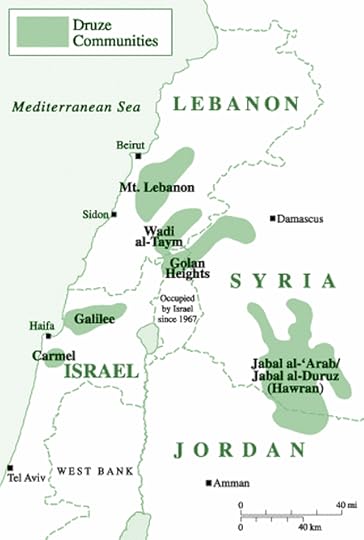
The Druze are an Arab speaking people who have persisted for over 1000 years, having fought in the Crusades. The modern Druze are situated within the overlapping States of Syria, Israel, and Lebanon. The Druze continue to identify themselves as interrelated, even across the borders of the nationalities where they reside.
The oldest and most dense conglomerations of Druze are found in Mount Lebanon and the south of Syria around Jabal al-Druze. Prominent Druze communities are illustrated in the following graphic:
Too little is really known about the true make-up of Druze religion, but various authors describe it as a fusion of gnosticism, unitarianism, Islam, Hinduism and Platonic Christianity. From what I can ascertain form my readings, it seems considerably congruent with Gnosticism and certainly it is not unreasonable to expect a people as ancient and secretive as this to bear Gnostic attributes. It is indeed a monotheistic and Abrahamic religion. Like Christians, the Druze believe God was incarnated into human beings; but, unlike Christians, they seem to recognize this somehow as continuing into descendants. The Druze reject nicotine, alcohol, and other drugs. They also reject polygamy.
The Druze have been targeted by the Islamic State of Iraq and Al-Qaeda in their efforts to cleanse Syria and neighboring countries of non-Islamic influence. Nevertheless, the Druze faith is one of the major religious groups in the Levant, with nearly a million adherents.
The Druze follow seven moral precepts that are considered the core of the faith:
(1) Veracity in speech and truthfulness of tongue. (2) Protection and mutual aid to the brethren in faith. (3) Renunciation of all forms of invalid creeds and false beliefs. (4) Repudiation of all forces of evil. (5) Confession of God's unity. (6) Acquiescence in God's acts no matter what they be. (7) Absolute submission and resignation to God's divine will in both secret and public.
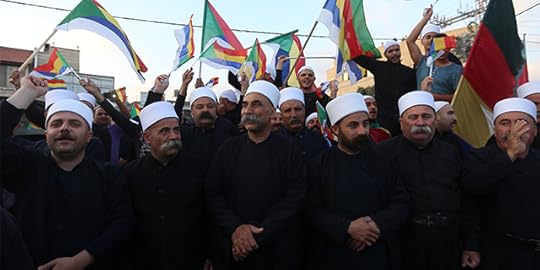
The Druze avoid iconography but use five colors (green, red, yellow, blue, and white) for identification, arranged in a flag or a five-pointed star. The graphic below depicts male Druze attire and flags.
Like the Gnostics, the Druze do not recognize religious hierarchy and permit women to rise within the religious foundation. However, only a few of the Druze are fully initiated into the utmost secrets of the sect. Most maintain only a broad idea of their theology. A smaller proportion (less than 10%) are fully initiated into the secrets of the theology and these include women of the society.
Perhaps the most tragic thing about the Druze is how they have been mis-characterized by the fake news media that dominates the American press, which tends to lump every Non-Christian middle-eastern sect as a radical Islamic terrorist. It is a tragedy that Americans must suffer the daily politicalization of the dominant press networks that constantly attempt to influence elections, even while vilifying others for doing so.
Unfortunately, Freedom of Press has for too long only applied to those who own the press and the result is proliferation of untruths that promote war, instability and exploitation. Taking time to explore beyond the press, to look more inquisitively into the real beliefs of those the fake news media chooses to vilify, will often offer pleasant surprises.