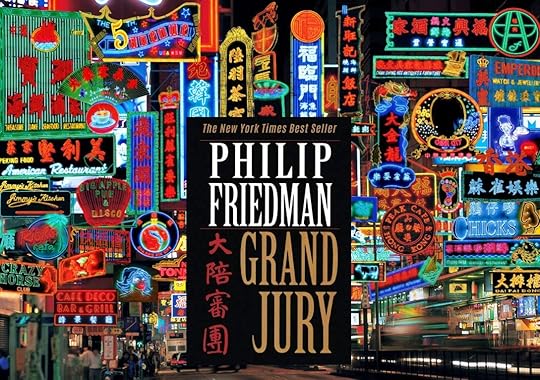
The New York police seize more than a million dollars tainted with heroin powder, implicating two elderly and distinguished Chinatown residents. Their case is rushed before the grand jury.
Susan Linwood and David Clark are strangers before being asked to serve in the name of justice. Yet as prosecuter Dan Mahoney presents the drug-conspiracy case, they soon become completely absorbed with the proceedings - and increasingly with each other.
As Mahoney struggles with facts that refuse to fit the crimes his superiors have told him to pursue, Linwood and Clark are launched onto a treacherous path to Hong Kong and China, to the edge of disaster - uncovering an ultimate truth with chilling, worldwide implications.
Philip Friedman’s novels Reasonable Doubt, Inadmissible Evidence and Grand Jury spent a total of 26 weeks on The New York Times’ bestseller lists, and appeared on bestseller lists around the world. His cold war thriller, Termination Order, called “one of the best of the year,” was a New York Times Notable Book. He is also the co-author of The Pilates Method of Physical and Mental Conditioning, the book that first brought Pilates to a wide audience. Vogue called it “one of our favorite exercise books.”
Writing as Philip Chase, he has written four thrillers about Bill Kendall and Ron Eisenberg and their team, top secret military investigators for the Chairman of the Joint Chiefs of Staff.
Mr. Friedman has also written for The New York Times, Elle, and The Forward, among others. He is a former member of the National Board of Mystery Writers of America and is a member of the Authors Guild and the Dramatists Guild. He served on the Board of Directors of Learning in Focus, producer of the award-winning American Short Story series. He studied mathematics (and lots of other things) at Princeton University and holds a law degree from NYU.
When Susan and David are in the Grand Jury, they get entangled in a case that doesn't seem to add up. Susan decides to do some investigating, as her sense for justice won't let her leave it alone. Both she and David get tangled up into something much more dangerous than they anticipated.
This book has a serious issue with pace. I can say this quite confidently, it isn't just me. Just read some of the other reviews here. This book could have done with half the page count easily. The first 2/3rds I felt like I had to dig through with a spade, that is how slow it was. Then the last bit was so thrilling and exciting that I had to stay awake to finish it.
So, it gets 3 stars for me, even though I'm not entirely sure wading through those first 400 pages was worth it just to get to the last bit.
Shifting from the Pope controlled Medieval Inquisitions, the reign of terror established around 1478 by King Ferdinand II of Aragon and Queen Isabella I of Castile, both subscribing to Catholic faith, ruled supreme in all Spanish lands, both original as well as those seized and stolen. Lasting a smidge over fifty years, the Spanish Inquisition wreaked havoc on about 150,000 lives and brutally ended about five thousand, give or take, in Spain, Naples, and both North and South America. Good record keeping wasn't in its heyday back then. The modern equivalent, as it were, is the New York State GRAND JURY, a bevy of twenty-three members, 16 of which have to be present to getting work done, functioning as a quasi rubber stamp process for the mighty state prosecutors, backed by law enforcement. Running through almost six thousand cases per year, the assembled grand juries hand down indictments 70% of the time. Dealing with Chinese money laundering like Mel Gibson's PAYBACK, Philip Friedman's GRAND JURY swaps a dirty-money heist by a bunch of crooks to hard currency cash theft perpetrated by cops under shady asset forfeiture laws, turning it into Grand Theft Jury.
Deep in the bubbling cauldron of a literary HOT TUB TIME MACHINE, GRAND JURY sits smack dab in the middle of the 1990s, dialing it back almost thirty years. Back to a time before everyone was connected via miniature supercomputers in their pocket, a world with post-verdict 50-yard dashes to public telephone banks. Coming in at a whopping 700 pages, GRAND JURY suffers from the same rudderless navigation that other lengthy novels exhibit, changing direction and focus in midstream. Almost pulling off a metamorphosis from court-procedural to international thriller, GRAND JURY has the charms of many-a-yarn from the heyday of the 'Legal Thriller', laying in on the ins and outs of a New York Grand Jury, deliberation interpersonal conflict, courtroom antics, and political courtroom maneuvers, all without coming off as a law school introductory course. Weaving interesting concepts like transactional immunity, prosecutorial discretion, implicit bias, quorum, and peremptory challenges into the often insanely immature and inexplainable character actions of both protagonists, Susan and David, one of which is a female exec in PR with latent Chinese ancestry, GRAND JURY picks up speed half way through, dashing from Chinatown, NYC to Hong Kong, deep into hostile China and then back to Manhattan. Involving triads, drugs, dirty cops and even dirtier Chinese global politics, GRAND JURY somehow manages to link the woman's past and family tragedy to money laundering, drug interdiction, the DEA, and an innocuous wizened old Chinese immigrant couple dragged before the GRAND JURY.
While not quite on the level of a John Grisham thriller, GRAND JURY steers clear of the inanity of a legal brief by adding a dash of JUDGE JUDY antics, doting on the personal and interpersonal aspects of jury duty and everyday life of those "burdened" with said civic duties. Lacking snappy dialogue, GRAND JURY bears the mark of a former lawyer, the wordy prose to overstate while keeping things vague and open to interpretation, but also taking advantage of the brutal realities of carousing cops and oriental outlaws operating in the boundaries of tyrannous China. Doubling down on the dubious proverb that China's been a garden of corruption from the beginning of time, and that the blossoms always stink, GRAND JURY is a fascinating retrospective predicting factors that would affect China in reality a few years hence. Late in the book, GRAND JURY pontificates on China's economic future considering its population, labor situation and real estate availability versus the ability to produce food, adding intellectual weight to its considerable heft. GRAND JURY, as it's IRL counterpart is probably accused of, is a burden on time and requires deep commitment to wade through. The reward is better than the scant greenbacks issued for serving the court, a globe trotting legal thriller heady with passion, love, sex, money, violence, religion, injustice and death.
I was deeply hooked by the storyline. In fact I highly recommend reading this book. Engaging and you can see our two main protagonists change personally as they go through the story. I even was writing in the book my reactions to the story. For example goons in this book will murk ya for around $25 USD (Hong Kong currency conversion). Also one protagonist, Susan, wrote an Op-Ed in a newspaper accusing the DA of taking shortcuts and how they seize assets and get to keep them (even if no criminal conviction) and she also said the grand jury for a case had trouble indicting.... Well she did this in her own name without an alias like Rhod Tapeet (anagram of Deep Throat). I mean just stupid stuff like that! I was surprised at the dumbfounded foolishness of the characters. It is really an interesting book!
There were some parts of the book that was already clearly explained earlier but the main characters felt the need to waste a couple of chapters going over it again.
There was another thing that bothered me. Please bear with me, I am about to go all nerd here. I am doing this to avoid spoiling stuff. After the nerdgasm I will explain what I mean in layperson terminology. Cool? Cool. Ready? 3... 2.... 1....
You go a party to investigate more into something that already put you in deep shit. Rumor has it that Captain Planet is receiving bribes from ExxonMobil. At the party you see Linka engaging with Rigger and Dick Dastardly. Oh Captain Planet! Readers can come up to the conclusion on their own that kickbacks are being tossed like salad in a jail.
The protagonists don't need to have a meaningless conversation going through EVERY detail of stuff that already happened and then mention "Ohez! Byez de wai u c Linka wit dat archenemy? Oh noes!"
OK still here? Basically this example is of two country VIPs engaging in scandals. It is obvious that it is happening.... We don't need the two main characters SLOWLY coming to the conclusion that it is happening! Save some trees Friedman!
Besides these little complaints I did thoroughly enjoyed reading this novel. I read about 75-100 pages daily, I was hooked! I'm def gonna read Friedman's other legal thrillers.
For a thriller/mystery novel it is way to big. If a story line needs extra pages to ensure the plot has everything to complete it, then it is understandable. But when the pages just seemed stretched out for no apparent reason it gets on your nerves.
Although it starts as a good legal thriller, it turns into a complete let down soon after. The writing does not hold your attention, and sometimes you think why is this being elaborated to such an extend. The characters in the book are also very two dimensional without much dept. I will not recommend this book, especially because of its length.
Book Summary Susan Linwood and David Clark are asked to serve as juries in a case against two prominent Chinatown residents are caught by police with a million dollars covered in traces of heroin. Prosecutor Dan Mahoney presents the case in front of the jury in the way it was presented to him by the police.
But something does not sit right with Susan and David. Because Susan is Asian too, she develops sympathy for the accused old couple and tries to find what she can with David's help. There search for truth leads them to Hong Kong. They soon realize that they have gotten themselves involved in something too dangerous an the innocent old couple may not be that innocent after all.
At around 600 tightly packed pages , this was a long read but well worth reading to the end . The first third was an interesting insight into the workings of the US grand jury system . There is nothing similar in the UK . The premise seems to be that , while the authorities cannot reduce the amount of crime in the country , they can stop many of the cases coming to court using the grand jury . The story then follows a case where 2 jurors disagree with the indictment and decide to investigate afterwards on their own . Colluding with the accused , this takes them to Hong Kong and China as they seek out truth and justice . Although the storyline is quite different , the book reminds me of Nelson DeMille's excellent marathon novel Up Country . Anyone who enjoyed one will enjoy the other , I think .
Seldom do I read a book that just MUST be read to the end, and quickly. This great tale begins benignly enough but as it progresses the principal characters become more deeply involved until they are no longer in control but events are overtaking them. There is a main theme with numerous subplots that add dimension to the story. The reader may find things a little stretched at times but that will not distract from it at all. From becoming a mission to complete the 758 pages as iun a previous book I had read (by a different author) I found myself picking this one up at every opportunity. Five stars, if they gave more Philip Friedman would surely qualify.
Abandoned. Sadly. While I really enjoyed author Philip Friedman's two earlier books (which led me to seek and purchase two more), this book was very hard going. I made it to page 80 and really couldn't see myself reading another 700 pages. By that point I was feeling bored. Too much detail. Slow moving. I flicked through the rest of the book. It looked like the story would open up and become more dynamic but I wonder if the number of pages could have been pared down. Maybe not. I'm sure someone will have time and inclination to read it. I'll pass it on, as I usually do.
A facinating legal thriller that starts with an inside view of the Grand Jury and carries through Chinatown, Hong Kong, the country of China, and back to New York. I felt the word pictures were beautiful, the characters had depth, and the language was real.
It is a very long book but held my interest until the very end. Not much physical action in this one, but lots of intrigue and plot turns. Other reviewers called it, "Riveting", "...engrossing", and "...suspenseful". I would agree!
I will be honest, I could not get into this book. I couldn't follow the characters, the story line, or problem. There was a lot of jumping around from one scene to another scene. If I was watching a movie of this book, I would probably have a seizure trying to keep up (and I'm not prone to seizures).
I enjoyed the book, and the plot was good, although I couldn't attach myself to the female character, she came out as pushy and a bit juvenile at times. Friedman got into a bit too much detail about the Chinese political affairs it became repetitive after a while. But I enjoy his writing style and the first part of the book was good!
Has a very slow build but I stuck it out and I’m glad I did. The book got crazy fast- especially towards the end. I loved the characters, but thought Susan was a little childlike, especially as the book went on. I wish she grew more as a character and came out stronger. Overall, I really liked it and will probably read more of the authors stuff.
WOW!!! What a wonderful, satisfying read!! Grand in scope, characters, setting, and insider police and grand jury stuff. A clear look into Chinese dealings of a non legal nature and their outcome.
Well....while Mr. Friedman does spin an interesting web of intrique and his characters are very detailed and multi-dimentional (altho, I didn't really like the heroine of this one), I think this one could have been just as well-written and entertaining, in about 200 pages less. At nearly 700 pages, I found myself 'skimming' some of the more irrelevent passages, just to get to the end! Yes, a tad long, but entertaining enough that I would probably read others by Friedman.
I don't know what to think about this book. Overall it was good. There were parts that were very slow. Part of me feels it was intentional based on the cultures in the book and how deliberate they appear to be. And then, when it comes to the end it's just over. I feel as though some of the middle could have been cut back so there was more time to focus on the end. There were parts of the story that may not have been necessary.
I learned a lot about the grand jury process. I don't think I want to be involved with the lives of those appearing in front of the grand jury. The involment almost proved fatal. There was a lot of action in this book for the primary characters and it kept my interest clear through. All in all, it was pretty good read.
Wish this had a 2 and 1/2 rating because it didn't reach three for me. The information about drugs, dirty cops and China was extremely interesting, but what happened with her son, Charles? It seemed that the book ended prematurely - even with 690 pages. There are things left unresolved (as in life) but somehow it felt as if Friedman ran out of energy to complete the novel.
I have another Philip Friedman book that I have enjoyed rereading many times over the years, but for some reason I'd never gotten another by him. This one was just as good as the one I'd already read. I'm going to keep my eyes out for more by him next time I hit the library.