Jump to ratings and reviews
Rate this book

Voices of the First Day: Awakening in the Aboriginal Dreamtime

Rate this book
Australian aboriginal people have lived in harmony with the earth for perhaps as long as 100,000 years; in their words, since the First Day. In this absorbing work, Lawlor explores the essence of their culture as a source of and guide to transforming our own world view. While not romanticizing the past or suggesting a return to the life of the hunter/gatherer, Voices of the First Day enables us to enter into the mentality of the oldest continuous culture on earth and gain insight into our own relationship with the earth and to each other.

This book offers an opportunity to suspend our values, prejudices, and Eurocentrism and step into the Dreaming to

• A people who rejected agriculture, architecture, writing, clothing, and the subjugation of animals

• A lifestyle of hunting and gathering that provided abundant food of unsurpassed nutritional value

• Initiatic and ritual practices that hold the origins of all esoteric, yogic, magical, and shamanistic traditions

• A sexual and emotional life that afforded diversity and fluidity as well as marital and social stability

• A people who valued kinship, community, and the law of the Dreamtime as their greatest "possessions."

• Language whose richness of structure and vocabulary reveals new worlds of perception and comprehension.

• A people balanced between the Dreaming and the perceivable world, in harmony with all species and living each day as the First Day.

Voices of the First Day is illustrated throughout with more than 100 extraordinary photographs, bark paintings, line drawings and engravings. Many of these photographs are among the earliest ever made of the Aboriginal people and are shown here for the first time.

432 pages, Paperback

First published January 1, 1991

15 people are currently reading
437 people want to read

About the author

Robert Lawlor

20 books20 followers

Ratings & Reviews

What do you think?
Rate this book

Friends & Following

Create a free account to discover what your friends think of this book!

Community Reviews

5 stars
49 (47%)
4 stars
35 (33%)
3 stars
15 (14%)
2 stars
4 (3%)
1 star
1 (<1%)
Displaying 1 - 14 of 14 reviews
Profile Image for Rafael.
8 reviews
September 9, 2015
I started to read thinking it was historical, and ended up with an almost esoteric book.
That parts that bothered me the most were the ones about science.
Darwin never said we came from the apes, for example. Instead he said we have a common ancestor with the other primates. After this, in the same chapter, the evolution is said to be central in the capitalism worst activities.
In chapter 6 I found this: "Scientific research has verified this theory, nothing that the blood's propensity for curdling and coagulating is directly related to energies received from the sun and the moon."

In other parts of the book, there is an effort to unify science, Mythology and spirituality in general. While this can be interesting to imagine in our own minds, it is not something to be encouraged to write on any serious book, especially if this attempt is nothing but an exercise of imagination with loose examples.
Profile Image for Owain.
Author 2 books4 followers
October 7, 2019
You're reading through that book you thought was supposed to be about Aboriginal culture when...

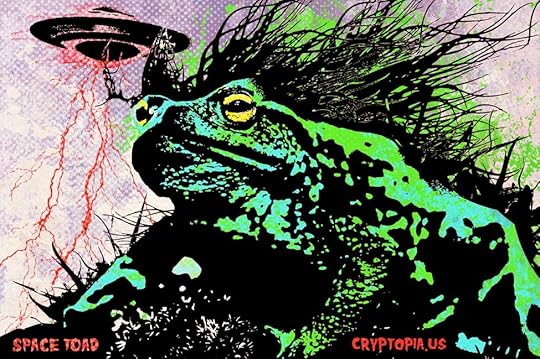
these characteristics make the toad an ideal candidate for space travel, far superior to the human astronauts with their lack of physical adaptability, their dependency on machines and medicines, and their comparatively high intake of food, air and water. In fact, the space program had to devise mechanical methods to imitate the totemic toad capacity to reabsorb urine so that the astronauts' urine could be purified and reused for drinking water during space expeditions. Toads are synchronically linked to space travel in the sense that many shamanistic cultures use chemicals excreted by toads for hallucinogenic journeys. Other toad excretions may instantaneously cause death - our final departure into space. Since the evolutionists and mechanists can devise no long-term future for humanity other than migration to another planet, perhaps it is time to revise the ladder of evolution. Rather than continue to defend the singular elevation of human cerebral in-intelligence (which is already responsible for the desecration of this planet), we might admit that toads are much better equipped to lead the thrust into future interplanetary evolution.

description


In the grim darkness of the future, there is only toads.

This book is about Aboriginal Australians apparently. In fact that's why I picked it up. It's well made and presented and I thought it would offer a decent initial insight into Aboriginal cultures of Australia and Tasmania. Which it did to an extent. But what it also did was give a lot of bullshit tangents off into the author's particular New-Age theories and philosophies. We didn't really need the first chapter to be focused on debunking the Darwinian theories we base our understanding of evolution upon.


The author also bizarrely states that there's no proof of human evolution. Apparently humans actually evolved in Australia, not Africa. Australia, the continent with no native placental mammals. Certainly no primates.

It is abundantly clear that his understanding of evolution is basic at best. We are offered instead random word-vomit about crystals and ley-lines. Energy man. Evolution is only a theory, there's no way you can prove that shit.

I do think the author is right when he says the transformation of Judaism from the Ancient Babylonian pantheon was to do with the need to centralise power to strengthen the group's need for domination over its neighboring tribes and that this centralisation was passed on to Judaism's two children, Christianity and Islam. I think that's a very good materialist analysis. I would go one step further and say that this was essential for the foundation of Capitalism which was significantly aided by Christianity as a centralised organisation of controlling the masses. I also agree with the author when he states that most organised, Abrahamic, Buddhist, Hindu, promote individuality. Salvation/the afterlife can only be gained by the individual acting out of self-interest in the promise of a reward. This is something I feel I need to explore more as whilst I think that's definitely true, I haven't explored all elements of the religions. I have a feeling that there might be some sects of Christianity at least where there is a collective element to salvation. Thinking about the Diggers, Quakerism and Methodism.

In short it will give you an understanding of Aboriginal cultures. It will also give you that understanding through a hippy-westerner lense. Like, magnetic fields man, they like, toke power the ley lines man...and that means...like, nature and shit dude.
Profile Image for Mike S.
385 reviews41 followers
April 24, 2008
I found this to be a very interesting and well written book, describing the traditions and lifestyle of the Aborigine with thoroughness and appreciation. It becomes very clear that, far from being lazy or ignorant, these people are quite intelligent, with many practices and beliefs that westernized people would do well to emulate. I think it would be fascinating spending a few years living this way, if possible. The book has numerous quotations, pictures of the people and their artwork, and goes into a good amount of detail about their rich and fascinating metaphysical life. A great read!
Profile Image for Molly.
450 reviews
Read
May 16, 2022
So here's a thing this book genuenly tries to say: "The body is magnetic, left side negative, right side positive. Blood has iron in it and that's why blood goes around the body. The aboriginal people believed in something similar, so it must be true!"

This book disgusts me. You can call this book outdated, say it doesn't understand science, that it's infantilizing and full of stereotypes, all points I agree with, but to me, it's first and foremost cultural apropriation used to sell new age ideas.

If this had been the only book about aboriginal culture I'd be kinder and say you can skip the blatant exploitation to learn about the actual culture. But it isn't. It's just a repulsive book written to make money, not inform.
Profile Image for Cameron Kobes.
Author 1 book18 followers
June 14, 2024
This book is frustrating because it has this whiplash of interesting and intriguing ideas placed alongside the most goofy pseudoscience. There's a real earnestness to the work. I believe the writer believes all the things that he says. But, many of the claims he makes about the world works are just so ridiculous that I can't give much credibility to his claims about the beliefs and practices of Australian Aboriginal peoples.

For an example of the good, he talks about the development of agriculture leading to the many problems of the modern world and disconnecting people from nature and the freedom that comes with the hunter-gatherer lifestyle. He also says that Aboriginal languages refer to both past and present forms of objects, allowing a clearer and realer view of how an object has been made and how its making has effected the world, in contrast to Western languages that only refer to an object's present form and therefore allow the speaker to ignore the consequences of an object's creation.

For the bad...

Darwinian evolution is a myth that's being disproven more and more every day, and humans actually originated in Australia (specifically Tasmania) and then spread throughout the world. Aboriginal peoples are magically sensitive to magnetic fields or ley lines or something like that, so they never get lost. "Blood's propensity for curdling and coagulating is directly related to energies received from the sun and the moon." And there's the section on toads that many reviewers have already noted: "Toads are synchronically linked to space travel in the sense that many shamanistic cultures use chemicals extreted by toads for hallucinogenic journeys. Other toad excretions may instantaneously cause death--our final departure into space."

These aren't things that the author says Aboriginal peoples believe. They are things that he says are true. They seem to be things that he believes. And there's a lot more.

Are we supposed to believe that subjective drug-induced hallucinations are the same thing as the outer space that objectively exists outside Earth's atmosphere? Because that's just silly.

There's a lot of silliness in this book. To its credit, it does make me want to learn more about Australian Aboriginal peoples, but preferably from a book written by an actual Aboriginal person, or an actual anthropologist.
Profile Image for Vidura Barrios.
154 reviews11 followers
April 27, 2020
I was expecting a much more scientific approach, instead we got some facts mixed in with tenous comparisons with Aboriginal people with ancient Egypt and Hinduism. Also it really bothered me the fallacy being stressed that Aboriginal people were in perfect harmony with each other and the land and that they were only hunter gatherers. (Recent scholar work has shown they did some agriculture) There were some nice thoughts and intentions but I can’t recommend the book since it has so much disinformation and so many tropes and cliches about the Aboriginal people.
Profile Image for Goober.
24 reviews
September 28, 2020
Really astonishing & interesting concepts. I took down lots of notes. We all really need to learn from ancient gatherer & hunter traditions. However some of the “traditions” (deflowering of girls after first menstruation by a group of males, women being “loaned out” as prostitutes to travelling hunters, etc.) seemed pretty terrible for the women. These things are problematic. I think patriarchal beliefs aren’t limited to newer belief systems and that we need to research all traditions and take the good and leave some of these toxic beliefs. I’m still unsure of what I think about this. But most of it is very transformative as far as how we can all look at reality. Please don’t respond to this saying that I “misunderstood” the gender roles etc. because I think some things are just toxic, regardless of the time and place and tradition they are found. I think that the more autonomy and choice is given to women about their sexuality, the better.
4 reviews
July 23, 2021
I love this book! Robert Lawlor has dedicated himslf to a deep dive of reasearch into the history of and the length and breath of this amazing culture, that of the Austrailian Aboriginals. We all can learn so much by reading this book and gaining the insight that Lawlor shares into the amazing innocence, and wisom of the Austrailian Aboriginals. When you look at this anacient culture, you see just how advanced thay were/are. Enjoy!
Profile Image for Shaazi.
33 reviews
March 18, 2021
This book is worth the time as an alternate view point. It requires an open, curious mind to be truely appreciated.
Profile Image for Alexander Curran.
Author 6 books469 followers
May 9, 2018
"We are all visitors to this time, this place.
We are just passing through.
Our purpose here is to observe,
to learn, to grow, to love...
and then we return home."
― Aboriginal Proverb


Aboriginal Dreamtime relates to stories and the connections between everything they tell.

The Aborigines believe in a sacred time of creation where mythical ancestral
beings eventually manifested themselves and took human, animal or plant form.
The Rainbow Serpent was said to control all of the water and oils found in the lands in addition to being the deity of life, social relationships and fertility.
These ancestors existed within the earth in a dormant state where the indigenous
word alcheringa should be mentioned:
The meaning of the word alcheringa
is uncreated or eternal which also describes the dreaming
state as well as this creation one.

In essence physical time (reality) began when they awoke
making their way to the surface of the earth and emerging from the oceans.
It is believed that their actions and wanderings brought into being all the
physical features of the landscape.
These Spirit ancestors wandered the earth and each place they emerged, made camp,
slept and the tracks on which they travelled have sacred meaning to the
Aboriginal people.
According to the Aborigines, when the Wandjina lay down, they entered the Earth, leaving their imprints on the stone, so they were believed to be the originators of the rock paintings.

The stories of these ancestral beings form the basis of
the laws by which the Aboriginal people live are an integral part of their
belief system.
This is referred to as the Dreamtime: A time of creation of sacred places, land,
people, animals, plants and the laws/pattern of life by
which the Aborigines live.

Aboriginal Dreamtime is a network of knowledge; these stories that are passed from
generation to generation by word of mouth, symbols, dancing, songs and ceremonies.
The Aboriginal Dreamings are the individual or groups set
of beliefs carried forward from the Dreamtime.
Each person inherits a specific totem and dreaming
stories for which they are the guardians. Each part of an Aboriginals tribal
land is clearly identified as belonging to a dreaming spirit.
In Aboriginal mythology these ancestral spirits were the first people on earth during the Dreamtime creation.

When a pregnant mother first feels her child move in her womb wherever she is
at that moment will relate the totem to the unborn baby.
A person could inherit for example a snake, kangaroo, dingo, emu, ant, bee and the dreaming stories that go with
that totem.
Their place in the kinship system of the tribe also influences the other dreamings
related to sacred sites, hunting, gathering, medicine or crafts.

The obligations to pass on their own cultural dreaming
story is depicted in Aboriginal Art.

“The unconscious becoming conscious and from time to time
vice versa: An allegory kaleidoscope for
the Kosmos coming into being, a transitional journey that suddenly continued
yet changed.”
4 reviews
Currently reading
July 14, 2009
Estou adorando este livro. Nos faz refletir sobre nossa estrutura social e a maneira como nos relacionamos com nosso planeta.
Profile Image for Chad.
1 review
December 8, 2012
Preachy at times, but an otherwise fantastic journey into Aboriginal culture.
Displaying 1 - 14 of 14 reviews

Can't find what you're looking for?

Get help and learn more about the design.