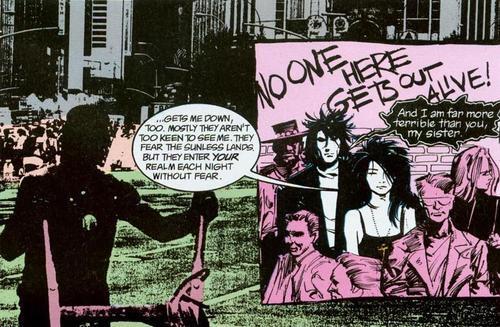
This book brought me a whole new respect for Neil Gaiman as an author. His brilliance storytelling skills, his deep understanding of human nature and his impressive knowledge of mythology as well as pop culture are to be marveled at. I have always enjoyed his style of writing, the matter-of-fact way he present ideas that are layered yet never pretentious, that invite but never force you to think. His fantasy worlds were crafted in an almost absurdism way, very nonchalant. But throughout this book, I came to realize how meticulous he is about his writing, how he connect each ideas and maintain a theme throughout what seemingly are fragmented storylines. For me, that is the great part about Neil's writing - the way his stories would be a little all over the place and hard to follow at first, then before you realize, all the puzzle would fall into place perfectly and you are left to wonder how you didn't see it before.
The Sandman, many would argue, was his magnum opus, and they wouldn't be wrong. There has never been a more frustrating, unlovable main character that you cannot help but love and feel heartbroken for. There has never been a tragedy that left me as a reader absolutely wrecked, but cannot find a different way to change the ending. It has been a minute since a story affected me this way, and this companion book elevated it to a new level of appreciation. A story about gods and myths and otherworldly beings, and it was so human, the way as every creature, they are unaware of their shortcoming, they are selfish, they are emotional, they are vain, and their problems are deeply personal. Yet it doesn't make them less of an incomprehensible force, it just makes you understand why human was their creation.
Besides the titular character, which I could write essays and essays about, the amalgamation of supporting characters were all created with love and care, and that was genuinely impressive. Every one of them had a soul, a motive, complex even if we only see a snapshot of them in a few panel. It was incredibly diverse, yet never inauthentic. Every conversation, every character, was inspired by looking at humanity with an empathetic eye and see them as you are, as a person, and not as a character, and that what made it work. It is easy to see why The Sandman was revolutionary when it was first published, and unfortunately, still is to this day in some aspects.
This book is invaluable to readers of The Sandman: where else would you be able to be in conversation with the author, and he laid his brain out for you to look into the process of creating this magnificence of a tale? More than a guide to The Sandman, this book is a guide to the craft of storytelling, and it was truly a gift to anyone who love reading and writing. This book really spoiled me as a reader, and now I would go on to read any other book and wishing for a peek inside the machinery of the author. And it definitely stoked the fire of my love for writing again, itchy to try my hand at spinning the yarn of a tale and let it take me to places I could only dream of (pun intended). A shame it was out of print, because I would buy it and display in with the highest honor in my bookshelf and go back to it every time I want to remember the magic power of stories.