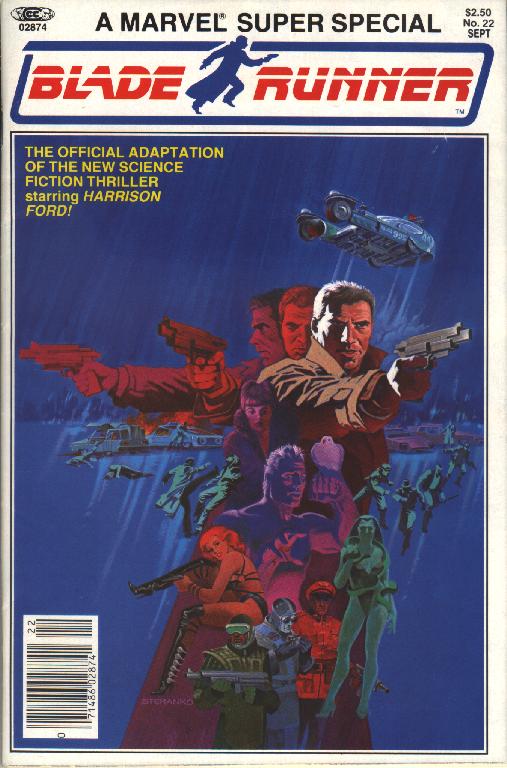
Archie Goodwin was an American comic book writer, editor, and artist. He worked on a number of comic strips in addition to comic books, and is best known for his Warren and Marvel Comics work. For Warren he was chief writer and editor of landmark horror anthology titles Creepy and Eerie, and for Marvel he set up the creator-owned Epic Comics as well as adapting Star Wars into both comics and newspaper strips. He is regularly cited as the "best-loved comic book editor, ever."
(Issue #2 of the 2-part full color edition from Marvel Comics, cover art by Brent Anderson)
This Marvel adaptation would have been great to own back in the day before VCRs became widespread, but today, with so many different cuts of the film available at the push of a button, it's more of a novelty than anything else, imo. The pencil work from Al Williamson and Carlos Garzon is mostly decent, occasionally striking, but much of it lacks the moody, gorgeous atmosphere of the film. There are a number of differences as well, with entirely new dialogue in spots (such as Roy's "tears in rain" monologue), and a couple scenes play out somewhat unexpectedly since writer Archie Goodwin was apparently working off of an earlier version of the screenplay. Overall, I feel the art works much better in the full-size, full-color comics edition* as opposed to the downsized B&W art in this small, digest-sized mass-market, but either way I think I'll stick to the many film versions of this in the future.
Still, I'm happy to have come across a pristine copy at my local 2nd & Charles bookstore, as I'm an unabashed Blade Runner (and Philip K. Dick) fanboy.
*ETA: Even though I don't own the colored, full-sized version, I'd probably rate that one 4 stars instead of 3 based on what I've seen of it online, as the art is more captivating, and just..."pops" more, at least for me.
"I've seen things you people wouldn't believe. Attack ships on fire off the shoulder of Orion. I watched C-beams glitter in the dark near the Tannhäuser Gate. All those moments will be lost in time, like tears in rain. Time to die."
- Tears in rain monologue by Roy Batty, from the film Blade Runner
Man, am I ever slipping on writing my GR reviews lately. I finished this almost a month ago and am only getting to reviewing it now. Anyway...
Blade Runner, a.k.a. Marvel Super Special #22, is a Marvel comic that was released simultaneously with the iconic film in 1982. In a nutshell, it is a comic adaptation of the screenplay of the film, not of the final film. This results in some interesting differences between this book and the eventual film, like the Tears in rain monologue I quoted at the beginning of this review.
The actor who played Roy Batty in the film, Rutger Hauer, didn't like the wording of the monologue as it was written in the film script, and so when they filmed that scene for the movie he actually spoke his own unscripted version of the speech, resulting in one of the greatest and most moving monologues in cinematic history (it even has its own Wikipedia page: "Tears in rain monologue").
The wording I quoted at the beginning of my review is what Hauer used in the film. This comic, because it was based on the screenplay, uses the original and, in my opinion, vastly inferior wording for the monologue. There are a few other small differences between the film and comic that I found interesting. In the film, Rachael asks Deckard if he has ever accidentally retired a human thinking it was a replicant, and he answers immediately and definitively that he hasn't. But in the comic, he hesitates before answering, and the text of the comic indicates that he actually has mistakenly retired a human before.
Overall, the art is pretty good, though often enough Deckard doesn't really look like Harrison Ford. If you're a fan of the film this is worth checking out, but it's somewhat hard to come by and can be quite expensive, so keep that in mind; it's not necessarily worth the cost if you're anything other than a hardcore Blade Runner fan.
Reading comics, I always think it’s odd when the refrain “comics are for kids” is said. (These days it's like saying hip-hop/rap isn't music.) Besides for French language Tintin comics (and some illustrated books like Captain Underpants) comics were not available to me at all as a kid.
It was until my teens when I discovered comics at a local book store. The first comic I picked up was a random Fantastic Four based on its namesake, a Conan magazine because I loved the movie. Later I grabbed Watchman because of the fame. But this one was one of the early comics I found.
I wasn’t prepared for the level of craft in here. Not until this year did I start to become an Al Williamson fan, and through other means. At the time I think I was flabbergasted by this comic. So much detail and precision, but I turned my nose up on adaptations of popular media.
Coming back to this comics all these years later (still the same copy) I’m able to really appreciate the line work of Williamson and the work of the other people on this title as well. Not to mention that beautiful cover illustration by Steranko.
I must have known this comic was a bit special because I disposed of most of my “random” comics, stuff that didn’t fit my main collection of Conan, Kirby and co, Vertigo.
Blade Runner is quite possibly my favorite scifi film ever made and, in general, is considered one of--if not THE best scifi film ever made. I have been searching for this for quite some time, but I prefer to find things in the wild, rather than just buying them online. The journey is always the best part.
You could imagine the suprise/happiness on my face when I ventured to "Fourcorners Comics & Games" in Gettysburg, PA and found the Marvel Super Special no. 22 for $7, after years of searching. Something neat to note was that online, I noticed the price for it could be a bit much, so $7 was a steal.
Written by Archie Goodwin (ALIEN: the Illustrated Story; 1979) and art by Al Williamson (Indiana Jones and the Raiders of the Lost Ark promo art), this is a wonderful adaptation of the film. The writing was based on the one of the first scripts and so (in my opinion), some of the lines are not as good as what we got in the Final Cut, but the artwork does as much justice to the film as a comic book can. The lighting and atmosphere are brilliant.
I would definitely recommend to any fan of scifi, comics or Blade Runner, but do not expect any added scenes that weren't in the film.
Sin ser tan brillante como la película, es una buena adaptación al 9° arte de la misma.
La obra maestra de Ridley Scott, junto a "Alien: el octavo pasajero", ya era distinta en sí a la obra original de Philip K. Dick. Con la omisión de Wilbur Mercer, de la cajita negra (precisamente título que dio Dick al relato precursor de su novela "Sueñan los androides con ovejas eléctricas"), de la esposa de Rick Deckard, además de omitir todo lo que atañe al mercerismo, cambió ostensiblemente el resultado final al adaptarla a la gran pantalla.
No así sucede con este cómic, que es una fiel recreación de la película de ciencia ficción que menos diría yo que se entendiera en su momento (tuvo animadversión entre una parte de la crítica y fue incomprendida por parte de algunos espectadores, que además la tachaban de aburrida allá por el año 1982 en su estreno), y que más tarde se volvió una película de culto (a Donnie Darko le pasó igual), y uno de los mejores exponentes de la ciencia ficción.
El arte de Al Williamson es sublime, y ya había adaptado antes otras películas de sci-fi, como "El imperio contraataca" y "Flash Gordon". Al guión Archie Goodwin, también se contó con los lápices de Carlos Garzón para ciertas escenas, y con el entintado en su segunda parte de Dan Greene y Ralph Reese.
Por último recomiendo encarecidamente revisitar la película antes de leer esta adaptación. Valoración final: 3'75 ⭐ replicantes de 5.
This works as a great comic book adaption of the movie for younger readers. For adults, it's a little like reading the Cliffs Notes for a book you already understand, but it's still a fun summary for fans of Blade Runner. The short length prevents this from capturing the beauty of the movie script, and the art is cool, but is in b&w newsprint rather than glossy photo common these days, so that fails to capture the beauty of film's cinematography
Impressive adaptation in only two issues from Archie Goodwin. Of course it is a bit edited and it translates even more as a film noir than the movie with lots of inner monologues but it is still positively great. As for the art it’s Al Williamson so expect nothing short of excellent.
Some things get better with age, while others just don't seem to stand the test of time. Thankfully, Marvel Comics' adaptation of the 1982 cult classic film, Blade Runner, leans pretty heavily in the direction of the former. Granted, when judged by the standards of comics produced in the past decade or so, the full color inking doesn't quite measure up to today's computer generated standards. But make no mistake; this is still a beautifully crafted piece of vintage comic art. And the writing is pretty darn good too.
Just for starters, back in the early 1980s, when this near perfect adaptation was painstakingly conceived (almost certainly before the film itself had been released), the handiwork of frequent collaborators Al Williamson and Carlos Garzon was truly the best of the best that Marvel could possibly offer. And even all these years later, it definitely shows.
Even better, back in the day, legendary scribe Archie Goodwin was the penultimate choice for just about any adapted work that could be tossed in his general direction. Having had tons of experience as an editor and a writer of original stories (plus having started in the business as an artist in his own right), Goodwin could always be counted on to deliver the proverbial goods. So all this spectacular star power really shows in Marvel's Super Special #22.
It's worthy of note that these beautifully executed pages were also released as a limited series of 3 separate single issues, but this collected "Super Special" edition more than suffices - especially given the quality of paper that it was printed on. The single issues were of course printed on the then standard, cheap newsprint, which tended to dull colors and negate image quality somewhat. None of which is a problem at all with this Super Special version, of course.
Sure, the actual story ends on page 48 (of 65 total pages), but the "Cast Credits," "Behind the Comics Adaptation," and "Photo Section" bonus materials actually add even more nostalgic class to an already superbly crafted graphic novelization. And speaking of novelizations, being a mere comic book, some scenes from the film seem just a bit truncated on the printed page, but overall, all the most memorable parts are there, are mostly intact, and are at least as effective as their cinematic counterparts.
Still, for die-hard Blade Runner fans who've never cared much for the much maligned voice-over narration of the original version of the film, good old Archie Goodwin actually added even more narration for our reading pleasure! Not a problem for yours truly, however, since I've definitely always been a fan of the original version that both director Ridley Scott and star Harrison Ford have oft expressed their dislike for over the years. But like a lot of us that first saw the film that way in the theater, and watched it again and again AND AGAIN, on VHS, before all the subsequent editions were eventually made available on DVD and Bluray, the original theatrical version still suits me just fine.
There's just one catch here, though.... Rutger Hauer's now immortal ad-libbed lines for his iconic super soldier character Roy Batty, "Like... tears... in rain. Time to die," DO NOT appear in Marvel's otherwise wonderful adaptation! Most likely because, as mentioned above, Goodwin and company were working from the shooting script, without the benefit of seeing the final version of the film.
Yet this is still an amazingly good comic adaptation that more than effectively captures the stunningly atmospheric, brooding, dystopian mood and rain soaked flavor of the classic source material. In fact, when re-reading this book after so many years, and despite the fact that most of the dialog is approximated (rather than being the word for word lines spoken in the film), I was surprised at how well Archie Goodwin's subtle line changes and descriptive additions actually make the overall narrative that much more clear, concise and meaningful.
So yeah, even without the "tears in rain" line, this is still one of my absolute favorite comic book adaptations of all time. Maybe even the very best of the best. Just like its creators, who were, let's face it, pretty much the Nexus 6s of the comic book industry in their day. Except that they weren't actually replicants (AKA, androids).... Nor was legendary writer Philip K. Dick, upon whose groundbreaking novel, "Do Androids Dream of Electric Sheep?" the film itself was based. But seriously, folks, should anyone, man or machine, dream of a better comic book adaptation of the classic film, Blade Runner? I for one, think not.
This is not an easy five stars to give. I love the film Blade Runner and so, how could I not love this? It's like catching one of your favorite movies in syndication on a local TV station. It's slightly edited. The quality and look isn't as good. And yet, it still hits.
Great comic based off the movie of the same name, a good summary for the film in paperback form but loses parts of the script of the movie with this condensed graphic novel version
I'm a pretty immense fan of Philip K. Dick and I've been consuming just about anything related to his works of late. I discovered this comic book on The Internet Archive which was hosted by the Boston Public Library and decided to give it a read.
The comic features some excellent artwork that's very reminiscent of the movie and follows the overall plot of the movie as well. It's a pretty short comic as well so it didn't take me very long to read and I felt it was a pretty decent summary of the movie. If you're expecting it to give a bit more background story-wise you'll likely be a little disappointed here. I'll admit that I was hoping it was going to add some details from the book but sadly, this wasn't the case.
If you're an avid fan of anything Philip K. Dick, you'll likely enjoy this comic, but for those already familiar with the movie, or have read the book, there's nothing new in this comic to separate them so it's not an important read. That said, it's a good refresher for them but nothing overly impressive. I give it 4 out of 5 stars.
In many ways, I prefer this paperback version to the comic book, because it's in black and white only. Some of the images had to be trimmed, of course, and one misses the large-format, comic book layouts. But the comic book colors dulled the sharpness of the inks, which can be seen in their full glory in this version.
Although I have not seen the film recently, this adaptation seemed to capture the plot and images quite well. It was almost like watching the movie in fast-forward mode!
I am an avid Blade Runner fan. I consume anything I can get my hands on regarding the film, its universe, Philip K Dick, you name it. I believe I have the ability to rate content in a vacuum, fully realizing that it likely won't live up to the film that I hold in such high reverence.
This Marvel adaptation is kind of a mixed bag. For one, the art and color palette is quite good in my opinion. As is such with any novelization or comic book adaptation of a film, the story feels a bit rushed but that has a lot to do with the restraints of page count. Pretty much all the plot points from the film were in there though. The thing that sucks about this adaptation though... every iconic quote from the film, like every single one you can think of... the comic got wrong.
What it gets wrong is kind of a bummer to be honest but if you're able to get past it, this isn't a bad read by any means.
It's amazing how Marvel was able to take brilliant source material like Do Androids Dream of Electric Sheep? and Blade Runner and produce such a remarkably lame illustrated "novel". The art, the writing...just astonishingly bad. Do yourself a favor and go to the originals, not this churned-out piece of garbage.
Curiosa adaptación de Archie Goodwin al cómic. Tiene multitud de apuntes que amplían la historia original como el por qué Deckard dejó de ser un Blade Runner o decenas de detalles como la enfermedad del hígado de Bryant que hace que Deckard beba por él cada vez que se reúnen. Una rareza para amantes de la película y para mí fue un regalazo tener este ejemplar en grapa con fecha de un año anterior a que yo naciese.
I get that they had a limited number of pages to do this. The art is nice even though it's printed ion newsprint instead of the fancy new glossy paper we see nowadays. Goodwin does a fine adaptation within the low amount of pages given. Overall, I would have liked to see what we could have gotten if they had been given a limitless number of pages to work with.