

What do you think?
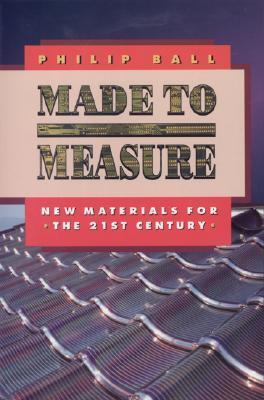
Made to Measure: New Materials for the 21st Century
Made to Measure introduces a general audience to one of today's most exciting areas of scientific materials science. Philip Ball describes how scientists are currently inventing thousands of new materials, ranging from synthetic skin, blood, and bone to substances that repair themselves and adapt to their environment, that swell and flex like muscles, that repel any ink or paint, and that capture and store the energy of the Sun. He shows how all this is being accomplished precisely because, for the first time in history, materials are being "made to measure": designed for particular applications, rather than discovered in nature or by haphazard experimentation. Now scientists literally put new materials together on the drawing board in the same way that a blueprint is specified for a house or an electronic circuit. But the designers are working not with skylights and alcoves, not with transistors and capacitors, but with molecules and atoms.
This book is written in the same engaging manner as Ball's popular book on chemistry, Designing the Molecular World , and it links insights from chemistry, biology, and physics with those from engineering as it outlines the various areas in which new materials will transform our lives in the twenty-first century. The chapters provide vignettes from a broad range of selected areas of materials science and can be read as separate essays. The subjects include photonic materials, materials for information storage, smart materials, biomaterials, biomedical materials, materials for clean energy, porous materials, diamond and hard materials, new polymers, and surfaces and interfaces.
This book is written in the same engaging manner as Ball's popular book on chemistry, Designing the Molecular World , and it links insights from chemistry, biology, and physics with those from engineering as it outlines the various areas in which new materials will transform our lives in the twenty-first century. The chapters provide vignettes from a broad range of selected areas of materials science and can be read as separate essays. The subjects include photonic materials, materials for information storage, smart materials, biomaterials, biomedical materials, materials for clean energy, porous materials, diamond and hard materials, new polymers, and surfaces and interfaces.
472 pages, Paperback
First published December 1, 1997
About the author
Philip Ball
71 books517 followersPhilip Ball (born 1962) is an English science writer. He holds a degree in chemistry from Oxford and a doctorate in physics from Bristol University. He was an editor for the journal Nature for over 10 years. He now writes a regular column in Chemistry World. Ball's most-popular book is the 2004 Critical Mass: How One Things Leads to Another, winner of the 2005 Aventis Prize for Science Books. It examines a wide range of topics including the business cycle, random walks, phase transitions, bifurcation theory, traffic flow, Zipf's law, Small world phenomenon, catastrophe theory, the Prisoner's dilemma. The overall theme is one of applying modern mathematical models to social and economic phenomena.
Ratings & Reviews
Friends & Following
Create a free account to discover what your friends think of this book!
Community Reviews
Displaying 1 - 4 of 4 reviews

Read
December 31, 2023took me over a year to read (???)
June 20, 2008
Getting a bit dated now, many of the developments posited into the future have happened, but a great insight into the vision of where material sciences are going.

March 7, 2011
Dated now ( blue wavelength lasers were just being rolled out at the time of writing ) but like the previous ' Molecules ' essential to understanding nanotechnology. Neither book has a GLOSSARY !
April 11, 2016
Really profound look into materials science. Needs an updated edition though.
Displaying 1 - 4 of 4 reviews