Leo Lionni wrote and illustrated more than 40 highly acclaimed children's books. He received the 1984 American Institute of Graphic Arts Gold Medal and was a four-time Caldecott Honor Winner--for Inch by Inch, Frederick, Swimmy, and Alexander and the Wind-Up Mouse. Leo Lionni died in October of 1999 at his home in Tuscany, Italy, at the age of 89.
Leo Lionni has gained international renown for his paintings, graphic designs, illustrations, and sculpture, as well as for his books for children. He was born in Holland in 1910 of Dutch parents, and although his education did not include formal art courses (in fact, he has a doctorate in economics from the University of Genoa), he spent much of his free time as a child in Amsterdam's museums, teaching himself to draw.
Lionni's business training gradually receded into the background as his interest in art and design grew. Having settled in Milan soon after his marriage in 1931, he started off by writing about European architecture for a local magazine. It was there that he met the contacts who were to give him a start as a professional graphic designer. When he moved to America in 1939, Lionni was hired by a Philadelphia advertising agency as art director. Later he became design director for the Olivetti Corporation of America, and then art director for Fortune magazine. At the same time, his reputation as an artist flourished as he began to exhibit his paintings and drawings in galleries from New York to Japan.
Lionni launched his career as an author/illustrator of books for children in 1959. Originally developed from a story he had improvised for his grandchildren during a dull train ride, Little Blue and Little Yellow was the first of what is now a long list of children's picture books, including four Caldecott Honor Books.
This was a unique story. I have to lay aside my years of flute playing and knowledge of how that works here for the story to work. A tail is solid with no holes. It’s not going to make noise. I know this and I sit that aside so the story works.
A mouse finds a huge block of cheese and he has friends help him move it to his home. As he is giving out payments of cheese for work, he finds some ears in the block. He realizes there is a statue in there and he unearths it. It is a giant mouse playing his tail like a flute. At night, music fills Geraldine’s home with music, which is new to him and it stops with the light of day. He listens day after day until he knows it by heart and the music is in him.
I suppose the point is if the music is in you, you are able to make beautiful music. It’s a cute story. I think the mouse making a cheese statute is more interesting than the magic music, but it’s not my story.
The nephew thought the mice were very cute. He didn’t think the story made a whole lot of sense, but it was good he said. He gave this 3 stars.
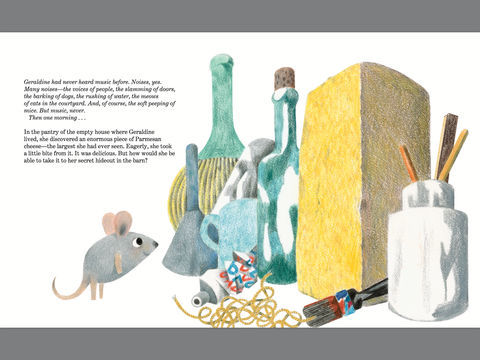
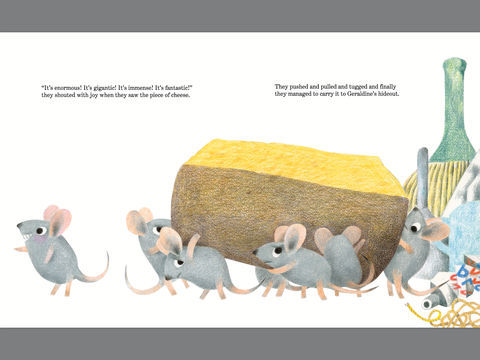
Geraldine discovers a huge hunk of Parmesan cheese and persuades her mouse friends to help her move it to a safe place. she rewards them with cheese tidbits but then discovers that there is the form of a mouse playing a flute inside all that cheese. Geraldine is at first so enamored by the music that she refuses to share the cheese with the other mice who are starving. Eventually, she decides that they need not abstain from dining on cheese since the music is now inside her. Although the story is a bit odd, the illustrations are colorful, showing the mice to great advantage with their striking black eyes, set against yummy yellow cheese and abundant white space. I'm not sure, but my guess is the illustrations have been created through the use of wax crayons. If someone else knows, please let me know. I've always found this author/illustrator's work fascinating.
Lionni, Leo Geraldine, the Music Mouse, PICTUREBOOK. Penguin Random House (Alfred A. Knopf), 1979. $17.99. Content: G.
When Geraldine, the mouse finds a very large piece of Parmesan cheese, she enlists some help to move it to her secret place in exchange for some large portions of cheese. But as she pulls off the chunks of cheese, the remaining block takes the form of a mouse playing its tail like a flute. Then, as night begins to fall, Geraldine hears beautiful music coming from the statue and gains an appreciation for music. But when her friends wants more cheese, Geraldine must decide what to do about the music. Beautifully illustrated, this classic children’s book can be enjoyed again by another generation.
When Geraldine, the mouse finds a very large piece of Parmesan cheese, she enlists some help to move it to her secret place in exchange for some large portions of cheese. But as she pulls off the chunks of cheese, the remaining block takes the form of a mouse playing its tail like a flute. Then, as night begins to fall, Geraldine hears beautiful music coming from the statue and gains an appreciation for music. But when her friends wants more cheese, Geraldine must decide what to do about the music. Beautifully illustrated, this classic children’s book can be enjoyed again by another generation.
This is a wonderful Leo Lionni reprint of a great story. The little mouse finds a chunk of cheese and as he is nibbling on it to give some to his friends there emerges a cheese statue of a mouse playing what looks like a flute but it was his tail. At night the mouse begins to play beautiful music but at day break it stops. The little mouse listened for may days and the music stayed with him throughout the day. One day the other mice came to him that there was no food to eat. Does he let them eat the cheese mouse statue which means his wonderful music is gone? He brings his tail to his mouth and tries to make music. Can he?
Lovely illustrations, and flowing poetic verse, yet I am not sure I am pleased with the story. It seemed to be a story of artistry, of imagination. But there are many unanswered questions. How did Geraldine know it was music and how did she "learn" the music, if she was just imagining it? How did she know the music came from a "flute"? Was she just an imaginative little mouse, who invented songs and sculpture on her own and shared it with the other mice? And why was there a large chunk of fresh cheese in the empty farm house?
I might cry. This was such a unique book that I read as a child, one that I was so enamored with and made me want to read, again and again, past my bedtime, and trace my finger over the pages. I can’t believe I almost forgot the name of the book. I love the illustrations so dearly.
An overall very odd story, how does a mouse play music with his tail? The point of the story is good, the way that the author goes about it is definitely unconventional.
Geraldine, the Music Mouse is another cute Lionni mouse story, with a slightly different art style--they have teeth! I liked the way the music was illustrated.
Found this story strange. A mouse lives in an empty house that has a pantry with a large block of cheese in it , Parmesan to be exact. She want to hide it out in the barn for some reason. It is too large for her to move herself so her friends help. As payment she nibbles off bites of cheese for them to eat and in doing so creates a sculpture of a mouse playing music on his tail. Never having heard music or seen a flute she instantly knows the mouse is playing music on a flute. Every night the sculptured mouse plays music and Geraldine listens. Eventually Geraldine's friends are starving and they want to eat the cheese. At first Geraldine says no but then because she can make the music they eat the cheese. My question once the cheese is eaten what will the mice do for food? It seems to me a better way to end story would be for the mice to come up with a way find food using their talents, as it is they will be starving by the next day with no solution in sight. That being said children will enjoy this tale with the mice and cheese and not think about the consequences of eating the cheese. The illustrations look like other familiar ones we have grown to love from Lionni and thus are fun to look at.
So far, my least favorite book by Leo Lionni. It is the story of a mouse who discovers a giant piece of Parmesan, and after sharing parts of it with his friend, realize that inside of it there is a mouse-shaped cheese sculpture that makes music. One day, his starving friends come back and demand to be feed... What happen next is a big metaphor that seem hard for a kid to grasp. I am perplexed...
Slightly strange story about a mouse who hears music from cheese. Then after she discovers how to make music on his own, she eats the cheese with her hungry friends.