This fascinating book presents a whirling, free-associating history of the cigar, beginning with the discovery of America by Columbus in 1492. Columbus sent Rodrigo de Xeres inland to prospect for gold; he came back with tales of men who think they are men who smoke, using a brown tube burning on one end. Here Guillermo Cabrera Infante describes the history of cigars in the Caribbean & the process of making cigars by hand in Cuba; & the history, customs & popularity of cigar-smoking in America & Europe. He also includes poems & passages from literary works that describe cigar smoking by famous authors, such as Rudyard Kipling, James Joyce, Colette, & John O'Hara. Originally published in 1985.
Guillermo Cabrera Infante (Gibara, Holguín, Cuba, 22 de abril de 1929 - Londres, Inglaterra, 21 de febrero de 2005) fue un escritor y guionista cubano, quien tras exiliarse de su país obtuvo la ciudadanía británica. Recibió el Premio Cervantes 1997.
What’s wrong with this picture? Certainly, nothing I can see, except perhaps she has not read Holy Smoke by Guillermo Cabrera Infante, a 300-page punning wordplay, a sidesplitting, outrageous history and celebration of the cigar. And here’s a puff from the first pages where, on the island that would become known as Cuba, a scout sent out by Columbus to scout out gold reports to the admirable Admiral on what he did discover:
“De Xeres came back not with nuggets of gold but with some astonishing piece of news: he had found the land of the chimney-men. The what? Men who think they are chimneys: men who smoke. Columbus was disappointed in de Xeres. The man had not only been unable to find any gold, as Marco Polo did, but he came back with this weird narrative. A likely story! What should he tell King Ferdinand? ‘Sire, my scout became a boy scout.’ Too much sun too soon. Or did he mean not chimney-men but chimeras? Too much Amontillado, that’s what it was! But de Xeres explained soberly that these savages he saw really smoked like chimneys. Everywhere they went they carried about a brown tube burning on one end. They stuck the other end in their mouths for a while and seemed to drink from the tube. After they did so they smoked from mouth and nostrils. And they seemed to enjoy the experience!”
From the dearth of book reviews posted here, it appears many other readers, similar to the above cigar-smoking lass, have also overlooked this smokin’ Cabrara Infante literary romp which, unlike his other classics such as Infante’s Inferno and Three Trapped Tigers, is not translated from Spanish into English but actually written in English.
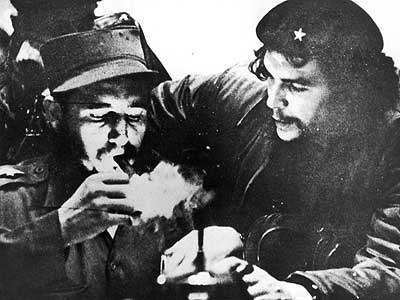
As part of the cigar’s illustrious history, we read, “Some twenty years ago the idea (come from England, no doubt) that cigars, like Loos’s blondes, were for gentlemen only, was dispelled by the scraggly mien of Fidel Castro and Che Guevara’s handsome head, both clad in US Army surplus fatigues, both enveloped in smoking beards and both sporting foul, fat cigars.”
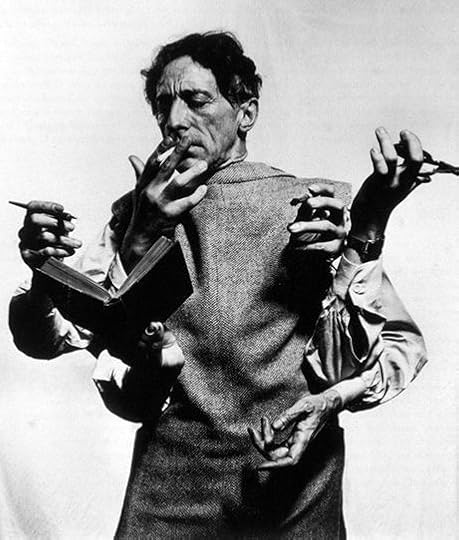
I’ll let Cabrera Infante end with his playing with language as he tells of Cocteau Holy Smoke: “Jean Cocteau is so opinionated in ‘Opium’ that his book should better be called ‘Opinions.’. He writes, badly, of old saws and he makes them sound like seesaws. A smoker who smoked twelve pipes a day all his life would be protected not only from the flu, colds and anginas but also in less danger than a man who drank a glass of cognac and four Havanas.’ Cocteau even has some dope not on dope but on cigars: ‘Tobacco is almost harmless. After combustion nicotine disappears. Usually one takes for nicotine (a white salt) that sort of yellow paste produced by modifying by fire all combustible matters. You’ll need four or five fat Havanas a day to provoke in you angina pectoris. Most of what is said on the harm produced by tobacco are spasms with no real danger.’ A white Cococteau projected on a smoke screen.”
You don't have to be a cigar smoker (I'm not) to enjoy this smokin' classic.
Even though I've never smoked & absolutely hate the smell when someone is smoking cigars (or weed or cigarettes), I found the book itself to be interesting & entertaining. At first I was a little thrown by the writing style since I was expecting a standard non-fiction book but this is a stream-of-consciousness work that reads like you're with a garrulous friend who rambles on about cigars, tobacco, Cuba, history, various Caribbean islands, England, Castro, Miami, the Cuban diaspora, movies (lots of old movies), books/authors, famous people who smoke, & other various digressions. There are no chapters & very few section breaks (300+ pages). My eyes did glaze over a little when he got into what seemed like an overly long detour into the nitty-gritty of lots of old movies (few of which I have seen), but I perked up again when his conversation then switched to focusing on various writers. I'm glad I read this one & now want to read other works by Cabrera Infante.
“Ufak bir gezinti ya da köpeği en yakın sokak lambasının altına götürmek amacıyla bile olsa, asla puroyla sokağa çıkmayın. Purolar kedi gibidir: Onların yeri evdir, kışın güzel bir şömine ateşinin yanıbaşında bir koltuk, yazın açık bir pencere önü. Fakat kalorifer ya da havalandırma cihazından kaçının — puro içerken televizyon da seyretmeyin sakın, yoksa suratının ortasındaki kısa puroyla hiç de komik olmayan bir komedyenle karşılaşabilirsiniz. Hem bir puro kendi görüntülerini yaratır zaten, ve başka bir filmin ya da şovun görüntüleri bu yayını bozar. Kendi hayal gücünüzü çalıştırın yeter: Puronuzdan yükselen duman —mızrak, spiral, bilge Süleyman’ın duman sütunları— sanki kafanızın üzerinde bulutlar, buğusu tüten bir baldaken örüyormuş gibi izleyin puronuzu. Şansınız varsa, yıldızlarla bezeli harikulade bir gökyüzü de görebilirsiniz. Fakat ateşin kor halinde yandığı puro ucuna da dikkat edin, canlı puronun değerli bir müteveffaya, yalnızca kül ve anıya nasıl dönüştüğünü izleyin.”
El libro se me ha hecho muy largo y pesado. No disfruto de sus juegos de palabras, ni entiendo su humor. Lo he acabado porque no puedo dejar un libro a medias :-(
"Sometime a cigar is just a cigar".---Sigmund Freud Not so fast, Ziggy. Why has nearly every man of power, at least in the twentieth century, been a cigar smoker? Fidel Castro would come in at number one (and, he gave up on cigar smoking in 1986) but other aficionados include Jack Kennedy, Winston Churchill, Freud, Einstein (although he preferred a pipe), Patton and Groucho Marx. Guillermo Cabrera Infante (when I met him at UCLA he was smoking cigarettes, not tobacco) the extraordinary Cuban novelist (THREE TRAPPED TIGERS, INFANTE'S INFERNO) had the ordinary Cuban male's love for el tabaco and in HOLY SMOKE he makes some pretty extraordinary claims. The history of the world would have been entirely different had the Spaniards, Portuguese and English, in that order, not planted tobacco in their American colonies. Let's start with Cuba. If the island had remained a tobacco-producing colony for Spain after 1492 rather than devoting itself to sugar, following the British occupation of Havana in 1762, it would have remained a sleepy isle of small farmers, not a hotbed of unrest and revolution; for sugar metaphorically is to cocaine as tobacco is to marijuana. All nations coveted the quantity of Cuban sugar and the quality of Cuban tobacco, but only the first led to war and bloodshed. Fidel would still have been a heavy smoker, like his Spanish father, but never had the chance to become a revolutionary. On a lighter note, Cabrera Infante doles on the delights of smoking a good cigar. The smoker is drowsy, philosophical and private. I knew one elderly Cuban gentleman in Miami who, when I asked him if he wasn't worried about smoking a cigar every day replied, "No. I light it and then suck on it the rest of the day"---a habit he shared with Churchill. Yes, I know, los yanquis often smoke collectively in rooms, including lady smokers, but that is barbaric. Then, we get the opposite: smokers in private and out of sight: Presidents McKinley (the one who stole Cuba from the Cubans), Harding, Bill Clinton and Obama all smoked cigars in secret. And, naturally, we all know what else Bill did with at least one cigar and his White House playmate. A first-class history and meditation, HOLY SMOKE did not make a smoker out of me but did convert me into embracing a tobacco-centric history of the world.
Un proyecto ambicioso, personal, una historiografía con todo derecho sobre el tabaco y más aún del puro. Sin embargo, con ello no quiero decir que sea un libro de divulgación, en el que la parcialidad sea la que tenga la última palabra, para nada. Lo más cercano que se puede encontrar a un ensayo es la genealogía que hace el autor al inicio del texto sobre el puro, pero de ahí en adelante es solo sentimiento, emoción, la tremenda destreza retorica del cubano para ensamblar su pasión por el humo, el cine y la literatura párrafo tras párrafo. El libro está plagado de anécdotas que cruza los cotilleos de Hollywood, los artistas y al medio de la cita el perenne humo que germina las reflexiones del autor respecto a la vida, el sexo y en cuanto tema pueda estar envuelto una calada al tabaco. Lo que hace Cabrera Infante aquí es magia, un embrujo que aúna el deseo y el ansia de los fumadores por el humo, acto tan mundano, prosaico, a un ritual en el que se barajan la meditación y la contemplación. Un libro denso, pero con gusto, que se lee por caladas.
This book is very very out of date. It has no structure and needs heavy editing. I got half way through it and for once in my life I said enough of this free-form rant. It uses large words and lofty references for a lot of self aggrandizing. I only gave it two stars because reading through all the gibberish there are some good anecdotes on tobacco and cigar. I had enough of it though. You could probably pick any page in the book, start reading and you'd be the same as if you read in order.
Actually, this is not my book, but Joey's: he talks about it a lot these days; it's on his bedside table in PW. He found it at the Book Barn in Hillsdale. I am going to have to drift downstairs some time soon and look though it!
Hysterical. Infante is in league with Peter Mayle and adept at revealing the little nuances that we all do (but rarely admit to). Holy Smoke is thoroughly enjoyable and a must-have for your personal reading shelf; you'll want to read it again!!!
Muito bem escrito, linguagem cativante. Mas os trocadilhos e o fluxo muito solto de idéias começam a te testas após metade do livro. Melhor recomendado para pessoas que entendem muito de cinema clássico não é o meu caso).