

What do you think?

Mighty Fitz: The Sinking of the Edmund Fitzgerald
The tragic story of the most legendary shipwreck on America's inland waters.
243 pages, Paperback
First published January 1, 2005
About the author
Michael Schumacher
35 books29 followersA lifelong resident of the Great Lakes region, Michael Schumacher is the author of twelve books, including biographies of Allen Ginsberg, Phil Ochs, and Eric Clapton, and the award-winning book Wreck of the Carl D. He has also written twenty-five documentaries on Great Lakes shipwrecks and lighthouses.
Ratings & Reviews
Friends & Following
Create a free account to discover what your friends think of this book!
Community Reviews
Displaying 1 - 30 of 164 reviews

July 13, 2016
“It all happened too quickly for anyone aboard to do anything but react to the moment. The pilothouse windows blew in, and inrushing torrents of water hurled everyone backward. The front of the ship, now angling downward toward the bottom of the lake, wavered unnaturally, sinking from the weight of the boarding water and rapidly shifting taconite pellets. At the back of the ship, the propeller continued to turn and drive the Fitzgerald forward. The middle of the ship buckled. The bow portion of the Fitz bent downward, laboring to drag the rest of the ship with it, while the stern section stubbornly held to the surface. The ship plunged to the depths in dark, frigid water, its running lights still on, every pocket of air filling with water, from front to back of the vessel…”
- Michael Schumacher, Mighty Fitz: The Sinking of the Edmund Fitzgerald
In November 1975, Lake Superior took the lives of 29 sailors.
In August 1976, a song made them immortal.
On November 10, 1975, the SS Edmund Fitzgerald sank in Canadian waters during a severe storm. She had been carrying a load of taconite from Superior, Wisconsin, to Detroit, Michigan. Her last radio contact occurred when Captain Ernest McSorley radioed the nearby SS Arthur Anderson and reported that: “We are holding our own.” Soon after that call, the Fitz disappeared with all hands. No distress signal was ever sent.
***
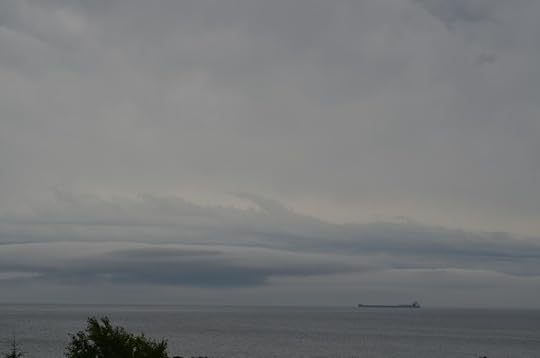
A long ship makes its way across Lake Superior
***
The Great Lakes are not oceans, but they can whip up storms of hurricane-force magnitude. For hundreds of years, these storms have been taking vessels to the bottom. Thus, when the Edmund Fitzgerald went down, there was no reason to think she would ever be more than a local tragedy, mourned only by those most directly affected. Who, after all, remembers the Carl D. Bradley?
Then, in the summer of the following year, Gordon Lightfoot unleashed The Wreck of the Edmund Fitzgerald upon the world. His ballad gave the ore-carrier both national and international renown. Instead of disappearing into history with the same finality with which she’d disappeared, the Edmund Fitzgerald gained a name recognition at least on par with the Andrea Doria, if not the great Titanic.
As a native Minnesotan who grew up summering in Duluth, visiting maritime museums, and hunting agates on Superior’s shores, I’ve long been interested in the Edmund Fitzgerald. With that said, it’s been tough to find the right book about it. After all, despite her fame, the sinking of the Edmund Fitzgerald is a small-scale tragedy, and most of the ship’s chroniclers have been regional historians with perhaps more passion than literary talent.
Though the competition is not exactly robust, Michael Schumacher’s Mighty Fitz is easily the best and most polished I’ve read on the Edmund Fitzgerald’s doomed voyage.
***
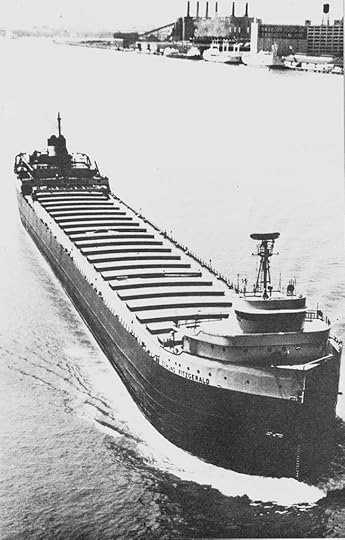
The Edmund Fitzgerald
***
At less than 200 pages, Schumacher doesn’t waste time. Mighty Fitz is focused, efficient, and well-paced. The curtain rises with the Edmund Fitzgerald receiving her final load of cargo, and moves quickly to a recounting of the final voyage. He intersperses the known details of the Fitz’s last run with lively descriptions of the history of Lake Superior, her weather, and some of the other shipwrecks that litter the lakebed. These asides are woven expertly into the narrative so that they don’t feel digressionary, but seamlessly bridge the obvious factual gaps you have when a ship goes down in a blink, taking all witnesses.
***
The Edmund Fitzgerald’s last night is told mostly from the perspective of the captain and crew of the Arthur Anderson, which happened to be sailing in close proximity – with the speedier Fitzgerald up ahead – when one of Lake Superior’s infamous November gales came howling.
In the late afternoon, Captain Bernie Cooper of the Anderson received reports from Captain McSorley that the Edmund Fitzgerald had lost vent covers and a railing. The ship had also taken on a list. Less than an hour after this report, McSorley told Cooper that no longer had radar, and wanted the Arthur Anderson to act as his eyes. At 7:10 p.m., McSorley made his grimly optimistic last observation about “holding [their] own.”
Minutes later, the Fitzgerald was gone.
***
Schumacher devotes two chapters to answering the looming question of what caused the sinking. The focus is on the United States Coast Guard’s Marine Board inquiry, which eventually concluded that the Edmund Fitzgerald sank due to ineffective hatch closures. During the storm – the hypothesis went – water seeped through the cargo hatches and into the hold, either due to improper sealing, or because the crew had left some of the hatches unclamped, in order to expedite their voyage. In any event, water began to accumulate in the cargo hold, causing a gradual loss of freeboard. The ship settled imperceptibly lower in the water – possibly explaining why Captain McSorley reported higher waves than anyone else – until a massive wave swamped her completely.
***
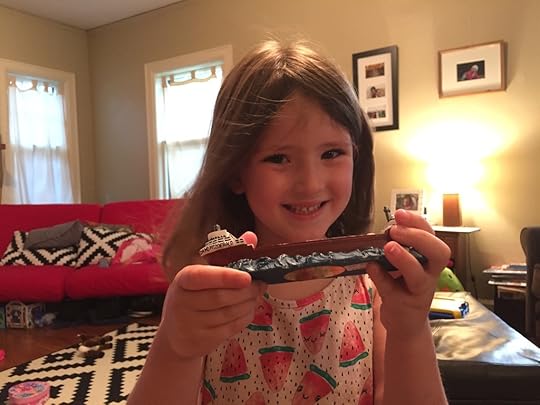
My Goodreads assistant holds up a model of the Fitz to demonstrate the ship's vulnerabilities. The cargo hold was not watertight; there were numerous potential openings all along her deck; and there was always the danger of the midships section hogging
***
The Marine Board’s findings were instantly controversial, and Schumacher does a fine job explaining the other theories that have been put forward. The National Transportation Safety Board (NTSB), for instance, targeted the hatches as well. Contrary to the Marine Board, though, the NTSB – which viewed underwater footage of the wreck – believed the hatches had been torn off by the storm. With the hatches sheared away, the lake came pouring in.
Another possible explanation is that the Edmund Fitzgerald grounded off Six Fathom Shoal. This theory – supported by Captain Cooper of the Arthur Anderson – posits that the Edmund Fitzgerald’s long, vulnerable midsection hit the lake floor, causing it to rise (or hog, as the book’s helpful glossary notes) while the bow and stern bent down at either end. Hogging puts incredible physical stress on the unsupported midsection, and if this happened, it might have precipitated a breakup. Of course, no answers have come simply, and an investigation of Six Fathom Shoal after the wreck showed no evidence that it had been struck.
In any event, I’m sure there are still dimly lit taverns and dive bars along the Great Lakes where you can get into a fight discussing these alternate scenarios. Schumacher is mostly content to simply lay out the evidence for and against, implicitly accepting that only god and the crew of the Edmund Fitzgerald knows the real truth, and maybe not even the crew.
***
Schumacher ends Mighty Fitz by describing efforts to find and explore the wreck.
Unlike the Titanic, lying two miles beneath the surface of the Atlantic Ocean – and periodically killing explorers – the Edmund Fitzgerald can be reached by divers without the need for multimillion dollar investments in equipment. Also unlike the Titanic, the saga of the Fitz still exists in the realm of human memory. This makes her status as a graveyard far more potent than a ship that foundered in a distant epoch, back when high-bred men dressed in their dinner jackets to drown. Finally, the wreck did not take place in the midst of the wide blue ocean, but in Canadian waters, falling within the ambit of her laws. These factors make exploration of the Fitz incredibly fraught with legal and ethical implications.
The discovery of a body during an expedition ratcheted these complications up to eleven.
***
There are aspects of Mighty Fitz that compare favorably with Sebastian Junger’s The Perfect Storm. That said, there’s something about The Perfect Storm that transcends its subject matter. You do not have to be interested in shipwrecks, sword fishermen, or the Andrea Gail to enjoy Junger’s masterpiece. Mighty Fitz is tailored more towards students of shipwrecks in general, and obviously the Edmund Fitzgerald in particular. It probably has less appeal to general readers.
It does have a universal lesson, though: life can change from just fine to we’re sunk with startling rapidity, and we must govern ourselves accordingly.
- Michael Schumacher, Mighty Fitz: The Sinking of the Edmund Fitzgerald
In November 1975, Lake Superior took the lives of 29 sailors.
In August 1976, a song made them immortal.
On November 10, 1975, the SS Edmund Fitzgerald sank in Canadian waters during a severe storm. She had been carrying a load of taconite from Superior, Wisconsin, to Detroit, Michigan. Her last radio contact occurred when Captain Ernest McSorley radioed the nearby SS Arthur Anderson and reported that: “We are holding our own.” Soon after that call, the Fitz disappeared with all hands. No distress signal was ever sent.
***
A long ship makes its way across Lake Superior
***
The Great Lakes are not oceans, but they can whip up storms of hurricane-force magnitude. For hundreds of years, these storms have been taking vessels to the bottom. Thus, when the Edmund Fitzgerald went down, there was no reason to think she would ever be more than a local tragedy, mourned only by those most directly affected. Who, after all, remembers the Carl D. Bradley?
Then, in the summer of the following year, Gordon Lightfoot unleashed The Wreck of the Edmund Fitzgerald upon the world. His ballad gave the ore-carrier both national and international renown. Instead of disappearing into history with the same finality with which she’d disappeared, the Edmund Fitzgerald gained a name recognition at least on par with the Andrea Doria, if not the great Titanic.
As a native Minnesotan who grew up summering in Duluth, visiting maritime museums, and hunting agates on Superior’s shores, I’ve long been interested in the Edmund Fitzgerald. With that said, it’s been tough to find the right book about it. After all, despite her fame, the sinking of the Edmund Fitzgerald is a small-scale tragedy, and most of the ship’s chroniclers have been regional historians with perhaps more passion than literary talent.
Though the competition is not exactly robust, Michael Schumacher’s Mighty Fitz is easily the best and most polished I’ve read on the Edmund Fitzgerald’s doomed voyage.
***
The Edmund Fitzgerald
***
At less than 200 pages, Schumacher doesn’t waste time. Mighty Fitz is focused, efficient, and well-paced. The curtain rises with the Edmund Fitzgerald receiving her final load of cargo, and moves quickly to a recounting of the final voyage. He intersperses the known details of the Fitz’s last run with lively descriptions of the history of Lake Superior, her weather, and some of the other shipwrecks that litter the lakebed. These asides are woven expertly into the narrative so that they don’t feel digressionary, but seamlessly bridge the obvious factual gaps you have when a ship goes down in a blink, taking all witnesses.
***
The Edmund Fitzgerald’s last night is told mostly from the perspective of the captain and crew of the Arthur Anderson, which happened to be sailing in close proximity – with the speedier Fitzgerald up ahead – when one of Lake Superior’s infamous November gales came howling.
In the late afternoon, Captain Bernie Cooper of the Anderson received reports from Captain McSorley that the Edmund Fitzgerald had lost vent covers and a railing. The ship had also taken on a list. Less than an hour after this report, McSorley told Cooper that no longer had radar, and wanted the Arthur Anderson to act as his eyes. At 7:10 p.m., McSorley made his grimly optimistic last observation about “holding [their] own.”
Minutes later, the Fitzgerald was gone.
***
Schumacher devotes two chapters to answering the looming question of what caused the sinking. The focus is on the United States Coast Guard’s Marine Board inquiry, which eventually concluded that the Edmund Fitzgerald sank due to ineffective hatch closures. During the storm – the hypothesis went – water seeped through the cargo hatches and into the hold, either due to improper sealing, or because the crew had left some of the hatches unclamped, in order to expedite their voyage. In any event, water began to accumulate in the cargo hold, causing a gradual loss of freeboard. The ship settled imperceptibly lower in the water – possibly explaining why Captain McSorley reported higher waves than anyone else – until a massive wave swamped her completely.
***
My Goodreads assistant holds up a model of the Fitz to demonstrate the ship's vulnerabilities. The cargo hold was not watertight; there were numerous potential openings all along her deck; and there was always the danger of the midships section hogging
***
The Marine Board’s findings were instantly controversial, and Schumacher does a fine job explaining the other theories that have been put forward. The National Transportation Safety Board (NTSB), for instance, targeted the hatches as well. Contrary to the Marine Board, though, the NTSB – which viewed underwater footage of the wreck – believed the hatches had been torn off by the storm. With the hatches sheared away, the lake came pouring in.
Another possible explanation is that the Edmund Fitzgerald grounded off Six Fathom Shoal. This theory – supported by Captain Cooper of the Arthur Anderson – posits that the Edmund Fitzgerald’s long, vulnerable midsection hit the lake floor, causing it to rise (or hog, as the book’s helpful glossary notes) while the bow and stern bent down at either end. Hogging puts incredible physical stress on the unsupported midsection, and if this happened, it might have precipitated a breakup. Of course, no answers have come simply, and an investigation of Six Fathom Shoal after the wreck showed no evidence that it had been struck.
In any event, I’m sure there are still dimly lit taverns and dive bars along the Great Lakes where you can get into a fight discussing these alternate scenarios. Schumacher is mostly content to simply lay out the evidence for and against, implicitly accepting that only god and the crew of the Edmund Fitzgerald knows the real truth, and maybe not even the crew.
***
Schumacher ends Mighty Fitz by describing efforts to find and explore the wreck.
Unlike the Titanic, lying two miles beneath the surface of the Atlantic Ocean – and periodically killing explorers – the Edmund Fitzgerald can be reached by divers without the need for multimillion dollar investments in equipment. Also unlike the Titanic, the saga of the Fitz still exists in the realm of human memory. This makes her status as a graveyard far more potent than a ship that foundered in a distant epoch, back when high-bred men dressed in their dinner jackets to drown. Finally, the wreck did not take place in the midst of the wide blue ocean, but in Canadian waters, falling within the ambit of her laws. These factors make exploration of the Fitz incredibly fraught with legal and ethical implications.
The discovery of a body during an expedition ratcheted these complications up to eleven.
***
There are aspects of Mighty Fitz that compare favorably with Sebastian Junger’s The Perfect Storm. That said, there’s something about The Perfect Storm that transcends its subject matter. You do not have to be interested in shipwrecks, sword fishermen, or the Andrea Gail to enjoy Junger’s masterpiece. Mighty Fitz is tailored more towards students of shipwrecks in general, and obviously the Edmund Fitzgerald in particular. It probably has less appeal to general readers.
It does have a universal lesson, though: life can change from just fine to we’re sunk with startling rapidity, and we must govern ourselves accordingly.

November 22, 2023
3.5
She began her unfortunate journey from Wisconsin carrying a cargo of ore pellets, but was caught in a severe storm the next day. She sank in deep waters, with no distress signals sent previously. No one on board survived.
This book is about the sinking of the SS Edmund Fitzgerald in Lake Superior in 1975, the search for her wreckage and the subsequent investigations into the cause of the incident.
She began her unfortunate journey from Wisconsin carrying a cargo of ore pellets, but was caught in a severe storm the next day. She sank in deep waters, with no distress signals sent previously. No one on board survived.
This book is about the sinking of the SS Edmund Fitzgerald in Lake Superior in 1975, the search for her wreckage and the subsequent investigations into the cause of the incident.

June 19, 2020
Oh, that song. Oh, that voice. Like others, I only knew about the disaster of the SS Edmund Fitzgerald shipwreck through the musical poetry of Gordon Lightfoot. The details, the setting, the growing peril made my heart sink enough to want to know more about the disappearance of the Great Lakes ship.
Does anyone know where the love of God goes
When the waves turn the minutes to hours
The Fitz was the largest ship ever to have sunk in the Great Lakes and it's possible that it could have all been avoided. That's all hindsight, of course, but she was a vessel that most assumed could handle any storm system on the Great Lakes. She had a decent crew and was a tough ship, which bred overconfidence. The author makes a good point in noting that better safety measures had created a false sense of security for the big Lakes ships. When the skies changed color and the Nor'easters blew in and the waves began to get higher and higher, the captains of the small boats had the good sense to anchor and wait out any nasty storm. The larger ships went ahead as usual.
Nor'easters come to the Great Lakes in the month of November. The cold air moves over the still-warm summer water, thus giving paid to the line, T'was the witch of November come stealin'. Brutal month, brutal storms. And let's call out Lake Superior for what it is...Old Treacherous. LAKE SUPERIOR DOES NOT NEGOTIATE! Maybe you can call Mother Nature's bluff on little old Lake Erie, but don't go there with the big boys.
This book tells the story very well, I was completely absorbed. This isn't a mystery, the reader already knows there is a disaster and the author's job is to explain the front-end and back-end of the event. This really gets nitty-gritty when it comes to the question of why the ship foundered. Fault of the captain? Fault of the corporation? Fault of the weather service? Some thought it shoaled, some thought it was hit by a rogue wave, some thought its hatches blew. And how much pounding can one ship, even a leviathan like the Fitz, really take?
As a resident of coasts, I never cared to learn about the Great Lakes. After all, I had the mighty Pacific, so how bad could some inland lakes really be? I changed my mind on a business trip to Chicago, in winter no less. My hosts walked me over to Lake Michigan and that did it for me. Yes, lakes can have horrendous waves. The word that stuck with me was "brutal". After I ran back to the hotel, I spent the rest of the evening in a hot bath looking up every single shipwreck that ever took place on the Great Lakes. One can only imagine the terror of the crew of the Mighty Fitz as that ship took its final dive.
And all that remains is the faces and the names
Of the wives and the sons and the daughters
Book Season = Winter (doomed mariners)
Does anyone know where the love of God goes
When the waves turn the minutes to hours
The Fitz was the largest ship ever to have sunk in the Great Lakes and it's possible that it could have all been avoided. That's all hindsight, of course, but she was a vessel that most assumed could handle any storm system on the Great Lakes. She had a decent crew and was a tough ship, which bred overconfidence. The author makes a good point in noting that better safety measures had created a false sense of security for the big Lakes ships. When the skies changed color and the Nor'easters blew in and the waves began to get higher and higher, the captains of the small boats had the good sense to anchor and wait out any nasty storm. The larger ships went ahead as usual.
Nor'easters come to the Great Lakes in the month of November. The cold air moves over the still-warm summer water, thus giving paid to the line, T'was the witch of November come stealin'. Brutal month, brutal storms. And let's call out Lake Superior for what it is...Old Treacherous. LAKE SUPERIOR DOES NOT NEGOTIATE! Maybe you can call Mother Nature's bluff on little old Lake Erie, but don't go there with the big boys.
This book tells the story very well, I was completely absorbed. This isn't a mystery, the reader already knows there is a disaster and the author's job is to explain the front-end and back-end of the event. This really gets nitty-gritty when it comes to the question of why the ship foundered. Fault of the captain? Fault of the corporation? Fault of the weather service? Some thought it shoaled, some thought it was hit by a rogue wave, some thought its hatches blew. And how much pounding can one ship, even a leviathan like the Fitz, really take?
As a resident of coasts, I never cared to learn about the Great Lakes. After all, I had the mighty Pacific, so how bad could some inland lakes really be? I changed my mind on a business trip to Chicago, in winter no less. My hosts walked me over to Lake Michigan and that did it for me. Yes, lakes can have horrendous waves. The word that stuck with me was "brutal". After I ran back to the hotel, I spent the rest of the evening in a hot bath looking up every single shipwreck that ever took place on the Great Lakes. One can only imagine the terror of the crew of the Mighty Fitz as that ship took its final dive.
And all that remains is the faces and the names
Of the wives and the sons and the daughters
Book Season = Winter (doomed mariners)

April 8, 2015
I'm from Michigan and remember the popular folksong by Gordon Lightfoot about this massive ship sinking. I always wanted to know more about the details so I finally got this book to learn, and it was a wonderful source of details about the mystery, and many of the probabilities of what likely happened that night it went down fully loaded in a storm 15 miles from land.
It delved into some of the attempts and dives to get to the wreck and view or recover things, and how this upset the surviving family members. Many of whom felt it should be treated as a grave and left alone. Especially when filming was started. There were some drawings and a few pictures of the wreck, which made you really want to see what was later filmed, when they had better equipment and better lighting. Similar to a fascination with the Titanic I suppose, which sent me going off to a museum in St. Petersburg, when I lived in Florida, to look at all the items there, which I was totally entranced by, including the small submarine thing that they went down in to get the pictures and items.
But the main curiosity was mostly to try and figure out what happened, and I don't think even the experts really agree on that topic. I believe they can agree on a couple or a few probable things that may have happened, but even with a ship following not all that far behind, its still a mystery. Beyond that it needed to go to the family's wishes being honored, and they were. The site was consecrated as a gravesite by a ceremony with family and others present, so that it should no longer be explored or disturbed again.
It delved into some of the attempts and dives to get to the wreck and view or recover things, and how this upset the surviving family members. Many of whom felt it should be treated as a grave and left alone. Especially when filming was started. There were some drawings and a few pictures of the wreck, which made you really want to see what was later filmed, when they had better equipment and better lighting. Similar to a fascination with the Titanic I suppose, which sent me going off to a museum in St. Petersburg, when I lived in Florida, to look at all the items there, which I was totally entranced by, including the small submarine thing that they went down in to get the pictures and items.
But the main curiosity was mostly to try and figure out what happened, and I don't think even the experts really agree on that topic. I believe they can agree on a couple or a few probable things that may have happened, but even with a ship following not all that far behind, its still a mystery. Beyond that it needed to go to the family's wishes being honored, and they were. The site was consecrated as a gravesite by a ceremony with family and others present, so that it should no longer be explored or disturbed again.

August 17, 2016
A fine account of the loss of the "Edmund Fitzgerald" with all hands. You can't really have grown up in America and not know Gordon Lightfoot's haunting song about the disaster, and Schumacher's book fleshes out the lyrics and discusses what happened out on Lake Superior when one of the largest ships on the Lake simply vanished in a storm that would be called "the Fitzgerald storm" ever after. Very good background, too--- Schumacher gives a good account of the Great Lakes ore trade and the ships carrying taconite ore out of lake ports. And he succeeds very well at humanizing the crew, in letting his readers know that the twenty-nine men lost aboard the Fitzgerald were individuals, with lives and histories and families. Very much worth reading.

February 17, 2016
A pretty good history of the famous ship and its sinking. I truly enjoyed how Schumacher dealt with the actual sinking in an understated way, mirroring (or at least attempting to) the feeling that the other boats would have at the sudden disappearance of the ship.

October 6, 2020
For those of you old enough to remember this, I was growing up but, due to the fact that I was away from home for the fall and didn't see any newspapers the first I heard of this was when Gordon Lightfoot's song came out, and I will include the link, because that song, which was a very unexpectedly huge hit, helped keep attention on this disaster.
This book, although naturally a bit dry at times due to the nature of the topic, was well done. Long enough to cover the topic and short enough to be interesting. The wreck was shocking, because the Edmund Fitzgerald, one of the largest vessels on Lake Superior, should have been able to handle the storm. To this day, no one really knows exactly what happened, but theories abound--experts disagree. There were no survivors and there was no radio call saying they were going down. In his epilogue, he includes things about several people not directly involved (some are relatives) and one is a man who was born c. ten years after the disaster who got so interested in this during a school project that he began a website that still exists today in a more sophisticated format that is very respectful to the families and that was the first (and may still be the only) website devoted exclusively to this disaster.
Links: The song on Youtube: https://www.youtube.com/watch?v=9vST6...
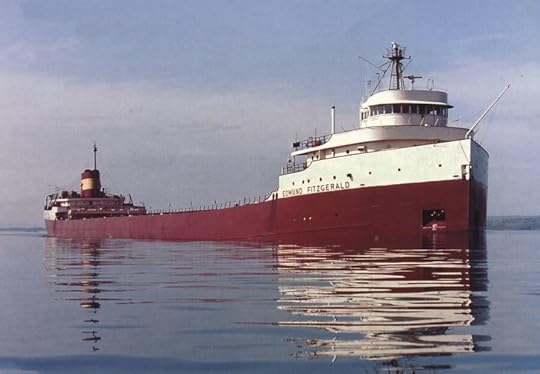
The website, with a 2020 copyright and still by Tim McCall (but with his full name) https://ssedmundfitzgerald.org/ and if you read the book, it's good to know about it because there are no photos in the book. The lyrics to the song are there, but the song link on the site no longer works.
This book, although naturally a bit dry at times due to the nature of the topic, was well done. Long enough to cover the topic and short enough to be interesting. The wreck was shocking, because the Edmund Fitzgerald, one of the largest vessels on Lake Superior, should have been able to handle the storm. To this day, no one really knows exactly what happened, but theories abound--experts disagree. There were no survivors and there was no radio call saying they were going down. In his epilogue, he includes things about several people not directly involved (some are relatives) and one is a man who was born c. ten years after the disaster who got so interested in this during a school project that he began a website that still exists today in a more sophisticated format that is very respectful to the families and that was the first (and may still be the only) website devoted exclusively to this disaster.
Links: The song on Youtube: https://www.youtube.com/watch?v=9vST6...
The website, with a 2020 copyright and still by Tim McCall (but with his full name) https://ssedmundfitzgerald.org/ and if you read the book, it's good to know about it because there are no photos in the book. The lyrics to the song are there, but the song link on the site no longer works.

August 15, 2022
The legend lives on from the Chippewa on down
Of the big lake they called Gitche Gumee
The lake, it is said, never gives up her dead
When the skies of November turn gloomy
Of the big lake they called Gitche Gumee
The lake, it is said, never gives up her dead
When the skies of November turn gloomy

October 3, 2015
Though the sinking of the Edmund Fitzgerald is a very interesting topic, I did not find this book so much. I think that with a couple of changes it would have been a better reading experience for me. First, I think this book could have benefitted from the addition of a map of the great lakes. There were many references in the book to harbors, shipping routes, and of course the location where the ship went down that I would have liked to have been able to place on a map. Second, though there was a glossary of shipping terms, an actual diagram of a ship and the various decks, etc. would also have been immensely helpful.

November 10, 2019
I really enjoyed this book. Well-written and very readable even though I know very little about cargo ships. I read on kindle but may recommend a paper copy because there’s a glossary in the back that is helpful. However, I read and understood the book just fine without using the glossary. Very informative, atmospheric, and a page-turner. Highly recommend!

August 13, 2014
The story behind the sinking is more complex than you think. If you've heard the song, you still don't know the whole story.
April 22, 2024
Since I visited the Ship Wreck Museum at White Fish Point in Michigan, the account of the sinking of the Edmund Fitzgerald, was particularly interesting. We were able to stand and look in the direction of the sinking and it was easier to relate to the facts of the storm and sinking. This was a great read and I’m going to read another book on this topic by Michael Schumacher…

April 8, 2025
Pretty good, was long and dove into a lot of possibilities.

September 25, 2012
I remember when I was in high school and me and a good friend on mine traveled across the US leaching dinners and beds off relatives and we came to roost at one the house of one of his uncles. We stayed there a good couple of weeks. He lived on an island on a backwater of Lake Huron not far from the town of Noble, Ontario. It was a beautiful spot, fishing, clear water, trees, peace and quite. That was a few years after the Fitz went down. His uncle had a crows nest sorta room built on the top floor of the cabin-style house. One afternoon his relatives had gone into town to do some shopping - not an easy feat, 5 miles across the water to the car and then the drive to Noble. It rained that afternoon and my friend and I hung out with not much to do. The crows nest had a small library amassed and I pulled a couple of books off the shelf - one being something called "Ghost Ships of the Great Lakes." I was fascinated and have been ever since. This wreck especially - I ask myself, as I'm sure a lot of others have over the years - "how can something this big, in modern times, just a few miles from shore simply vanish without so much as a cry for help?" All shipwrecks have a mysterious quality to them...unheard last words, last thoughts, etc. The wet cement-color water and bleak skies of winter on the Great Lakes and the silence of the depths, with all the ghosts floating in the carcasses of the dead ships in the dark depths...it's creepy.
May 30, 2026
On November 10th in 1975, when the Edmund Fitzgerald went down on Lake Superior--"The legend lives on from the Chippewa on down, Of the big lake they call Gitche Gumee." I was no more than a Freshman in high school in the southern state of TN. So I did not remember hearing of it because the news was not my worry (my daddy would not be proud to hear that since he worked for newspapers his entire life starting as a teenager till retirement). But then my world was rocked by a beautiful haunting ballad by Gordon Lightfoot--Gordon Lightfoot's "The Wreck of the Edmund Fitzgerald" was released in August 1976. The song was recorded in December 1975 a month after the tragedy. Then the story became an obsession and this book was devoured by me and settled well so to say.
The book starts with the preface telling the story of the raising of the bell from the depth of 500 feet on July 5, 1995 (yep I watched). Bruce Fuoco drifted down through the frigid waters of Lake Superior--"The lake, it is said, never gives up her dead, When the skies of November turn gloomy." He dove in what's called a “Newt Suit,” which is an 850-pound wearable submersible that allowed him to maneuver in the water and not be crushed by the pressure. As he finally cut loose the bell it almost smacked him in his faceshield of the helmet which would have been another disaster added the the Edmund Fitzgerald I'm sure. The bell was rung upon retrieval by the family members of the lost crew (if that doesn't tug your heartstrings you have none). Divers placed the engraved with the 29 crew members names replica bell onto the Edmund Fitzgerald wreck on July 5, 1995, they put it there to serve as a memorial.
The actual book after all this marches on to try and make sense of this mystery tragedy--"And every man knew, as the captain did too T'was the witch of November come stealin" it tells the story of the Fitzgerald's life, its final voyage, and the aftermath, including the search and investigation. No answers were found as there was never even an SOS sent out--"And later that night when his lights went outta sight, Came the wreck of the Edmund Fitzgerald." Schumacher delves into the official hearings and testimony, providing a more thorough analysis than many other books on the topic (which I am eternally grateful for)--"The searchers all say they'd have made Whitefish Bay
If they'd put fifteen more miles behind her, They might have split up or they might have capsized,
They may have broke deep and took water." The book is told with respect for the victims and their families, while also exploring the technical and human factors that could have led to the sinking or was it just a mystery that went down into the depths of Lake Superior--"The legend lives on from the Chippewa on down, Of the big lake they call Gitche Gumee, Superior, they said, never gives up her dead, When the gales of November come early."
The most haunting line of the song is what tears at your thoughts of these 29 crew members--"Does any one know where the love of God goes, When the waves turn the minutes to hours?" If you've never heard the song, find it and listen to these men's story in ballad form. The original 200-pound bronze bell of the SS Edmund Fitzgerald is on permanent display at the Great Lakes Shipwreck Museum located at the Whitefish Point Light Station in Paradise, Michigan and every November 10th they ring it 'til it rings twenty-nine times for each man on the Edmund Fitzgerald then once more for every life lost on Lake Superior.
Here’s the list of the 29 crew members who lost their lives aboard the SS Edmund Fitzgerald on November 10, 1975 :
1. Michael E. Armagost, 37 – Third Mate, Iron River, Wisconsin
2. Fred J. Beetcher, 56 – Porter, Superior, Wisconsin
3. Thomas D. Bentsen, 23 – Oiler, St. Joseph, Michigan
4. Edward F. Bindon, 47 – First Assistant Engineer, Fairport Harbor, Ohio
5. Thomas D. Borgeson, 41 – Maintenance Man, Duluth, Minnesota
6. Oliver J. Champeau, 41 – Third Assistant Engineer, Sturgeon Bay, Wisconsin
7. Nolan S. Church, 55 – Porter, Silver Bay, Minnesota
8. Ransom E. Cundy, 53 – Watchman, Superior, Wisconsin
9. Thomas E. Edwards, 50 – Second Assistant Engineer, Oregon, Ohio
10. Russell G. Haskell, 40 – Second Assistant Engineer, Millbury, Ohio
11. George J. Holl, 60 – Chief Engineer, Cabot, Pennsylvania
12. Bruce L. Hudson, 22 – Deck Hand, North Olmsted, Ohio
13. Allen G. Kalmon, 43 – Second Cook, Washburn, Wisconsin
14. Gordon F. MacLellan, 30 – Wiper, Clearwater, Florida
15. Joseph W. Mazes, 59 – Special Maintenance Man, Ashland, Wisconsin
16. John H. McCarthy, 62 – First Mate, Bay Village, Ohio
17. Ernest M. McSorley, 63 – Captain, Toledo, Ohio
18. Eugene W. O’Brien, 50 – Wheelsman, Toledo, Ohio
19. Karl A. Peckol, 20 – Watchman, Ashtabula, Ohio
20. John J. Poviach, 59 – Wheelsman, Bradenton, Florida
21. James A. Pratt, 44 – Second Mate, Lakewood, Ohio
22. Robert C. Rafferty, 62 – Steward, Toledo, Ohio
23. Paul M. Riippa, 22 – Deck Hand, Ashtabula, Ohio
24. John D. Simmons, 63 – Wheelsman, Ashland, Wisconsin
25. William J. Spengler, 59 – Watchman, Toledo, Ohio
26. Mark A. Thomas, 21 – Deck Hand, Richmond Heights, Ohio
27. Ralph G. Walton, 58 – Oiler, Fremont, Ohio
28. David E. Weiss, 22 – Cadet, Agoura, California
29. Blaine H. Wilhelm, 52 – Oiler, Moquah, Wisconsin
Song Lyrics are from The Wreck of the Edmund Fitzgerald by Gordon Lightfoot which appear at the end of the book
The book starts with the preface telling the story of the raising of the bell from the depth of 500 feet on July 5, 1995 (yep I watched). Bruce Fuoco drifted down through the frigid waters of Lake Superior--"The lake, it is said, never gives up her dead, When the skies of November turn gloomy." He dove in what's called a “Newt Suit,” which is an 850-pound wearable submersible that allowed him to maneuver in the water and not be crushed by the pressure. As he finally cut loose the bell it almost smacked him in his faceshield of the helmet which would have been another disaster added the the Edmund Fitzgerald I'm sure. The bell was rung upon retrieval by the family members of the lost crew (if that doesn't tug your heartstrings you have none). Divers placed the engraved with the 29 crew members names replica bell onto the Edmund Fitzgerald wreck on July 5, 1995, they put it there to serve as a memorial.
The actual book after all this marches on to try and make sense of this mystery tragedy--"And every man knew, as the captain did too T'was the witch of November come stealin" it tells the story of the Fitzgerald's life, its final voyage, and the aftermath, including the search and investigation. No answers were found as there was never even an SOS sent out--"And later that night when his lights went outta sight, Came the wreck of the Edmund Fitzgerald." Schumacher delves into the official hearings and testimony, providing a more thorough analysis than many other books on the topic (which I am eternally grateful for)--"The searchers all say they'd have made Whitefish Bay
If they'd put fifteen more miles behind her, They might have split up or they might have capsized,
They may have broke deep and took water." The book is told with respect for the victims and their families, while also exploring the technical and human factors that could have led to the sinking or was it just a mystery that went down into the depths of Lake Superior--"The legend lives on from the Chippewa on down, Of the big lake they call Gitche Gumee, Superior, they said, never gives up her dead, When the gales of November come early."
The most haunting line of the song is what tears at your thoughts of these 29 crew members--"Does any one know where the love of God goes, When the waves turn the minutes to hours?" If you've never heard the song, find it and listen to these men's story in ballad form. The original 200-pound bronze bell of the SS Edmund Fitzgerald is on permanent display at the Great Lakes Shipwreck Museum located at the Whitefish Point Light Station in Paradise, Michigan and every November 10th they ring it 'til it rings twenty-nine times for each man on the Edmund Fitzgerald then once more for every life lost on Lake Superior.
Here’s the list of the 29 crew members who lost their lives aboard the SS Edmund Fitzgerald on November 10, 1975 :
1. Michael E. Armagost, 37 – Third Mate, Iron River, Wisconsin
2. Fred J. Beetcher, 56 – Porter, Superior, Wisconsin
3. Thomas D. Bentsen, 23 – Oiler, St. Joseph, Michigan
4. Edward F. Bindon, 47 – First Assistant Engineer, Fairport Harbor, Ohio
5. Thomas D. Borgeson, 41 – Maintenance Man, Duluth, Minnesota
6. Oliver J. Champeau, 41 – Third Assistant Engineer, Sturgeon Bay, Wisconsin
7. Nolan S. Church, 55 – Porter, Silver Bay, Minnesota
8. Ransom E. Cundy, 53 – Watchman, Superior, Wisconsin
9. Thomas E. Edwards, 50 – Second Assistant Engineer, Oregon, Ohio
10. Russell G. Haskell, 40 – Second Assistant Engineer, Millbury, Ohio
11. George J. Holl, 60 – Chief Engineer, Cabot, Pennsylvania
12. Bruce L. Hudson, 22 – Deck Hand, North Olmsted, Ohio
13. Allen G. Kalmon, 43 – Second Cook, Washburn, Wisconsin
14. Gordon F. MacLellan, 30 – Wiper, Clearwater, Florida
15. Joseph W. Mazes, 59 – Special Maintenance Man, Ashland, Wisconsin
16. John H. McCarthy, 62 – First Mate, Bay Village, Ohio
17. Ernest M. McSorley, 63 – Captain, Toledo, Ohio
18. Eugene W. O’Brien, 50 – Wheelsman, Toledo, Ohio
19. Karl A. Peckol, 20 – Watchman, Ashtabula, Ohio
20. John J. Poviach, 59 – Wheelsman, Bradenton, Florida
21. James A. Pratt, 44 – Second Mate, Lakewood, Ohio
22. Robert C. Rafferty, 62 – Steward, Toledo, Ohio
23. Paul M. Riippa, 22 – Deck Hand, Ashtabula, Ohio
24. John D. Simmons, 63 – Wheelsman, Ashland, Wisconsin
25. William J. Spengler, 59 – Watchman, Toledo, Ohio
26. Mark A. Thomas, 21 – Deck Hand, Richmond Heights, Ohio
27. Ralph G. Walton, 58 – Oiler, Fremont, Ohio
28. David E. Weiss, 22 – Cadet, Agoura, California
29. Blaine H. Wilhelm, 52 – Oiler, Moquah, Wisconsin
Song Lyrics are from The Wreck of the Edmund Fitzgerald by Gordon Lightfoot which appear at the end of the book

July 10, 2017
This is a comprehensive account of one of the most well-known Great Lakes shipwrecks - the wreck of the Edmund Fitzgerald. Immortalised in a Gordon Lightfoot song, the massive ore carrier sank in a brutal November storm in Lake Superior in 1975 leaving no survivors and a vexing mystery as to just why it sank. No distress call was made and the crew seem to have had no warning that their ship would sink before it was too late to make any effort to abandon ship. This book provides what information is know about the last voyage of the ship along with a history of the ship, interesting background on other similar sinkings of Great Lakes freighters, and a thorough account of the aftermath of the disaster. It’s these later sections focusing on the investigation of the wreck, some disputes over the treatment of the underwater wreckage, and explorations of the wreckage by documentarians and Jacques Cousteau’s son that drag a bit and somehow seem superfluous to the topic. The book strives towards an encyclopedia-like thoroughness on the topic of this famous ship that waters down the compelling and fascinating early account of the fateful voyage complete with biographical information of the crew of mostly lifelong midwestern seamen whose careers at sea lasted anywhere from a few years to 4 decades. It’s these personal details drawn from news accounts and interviews with friends and family that make this such a rich account and give it a personal dimension. There are plenty of facts and figures about this 729 foot long ship carrying over 26,000 tons of iron ore in this book but it’s the stories of people like Captain Ernest McSorley who made the last communication from the ship when he told a nearby ship “We are holding our own” that make this book such an interesting sea tale.

February 26, 2022
I was 8 when the Edmund Fitzgerald sank and I remember being told about it in class [I lived in Ohio, where quite a few of the men were from] and we discussed it and what it meant. The following year the song by Gordon Lightfoot was released and I became even more interested in this story and what had really happened that fateful night [I was a very odd and particular child]. I have read articles about it and had made plans to visit the museum but those plans fell through [I will be rectifying that soon - plus a visit to the church in Detroit], but every November I light a candle and say a prayer for the families that are still dealing with the tragedy. This book brought back that thirst for knowledge, but I have to say that I believe that we will never know the real truth of what brought The Mighty Fitz down that night. I think we will all have to be content with what we know and just be willing to continue to honor the dead the best way we all know how.
There were issues with this book; the chapters were obscenely long, there were multiple spelling, punctuation and grammar errors and it did get sloggingly repetitive at times, to the point that I found myself skimming at points. That said, this was still an amazing read. I had never read a full account what happened that night [just shortened articles in papers and magazines] and that was horrifying and enthralling all at the same time. The author does a really good job of not sensationalizing it and just writing what was known and you are swept into that story and even though the end is known, I had to admit that I kept hoping for a different outcome as the story progressed - I cannot think of a better compliment to give an nonfiction author.
IF you have any kind of interest in this tragedy, I highly recommend this book. It will not disappoint.
There were issues with this book; the chapters were obscenely long, there were multiple spelling, punctuation and grammar errors and it did get sloggingly repetitive at times, to the point that I found myself skimming at points. That said, this was still an amazing read. I had never read a full account what happened that night [just shortened articles in papers and magazines] and that was horrifying and enthralling all at the same time. The author does a really good job of not sensationalizing it and just writing what was known and you are swept into that story and even though the end is known, I had to admit that I kept hoping for a different outcome as the story progressed - I cannot think of a better compliment to give an nonfiction author.
IF you have any kind of interest in this tragedy, I highly recommend this book. It will not disappoint.

March 20, 2025
I found this book to be quite interesting. Particularly interesting to me was the first half, which chronicled the last voyage and sinking of the SS Edmund Fitzgerald. I thought the author did a really great job at building a compelling narrative based on a limited number of facts, no one truly knows what happened to cause the Fitzgerald to sink.
The book begins to suffer a bit after the wreck. The author details the investigations into the sinking by various agencies and boards and their contradictory findings. This was interesting to a point, but also repetitive. The final part of the book details the various excursions and dives to the wreck itself and the families attempts to have the wreck site declared a gravesite to prevent desecration. Again it was interesting, to a point, as I felt it got a bit repetitive.
I was glad the author did not ignore the giant elephant in the room when it comes to the Edmund Fitzgerald story. The author acknowledged Gordon Lightfoot’s song and it’s effect on the story of the shipwreck. It’s thanks to Lightfoot’s masterpiece that people remain fascinated by the story of the Fitzgerald and is truly a great tribute to the twenty-nine men who lost their lives.
Overall, this was a solid account of a very famous shipwreck. So many mysteries surround the sinking of the Edmund Fitzgerald and I though the author did a solid job in detailing all the possibilities.
The book begins to suffer a bit after the wreck. The author details the investigations into the sinking by various agencies and boards and their contradictory findings. This was interesting to a point, but also repetitive. The final part of the book details the various excursions and dives to the wreck itself and the families attempts to have the wreck site declared a gravesite to prevent desecration. Again it was interesting, to a point, as I felt it got a bit repetitive.
I was glad the author did not ignore the giant elephant in the room when it comes to the Edmund Fitzgerald story. The author acknowledged Gordon Lightfoot’s song and it’s effect on the story of the shipwreck. It’s thanks to Lightfoot’s masterpiece that people remain fascinated by the story of the Fitzgerald and is truly a great tribute to the twenty-nine men who lost their lives.
Overall, this was a solid account of a very famous shipwreck. So many mysteries surround the sinking of the Edmund Fitzgerald and I though the author did a solid job in detailing all the possibilities.
Read
January 12, 2026it appears I'm not the only one that came to know about the sinking of the Mighty Fitz because of Gordon Lightfoot's song. I remember my sister telling me what the song was about and I've been interested in the story ever since. I think it's safe to say that anybody interested in the story wants to know exactly what happened that fateful trip, but with no witnesses, that truth is out of reach. The author does a great job of telling the story and outlining the possible reasons for the Fitzgetald's sinking. I thoroughly enjoyed this book

January 1, 2019
Good book overall though a little tedious in places. A book like this should really have some pictures and maps to go along. I didn't know much about this incident other than the Gordon Lightfoot song, and I feel I have a better understanding after having read this book. Overall a good book, but not necessarily a page turner.

February 25, 2021
This was such an excellent, interesting read. I vacation around Lake Superior every summer and love the freighters but admittedly didn't know much about the Fitzgerald other than the basics. After reading this I feel like I know so much and it also would be interesting to learn more about the other Great Lakes shipwrecks

November 22, 2018
Great book. The 3rd book on Great Lakes maritime history that I have read. Pretty much direct and to the point writing. Not a lot of unnecessary details. Got hard to put down at some points. A terrible tragedy that will leave you wondering what the heck happened! A question that will never be answered. If you aren't currently a fan of maritime disasters, this book might make you one.

March 31, 2021
3 1/2 stars

November 16, 2023
Spelling errors, but a very good book.

December 6, 2024
This book is excellent, well written and easy to understand. I highly recommend for anyone looking to learn more about the Edmund Fitzgerald!

December 30, 2024
Fascinating recap and look at our Great Lakes' most iconic and mysterious tragedy. I learned a ton!
Read
May 3, 2024The legend lives on from the Chippewa on down

March 13, 2026
Picked this up while at the shipwreck museum in whitefish two years ago.
While the first half was a little slow, the back half with the ensuing legal battles and hearing from family members was really well done.
Also shout out pages 98-99 for the St Joe mention.
While the first half was a little slow, the back half with the ensuing legal battles and hearing from family members was really well done.
Also shout out pages 98-99 for the St Joe mention.
October 21, 2021
Not totally sure how this ended up on our bookshelf, but it did and I read it [ed: Zack says this was a gift to him from my parents?!]. Great lakes shipping and the sinking of the Edmund Fitz are not areas of expertise for me, so I learned a few things! Expectedly does not pass the Bechdel Test.

June 29, 2017
The legend lives on from the Chippewa on down of the big lake they call Gitche Gumee. ~ Gordon Lightfoot from The Wreck of the Edmund Fitzgerald
If you know anything about the S.S. Edmund Fitzgerald you probably learned it from the song The Wreck of the Edmund Fitzgerald by Canadian folksinger Gordon Lightfoot. However, the song is, in a few points, not quite accurate. This is by no means a criticism. Poets are entitled to creative license and much was still unknown about that fateful night of November 9-10, 1975 when Lightfoot penned his ballad. He filled in some of the blanks. A few items were later disproved – but this in no way diminishes the artistic value nor the labor of love that was Gordon Lightfoot’s hauntingly beautiful tribute to “the 29”.
My full review: http://100greatestnovelsofalltimeques...
If you know anything about the S.S. Edmund Fitzgerald you probably learned it from the song The Wreck of the Edmund Fitzgerald by Canadian folksinger Gordon Lightfoot. However, the song is, in a few points, not quite accurate. This is by no means a criticism. Poets are entitled to creative license and much was still unknown about that fateful night of November 9-10, 1975 when Lightfoot penned his ballad. He filled in some of the blanks. A few items were later disproved – but this in no way diminishes the artistic value nor the labor of love that was Gordon Lightfoot’s hauntingly beautiful tribute to “the 29”.
My full review: http://100greatestnovelsofalltimeques...
Displaying 1 - 30 of 164 reviews