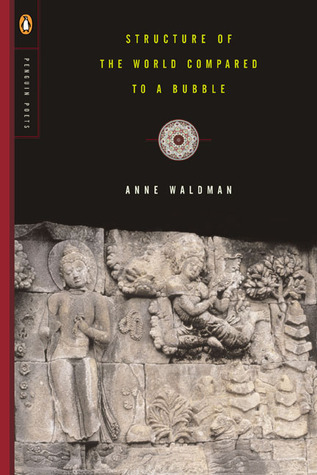
The Stupa of Borobudur in Java is one of the architectural wonders of the world, designed as both a mandala and as an aid for the Buddhist pilgrim that can be read as a holy book. It has inspired Anne Waldman to create a work which is at once a walking meditation, a "cultural intervention", a "recovery" of a sacred site, and a take on contemporary reality and how the busy "monkey brain" (as it is called in Buddhism) works and travels. Exploratory and meditative, even playful at times, it expands the sense of invocation and incantation that Waldman is celebrated for, while also reflecting an engaged political/cultural awareness.
Anne Waldman was part of the late Sixties poetry scene in the East Village. She ran the St. Mark's Church Poetry Project, and gave exuberant, highly physical readings of her own work.
She became a Buddhist, worshipping with the Tibetan Chogyam Trungpa Rinpoche, who would also become Allen Ginsberg's guru. She and Ginsberg worked together to create a poetry school, the Jack Kerouac School of Disembodied Poetics, at Trungpa's Naropa Institute in Boulder, Colorado.
Anne Waldman is one of the most interesting, vibrant and unpredictable members of the post-Beat poetry community. Her confluence of Buddhist concerns and thought-paths with sources of physicality and anger is particularly impressive (did you get all that?).
She was featured in Bob Dylan's experimental film 'Renaldo and Clara.'
Waldman’s Structure of the World Compared to a Bubble is a frustrating exercise of stream-of-consciousness writing and unapologetic self-centeredness. In her introduction, Waldman makes a big fuss about her circumambulating poems and how they mirror Buddhist philosophy and art, but in actuality the poems don’t travel in a circle, exploring and returning and reexamining, but instead march in place; there is a lot of repetitious movement but very little ground covered. Also, while Buddhism is mentioned (but not always explored), most of Structure of the World feels like a rehash of Beat values. The Beat movement is often associated with Buddhism, but Beat culture doesn’t reveal Buddhism any more than the American Republican party reveals Christianity or the Taliban reveals Islam.
The work as a whole has a raw, unfinished feel, as if it was written in one frantic burst and published after an editing process that consists of a single cursory glance. Most of the poems address the author’s internal dialogue with strings of words too ungrounded to mean much of anything to anyone except the author herself. Two pages contain a copy of a handwritten section. Both ampersands and the word “and” are used interchangeably, sometimes within the same line. Words are misspelled. The entire book screams of an author above polishing or even editing her own work (but I’m not sure what happened with the editors at Penguin).
An alienating, self-indulgent collection of poems. Steer clear of this one.
For me Manatee/Humanity is the pinnacle of Anne Waldman's work. I was taken by her Buddhist acceptance of environmental degradation meanwhile mourning the loss. She took a deep spiritualized look at our sad environmental fate using the ancient, gentle, and slow manatee as a salient metaphor. Structure of the World Compared to a Bubble has a more academic tone as she tries to explore a Buddhist Stupa in Java, Indonesia. The strongest poems in the collection dug into her reconciling Buddhist and Hindu philosophy within herself and the weaker poems use a bunch of esoteric Hindu words as she displays what she has learned at the stupa.
Her poem "An Aside on Karma" was striking because she strung along abstract causes and effects to implicitly demonstrate how karma works. "Maybe it was the voice of an overpowering mother, an angry lover, a retaliatory worker who lost a choice job. And had a family to support. Someone was always sick or tired or needy. So many grudge in a world."
The less successful poems introduced me to new concepts in Hindu and Buddhist philosophy but she used words almost as if she had a bank of words and concepts that she challenged herself to use in poems without developing or internalizing them fully. This became more obvious when one of the poems was simply her hand written notes about the history of the stupa.
Although, poetry was an engaging way to explore some of these concepts I hope to find a writer or teacher who has a less fresh or less foreign relationship with these topics.