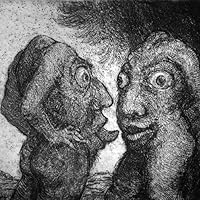
"Give me your sorrows. Give me your needings...I will take them from you..."
In a muddy field in Faulkner, Illinois, a crowd has come to see the smooth-cheeked boy in a makeshift canvas tent -- the boy whose stern father claims he can work a peculiar kind of miracle.
"And you will be mine."
Our worst secrets, our darkest pain, our weakness and shame -- the hollow part of us -- these he takes upon himself, leaving behind a strange white light of peace and contentment.
What grows in that eerie human light? While word of his power spreads and hundreds are "reborn," two people remain impervious to Paul's power. A priest and a young woman reporter come face-to-face with a nightmare. Relieved of guilt, steeped in self-acceptance, Paul's followers are possessed by a strange new evil no one can control: a living, breathing, palpitating evil freed to live without restraints -- and marching toward blood-soaked dominion.
Librarian note: There is more than one author in the GoodReads database with this name
John Lindley Byrne is a British-born Canadian-American author and artist of comic books. Since the mid-1970s, Byrne has worked on nearly every major American superhero.
Byrne's better-known work has been on Marvel Comics' X-Men and Fantastic Four and the 1986 relaunch of DC Comics’ Superman franchise. Coming into the comics profession exclusively as a penciler, Byrne began co-plotting the X-Men comics during his tenure on them, and launched his writing career in earnest with Fantastic Four (where he also started inking his own pencils). During the 1990s he produced a number of creator-owned works, including Next Men and Danger Unlimited. He also wrote the first issues of Mike Mignola's Hellboy series and produced a number of Star Trek comics for IDW Publishing.
I normally don't do horror but I was a huge John Byrne fan at the time from his comic work and wanted to see how he would tackle a novel. Good stuff yet graphic.
In my experience, comic book writers don't make the best novelists. M.R. Carey aside, their novels tend to be overly descriptive, making them overlong, and while they have a strong visual characteristic, the characterization tends to be lacking. Whipping Boy is no exception.
This is a long novel -- nearly 500 pages of small type -- and I feel like it could have been trimmed by at least 20% if Byrne had kept his descriptions under control. He also has a flair for the overdramatic: e.g., "From that awful, gaping, distended maw issued forth a cry that Clay Garber did not believe could have been equaled by the voices of a hundred souls pitched headlong into boiling tar." It's the kind of prose that makes you feel embarrassed for the writer.
The thing is, the story is fairly interesting, at least by way of its theme. The story is about Paul Trayne, a young boy who has the power to absorb the guilt, shame, and other negative feelings of people around him. The problem is that once he absorbs those feelings, the people are left with no moral compass, no way of knowing right from wrong. After unleashing his powers on a small town and leaving them in the chaos of not caring, he moves on to Chicago, where he plans to use his powers on a larger scale. It's an intriguing premise, with an interesting theme, especially when, near the end of the story, Byrne has a character soliloquize internally about how it's not the boy who did the terrible things, but the people. Sure, it's a tired horror trope, but it's effective.
The problem is Byrne doesn't do anything with it but tell a story. He doesn't capture the characters well enough for us to empathize with their dilemmas, instead presenting us with more and more graphic depictions of the horrible things people do to each other. We don't get that unsettling feeling that, yes, we the readers could just as easily become the monsters if we were in the same situation. It feels emotionless and pointless.
The other issue is that Byrne doesn't give us a compelling reason as to why Paul and his father are doing what they do. I think they're just supposed to be evil (there's a priest character who reinforces that idea), but it's not enough to define their motivation, and it's hard to feel engaged with their characters without it. Plus, in the final act of the novel, Paul's character changes on us, and while Byrne explains why it changes, and it fits with the story, he doesn't get us to feel it. As such, it feels flat and forced.
So, there's potential here, but Byrne doesn't bring it to fruition. For an Abyss book, it's still a level above the other dreck they published (barring Tem and Koja), but it's not so much that it stands among the best works from the line. It has too many cliches, it tells too much, and it doesn't stick the landing well enough.
This is a very uneven book. While, overall, I enjoyed it, the pacing was a mess. This is not a short book, clocking in at almost 500 pages. It really needed a heavier hand in the editing, as parts of the book cut the forward momentum off completely and slow everything to a snail's pace so characters can wax philosophical about the notion of sin. Also, the slow burn beginning could have probably been tightened up by a good twenty pages to get the story moving faster.
The pacing issues aside, this is a brutal, mean horror novel, and I loved that part of it. It takes a while to get there, but once everything hits the fan all bets are off. There are scenes of mass brutality that would make Bentley Little proud. I also enjoyed the characters. They aren't the most original, but they are strong enough to keep you invested in the story.
If you can find it cheap, pick it up. It's a fun, but sadly uneven, horror novel.
Stephen King endorsed the entire Dell Abyss Horror line. Here is his blurb:
"Thank you for introducing me to the remarkable line of novels currently being issued under Dell's Abyss imprint. I have given a great many blurbs over the last twelve years or so, but this one marks two firsts: first unsolicited blurb (I called you) and the first time I have blurbed a whole line of books. In terms of quality, production, and plain old story-telling reliability (that's the bottom line, isn't it), Dell's new line is amazingly satisfying...a rare and wonderful bargain for readers. I hope to be looking into the Abyss for a long time to come."
The premise of this book is thought-provoking: what if someone offered to remove from you, but take on himself, all your negative emotions like guilt, fear, and anger, even though the "gift" would hurt the other person deeply? The book's a bit long and some of the Zombie apocalypse-type events are so prolonged they're almost boring, but I appreciated the way it inspired me to think about the nature of good and evil and the perils of instant redemption.
This book is not really very well written; comic book writers rarely write good novels. However, the ideas in this book are fascinating: What would a world without guilt be like? And what happens when an empathic mirror meets a sociopath?
I don't necessarily agree with Byrne's answers to these questions, but the final scene is profoundly interesting to me.
This entire review has been hidden because of spoilers.