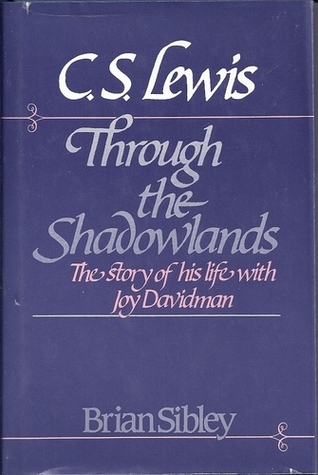
More than a biography, more than a love story, C.S. Lewis Through the Shadowlands is a moving tribute to a couple whose faith, hope, and love grew through adversity.
Brian Sibley is an English writer, broadcaster, and award-winning dramatist.
The author of over 100 hours of radio drama and hundreds of documentaries and features for the BBC, he is best known for his acclaimed 1981 radio adaptation of J. R. R. Tolkien’s The Lord of the Rings, co-written with Michael Bakewell, as well as dramatizations of C. S. Lewis’s The Chronicles of Narnia, Mervyn Peake’s Gormenghast novels, and Richard Adams’s Watership Down.
Sibley has also written numerous original plays for radio, presented popular BBC programmes including Kaleidoscope and Talking Pictures, and produced documentaries on figures ranging from Lewis Carroll and Ray Bradbury to Julie Andrews and Walt Disney.
His contributions to broadcasting have earned him accolades such as the Sony Radio Award and the BBC Audio Drama Award for Best Adaptation.
In print, Sibley is the author of many acclaimed film “making of” books, including Harry Potter: Film Wizardry, The Lord of the Rings: The Making of the Movie Trilogy, and Peter Jackson: A Filmmaker’s Journey, as well as companion volumes for The Hobbit films, The Golden Compass, and Disney classics. His literary works range from Shadowlands to children’s books like The Frightful Food Feud and Osric the Extraordinary Owl, with stories appearing in official Winnie-the-Pooh collections.
A noted Disney historian, Sibley has contributed essays to The Walt Disney Film Archives and recorded DVD commentaries for classic films. He is the editor of J. R. R. Tolkien’s The Fall of Númenor, winner of the Tolkien Society’s Best Book award in 2023.
Sibley has served as President and Chair of The Lewis Carroll Society and is an honorary member of The Magic Circle, the Tolkien Society, and The Children’s Books History Society.
Still so inspired every time I read about this amazing author and his life of discovery.
It comes through so clearly how, even though he was a gigantically gifted person, he was very much a human.
The way he grapples with his faith after losing his wife is an encouragement to anyone who walks through "deep waters".
A quote that struck me from this book: "He always knew my temple was a house of cards. The only way he could get me to recognise this fact was to knock it down".
Also made me excited again about reading and made a list of authors from the book that Lewis enjoyed; a whole new trail for me to follow!
I enjoyed reading about C.S.Lewis, an author who is well-known for his children's Narnia books as well as many books and articles on the Christian faith. This book concentrated on the years he knew Joy Davidman, first in correspondence and later as a friend and eventually his wife. There was much about "Jack" Lewis that I had never known before, though I have read several of his works. The fact that Joy had been born Jewish, was for a long time an agnostic and Communist, and a divorce' made the friendship between the two highly unlikely. Joy converted to Christianity before the two met in person. The years of their marriage were few, as shortly after they were married, Joy was diagnosed with cancer. Her struggles with the disease, a few short years of remission, and then relapse are well written. The effect her death had on Lewis made him for a while question his own faith, the faith that inspired so many others. How he eventually worked his way back to belief, while only dealt with briefly, was powerful. I would recommend this book to those who like biographies, are interested in learning more about this famous author, or enjoy an inspirational true story.
Sibley puts together the basic story of Lewis and Joy’s relationship. He gives biographies for each, though admittedly focuses more on Lewis, and talks about their growing love for each other. He inserts lots of quotes and pieces from their writings, which I think added a good dimension to the biographies. But sometimes his commentary got a little too... saccharine, or emotional.
Nothing groundbreaking, and definitely not exhaustive. But overall a good addition to the cannon of books-on-Lewis, especially considering its time. Originally published in 1985.
I read this when I was 12 as a time passer in a foreign country where no one spoke english and it was the only literature that could be found in the house that was in English. I wasnt expecting much being young and silly, but I was pleasantly surprised. I couldnt put the book down. C.S. Lewis' Life was so interesting and amazing, and Sad. I read through the night till I was finished. Amazing Man, one of my favourite author's. Reading this gave me such insights into his life, helped me understand how he became such an Awesome writer. To be fair I havent read it since, so these are all my memories of the book from when I read it, the ideas of a 12 year old, Hmm Need to read it again YeSh!
While I have read a number of books by C.S. Lewis, I have never read one about him. I'm glad I picked this one up. (This book is much more than just the love story between him and Joy.)
Immediately upon finishing this, I gave it 5 stars. Now I'm less attached emotionally to what happened, so I was tempted to give it 3. I've compromised and given it 4 (FINAL ANSWER!).
C.S. Lewis is one of those people I've never met that I nonetheless trust implicitly.* I've found myself struggling with a lot personally in the last year, and so I picked up A Grief Observed with the hope that Lewis' thoughts would help me through some of it. It definitely did (and I find myself needing to reread it already), but it was also a complete surprise. And it led me to this.
Lewis was married in 1956 to Joy Davidman. They were only together for four years before her death. I had no idea before reading Grief that he was ever married, so I was curious to learn more about their relationship.
Knowledge is a weird thing. I could count on one hand the things I knew about C.S. Lewis before, and now I know another handful more, but I'm not sure all of them are things I like knowing. I suppose the benefit is that I have a more complete picture of him as a person, but I was still left feeling kind of blindsided and confused. This isn't how one wants to feel after learning more about someone they trust implicitly 😅 The story of Lewis and Joy is still lovely, and the parts that got me about Grief were definitely involved in the strong emotional reaction I had to their story, but I am also saddened by some of what I learned.
Obviously the author's focus was on their romantic relationship, but we also got some insight into their lives before meeting each other, and the book takes us through the end of Lewis' life. The book is short and well-written, and has gotten me all fired up to read more about the Inklings. I'm curious specifically to dig more into the friendship between Tolkien and Lewis, because I thought they were closer friends than this book implies. We really only see that they interact for a brief period of time, and then the only interactions highlighted are moments of dissonance between them.
OFF, to more reading (and probably more Lewis because I want to read Narnia so bad 😭)
*There aren't many, but Ryan O'Neal (Sleeping at Last) is another one of them, as is a good friend of mine you've never heard of.
This is the first biography I’ve read of C.S. Lewis. I thoroughly enjoyed getting to know him, his brother, Warnie, and Joy. How awesome it would have been to be a part of the Inklings and sit and listen to Lewis and Tolkien read their writings to one another.
A quick read about two incredible minds! I am always amazed at the depth and resilience of C.S. Lewis, and it was a pleasure to learn that Joy Davidman was just as brilliant. What I wouldn't give to sit in a pub and talk with them!
C. S. Lewis is one of ,y heroes & his love affair with Joy Davidman captured my heart. What brilliant he was & found love late in his life! Poignant for sure!
The love of C.S. Lewis and Joy Davidson was controlled by the Church of England. In the Church's eyes, a divorced woman sinned if she remarried. This allowed no room for flexibility in an American woman's struggle to survive on her own while raising two young boys. As a wife of domestic violence (by modern law), Joy fled to England and created a new life with her children. Many of Jack's judgmental literary friends judged Joy for being a gold digger. Jack paid the expensive tuition for Joy's sons at private schools. When Joy faced the possibility of losing her visa, Jack decided to marry her.
This is where the Church comes into play. After reading the active role the Church played in the lives of citizens from England, I have a better understanding of why early citizens left for America. The Church dictated the first phase of the Lewis marriage. Jack married Joy to fulfill a social obligation he had as a friend. This meant the married couple lived in two separate houses. The married produced the abrupt vacancy of Joy from her house. When Joy fell down and broke her hip, Jack fell in love with her. He stepped up to the plate to be a loving husband and be more considerate of his wife's biological needs.
As a small child, Jack watched his own mother suffer and pass away from cancer. As a man in his sixties, Jack watched Joy slowly slip away from his world. The death of Jack's mother resulted in his brother abusing alcohol and him turning to education. Their father was not able to speak about his wife's death. The grieving process never ended for Jack, even after Joy's death. People were afraid to discuss Joy's death with Jack and her two sons. Jack did keep his feelings in journal format in a book called A Grief Observed. This literary piece expresses the emotions Jack felt during the grieving process. Being able to open up enabled Jack to handle living. This living did not last long, as Jack passed away from a heart attack.
Further research on C.S. ("Jack") Lewis led me to discover that Douglas Gresham remembered his stepfather being able to recall childhood stories from his photographic memory. Jack also made sure food was kosher before the boys returned home for visits. My research has led me to the conclusion that Jack's actions were as thoughtful as his wife's writing of Anya. I felt like I attended the greatest love story ever written. Two intellectual minds meeting on a high tidal wave that never stops is the way I would describe the Lewis marriage. Joy was stolen from Jack's life too many times.
I am left with the following question: What became of the American woman Jack corresponded with for so many years? Did she attend Jack's funeral? Did she become a famous feminist writer?
This was SUCH a weird book. If you love all things C.S. Lewis-ian and you are the kind of person who loved reading The Encyclopaedia Britannica for fun when you were a kid, you will like this book. I liked reading about all of his books in their historical context, especially their relationship to what was occurring in Lewis' life. I also like how the book is telling a story primarily through passages from Lewis', Joy Davidman's, and their contemporaries' writings. There were SO many interesting tidbits in here: C.S. Lewis went by "Jack" his entire life; Tolkien was the first person to read Narnia and hated it, even discouraging Lewis to pursue publishing it; and the story behind A Grief Observed.
However, even though I fit both of the above categories (i.e., encyclopedia-reading, Lewis-obsessed), I still had issues with this book. It might have been the obvious, blinding infatuation the author had with Lewis. Or it might have been the way the author viewed the relationship between Joy Davidman and Lewis: repeatedly describing her an unattractive American divorcee who relentlessly pursued and was lucky enough to land Lewis. The author's apparent disregard for the women in Lewis' life is a theme throughout the book. The mysterious Mrs. Moore ("a woman of very limited mind, and notably domineering and possessive by temperament") "traps" Lewis into a life of quiet desperation. The "American lady friend" who was, it seems, his most significant relationship at the end of his life, was never even named, though Lewis' intimate letters to her are substantially quoted. However, all of his male friends, who mostly abandoned him at the end of his life, are named and described in detail. Mostly, this book just left me wanting to know the real story behind C.S. Lewis' life, absent the apparent prejudices of the author.
A bit disappointing in that it takes almost the whole first half of the book before we even get to Joy and her relationship with CS Lewis. A lot of rehashing and reselling of Lewis' early life, only some of which would be relative to the story the author is attempting to tell, in a way to set up how Lewis related to women.
I've read a lot of book by C.S. Lewis, from his books on theology (Mere Christianity), to his children's literature (The Chronicles of Narnia), to his poetry. I've also read biographies and books that have profiled Lewis and have commented on his works and connections with other writers, like JRR Tolkien. For readers who also fall under that category, this book will add more to what they already know. The chapter titles alone ("The Magician's Nephew," "Surprised by Joy," "A Grief Observed") are effective Easter eggs.
Sibley spends the first three chapters on C.S Lewis and his life before meeting Joy Davidman. For those who already know his story, it may be a bit of repetition. From there, he shifts into a description of Davidman's early life and first marriage, and eventual meeting with Lewis. In many books about Lewis, Joy Davidman is a footnote or is referenced in passing. Perhaps it makes sense, since she was present for only a few years in his life. Sibley uses various texts to fill in the story: excerpts from letters, books and other published works, articles, and poems. Some of the quoted text is direct commentary in the form of letters and diaries. In other places, Sibley relies on books, such as Joy Davidman's Smoke on the Mountain: An Interpretation of the Ten Commandments, to show figures, their perspectives, and how those perspectives have woven their way into fiction and poetry--it makes for interesting reading if you buy into this lens of criticism.
Sibley carefully addresses controversy in the figtures' lives, relying on facts and quotes to tell the bulk of the story, reserving his own judgment. As a result, Sibley presents an account that seems well-supported and plausible, in places where he may be making inferences. For those who are fans of C.S. Lewis and would like to place books like Surprised by Joy: The Shape of My Early Life and A Grief Observed in their proper context, this book helps.
Who should read this book: fans of C.S. Lewis, those who have read multiple books by/about C.S. Lewis, biography readers.
C.S. Lewis; Through the Shadowlands by Brian Sibley
Having read Randy Alcorn’s book “If God be Good” and then this book on the suffering of Joy Davidman, C.S.Lewis’ wife, I have come away with a new insight to this comment he made. “Lord of the narrow gate and the needle’s eye, Take from me all my trumpery lest I die.”
He wrote that as he prayed as a humble man not seeking worldly wealth but only God's love.
Lewis as a middle aged man and having never married was swept up into love from a divorcee he met through correspondence. Lewis was known throughout his life to taking in and helping others but he was unaware of love that came creeping in soever so quietly through the life of Joy. Ironically he had titled on of his books "Surprised by Joy" before they met. In their short wedded life they moved each other to know the foibles and beauty of love that only God can bring. In death Lewis wrote one of his most famous books on grief as he sought to find peace in her home-going.
Sibley shares that how Joy came to God explaining He was like a cat creeping upon its prey and then pouncing upon it when the prey least expects it. That is how Christ came to her and how she surrendered to His will. He fulfilled her longing for extraordinary love that she earnestly needed for the last journey from this life to the next. In some ways both she and Lewis had similar experiences of coming to God.
Brian Sibley has researched their lives and keeps the reader moving from one year to the next sharing how these two met and embraced Christ. Lewis was a prolific writer and Sibley shares excerpts from The Chronicles of Narnia to expertly show how Lewis faced life through the children and Aslan the Beloved Lion. Sibley also shares with the reader how the world did not immediately take to his books of fantasy and in fact it was not until later in life did the Chronicles hit their stride. Now we appreciate them as some of the most coveted of books to read to children sharing how Aslan loves and gives his life thus showing Christ’s sacrifice.
Joy died in 1960 from cancer, Lewis would join her in death on Nov 22 1963--the same day JFK was assassinated. The irony.
Highly recommend this book to any Narnia fans and to any wanting to know more about this author.
Read this last year for probably the second time. Very good book on C.S. Lewis.
page 22: "It was Warnie, Jack was later to recall, who first opened his eyes to the beauty of nature, when he 'brought into the nursery the lid of a biscuit tin which he had covered with moss and garnished with twigs and flowers so as to make a toy garden...That was the first beauty I ever knew. It made me aware of nature as something cool, dewy, fresh, exuberant...As long as I live my imagination of Paradise will retain something of my brother's toy garden.
Again and again in later years, Jack was to use the image of the garden in his writing, as a symbol of romance and mystery and life everlasting: "At the end of one long lake which looked as blue as turquoise, they saw a smooth green hill. Its sides were as steep as the sides of a pyramid and round the very top of it ran a green wall: but above the wall rose the branches of trees whose leaves looked like silver and their fruit like gold..."
Page 42: "Having learned from childhood 'to make a minor illness one of the pleasures of life,' he comforted himself with the satisfying thought that he had temporarily traded the trenches for a bed and the opportunity to do what he liked doing more than anything else - read. One of the books he read was a collection of essays by G. K. Chesterton, whose writings were later to have a powerful effect on Jack's thinking about Christianity.
'In reading Chesterton, as in reading MacDonald,' he was to reflect, 'I did not know what I was letting myself in for. A young man who wishes to remain a sound Atheist cannot be too careful of his reading. There are traps everywhere--'Bibles laid open. Millions of surprises,' as Herbert says, 'fine nets and strategems.' God is, if I may say it, very unscrupulous.'"
It is extremely rare to be so familiar with certain personages from having read deeply about the Inklings * in general, and about C.S. Lewis in particular, and then to have been fortunate enough to see them portrayed so very authentically in all respects
Though from a time gone-by, their presence on-screen seemed essentially timeless in the best-possible way, allowing those who live nearly a Century thereafter to so easily become a part of their world, at least for a while.
The director of the film, produced for broadcast by the BBC Television network, was Norman Stone, and the screenwriters were both Norman Stone and David M. Thompson, (winning the 1986 BAFTA TV AWARD for Best Single Drama; and the BAFTA TV AWARD for Best Actress went to Claire Bloom, whose very full presence in each scene was astonishing), as was each of the characters, including the young lads, both remarkably-subtle performances, especially for children so young. All of the characters were brought to life so vividly, and almost exactly as had been imagined through the backstory; almost a sort of 'miracle' in and of itself, as a great work of art, in the opinion of one closely scrutinizing enthusiast! Bravo!
Readers of this original book by Brian Sibley (whose friends were also friends of C.S. (Jack) Lewis, who may have found it to be delightful, should know about this brilliant, very life-affirming, film!
I read Shadowlands as I prepared to see David Payne in his 1,000+ performance (in 20 years) of "An Evening with C.S. Lewis". The show is a step back in time to 1963 when the Christian author is meeting with a group of American writers at his home near Oxford. This book is similarly a look-back at his life overall and more specifically the way-too-short but sweet love for Joy Davidman. I learned so much about this incredible writer.... his initials stand for Clive Staples but he went by the name "Jack"; he was friends with J.R.R. Tolkien and Victor Hugo; he wasn't a lifelong Christian but rather a convert (thanks in part to J.R.R. Tolkien) after being an atheist for 15+ years; his brother, Warnie, battled alcoholism; he had an "Adopt-A-Mom", Jane Moore (who was his WWI buddy Paddy's mom); Jack was a loving stepfather for Joy's sons (Douglas and David Gresham); and, his letters were as interesting as his books (no doubt enticing Joy to move to England from New York with her pre-teen boys). C.S. Lewis led an interestingly unique life and an inspirational faith.
This book paints a thumbnail sketch of C. S. Lewis's life before meeting Joy Davidman, who was to become his wife. This sketch is useful background for anyone wanting to read and learn more about Lewis, but is also a good background about where he was when he met her and how they fell in love. As she becomes ill, rallies, then ultimately dies, we Lewis transformed into a new and better man. The book does not emphasize Lewis's faith or how it was transformed by his marriage and his loss of Joy, but no study of Lewis can ignore the role played by his faith in his life. This book is more about personal relationships, than about religion or religious philosophies. It proved to be an excellent topic for our book club, but is not sufficient to get a complete picture of C. S. Lewis, the man or C. S. Lewis, the apologist. For that, I believe it's necessary to read what he actually wrote, in addition to what has been written about him. The movie based on the book, starring Anthony Hopkins, was also excellent.
The first pages about CS Lewis's early life were incredibly dry. When we are introduced to Joy Davidman a few chapters in, things perk up. She was interesting and complicated and her early life and first marriage was engaging enough to read about.
Then she meets CS Lewis and the book goes back downhill.
It reads like a Coles Notes of a larger, more interesting biography, with quotes heavily utilized and little else to engage the reader.
On top of that, Sibley goes out of his way to talk about how unattractive Joy is. She's constantly at her most unattractive, according to him. Lewis, on the other hand, only gets commentary on his clothing for the most part.
Last night, with 30 pages left, I almost DNFed because there was "too much left". With 30 pages.
I should have DNFed this when I originally wanted to and just gotten on with my life, but didn't because the book is so short I thought I would bang it out quickly enough, but instead it followed me around for two weeks and made me dread returning to it.
I don't very often give out two-star reviews, but I just didn't enjoy this book. I did finish it because I have always loved the movie "Shadowlands". I know that it is a movie based on a true love story, and also that it probably took some license with the actual story. I expected to read a book about two people who loved each other deeply and dearly and their short time together. This book, however, I found to be dry and boring. A lot of quotes from the writings of CS Lewis and Joy Davidman and a long introduction chronicling the early life of CS Lewis. I had a hard time getting to the end, even of its short 200 pages. I guess it doesn't help that I haven't read any of his or her writings and so was not prepared for so much quoting of them. It did help me to fill in details of their lives that were not covered by the movie. For that I am grateful.
I took this book slow. I wanted to wrap my head around the human and his persona. An amazing author of so many books, under went a lot of personal tragedy, the loss of his mother in his early years, the military duties, caring for a demanding surrogate mother, many years working at Oxford and demands on his time that wasn’t his own.
This book focuses on his personal life and how he meets and later married a divorced woman, whom embraced Judaism, Atheism and Communism before turning to Christianity, first in secret, for her to obtain a visa to stay in the country and later talks a young priest into going against his church to marry them. He cares for her until her death. Many of his closest peers refused to go to the wedding and later to her funeral because they felt they had gone against his own principles to do so.
What a lovely insight into the life of a man whose children’s books have delighted millions. For parents and children alike, they enchant with stories of good triumphing over evil in magical worlds with magical creatures. Many of his theological thoughts have uplifted and edified me as well as so many others. His quotes finding themselves interwoven in many talks and sermons. It was so poignant to read how his faith developed. I had no idea that his mother died and his father was so distant. That he lost his faith completely before finding it again in adulthood. And then it was tested again at the loss of his beloved wife Joy. What a charming man he was.
This entire review has been hidden because of spoilers.
I am a little torn about this book. I expected it to be like most biographies: the story told through the voice of the author based on his research. Instead, this book is a collection of quotes weaved together by the author. This style made it a bit segmented and less unified.
Nevertheless, it was great learning about the life for C. S. Lewis and Joy Davidman. Although I have read most of Lewis' books, there was much I did not know about his life. I especially liked learning about at what stage of life he wrote his various books.
The saw the movie years ago but hardly remember it. So when I came across this book I decided to read it to learn more about C. S. Lewis. It was very interesting learning about what was going on in his life while he was writing certain book—some that I’ve read but others that are now on my reading list. Like another reviewer, it made me want to explore some of his favorite authors particularly George MacDonald so now I’m reading The Princess and the Goblin. I’m loving that book. This book has given me a long reading list.
A biography of C.S.Lewis- his time with Joy Davidman is the main focus. Enjoyed reading this along with a fiction 'Becoming Mrs. Lewis'. I'm no romantic, but seeing Joy falling in love with words of Jack did tug at something...
"When a loved one dies, we think of this as love cut short; like a dance stopped in mid career or flower with its head unluckily snapped off -something truncated and therefore, lacking its due shape. Whereas it is really, a universal and integral part of our experience of love."
A book of beauty and depth. It takes you on a journey to another era through the life of C. S. Lewis, author of Narnia -among others, and the poet (and his wife), Joy Davidman. The passion for reading and writing, the journey on the path of faith, the unique taste of real love and the pain of loss pervade the book. The vocabulary is difficult in several parts but the writing is smooth, special and suitable for such a book.