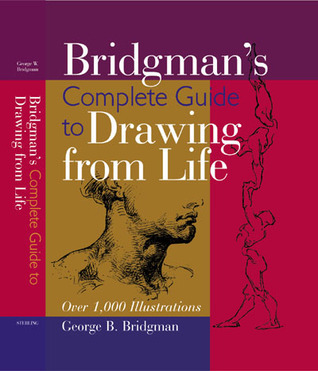
“An indispensable volume...published for the first time in paperback....More than 200 illustrations of hands and hundreds of images of arms, shoulders, heads, torsos, legs, knees, and feet.” — Library Journal. “It will...meet a deeply felt need to draw the human figure from a vantage point of understanding and visual acuity.”— Arts & Activities.
George Brant Bridgman was a Canadian-American artist, teacher and writer. Born in Canada he spent most of his working life in the USA teaching anatomy and figure drawing at the Arts Students League of New York. His students included many future famous artists including Will Eisner, Marion Greenwood, Andrew Loomis and Norman Rockwell.
There are a couple of George Bridgman anatomy books if you look around. If you just want one Bridgman anatomy book, Bridgman's Complete Guide to Drawing from Life is the book for you. It essentially collects most of the illustrations and commentary from his other books.
This edition is published by Sterling and it's much larger than the Dover editions. It's also thicker at 352 pages. Books included here are:
* Bridgman's Life Drawing * Constructive Anatomy * The Human Machine * Heads Features and Faces * The Book of a Hundred Hands * Drawing the Draped Figure
That's six books for the price of one. Well, almost. It's not a complete duplication of those books, some drawings are left out. The text is slightly rewritten and move around but the main gist remains.
This book covers all parts of the human body. It also touches on topics like use of balance, rhythm and light in drawing figures.
This is not a book that I will recommend to beginners. The commentary is great only if you already understand your anatomy and know your muscles well. This is because most of the illustrations don't have labels so it's not easy to figure out which part he's referring to, unless you already know generally where those muscles are. The drawings are a little sketchy and sometimes hard to make out different muscle groups.
The main use of this book is probably to help artists visualise the weight, forms of construction and mass of the figures. To that extent, the plenty of illustrated examples are helpful at bringing the concept across, and to practice from.
Below's the preview I found on Google Books. You can get a feel of the style just by browsing through the pages.
This book is a must for any aspiring comics artist. It's kicking my ass but I'm learning a hell of a lot about the human anatomy or the flesh machine as I like to call it.
I'm doing what all professionals advise: draw everything in this book!
George Bridgman's illustrations are, at first glance, not as appealing as you'd like. However, as you read his information and try to understand what hes's showing, you start to build an appreciation for his work.
In his "Complete Guide to Drawing from Life", Bridgman takes the human figure step by step explaining the function and shape of every part of the human body.
I recommend this book to anyone wanting to understand figure drawing. This book is great for all levels of artists. There is a lot of content in this book.
Bridgman dedicated chapters on all the main parts of the body and explains, in detail, the framework behind it.
It's good for an absolute beginner to just copy Bridgman's drawings as you'd be training your eye-to-hand coordination on something that is foundational but I'd also recommend that you read every bit of text on the pages. As one person once said about this book, "The text isn't just there to fill up empty space". Bridgman teaches you things you'll carry on for a long, long time.
Definitely worth having in your art library. Highly recommended!
My teacher recommended copying every picture in this book. Since I'll probably only be able to complete 3 or 4 drawings a week and there are thousands - I guess I'll be always reading it.
This book was staggeringly bad in so many ways. The drawings themselves have some virtue, as Bridgman came up with some somewhat unique ways to approach and chunk up anatomy for easier drawing, but beyond that it's... well, it's not a good read. The anatomical terms he uses are often archaic and he has a terrible habit of switching back and forth between a common name and the scientific name without any reference between the two, so it can be a challenge to know what he's talking about. Let me put it this way - I have extensive knowledge of structural anatomy and I struggled to know what he was talking about. I had to look up some of the archaic terms from time to time to have any idea what muscle he was referring to, especially since he would often switch between archaic and modern scientific names on top of his already frustrating habit of switching between common and scientific names. His drawings also didn't always help me to figure out which muscle he was referring to, so I just had to resort to google.
I can't help but wonder if Bridgman ever actually looked at a living, breathing human for reference when drawing and studying the human form. He seems to have referenced just about everything but, including woodwork and fixtures, while getting most of his references from other artists' work and his own imagination. This has resulted in some truly bizarre anatomy at times, especially in how he draws children. I find it bizarre that he had three children of his own, yet seemed to think children looked like big headed aliens with small adult faces.
On the good side, they seemed to have edited out most of the racism that was in the smaller books.
This is a great book for referencing the images of how he wedged and chunked up the human form. It's a somewhat decent reference for bones and muscles and to a lesser degree the human form with skin on it, but approach with caution and always, always compare his work to actual life and actual anatomy books. I'm giving it two stars instead of one for this reason.
This is my all-time favorite book on life drawing. It was the first book I read about figure drawing. Previous to finding this book I had never gave any thought to what goes underneath the skin or proportion, or that these things really even existed. I just drew and if it seemed okay looking, then I was satisfied. After this book, I was unsatisfied with what I'd been doing. I began PAYING ATTENTION and applying that to my work. And it showed, when I compare the work I did before and the work I did after discovering this book, it showed a good deal of improvement.
I would recommend any artist to have this book on their shelves.
Although I have several of the books included within this collection, I was hoping that the additional books would provide further insight into Bridgman's methodology. But, alas it was more of the same. I just don't seem to "get" Bridgman, the same way others do. Don't get me wrong... Bridgman does include some interesting material, and for some people, that information may be beneficial, but I believe that there are far better books currently available.
A very helpful look at the structure and anatomy of the person. Quite a bit farther along than my skill is at, but this would be a great shelf reference.
This book was written back in the 1920s but it is still very useful to understand how to draw the human body accurately. I might read it again it is so good.
Good for images. The text is rambling and outdated. I would recommend "Bridgman's Complete Guide to Drawing from Life" over this book as all of this book is contained in the other
I've bought this book 6 months ago, starting with the pelvis, legs, torso and arms, I still have yet more to learn with hand and the head ( I've always I always practised the head prior ).
This book isn't going to teach you a specific way to draw anatomy, as mentioned in the introduction. Its going to show you Bridgman's thought process.
The text is probably the most important part, rather than the illustrations, as they are more like supporting material. The best way I have learnt from him, is to read and draw the text as he has written. It helps develop his 'idea' into your drawings.
I have known about the anatomy for the human figure for years, but I have never thought of the way Bridgman has. It's almost an eye opener to how I see the human figure now. I almost see shapes when I look at people.
I've seen a guide on the book, and often mentions the inconsistencies within his work. And I think that's representative of his mindset. To not be so stuck on the small areas, but to encapture the idea with shape.
This is not a beginner book. It goes in-depth with the anatomy, which can be too distracting when you forget about basic form, gesture and rhythm.
If you want to benefit from his ideas, you have to actually study it ( draw ideas of the text, research the bones and muscles, make new abstractions and ideas) and not breeze through the pages.
On Bridgman and more specifically what enlightenment you can get from reading. Bridgman has a multitude of books but out of all of them this is the one you should attempt to understand. Personally I believe his body's (excluding the hands, neck and head) are worth looking to this book for. Most of his books are on construction, therefore you should look elsewhere for anatomical diagrams. It's very vague on the descriptions so this is something you'll want a teacher to walk you through.
Marshal Vandruff of Proko notoriety has a 10+ episode full walkthrough of the book free on YouTube, please look to it. Very powerful construction skills (Comic Artists must read, as most professionals looked to this so should you)
Not as good as I'd hoped. Bridgeman's drawing from life is not aimed at the artist but the medical student, he actually starts off with a few good techniques for artists, but it quickly transitions to minute details in human anatomy, he names every little bone and muscle and explains what they do, but as far as how to draw them, he does not cover, in fact he is way too worded and uses terms that are beyond me. This book should be more visual and have a simple instructive way to guide the ARTIST and not the med student on how to actually DRAW the human figure.
At the same time it's an invaluable resource, it is horribly and unevenly organized. For example, while it repeats drawings and explanations sometimes not even 2 pages apart, adduction and abduction are talked in pages 240 but only explained 70 pages later.
I had to read it through it in 3 days and I'm unsure if it's meant to be for consultation or to be read thoroughly. Maybe it's both, a quick read then kept as a consultation. Some sections are pretty independent and others aren't, but regardless of its faults it's crucial for anatomy.
My first official DNF since that's now an option on here! This is a good book, even if some of the reproductions of Bridgman's drawings can be a little too muddy. It's extraordinarily comprehensive, with the section on hands being bigger than any other part, and he does a good job breaking things down and even doing weird Hogarth-esque mechanical drawings to demonstrate how muscle and tendon work to move different parts. It's just, yeah, not something I could read start to finish but can absolutely use as a resource when I need specific help drawing.
A reread, I hadn't enjoyed it as much the first time that I read it years ago, mostly because it is impossible to work from. The sketches in the book are very rough, and the photographs in the book are tiny and old. You must work from life, and if you follow the author's instructions on poses and drapery, you will get similar sketches to the ones in the book. I don't have a live model to work from, nor the classical Greek marble statues that the book references, but I do have Pinterest.
This is probably the art book I use the most. It's not like I have worked through it from front to back. But if I feel like my drawing is looking a little ragged or if I can't find the energy to come up with an art project I can just pull this out and copy some anatomy illustrations. Gives the brain a little workout and reminds you of how all those bones and muscles are put together.
Great book with amazing advice for artists. Though it’s an old book with a classical art style, you can always get the best of it and apply the basics. Love and quote the author, “Remember that the things you know and leave out are the things that give power and simplicity to your drawings.” Definitely a book to come back when needed.
I will never truly be finished reading this book, but in my first pass, I gained an appreciation for how Bridgman thought about the human body in abstract ways, and the emphasis he placed on good design. Bridgman thinks every artist should explore many artistic methods and not get stuck believing one way is the best way. Always think for yourself and design what you want, how you want.
This book is not meant to be read casually; it is, first and foremost, a lesson plan. The drawings inside are worthy references, but the text is difficult and requires attention. That said, certain excerpts are beautifully written (the section on hands, in particular) and merit reading on their own.
Most are unexplained images, and sometimes the drawings are finished and show no processes, the explanation helps more in the first part of the book than the second, where everything begins to be more interpretive, which shouldn't happen in a book thats supposed is to explain the human figure
Teaches you anatomy/figure drawing in a functional and dynamic way. However a lot of the times it can be unclear to the details of particular muscles e.g. origins/insertions. I would recommend using this book along with a more straightforward anatomy/medical book.
Started this book in January of 2020 with the goal to draw through it by the end of the year and I did! It was well worth the work. Such a fantastic book filled with sketches from the master of anatomy.
While the book is full of great illustrations and explanations for the position and mechanics of human physical anatomy, it feels closer to a biology book than an art book. Only later is flow and drapery discussed in a way that discusses a practical method of drawing these forms.