

What do you think?

The Beast with Five Fingers
'...the hand was writhing in agonized contortions, squirming and wriggling upon the nail like a worm upon a hook. 'We'll keep it there until it dies, ' he said. 'May I burn in hell, if I ever open the door of that safe again.'
The brilliant and scary The Beast with Five Fingers, is the first entry in this mammoth collection of strange and chilling short stories by W.F. Harvey, an unjustly neglected author of supernatural tales. This unique volume demonstrates clearly that Harvey is one of the masters of the genre.
Along with such classics as August Heat, which concerns two strangers whose individual fates become inextricably entwined in a nightmare scenario and the gruesome school yarn, The Dabblers, you will find such minor masterpieces of the uncanny as The Man Who Hated Aspidistras, Sarah Bennet's Possession, The Habeas Corpus Club and many more stories which refreshingly avoid the cliche while at the same time creating that wonderfully eerie sense of fear.
The brilliant and scary The Beast with Five Fingers, is the first entry in this mammoth collection of strange and chilling short stories by W.F. Harvey, an unjustly neglected author of supernatural tales. This unique volume demonstrates clearly that Harvey is one of the masters of the genre.
Along with such classics as August Heat, which concerns two strangers whose individual fates become inextricably entwined in a nightmare scenario and the gruesome school yarn, The Dabblers, you will find such minor masterpieces of the uncanny as The Man Who Hated Aspidistras, Sarah Bennet's Possession, The Habeas Corpus Club and many more stories which refreshingly avoid the cliche while at the same time creating that wonderfully eerie sense of fear.
418 pages, Paperback
First published January 1, 1928
About the author
W.F. Harvey
214 books32 followersWilliam Fryer Harvey was an English writer of short stories, most notably in the macabre and horror genres. Among his best-known stories are "August Heat" and "The Beast with Five Fingers", described by horror historian Les Daniels as "minor masterpieces".
Born into a wealthy Quaker family in Yorkshire, he attended the Quaker schools at Bootham in Yorkshire and at Leighton Park in Reading before going on to Balliol College, Oxford. He took a degree in medicine at Leeds. Ill health dogged him, however, and he devoted himself to personal projects such as his first book of short stories, Midnight House (1910).
In World War I he initially joined the Friends' Ambulance Unit, but later served as a surgeon-lieutenant in the Royal Navy, and received the Albert Medal for Lifesaving.[4] Lung damage received during the rescue leading to the award troubled him for the rest of his life, but he continued to write both short stories and his cheerful and good-natured memoir We Were Seven.
Harvey was a practicising Quaker.
Before the war he had shown interest in adult education, on the staff of the Working Men's College, Fircroft, Selly Oak, Birmingham. He returned to Fircroft in 1920, becoming Warden, but by 1925 ill-health forced his retirement. In 1928 he published a second collection of short stories, The Beast with Five Fingers, and in 1933 he published a third, Moods and Tenses. He lived in Switzerland with his wife for much of this time, but nostalgia for his home country caused his return to England. He moved to Letchworth in 1935 and died there in 1937 at the age of 52. After a funeral service at the local Friends Meeting House Harvey was buried in the churchyard of St Mary the Virgin in Old Letchworth.
The release of the film The Beast with Five Fingers (1946), directed by Robert Florey and starring Peter Lorre, inspired by what was perhaps his most famous and praised short story, caused a resurgence of interest in Harvey's work. In 1951 a posthumous fourth collection of his stories, The Arm of Mrs Egan and Other Stories, appeared, including a set of twelve stories left in manuscript at the time of his death, headed "Twelve Strange Cases".
In 2009 Wordsworth Editions printed an omnibus volume of Harvey's stories, titled The Beast with Five Fingers, in its Tales of Mystery and the Supernatural series (ISBN 978-1-84022-179-4). The volume contains 45 stories and an introduction by David Stuart Davies.
[https://en.m.wikipedia.org/wiki/W._F....]
Born into a wealthy Quaker family in Yorkshire, he attended the Quaker schools at Bootham in Yorkshire and at Leighton Park in Reading before going on to Balliol College, Oxford. He took a degree in medicine at Leeds. Ill health dogged him, however, and he devoted himself to personal projects such as his first book of short stories, Midnight House (1910).
In World War I he initially joined the Friends' Ambulance Unit, but later served as a surgeon-lieutenant in the Royal Navy, and received the Albert Medal for Lifesaving.[4] Lung damage received during the rescue leading to the award troubled him for the rest of his life, but he continued to write both short stories and his cheerful and good-natured memoir We Were Seven.
Harvey was a practicising Quaker.
Before the war he had shown interest in adult education, on the staff of the Working Men's College, Fircroft, Selly Oak, Birmingham. He returned to Fircroft in 1920, becoming Warden, but by 1925 ill-health forced his retirement. In 1928 he published a second collection of short stories, The Beast with Five Fingers, and in 1933 he published a third, Moods and Tenses. He lived in Switzerland with his wife for much of this time, but nostalgia for his home country caused his return to England. He moved to Letchworth in 1935 and died there in 1937 at the age of 52. After a funeral service at the local Friends Meeting House Harvey was buried in the churchyard of St Mary the Virgin in Old Letchworth.
The release of the film The Beast with Five Fingers (1946), directed by Robert Florey and starring Peter Lorre, inspired by what was perhaps his most famous and praised short story, caused a resurgence of interest in Harvey's work. In 1951 a posthumous fourth collection of his stories, The Arm of Mrs Egan and Other Stories, appeared, including a set of twelve stories left in manuscript at the time of his death, headed "Twelve Strange Cases".
In 2009 Wordsworth Editions printed an omnibus volume of Harvey's stories, titled The Beast with Five Fingers, in its Tales of Mystery and the Supernatural series (ISBN 978-1-84022-179-4). The volume contains 45 stories and an introduction by David Stuart Davies.
[https://en.m.wikipedia.org/wiki/W._F....]
Ratings & Reviews
Friends & Following
Create a free account to discover what your friends think of this book!
Community Reviews
Displaying 1 - 21 of 21 reviews
August 29, 2023
I listened to this as part of the Classic Tales of Horror - 500+ Stories. It was very entertaining 2023

December 6, 2009
The Beast With Five Fingers is a rather indiscriminate collection for a 'Mystery & Supernatural' imprint, with only a third of the tales qualifying as horror (several of which are psychological rather than supernatural) and only one real mystery tale. The remainder consists of droll little vignettes of human nature, quasi-moralistic slices of life and so forth. These are not without interest, but they are generally very slight.
Of the horror tales (or rather, the tales of unease - horror is generally too equivocal a term to use here) the title tale is something of an anomaly, being both the most famous and the most atypical tale by WF Harvey. It's an unsubtle sort of affair, in its key concept, and subtly chilling concepts are a keynote of Harvey's more effective tales. These include the superb The Dabblers, a tale which contains its own critique in the form of a cynical listener dismissing the narrator's tale, and then overcomes the critique with a chilling little coda. August Heat is another very effective and uncanny tale. These are both frequently anthologised stories, as is the title story. A few stories that barely offer more than the cliched ghost story of the Victorian/Edwardian era have been included, as have several variations on recurring themes, where everyone concerned would have been better served by only including only the very best example of the type.
There are nevertheless several good tales here, and one wishes the editor has seen fit instead to assemble a slimmer but more effective volume of about 12 to 15 short stories.
Of the horror tales (or rather, the tales of unease - horror is generally too equivocal a term to use here) the title tale is something of an anomaly, being both the most famous and the most atypical tale by WF Harvey. It's an unsubtle sort of affair, in its key concept, and subtly chilling concepts are a keynote of Harvey's more effective tales. These include the superb The Dabblers, a tale which contains its own critique in the form of a cynical listener dismissing the narrator's tale, and then overcomes the critique with a chilling little coda. August Heat is another very effective and uncanny tale. These are both frequently anthologised stories, as is the title story. A few stories that barely offer more than the cliched ghost story of the Victorian/Edwardian era have been included, as have several variations on recurring themes, where everyone concerned would have been better served by only including only the very best example of the type.
There are nevertheless several good tales here, and one wishes the editor has seen fit instead to assemble a slimmer but more effective volume of about 12 to 15 short stories.

September 11, 2025
Hands-free.
The wealthy and notoriously eccentric Adrian Bolsover has recently passed away. Due to his work practice, young Eustace Bolsover receives part of the inheritance left by his deceased uncle; an extensive and extremely valuable book collection, so large as to fill an entire library room, and also the late old man's right hand.
Not bad, although maybe too long, for a short story. Not a bad concept, even if mostly pretty predictable. I don't know, it just felt kinda average I suppose, and underwhelming. I think the main problem with this story is that the MC is extremely unlikable, and foul-mouthed. If he were likable at least I think maybe I'd have felt much more invested, but, alas, it was not the case. I don't regret reading it, it just wasn't that much worth it, for 48 pages.
It’s public domain. You can find it HERE.
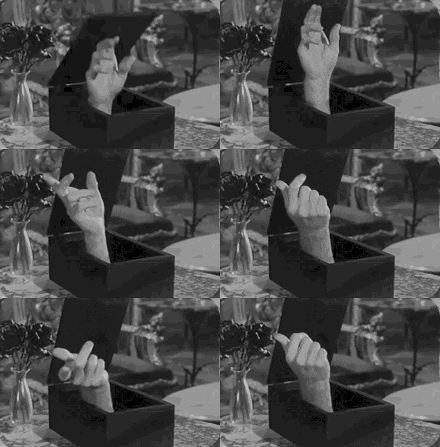
-----------------------------------------------
PERSONAL NOTE :
[1928] [48p] [Horror] [2.5] [Not Recommendable]
-----------------------------------------------
★★★☆☆ Famous Modern Ghost Stories <--
★★★☆☆ August Heat [3.5]
★★☆☆☆ The Beast with Five Fingers [2.5]
-----------------------------------------------
Manos-libres.
El rico y notoriamente excéntrico Adrian Bolsover murió recientemente. Por su práctica laboral, el joven Eustace Bolsover recibe parte de la herencia dejada por su tío fallecido; una colección de libros extensa y extremadamente valiosa, tan grande como para llenar una sala entera de biblioteca, y también la mano derecha del difunto anciano.
No está mal, aunque quizá demasiado largo, para un cuento corto. No un mal concepto, aunque en su mayoría bastante predecible. No sé, supongo que me pareció un algo promedio, y escasamente excitante. Creo que el principal problema de esta historia es que el MC es extremadamente desagradable, y malhablado. Si fuese agradable, al menos creo que tal vez me habría sentido mucho más involucrado, pero, lamentablemente, no fue el caso. No me arrepiento de haberlo leído, simplemente cómo que no valió tanto la pena, para 48 páginas.
Es dominio público, lo pueden encontrar ACA.
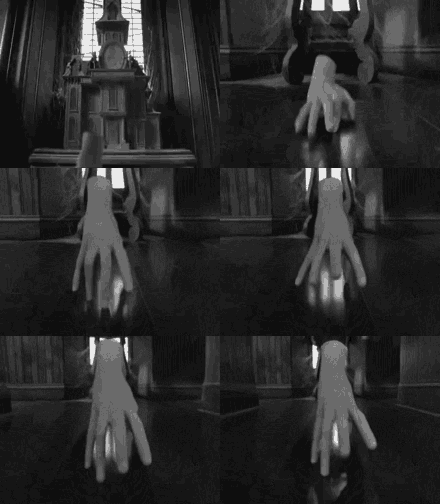
-----------------------------------------------
NOTA PERSONAL :
[1928] [48p] [Horror] [2.5] [No Recomendable]
-----------------------------------------------
The wealthy and notoriously eccentric Adrian Bolsover has recently passed away. Due to his work practice, young Eustace Bolsover receives part of the inheritance left by his deceased uncle; an extensive and extremely valuable book collection, so large as to fill an entire library room, and also the late old man's right hand.
Not bad, although maybe too long, for a short story. Not a bad concept, even if mostly pretty predictable. I don't know, it just felt kinda average I suppose, and underwhelming. I think the main problem with this story is that the MC is extremely unlikable, and foul-mouthed. If he were likable at least I think maybe I'd have felt much more invested, but, alas, it was not the case. I don't regret reading it, it just wasn't that much worth it, for 48 pages.
It’s public domain. You can find it HERE.
-----------------------------------------------
PERSONAL NOTE :
[1928] [48p] [Horror] [2.5] [Not Recommendable]
-----------------------------------------------
★★★☆☆ Famous Modern Ghost Stories <--
★★★☆☆ August Heat [3.5]
★★☆☆☆ The Beast with Five Fingers [2.5]
-----------------------------------------------
Manos-libres.
El rico y notoriamente excéntrico Adrian Bolsover murió recientemente. Por su práctica laboral, el joven Eustace Bolsover recibe parte de la herencia dejada por su tío fallecido; una colección de libros extensa y extremadamente valiosa, tan grande como para llenar una sala entera de biblioteca, y también la mano derecha del difunto anciano.
No está mal, aunque quizá demasiado largo, para un cuento corto. No un mal concepto, aunque en su mayoría bastante predecible. No sé, supongo que me pareció un algo promedio, y escasamente excitante. Creo que el principal problema de esta historia es que el MC es extremadamente desagradable, y malhablado. Si fuese agradable, al menos creo que tal vez me habría sentido mucho más involucrado, pero, lamentablemente, no fue el caso. No me arrepiento de haberlo leído, simplemente cómo que no valió tanto la pena, para 48 páginas.
Es dominio público, lo pueden encontrar ACA.
-----------------------------------------------
NOTA PERSONAL :
[1928] [48p] [Horror] [2.5] [No Recomendable]
-----------------------------------------------

Read
December 15, 2024An excellent short tale of horror.

January 7, 2025
Aner ikke egt hvorfor jeg eier denne, tror jeg kjøpte den på vgs. Ganske greit skrevet, og det er noen av historiene som er veldig bra, men de fleste av de er bare kjedelige

April 8, 2019
W.F. Harvey (1885-1937) was born in Yorkshire, of Quaker family, and became a doctor. However, his health was poor and he was often unable to practice, so he wrote short stories on the side, many of them falling generally into the “weird” category. This volume collects stories from all of his collections, including the posthumously published “Twelve Strange Cases.”
The title story is perhaps the best-known. Eustace Borlover discovers that his blind uncle Adrian’s right hand has begun writing on its own. After his uncle’s death, Eustace receives the severed hand in the mail. According to the solicitor, a new codicil was found to Adrian’s will, asking that the hand be severed and sent to Eustace as part of his inheritance.
It soon emerges that the hand is alive in some sense, intelligent, very mobile, and a master forger. Eustace and his secretary immediately assume the hand is evil, but to be honest it seems more mischievous than malevolent. Until, of course, Eustace nails the hand to a board and sticks it in a safe for several months. I’d be inclined to swear vengeance after that myself.
After that comes a final showdown between men and appendage. It’s one of the best severed hand stories out there.
It’s also one of Dr. Harvey’s least ambiguous stories. Many of them leave some doubt as to what’s really going on, or what happened at the ending. The best example in this volume is “The Clock” wherein a young woman finds a clock ticking in a situation where it should be fully wound down. Is our heroine a very sensible young woman who would survive a horror movie by vacating the premises as soon as the spooky stuff starts happening but before the monster strikes? Or is she a nervous ninny who panicked over perfectly mundane and explainable phenomena? She’ll never know, and neither will we.
Dr. Harvey did not only write eerie stories; about half of the ones in this volume are observational humor. A couple of standouts in this area are “The Star”, in which an astronomer is amused by his wife’s recounting of a sermon about stars (the minister having clearly never asked an astronomer about their job); and “After the Flower Show” where a country doctor reveals the skullduggery involved in what on the surface looks like a quaint village festival.
There’s a couple of mentions of cockroaches in the cupboards at grand manors, and not even as an urgent problem.
The last part of the book is the “Twelve Strange Cases.” These are presented as the memoirs of a private nurse. The first story, “The Lake” opens very well with a statement that unless the story is published, the author’s life may be at risk. And indeed, the mysterious words uttered by her late patient do seem to pose a threat. Artists will catch on to the solution to the mystery faster than others, I think.
The other stories are a touch less exciting; I was very disappointed to find that “The Vicar’s Web” is the same story as the author’s “Unwinding”, about a parlor game gone horribly wrong, but with a slightly different framing sequence, found earlier in the collection. (“Unwinding” also appears in the book of thriller stories I reviewed a while back.) The collection finishes with “The Flying Out of Mrs. Barnard Hollis”, which may or may not involve astral projection.
Altogether, there’s 45 stories in the Woolworth Edition collection. Many of the stories are quite enjoyable, but keep in mind that it’s not all weird stories, so those readers looking only for that might not enjoy this.
The title story is perhaps the best-known. Eustace Borlover discovers that his blind uncle Adrian’s right hand has begun writing on its own. After his uncle’s death, Eustace receives the severed hand in the mail. According to the solicitor, a new codicil was found to Adrian’s will, asking that the hand be severed and sent to Eustace as part of his inheritance.
It soon emerges that the hand is alive in some sense, intelligent, very mobile, and a master forger. Eustace and his secretary immediately assume the hand is evil, but to be honest it seems more mischievous than malevolent. Until, of course, Eustace nails the hand to a board and sticks it in a safe for several months. I’d be inclined to swear vengeance after that myself.
After that comes a final showdown between men and appendage. It’s one of the best severed hand stories out there.
It’s also one of Dr. Harvey’s least ambiguous stories. Many of them leave some doubt as to what’s really going on, or what happened at the ending. The best example in this volume is “The Clock” wherein a young woman finds a clock ticking in a situation where it should be fully wound down. Is our heroine a very sensible young woman who would survive a horror movie by vacating the premises as soon as the spooky stuff starts happening but before the monster strikes? Or is she a nervous ninny who panicked over perfectly mundane and explainable phenomena? She’ll never know, and neither will we.
Dr. Harvey did not only write eerie stories; about half of the ones in this volume are observational humor. A couple of standouts in this area are “The Star”, in which an astronomer is amused by his wife’s recounting of a sermon about stars (the minister having clearly never asked an astronomer about their job); and “After the Flower Show” where a country doctor reveals the skullduggery involved in what on the surface looks like a quaint village festival.
There’s a couple of mentions of cockroaches in the cupboards at grand manors, and not even as an urgent problem.
The last part of the book is the “Twelve Strange Cases.” These are presented as the memoirs of a private nurse. The first story, “The Lake” opens very well with a statement that unless the story is published, the author’s life may be at risk. And indeed, the mysterious words uttered by her late patient do seem to pose a threat. Artists will catch on to the solution to the mystery faster than others, I think.
The other stories are a touch less exciting; I was very disappointed to find that “The Vicar’s Web” is the same story as the author’s “Unwinding”, about a parlor game gone horribly wrong, but with a slightly different framing sequence, found earlier in the collection. (“Unwinding” also appears in the book of thriller stories I reviewed a while back.) The collection finishes with “The Flying Out of Mrs. Barnard Hollis”, which may or may not involve astral projection.
Altogether, there’s 45 stories in the Woolworth Edition collection. Many of the stories are quite enjoyable, but keep in mind that it’s not all weird stories, so those readers looking only for that might not enjoy this.
March 16, 2024
This is one of those collections of 'antique' horror that always sound better than they in fact are. Overall it was OK but definitely not great. I sent my copy to the charity shop immediately.

March 22, 2025
1.5/5 estrellas.
Tendría que haber dado miedo pero la verdad no me movió ni un pelo. Estrella y media para el estilo que fue muy lindo.
Tendría que haber dado miedo pero la verdad no me movió ni un pelo. Estrella y media para el estilo que fue muy lindo.
March 5, 2014
I was in single digit years when I first read Harvey's story, Across the Moors, which left an imprint on my memory ever since. I certainly wasn't disappointed by this collection, either. While many of the stories disturb in more of a psychological manner, the settings and the snapshots of time captured are superb. After finishing the collection, Midnight House has joined Across the Moors as one of the most memorable stories I've read. My only wish is that the remainder of Harvey's works were included.

March 12, 2023
Though the title story is just all right, and "6 to 6:30" was funny just for the part that i quoted, the rest i read was Not amusing and not entertaining. I just gave up on it.
The Beast with Five Fingers, 3 stars
" ' Oh, my aunt!' he giggled hysterically, 'look at it now.' for the hand was writhing in agonized contortions, squirming and wriggling upon the nail like a worm upon the hook."
This is a fairly comical, entertaining story.
Six to Six-thirty, 2 stars
" Gideon replaced the receiver. His face was red with anger. This came of having telephones in the house; there was no getting away from the outside world. If it was not business, or polite society, it was this tomfoolery! Angrily he took down the telephone directory. 68 Dunswick; that was the number he wanted, the police-station ."
The Beast with Five Fingers, 3 stars
" ' Oh, my aunt!' he giggled hysterically, 'look at it now.' for the hand was writhing in agonized contortions, squirming and wriggling upon the nail like a worm upon the hook."
This is a fairly comical, entertaining story.
Six to Six-thirty, 2 stars
" Gideon replaced the receiver. His face was red with anger. This came of having telephones in the house; there was no getting away from the outside world. If it was not business, or polite society, it was this tomfoolery! Angrily he took down the telephone directory. 68 Dunswick; that was the number he wanted, the police-station ."

October 10, 2026
This book was too long.
I liked Harvey's dry sense of humor, which made me think of "Alfred Hitchcock Presents." But as I read tale after tale, I started to become tired with his format of characters who forget they have committed murder, forget they have witnessed a murder, have seen a ghost, are insane, etc. I found myself really wishing to throw myself into some M. R. James, a British author who used something other than irony.
The two best stories in this book were "Miss Cornelius" and "Miss Avenal." "Miss Cornelius" is about a guy who crosses the titular character and has his life destroyed, either by her magic or his own madness. "Miss Avenal" is a superb psychic vampire story. I've read many anthologies of vampire tales, and I'm surprised I hadn't run across this one until now.
I liked Harvey's dry sense of humor, which made me think of "Alfred Hitchcock Presents." But as I read tale after tale, I started to become tired with his format of characters who forget they have committed murder, forget they have witnessed a murder, have seen a ghost, are insane, etc. I found myself really wishing to throw myself into some M. R. James, a British author who used something other than irony.
The two best stories in this book were "Miss Cornelius" and "Miss Avenal." "Miss Cornelius" is about a guy who crosses the titular character and has his life destroyed, either by her magic or his own madness. "Miss Avenal" is a superb psychic vampire story. I've read many anthologies of vampire tales, and I'm surprised I hadn't run across this one until now.

October 8, 2022
An old book of short stories by an early mystery/supernatural author, who wrote the short story that inspired a favourite childhood film of the same name.
The stories are of their era, often vague rather than direct about what makes them spine-tingling. Many of them are from an era when nurses traveled to homes to care for ill people, instead of their being put into hospital. Of course the homes are remote and there are plenty of opportunities for odd occurrences and/or deliberate mischie to occur.
Fun reading, however, may be difficult for those who prefer a more direct, modern style.
The stories are of their era, often vague rather than direct about what makes them spine-tingling. Many of them are from an era when nurses traveled to homes to care for ill people, instead of their being put into hospital. Of course the homes are remote and there are plenty of opportunities for odd occurrences and/or deliberate mischie to occur.
Fun reading, however, may be difficult for those who prefer a more direct, modern style.

October 23, 2024
I read this book in a large horror anthology many years ago - one that also boasted many another impressive story - and to this one’s credit, it was always one of the entries I particularly remembered. I rate it only three stars as I feel it still lacks in some things, and certain ideas are not developed quite a well as they might have been. But for all that, Harvey manages to take the idea of a reanimated deadman’s hand causing havoc in a gentleman’s household and make a darn good short story out of it, striking a fine balance between comical and unnerving.

January 12, 2018
The Beast with Five Fingers is a finger licking good read.
November 15, 2020
Really enjoyable read with some great ideas in it, though not as memorable or as scary as I was hoping. A nice set of stories for a rainy day.

April 23, 2024
A manic manciple seeking manumission and a manicure.

December 12, 2024
I have more questions than answers after reading this.

October 20, 2017
Lido apenas o conto "La Bestia con Cinco Dedos" no livro: "Horrorscope. Mitos Basicos del Cine de Terror, Volúmen 2." Con prólogo, selección y notas de J. A. Molina Foix. Editora Nostromo, Madrid, 1974.
A assistir: The Beast with Five Fingers (1947), de Robert Florey, com Peter Lorre. Música de Max Steiner. Warner Brothers.
A assistir: The Beast with Five Fingers (1947), de Robert Florey, com Peter Lorre. Música de Max Steiner. Warner Brothers.

July 9, 2021
It was more funny than scary most of the time.

August 2, 2010
hahahaha fab fun!
The Man in Black reveals the horror in a small box bequeathed to a scientist. Stars Edward de Souza and James Laurensen
Broadcast on:
BBC Radio 7, 12:30am Monday 2nd August 2010
Duration:
30 minutes
Available until:
1:02am Monday 9th August 2010
The Man in Black reveals the horror in a small box bequeathed to a scientist. Stars Edward de Souza and James Laurensen
Broadcast on:
BBC Radio 7, 12:30am Monday 2nd August 2010
Duration:
30 minutes
Available until:
1:02am Monday 9th August 2010
This entire review has been hidden because of spoilers.
December 7, 2015
I found it quite difficult to understand this story..
Displaying 1 - 21 of 21 reviews