She is Justice. Represented since the beginning of time as a robed woman, blinded, armed with naught but a sword and a sense of balance. A woman cut off from the masculine world of clues and hard realities, forced into the depths of her remaining touch, smell, taste, hearing. A woman joined with her innermost self, focused only on her mission. A woman who cannot be deceived, cannot be fooled. A woman blind¨ to all but justice. In times of trouble, the spirit of Justice appears before women and offers them the chance to take revenge on their male abusers. In this graphic novel collection, we see three instances of "Slow Death": Enrici has always prided himself on his ability to have any woman he wants. No woman can say no to him-until he meets Justine Omnibu, a mystery woman who wears a blindfold¨ and who will lead him down the path to Justice. "Woman About Town": Jordan Hacket is a parole officer who came to love an ex-con named Skeeter. When he was betrayed and killed during a heist, Justice came to Jodi with an offer-and demanded retribution. "Ravish'd Justice": Lynea Mitchell is an Assistant District Attorney fed up with the system, now that a known narcotics chemist-arrested for raping a teenage girl-has cut a deal with the government to inform on his mob boss. But when he's freed in an assault on the federal building, Lynea takes justice into her own hands¨
CJ Henderson is the creator of both the Jack Hagee hardboiled PI series and the Teddy London supernatural detective series. He is also the author of The Encyclopedia of Science Fiction Movies, several score novels, plus hundreds of short stories and thousands of non-fiction pieces. In the wonderful world of comics he has written everything from Batman and the Punisher to Archie and Cherry Poptart.
Actually stopped reading this. Poorly written story based on a character imagined by the great Neil Gaiman long ago, but not written by him. Some comic company owned the rights to the character from long ago and brought it back to life to cash in on Gaiman's success. I didn't even realize it wasn't written by him until a few pages in when I noticed that the writing was pneumatic, blood-thirsty, tone deaf and based on a simplistic "eye for an eye" worldview and I checked to see who had actually written it. Felt duped. Fans of Gaiman or Justice should avoid this series.
This book makes 90's era Image comics look like Shakespeare. The creators of the SciFi Network decided to create Techno comics in the mid 90's with a bunch of concepts from various science fiction authors. Neil Gaiman came up with the Lady Justice concept, even though she's more portrayed as Lady Retribution. That's his only contribution. This book is the epitome of bad Punisher clones from the 90's. The women in the book are helpless until Lady Justice comes along and turns them into unstoppable killing machines. From there, the books dissolve into murder porn. The art is amateurish at best. Georges Jeanty and Steve Leiber both contribute to the book but this is very early in their careers and the result is not good. The only bright spot at all is the Dan Brereton covers.
I really like the basic concept of this series. I think if it delved deeper into the ladies and made it more about them as opposed to killing hundreds of people, I would have been more invested.
I would hate to imagine what rage fueled this book -- it reads as though it was sparked by a specific event; hence the terrible, and really, rather male-seeming, revenge fantasy. It is so over the top, so helplessly unfocused, that it is not at all satisfying. I would not bother with another one.
I went into this one blind. Haha. I didn't know anything about Lady Justice (the comic version, anyway), but she is an entity who uses women to exact revenge in what we all know is an unfair world. I'm all on top of that! Don't get me wrong, I love superheroes who nab the baddies... but what happens next? Life in prison? Boo fucking hoo. Bring on Lady Justice! Right??
Umm... maybe? The concept really appealed to me. As much as I'd like to believe in karma when, say, some mother fucker rear-ends me with my kids in the car because he was looking at how long of a line he was going to have to wait in to get his McDonald's milkshake -- I can't help but thinking that said mother fucker will keep on rear-ending people his whole useless life until he dies. Why? Because karma isn't real and neither is Lady Justice.
I digress. The first and last avatar in this were good. Yes, there's more than one. I wish this volume was just the first avatar because she was kickass. But then it went into some gang war shit and lost me. The last avatar was a lawyer and that story was pretty cool. I like justice. Even if it means , because that was fucking epic.
I can see how the concept could have come from Neil Gaiman. It has a lot of promise, which the execution lives up to only occasionally. The stories would have been a lot more interesting if they didn't all rely on giant amounts of violence. Also I thought the Latino gang stereotyping in one story was racist.
"Judge no more, Janine Farrell, lest ye be judged."
I read this for a reading challenge-the prompt was reading a book with a low star rating. I was amazed that a Neil Gaiman story could warrant so much hate, but the reviews quickly informed me that Gaiman had little to do with this project.
The basic premise of this comic book is that the personification of Justice is searching for a worthy avatar to carry out her deeds on earth, although the definition of "justice" is vague at best. There are a string of meandering storylines with little to no cohesion. The story jumps around continuously with different protagonists and tones. This episodic nature could work if the writing tied each separate piece together, but it completely falls flat. The plot really just feels like a way to move from fight scene to fight scene, but even those are completely ruined by over-sexualized women contorting their bodies in strange and sexy(?) ways. Here are a few examples:
Here, the first avatar rises from her wheelchair after gaining the powers of Justice. She is about to go to bed after seeing her last living relatives brutally murdered, so of course she is wearing a sexy white bodysuit. Also, my tits also look like that when I'm not wearing a bra (I swear).
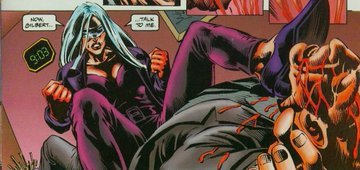
Here we see Justice straight up... straddling a guy? I'm not sure what's happening here to be completely honest.
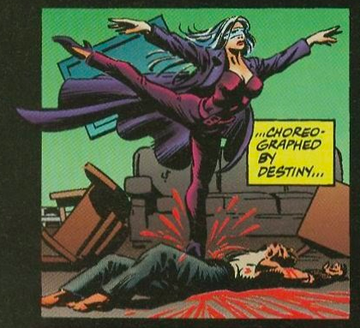
And finally, a finishing move sure to put fear in the toughest Mortal Kombat characters:
CW: gore, death of a child, (mentioned) rape/sexual assault of a minor, sexualization of a minor, ableism (kind of?)
It took me reading the post script to realize that this comic, while the idea belonged to Neil Gaiman, the stories themselves were written by someone else. That definitely made a lot more sense to me, because I spent the first half of the comics being completely mystified at this weird change in tone of Gaiman's writing style. Like, I found the premise very interesting, but the overall execution was definitely not my vibe. So the fact that he came up with the concept but didn't actually have a hand in the writing made way more sense.
Like I said, the concept is very cool - the personification of Lady Justice comes to wronged women and offers them assistance in revenge as long as they help her seek justice. It could be a very toxic system to explore, but it was really used very loosely on these pages. They spent a lot more time on the sexy ladies shooting. Which, I guess if you're into that kind of thing, they did very well. But I am definitely not. I was also really troubled by the second story arc, which was mostly about gang violence. The main girl is wearing like a cut off t-shirt with excessive amounts of under-boob, which, again, is fine if you're into that, except it was revealed in chapter two she was still in high school. Gross.
So, not really my vibe, but it was pretty cool to see Gaiman's ideas explored by other writers!
Meh. I almost wish that it didn't even have Neil Gaiman's name on it, as these stories, inspired as they might be by the wonderful author, had hardly a shred of semblance to his haunting and rather grey-toned worlds. At first, I envisioned something along the lines of Sandman, with a deity akin to Death possessing humans. I suppose that's true, but instead, it was ridiculously-figured (and, the further we got into the story, the scantily-clad) women beating up EVIL MEN. And true, they were evil men, but there it was right versus wrong with no grey in between, no ulterior motives that suddenly make you question if Lady Justice is actually serving her namesake.
The artwork itself was rather dated, action scenes ridiculously paneled, and panel layouts at times difficult to follow.
The editor actually comments on all these weak points, as well as that this comic was most likely written in an attempt to mirror the darkness of Dark Knight and Watchmen. Instead, it just was a lot of gratuitous violence that doesn't really add anything to the whole women in comics bit. Hence, me wanting to get rid of Neil Gaiman's name on it....
I borrowed this because it had Neil Gaiman's name on the cover. However it is a series of stories based on an idea of Neil Gaiman's, not written by him. It is full of busty women - never thought of Justice as a particularly voluptuous woman, but there's no reason why she shouldn't be, I suppose. The concept is that Justice empowers women who have witnessed serious injustice to act in extra legal ways (now there's a euphemism!) to right the wrongs. This usually involves much stomping, floods of blood, and screams of anguish. Real cathartic stuff. Jim Salicrup writes an analysis of the material in which he points out that if Gaiman had written the stories they would likely have been very different and if the actual authors of the stories were to write them now instead of in the 1980s they would likely be very different, too. Female empowerment just keeps on rolling along. Mr. Salicrup's discomfort didn't stop him from publishing the book, though. Beautiful artwork, great page layouts, and wonderful details. The artists do a great job with the avatars' faces, especially since they have to be drawn blindfolded.
I am so glad I got this discounted because it is not worth the money or the effort. The panels are confusing, the art is okay, but the story and the dialogue are seriously lacking. I just couldn't continue. I had to read pages over and over again just to get the sense of what I was reading and where the story was going and for any sort of comic or graphic novel, that should not be the case. There was no logical flow and I just found myself becoming more and more detached with each passing panel. I would pass on this one!
Lady Justice is about a busty justice spirit that inhabits busty avatars who then go around violently shooting hapless criminals in the most hilariously 90s comic ever written. It is so 90s words escape me. Really, everything about it is trash - the stories, the dialogue, the art, the gore, the cheesecake - all so over the top and plastic I actually laughed. Serious, I've been infuriated by a lot of bad comics lately, but Lady Justice has the risibility of a crap movie lampooned by Mystery Science Theater 3000. Not that I'd recommend reading this, though, because once you've read one of its stories of a bouncy-bossomed woman gunning down black-hearted, but strangely incompetent, criminals, with all the emotion and reflection of a ham actor spraying aphids, you've read them all. And then there's the tacky title, NEIL GAIMAN'S Lady Justice. The book was Gaiman's idea, but none of the writing was his , and it bloody shows.
I'm not sure where Neil Gaiman was or what he had to do with the making of this graphic novel but to say I was disappointed would be an understatement. I almost didn't want to rate it but here I am. Anyway, skip this one when you're working your way down Gaiman's back listed titles. Certainly don't spend money on it.
Neil Gaiman was involved in the formation of a comic book publishing house in the mid-1990s, mostly contributing ideas. One such idea was Lady Justice. Inspired by the famous statue of a blindfolded woman with scales in one hand and a sword in the other, Gaiman's idea was that the spirit of justice is searching for a human avatar (always a woman) in situations where a grave injustice occurs. The spirit gives the woman powers to visit justice upon wrongdoers but leaves the exact method to the woman. Some women are more bloodthirsty than others.
In the first story, Janine, a woman in a wheel chair, witnesses the death of both her brothers. When the spirit of justice comes, Janine accepts the offer to be justice's avatar and is able to walk again once she puts on a blindfold. Queue the dramatic violence and action as she works her way up the organized crime syndicate that's responsible for her brothers' deaths. She is viciously efficient, though the spirit of justice leaves her at the end because Janine is more about revenge than justice.
In the second story, a young African-American girl is initiated into an inner-city gang, a tradition in her family. Gang life is pretty rough and soon enough the spirit of justice comes to her to avenge a drive-by shooting. Certainly the cops can't get anything done about it. The story is sadder and more painful than the first.
The last story involves a young district attorney who is swept up in an attempt to take out a drug lord. She's a small town lawyer and the FBI is interested in the man she's prosecuting, though they want to plea bargain him to get bigger criminals. Plea-bargaining doesn't interest the spirit of justice (nor the lawyer) and the FBI guy has his own agenda.
The overall set-up is interesting and the characters are developed enough that they are sympathetic. Occasional conversations about the nature of justice give the book some depth but aren't too deep. Unfortunately, the focus really seems to be on the violence and there are a lot of underdressed women running around. The book looks like an exploitation shocker, which is less interesting to me. Maybe if Gaiman had written some of the stories or had some editorial oversight, the book might have more appeal for me.
Unless you're okay with lots of blood and boobs, I can't recommend this book.
From Neil Gaiman in concept alone (and by that I mean maybe he scribbled an idea on a napkin, condensation from his glass smudged it, and someone gave it to a writer and said "Do this!"), this is a gratuitous and intensely shallow story of vigilante justice that's not *bad*, but is really really not good either.
As of this review, the book has a 2.6 rating on GoodReads, which is the lowest I've ever seen. But this is more indicative of our fellow member's tendency to pass out stars like they're confetti. I agree with the 2.6. It feels appropriate. That said, there are a number of publications that deserve a lower score than this one, yet are having their mediocrity lauded with ZOMG praise and animated gifs.
It's a comfort that for at least one book...[sunglasses]... justice has been served.
Hmmmm...well, let me explain that my 4-star rating actually represents my 3.5-star opinion of this collection. I would really like to be able to give half-stars, but can't. Darn it. Okay, so, yeah...I love the idea of Lady Justice using avatars to accomplish her goals and, yep, I kind of like seeing so many disgusting people (mostly male) get their stuff* handed to them in desperate need of a good washing, but I'm over the comic book need to objectify any and all female characters. Seriously, quit it. Bleh. Let's just allow her to kick arse, ultraviolently or not, I don't care, just dress her in something sensible. Sensible can totally be sexy!
It was pretty clear from early on that Neil Gaiman just came up with the concept, and had nothing to do with the actual writing of this comic. The main character(s) don't have much depth or growth, and everything is much more black and white than Gaiman's usual murky worlds. Granted: at the very end of this collection Jim Salicrup basically admits it is just a super violent comic used to try and make comics as exciting as movies.
It was a little misleading that this was a comic by Neil Gaiman, when in reality (I learned after reading a bit) it was simply inspired by his idea. This just wasn't for me, there wasn't much plot to speak of and the violence and language was over the top. I thought a Gaiman comic about a female justice hero had great potential, but it was a letdown. I finished it because I felt obligated to, but I won't be looking for volume two.
you know them comics that are just an excuse to show off women's bodies, that have mediocre art and writing? that's what this is. you know them things that someone famous puts their name on to make them sell? that's what this is.
Man. So this was terrible. I didn't read the first volume, just the first issue. I have absolutely no desire to read further. Too bad, because Neil's original concept was kind of alright.
Initially, I thought ‘Neil Gaiman’s Lady Justice’ fit in with the ‘Neil Gaiman’s Teknophage’ and ‘Neil Gaiman’s Mr Hero’ saga and it does but there’s no evidence of that in this volume. However, I snuck a peek at Neil Gaiman’s Lady Justice Vol. # 2 and Mister Henry Phage puts in an appearance there so I guess it ties in later. As we’re given no information on the character’s origins here, there’s no inconsistency.
Lady Justice is a vengeful spirit who possesses wronged females by means of a white blindfold and helps them get justice. She calls them her avatars. Imbued with the soul of Lady Justice, these women make Bruce Lee look like a wimp in hand-to-hand combat. They are experts with all kinds of weapons and are too healthy specimens with figures like super-models.
This volume contains three story arcs covering multiple issues and a one-off: eleven in total. The first female to be possessed is Janine Farrell, who seeks justice after her brothers, Pat and Eddie, are gunned down by a gang stealing blood from a hospital. Over three issues, she gets her revenge. But is that the same as justice? This tale is written by C.J. Henderson. The first two parts are pencilled by Michael Netzer and they’re okay but the third by Jim Webb and George Jeanty looked sloppy to me.
The next three issues feature Latino gang wars. It opens with Sylvia getting beat up as her initiation into the 66 Camina Real Reinas. Her father is a veteran of the 66 Camino Real Reyes and he’s proud. A drive-by shooting in which a little girl is killed evokes her yearning for justice and you-know-who appears that night to give Sylvia the usual kick-ass powers. This segment was written by Wendi Green and drawn by George Boone and Greg Boone. The art was okay but nothing to shout about.
There’s a one-issue story titled ‘The Chains that Cannot Bind’ about a family that won’t sell the old homestead being attacked by multiple-armed goons. Luckily, one of them is a blonde with a super-model figure and Lady Justice comes to their aid. The art by Mike Harris was striking and C.J. Henderson managed the nearest thing you can get to a happy ending in this type of yarn.
Issues # 8-11 are a four-part story in which Lady Justice’s avatar is a female D.A. who’s bought in to prosecute a man who sodomised a thirteen-year-old girl. Sadly, the Feds want to make a deal with him as he is the top chemist for a drugs overlord. Justice will not be done, at least not by official methods. The story is a competent crime caper by C. J. Henderson and the art by Steve Lieber was pretty darn good. There are car chases, multiple shootings and a lot of people die. There’s a rumour Quentin Tarantino was interested in making a film of ‘Lady Justice’ but he opted out because it was too gory for him.
The foregoing makes it sound worse than it is. I quite enjoyed it overall. The format restricts how much you can do with the character but C.J. Henderson and Wendi Lee are both crime novelists according to the notes at the back and know how to spin a yarn. Much of the art doesn’t suit my old-fashioned tastes but it might suit yours and none of it hurts the eye. You get your money’s worth with over two hundred pages of story, several nice pin-ups and a bit of character history at the back from Jim Salicrup. If we did stars at SFCrowsnest, I’d give it three. Not highly recommended but worth a look.
Reprints Lady Justice (1) #1-11 (September 1995-May 1996). Justice is blind, but the embodiment of Justice is always seeking an avatar. Lady Justice shows that sometimes justice can’t be found in the courts. Taking on the bodies of five women who have been wronged, Lady Justice will seek to expose the truth within deadly gangs, violent drive-bys, and fatal land-grabs. Justice will be served!
Written by C.J. Henderson and Wendi Lee, Neil Gaiman’s Lady Justice—Volume 1 is a collection of the first volume of the 1990s comic book series based upon characters and ideas created by Neil Gaiman. Originally published by Tekno Comics, the series features art by Michael Netzer, Jim Webb, George Jeanty, Mike Harris, and Steve Lieber and was reprinted by the Super Genius imprint of MacMillan.
I didn’t read Lady Justice when it was initially released in the 1990s. It was when I was headed to college and comic books were tight…and I probably wouldn’t have sought it out even if I had ample money. The comic didn’t interest me much, but reading it over twenty years later, it does have some value.
The main interest in Lady Justice had to be the ties to Neil Gaiman. Though he wasn’t part of the comic book series, he was a hot commodity back in 1995. The Sandman was going strong and Gaiman was another author proving that comic books could be more than just kids’ stories. Gaiman created Lady Justice and the titles Mr. Hero and Teknophage for Tekno Comics, but all of the comics were written by other authors. This leaves me questioning how much Gaiman was involved beyond the initial ideas because the comic isn’t much in his style.
The character of Lady Justice however is an unique idea. It essentially is like the Captain Universe character at Marvel that could be anyone. Here, a person (in all cases here a woman) must be wronged and they are both seeking and compelled to seek justice in the crime committed against them or those they know. This opens up tons of story ideas that also include diving into the idea of the vengeance spirit that is controlling them…but the comic does little to explore that in this collection.
Lady Justice feels both like a high concept comic book and a comic book rooted in the 1990s. Though those ideas kind of contrast each other, the comic is a bit unusual in its structure and telling, but the presentation is lacking both in writing and art (though many of the covers are quite stylish). The Lady Justice comic was cancelled after issue #11 (which also featured a crossover story called “The Big Bang” which was not included here), but it was relaunched for a second series which is collected in Neil Gaiman’s Lady Justice—Volume 2.
Ah, the comic boom of the 90's, when publishers would slap a famous name on anything and hope for the best. That's exactly what this is - 11 issues of a comic whose only relationship to Gaiman is his name on the cover and the possibility that he coined the basic idea (the spirit of Blind Justice seeks out women who are wronged to allow them justice. Or vengeance). The rest is coming from completely different creators, and it doesn't hold a candle to pretty much anything Gaiman actually wrote - it shouldn't even be mentioned in the same sentence as Sandman. The plots aren't horrible (the second one even has a little twist), but the art hasn't aged well, the storytelling and pacing is muddled, there are a few too many frames that undercut the strong woman theme by playing the women as sex objects (and the women are never really portrayed as strong when they aren't possessed by Lady Justice, whose motivations are a little disturbing on their face); and the violence is absurdly excessive, especially considering it does little to justify the violence. One story is a woman going after blood bank robbers who killed both her brothers in one heist, and takes three issues to tell a story that is laughably stupid in its motivation. Then there's the gangs story which is like a blood-soaked after-school special, but does at least throw one curve ball. There are a couple of single issue stories that are the least worst of the collection, and then there's the woman who single-handedly takes down an entire drug family's operation in bloodbath after bloodbath. It was almost nauseating in its wallowing in violence, and the death of numerous corrupt cops really didn't help. I think it's telling that the editor's comments at the end of the book basically admit that he couldn't believe this was put out with Gaiman's name attached. If you're a fan of Neil Gaiman's comic work, give this a miss because it really isn't his. Unless you're fascinated to see the kind of books that led to the mid 90's Comics bust, there's really nothing here worth reading.
Update: So, looking closer, I noticed that Gaiman isnt guilty to the so-so writing. He just created the concept, and they are ripping off his name here. Reducing my review to one star because of this, since yes, I am a Gaiman fan boy.
Old review below:
Ok, so setting two stars on something that has Neil Gaimans name on it was hard, since Gaiman is like my favorite author, ever.
But, I guess it goes to show that even demi-gods lika Gaiman were human (and not that good) in the start, which gives hopes to the rest of us.
It's not bad (thus two stars instead of one) but more "Meh". The drawing were so-so, and the story was so-so. Nothing sticks out, nothing gives much of an impression. In a comic, the drawings and the stories help each other. Even average drawings can be made good with a great story, and a so-so story can be made good with great drawings, but here they are just equally average, egually uninteresting.
So, not bad, but also not anything I can recommend. The only one I can recommend it to is to the completionist, the person who wants to read everything Gaiman has been involved in. But, in that case, for the love of god, read the brilliant Sandman _before_ this, so that you can see his genius before delving into this.
Oof. When I see something with Neil Gaiman's name on it, I expect things like: nuanced stories, memorable characters, emotional beats that hit me right in the heart, a pinch of weird and maybe a touch of magic. This was none of that. I'm definitely glad there was a note from the publisher to explain how this book came to be because by the time I reached the end of it I was perplexed. Turns out that while Neil Gaiman came up with the idea and concept of Lady Justice, it doesn't appear he had any other involvement (& it DEFINITELY shows).
I saw a few people call this a subpar Punisher clone in their reviews as I was reading through them just now, and I have to agree. This was just gory revenge fantasy after gory revenge fantasy with little to no self-reflection, subversion, or any real attempt to grapple with the overall concept or consequences of vengeance as an actual theme. If all you're looking for is boobs, blood, and guns (and an overall depressing message of how much Justice is left unasnwered for), you've got it. Otherwise, this just didn't have much to offer, unfortunately.
Fun to read, but didn’t reach any of Gaiman’s heights, so I wasn’t surprised to see that he wasn’t the author, just the originator of the concept.
For mine, it would have benefitted from the story being told from the perspective of Justice, rather than just vignettes about her various avatars. That would have allowed for greater consistency, and would have allowed for it to sit within the world of the Endless, Gaiman’s primary comic universe.
It’s worth noting that there are a couple of references to Desire in the text, which work as a shout-out to Sandman’s sister - and also works as an examination of the underlying motivation that lies behind the concept of Justice - but sadly the authors never went there, happy to stick to a relatively one dimensional super hero story telling paradigm.
The art was OK, varied across editions; not enough to lift the overall collection above the average.
I'm going to be honest here, I only picked up this book because of Neil Gaiman's name on the cover. I've been re-listening to his VIEW FROM THE CHEAP SEATS and he has a whole section where he talks comics. I am not very familiar with that world so I tried branching out a bit. LADY JUSTICE is based off a concept from Gaiman, he didn't actually write it. And the concept is interesting, Lady Justice embodies different women with the spirit of justice to right wrongs and uphold justice. Be warned that there is a lot of blood, guts, and gratuitous violence. The very nature of this comic deals with the worst of human society, so be prepared for that. I could only imagine how Neil Gaiman would have treated the material. So no, I didn't love it but it was interesting and made me think.
The concept was solid, but the execution and art left a lot to be desired. The concept was that the eternal lady justice is burdened with chains with links formed whenever there is a "significant" injustice. To lesson the burden, lady justice will embody an avatar for a time to mete out justice, in whatever form the avatar sees fit. In execution, apparently the author feltthat all women are stereotypes. The artist felt that women heroes must have an unrealistic figure (even if they were wheelchair bound) and that the audience needed panty shots to keep reading. Honestly, two thumbs down. I want my time back... Neil Gaiman created the concept, but he clearly did not read the finished product. If he had, I wonder if he would have kept his name on this book...