

What do you think?

Let's Go Play at the Adams'
Surely, it was only a game. In the orderly, pleasant world Barbara inhabited, nice children -- and they were nice children — didn't hold an adult captive.
But what Barbara didn't count on was the heady effect their new-found freedom would have on the children. Their wealthy parents were away in Europe, and in this rural area of Maryland, the next house was easily a quarter of a mile away. The power of adults was in their hands, and they were tempted by it. They tasted it and toyed with it -- their only aim was to test its limits. Each child was consumed by his own individual lust and caught up with the others in sadistic manipulation and passion, until finally, step by step, their grim game strips away the layers of childishness to reveal the vicious psyche, conceived in evil and educated in society's sophisticated violence, that lies always within civilized men.
More than a terrifying horror story, Let's Go Play at the Adams' is a compelling psychological exercise of brooding insights and deadly implications.
But what Barbara didn't count on was the heady effect their new-found freedom would have on the children. Their wealthy parents were away in Europe, and in this rural area of Maryland, the next house was easily a quarter of a mile away. The power of adults was in their hands, and they were tempted by it. They tasted it and toyed with it -- their only aim was to test its limits. Each child was consumed by his own individual lust and caught up with the others in sadistic manipulation and passion, until finally, step by step, their grim game strips away the layers of childishness to reveal the vicious psyche, conceived in evil and educated in society's sophisticated violence, that lies always within civilized men.
More than a terrifying horror story, Let's Go Play at the Adams' is a compelling psychological exercise of brooding insights and deadly implications.
282 pages, Paperback
First published January 1, 1974
Ratings & Reviews
Friends & Following
Create a free account to discover what your friends think of this book!
Community Reviews
Displaying 1 - 30 of 876 reviews

February 20, 2020
Ugliness is not a fault of horror literature, it’s an attribute. Darkness is, unfortunately, a part of the human condition. We can choose to pretend it doesn’t exist, or we can try to understand it. We can trivialize it, or recognize its sinister impact. After all, what makes horror horror is empathy. If you can’t sympathize with the victim, it’s not scary. Good writers know how to do this, and the bad ones at least try. But I firmly believe, if more people read horror, more would understand how it feels to be hurt. To be marginalized, taken advantage of, or tortured. To be raped.
The world could use a lot more understanding.
I say all this not to say that Lets Go Play at the Adams’ is a great book. I think it’s okay. The author tries really hard to examine evil from a philosophical perspective. He tries to expose monstrosity as a raw human trait. Lord of the Flies managed to do that really well, and this novel puts in a solid effort.
Some have discarded the book purely because of subject matter, however, and I don’t think that’s fair. It’s true that there’s literally nothing enjoyable about it. It’s horrible through and through. If you do find it a pleasurable reading experience, you probably need therapy. And yet I think it’s necessary to read about human cruelty. We need horrible, hard-to-watch films like Blackfish or Blood Diamond, and we need stories like this one to show us what it’s like to be a victim of someone else’s games.
That said, there’s also a horror novel called The Girl Next Door by Jack Ketchum which explores this same theme, and is a far superior illustration of how young--and adult--minds can descend to this level of unimaginable heartlessness. Both books are painful experiences. They’ll make you angry. But they’ll make you angry for all the right reasons, and that’s why, I think, they’re valuable creative works.
Another reason to check out this book is Grady Hendrix’s introduction which is full of juicy tidbits about the novel’s origin and subsequent cult following. He quotes several contemporary reviews and ponders why there remains a fascination with the book, even though the author only published the one and has been long dead. To be fair, the book was previously out of print for some time, but even then demand was high. Up till now, used copies were selling for $100s.
If you pick this up, don’t say I didn’t warn you. But do comment and let me know what you think. Any reaction, from visceral hatred to surprise admiration, is fair I would say.
The world could use a lot more understanding.
I say all this not to say that Lets Go Play at the Adams’ is a great book. I think it’s okay. The author tries really hard to examine evil from a philosophical perspective. He tries to expose monstrosity as a raw human trait. Lord of the Flies managed to do that really well, and this novel puts in a solid effort.
Some have discarded the book purely because of subject matter, however, and I don’t think that’s fair. It’s true that there’s literally nothing enjoyable about it. It’s horrible through and through. If you do find it a pleasurable reading experience, you probably need therapy. And yet I think it’s necessary to read about human cruelty. We need horrible, hard-to-watch films like Blackfish or Blood Diamond, and we need stories like this one to show us what it’s like to be a victim of someone else’s games.
That said, there’s also a horror novel called The Girl Next Door by Jack Ketchum which explores this same theme, and is a far superior illustration of how young--and adult--minds can descend to this level of unimaginable heartlessness. Both books are painful experiences. They’ll make you angry. But they’ll make you angry for all the right reasons, and that’s why, I think, they’re valuable creative works.
Another reason to check out this book is Grady Hendrix’s introduction which is full of juicy tidbits about the novel’s origin and subsequent cult following. He quotes several contemporary reviews and ponders why there remains a fascination with the book, even though the author only published the one and has been long dead. To be fair, the book was previously out of print for some time, but even then demand was high. Up till now, used copies were selling for $100s.
If you pick this up, don’t say I didn’t warn you. But do comment and let me know what you think. Any reaction, from visceral hatred to surprise admiration, is fair I would say.

April 9, 2014
I don't believe in the world of this book, nor in its worldview.
HEAVY SPOILERS
three children and two teens, ages 10 - 17, trap a 20-year old babysitter; over the course of a week, she is repeatedly tortured and raped. in the end, they torture her to death.
I'm not a glass half-full kinda guy. I know that children can often (usually?) have little to no moral compass. more importantly, I know how the world can be a cruel and relentless place; I've seen the horrible things it can inflict on people. thank you, work history. but there is always context for why people do the things they do. not context that excuses those things, but context that allows an understanding of why they occurred.
5 kids are not going to quickly turn into psychopaths able to systematically abuse and murder a person within a week unless they were already deranged. only one of them is characterized as having mental issues; none have traumatic backgrounds or guidance from a disturbed adult. there is no believable context to why they do the things they do, unless it is mere coincidence that brings these 5 deeply disturbed individuals together. that's a hell of a coincidence. no, I don't believe in the world of this book.
on a formal level, the writing is excellent. really, quite top-notch. the perspectives of all six major characters are interestingly depicted. interestingly, not believably. surprisingly enough, the intellectual, clinical, yet oddly dreamlike manner in which Johnson views his subjects reminded me of writers like Duras or Ballard or film directors like von Trier or Fassbinder or Lynch. but you do not often approach those authors or directors as if they were depicting actual reality, real life there on the page or up on the screen, breathing and bleeding and genuine. instead their works have an almost ironic distance from the material that encourages contemplation of - rather than engulfment by - that material. one could try the same approach to this book. good luck! Let's Go Play is not an extended metaphor; it shows the actual thought processes involved during this situation, how escalated forms of projection and objectification and role-playing can lead to atrocity. the author brings a certain sardonic detachment to the material, but this is no stylized dream odyssey. it attempts realism but tries to paint human nature as inherently monstrous, psychopathic. that is not reality.
there are reasons given for the kids' actions. "It's all a game" ... "There always has to be winners and losers" ... "The world is all about hate" ... "We voted" ... that old bugaboo, violent media ... etc. the reasons provided are not convincing enough for me to believe that 5 kids (ok, let's not count the lil' psychopath) - 4 'regular' kids without traumatic lives or the guidance of a disturbed adult - are going to be able to slowly and dispassionately torture someone to death, and then methodically cover their tracks like supervillains. I call bullshit on that. I don't believe it. there needs to be context for such actions because all humans are not all monster. well, perhaps I am a glass half-full sorta guy after all.
so anyway, in case my feelings are not perfectly clear about the nihilistic, tunnel-visioned message that this book conveys, here is what I'd like to say to the book and its worldview:
usually when I finish a book, it goes to the donation shelf in my workplace's drop-in center. that will certainly not be happening with this book. my first inclination is to just throw it away. but this book is a cult classic that is both hard to come by and surprisingly expensive... so hey, first GR friend to message me about this will get it mailed to them for free. lucky you.
UPDATE: book has been claimed!
HEAVY SPOILERS
three children and two teens, ages 10 - 17, trap a 20-year old babysitter; over the course of a week, she is repeatedly tortured and raped. in the end, they torture her to death.
I'm not a glass half-full kinda guy. I know that children can often (usually?) have little to no moral compass. more importantly, I know how the world can be a cruel and relentless place; I've seen the horrible things it can inflict on people. thank you, work history. but there is always context for why people do the things they do. not context that excuses those things, but context that allows an understanding of why they occurred.
5 kids are not going to quickly turn into psychopaths able to systematically abuse and murder a person within a week unless they were already deranged. only one of them is characterized as having mental issues; none have traumatic backgrounds or guidance from a disturbed adult. there is no believable context to why they do the things they do, unless it is mere coincidence that brings these 5 deeply disturbed individuals together. that's a hell of a coincidence. no, I don't believe in the world of this book.
on a formal level, the writing is excellent. really, quite top-notch. the perspectives of all six major characters are interestingly depicted. interestingly, not believably. surprisingly enough, the intellectual, clinical, yet oddly dreamlike manner in which Johnson views his subjects reminded me of writers like Duras or Ballard or film directors like von Trier or Fassbinder or Lynch. but you do not often approach those authors or directors as if they were depicting actual reality, real life there on the page or up on the screen, breathing and bleeding and genuine. instead their works have an almost ironic distance from the material that encourages contemplation of - rather than engulfment by - that material. one could try the same approach to this book. good luck! Let's Go Play is not an extended metaphor; it shows the actual thought processes involved during this situation, how escalated forms of projection and objectification and role-playing can lead to atrocity. the author brings a certain sardonic detachment to the material, but this is no stylized dream odyssey. it attempts realism but tries to paint human nature as inherently monstrous, psychopathic. that is not reality.
there are reasons given for the kids' actions. "It's all a game" ... "There always has to be winners and losers" ... "The world is all about hate" ... "We voted" ... that old bugaboo, violent media ... etc. the reasons provided are not convincing enough for me to believe that 5 kids (ok, let's not count the lil' psychopath) - 4 'regular' kids without traumatic lives or the guidance of a disturbed adult - are going to be able to slowly and dispassionately torture someone to death, and then methodically cover their tracks like supervillains. I call bullshit on that. I don't believe it. there needs to be context for such actions because all humans are not all monster. well, perhaps I am a glass half-full sorta guy after all.
so anyway, in case my feelings are not perfectly clear about the nihilistic, tunnel-visioned message that this book conveys, here is what I'd like to say to the book and its worldview:
usually when I finish a book, it goes to the donation shelf in my workplace's drop-in center. that will certainly not be happening with this book. my first inclination is to just throw it away. but this book is a cult classic that is both hard to come by and surprisingly expensive... so hey, first GR friend to message me about this will get it mailed to them for free. lucky you.
UPDATE: book has been claimed!

February 10, 2018
Posted at Shelf Inflicted
This is an unpleasant, nasty book. Nevertheless, it was difficult for me to put down. Comparisons have been made to Jack Ketchum’s The Girl Next Door which I haven’t read yet, as both books are apparently loosely based on the 1965 murder of 16-year-old Sylvia Likens. The difference here is that the five children acted on their own, without any adult influence.
After looking at the lurid cover pictured in Grady Hendrix’s Paperbacks from Hell: The Twisted History of '70s and '80s Horror Fiction, I knew I had to find a copy. Copies start at over $80 on Amazon, so I was very fortunate to find one at my local library. I expected low-quality pulp fiction writing, but was surprised what a smart, taut thriller this was. The violence and savagery is understated. What is deeply disturbing and unsettling, however, is observing the children’s behavior and interactions with their captive. Through alternating viewpoints, the reader gets a glimpse into the minds of the children, as well as their 20-year-old babysitter’s physical and emotional suffering.
I was finishing up this book while visiting with my stepdad today. A 10-year-old neighbor came over and brought a few items from the corner store along with his change. I then warned my stepdad about trusting kids with his money and the danger of letting them step foot into his house. He just looked at me funny. When I got home, I side-eyed my 13-year old neighbor who was sitting on the balcony and wondered just what cruelties he was capable of inflicting on the adults in his life.
I’ll be fine in a few days.
“No one can bear to know humans and bear being human.”
This is an unpleasant, nasty book. Nevertheless, it was difficult for me to put down. Comparisons have been made to Jack Ketchum’s The Girl Next Door which I haven’t read yet, as both books are apparently loosely based on the 1965 murder of 16-year-old Sylvia Likens. The difference here is that the five children acted on their own, without any adult influence.
After looking at the lurid cover pictured in Grady Hendrix’s Paperbacks from Hell: The Twisted History of '70s and '80s Horror Fiction, I knew I had to find a copy. Copies start at over $80 on Amazon, so I was very fortunate to find one at my local library. I expected low-quality pulp fiction writing, but was surprised what a smart, taut thriller this was. The violence and savagery is understated. What is deeply disturbing and unsettling, however, is observing the children’s behavior and interactions with their captive. Through alternating viewpoints, the reader gets a glimpse into the minds of the children, as well as their 20-year-old babysitter’s physical and emotional suffering.
I was finishing up this book while visiting with my stepdad today. A 10-year-old neighbor came over and brought a few items from the corner store along with his change. I then warned my stepdad about trusting kids with his money and the danger of letting them step foot into his house. He just looked at me funny. When I got home, I side-eyed my 13-year old neighbor who was sitting on the balcony and wondered just what cruelties he was capable of inflicting on the adults in his life.
I’ll be fine in a few days.

September 29, 2020
1.0 Stars
I was initially excited to read this controversial horror novel. The premise sounded fun and, as someone who has a high tolerance for bad subject matter, I wasn't worried about the content warnings. Admittedly, I was okay when the story spiraled into torture horror. However, I have no tolerance for narrative that endorses victim blaming and other misconceptions surrounding rape culture. The author's misogynist voice was way too loud in the narrative and I have no interest in recommending his ignorant opinions. I do not recommend this book.
I was initially excited to read this controversial horror novel. The premise sounded fun and, as someone who has a high tolerance for bad subject matter, I wasn't worried about the content warnings. Admittedly, I was okay when the story spiraled into torture horror. However, I have no tolerance for narrative that endorses victim blaming and other misconceptions surrounding rape culture. The author's misogynist voice was way too loud in the narrative and I have no interest in recommending his ignorant opinions. I do not recommend this book.

March 27, 2017
Quality literature or exploitative crap? Who knows, but this WASP horror novel about nice suburban kids torturing their babysitter is an experience that sticks with you, for better or worse. "Goodness, go out of the world."

June 18, 2020
LET'S GO PLAY AT THE ADAM'S has quite the reputation, so I was excited to finally read it. In some ways, the book lived up to the hype, and in other ways, not so much.
I'm not going to run down the plot because it's pretty apparent even by just looking at the cover. This book was loosely based on a real case. The young woman's name was Sylvia Likens, and I know that I'll never forget her. I've read about her in another book: THE GIRL NEXT DOOR by Jack Ketchum. A book that I forced myself to finish. It was brutal in its descriptions of what happened to her, and I felt like I somehow owed it to her to keep reading until the end. I expected this book to be a kind of rehash of that one, but it wasn't. I also expected it to be rather trashy, and it wasn't that either.
LET'S GO PLAY has a different set up but it gets to the meat of the story right off the bat. This was where I began to realize that there was going to be a lot of psychology in this book. Not only in the captive's head, but in the heads of the children as well. We have kids varying in age from 17 down to 10. We get to peek inside the heads of all of them. I'm no expert, but I read a lot of psychological horror, and the thoughts going through all of these different heads seemed spot on to me. Everyone here acted their ages, and their inner thoughts reflected their later actions.
I have to say LET'S GO PLAY AT THE ADAMS' surprised me. It was more well written than I thought it would be, and the psychology seemed spot on. The facts remain however, this denouement was the same as in Ketchum's book, and as in real life. It was a tragedy and these kids were monsters.
Recommended!
Trigger warnings
Get your copy here: https://amzn.to/2YKNXv2
*Thank you to Valancourt Books for the e-ARC in exchange for my honest feedback.*
I'm not going to run down the plot because it's pretty apparent even by just looking at the cover. This book was loosely based on a real case. The young woman's name was Sylvia Likens, and I know that I'll never forget her. I've read about her in another book: THE GIRL NEXT DOOR by Jack Ketchum. A book that I forced myself to finish. It was brutal in its descriptions of what happened to her, and I felt like I somehow owed it to her to keep reading until the end. I expected this book to be a kind of rehash of that one, but it wasn't. I also expected it to be rather trashy, and it wasn't that either.
LET'S GO PLAY has a different set up but it gets to the meat of the story right off the bat. This was where I began to realize that there was going to be a lot of psychology in this book. Not only in the captive's head, but in the heads of the children as well. We have kids varying in age from 17 down to 10. We get to peek inside the heads of all of them. I'm no expert, but I read a lot of psychological horror, and the thoughts going through all of these different heads seemed spot on to me. Everyone here acted their ages, and their inner thoughts reflected their later actions.
I have to say LET'S GO PLAY AT THE ADAMS' surprised me. It was more well written than I thought it would be, and the psychology seemed spot on. The facts remain however, this denouement was the same as in Ketchum's book, and as in real life. It was a tragedy and these kids were monsters.
Recommended!
Trigger warnings
Get your copy here: https://amzn.to/2YKNXv2
*Thank you to Valancourt Books for the e-ARC in exchange for my honest feedback.*
April 16, 2021
"They're coming to get you, Barbara!"
Everyone likes a good scary book featuring evil children, right? Well, at least they did until Jack Ketchum blew up the literary world with "The Girl Next Door" which was based on the horrible Sylvia Likens murder in Indiana by a bunch of neighborhood delinquents. But what people forget is that Ketchum's famous work of extreme horror was preceded by another novel based on that same case... this clunker.
Thanks to "Paperbacks From Hell" respawning interest in almost forgotten horror titles from the golden age, "Let's Go Play" is enjoying new readership and gaining some notoriety. But there is a reason it does not ever appear on anyone's list of most disturbing books ever read, or best horror novels ever read, while you hear about Ketchum's version of this story discussed all over the place.
That's because where Ketchum's classic is a perfect blend of psychology, pathos, pacing, and grueling horror, Johnson's version is slow, repetitive, devoid of soul, and cruel for cruelty's sake.
Both novels deal with children who hold captive a girl, sexually humiliate and rape her, and torture her to death. No spoiler there. Everyone knows this now, but a reader going into "Let's Go Play" completely blind back in 1974 would certainly come out with the shock of a lifetime. Certainly, audiences back then had never read anything quite so brutal. But just as people regard Ketchum's book better, why is "The Exorcist" the book from the 70s that people really remember as being one of the most disturbing novels ever when "Let's Go Play" is so groundbreaking in violence?
Here are the problems as I see them. First of all, the premise. I just never could buy in to how the babysitter ends up in this predicament in the first place. And once the children have her captured and begin torturing her, you are not kept in any kind of suspense. The kids are just evil. Budding sociopaths created by rich parents and years of indulgence and excess. There seems to be no redeeming human quality in them, no chance that one could have a spark of realization of what they are doing to a fellow human being and save their victim.
And yet, we spend so much time with these homicidal brats in this novel. Johnson stretches out the story with page after page of the kids having meetings and pow-wows and planning sessions, and arguments, and making peanut butter sandwiches, and... For what purpose? I suppose it was to try to deliver a sharp contrast between the everyday behavior of innocent children and the evil of which they are capable. But it doesn't work.
The reason it doesn't work is because Johnson's choice for the motivation for their actions was not very compelling. Again, let's compare to Ketchum, where his novel has the victim an object of projected anger. Ever hear kids argue? I'm listening to it right now. My own kids started screaming at each other while I am writing this review, both sounding like Bette Davis screeching at Joan Crawford. Eh, I'm sure they'll be fine.
My point is that the innocence of children is coupled with a rage that makes them horrific, like little adults trapped in small cute elfen bodies not yet fully capable of the full destructive power of their older brethren. When that rage goes unsupervised, or if that fire is even stoked by the frustrations of a drunken, miserable, irresponsible, and mentally ill adult, as in "The Girl Next Door," then we get a portrait of innocence destroyed which is as tragic as it is horrific. Everyone is a victim here. Ketchum's work is truly heart-rending and compelling reading.
But this version has the kids never seeing their victim as a person at all. She is just a Barbie doll that they can undress, shave off the hair plugs, and start tearing apart. They do it out of boredom. Each time they take their game a little further, they get a new rush which quickly becomes usurped by more ennui, so they keep pushing the boundaries. The focus here could have been an exploration of addictive vulnerabilities of the human mind. But no, Johnson's writing seems to skirt around this just enough so that the kids simply come across as evil.
And so we are left with incredibly long chapters of pure cruelty and torture of a helpless woman with nothing to induce empathy or horror in the witnessing reader. It never really gets under your skin. And you get tired of it fast. Really fast.
After I had finished less than half of the book, I felt I had already gotten as much out of it as I ever was going to get. And would you believe that it was boring? Oh yes! Never had I before read something with this intense of content and had so much trouble staying awake, like Droopy Dog with sleep apnea.
So no wonder so many reviewers have admitted that this was a DNF. To finish this book is not a test of your sensibilities or bravery or good taste, but patience. And patience is not rewarded in this case.
Boring and repetitive as well as sickening, there is almost nothing to redeem this depressing failure. I cannot recommend it to anyone, even horror fans, as likely they've read and seen better examples of this kind of thing before. Only my third one-star review ever, and that's saying something.
Everyone likes a good scary book featuring evil children, right? Well, at least they did until Jack Ketchum blew up the literary world with "The Girl Next Door" which was based on the horrible Sylvia Likens murder in Indiana by a bunch of neighborhood delinquents. But what people forget is that Ketchum's famous work of extreme horror was preceded by another novel based on that same case... this clunker.
Thanks to "Paperbacks From Hell" respawning interest in almost forgotten horror titles from the golden age, "Let's Go Play" is enjoying new readership and gaining some notoriety. But there is a reason it does not ever appear on anyone's list of most disturbing books ever read, or best horror novels ever read, while you hear about Ketchum's version of this story discussed all over the place.
That's because where Ketchum's classic is a perfect blend of psychology, pathos, pacing, and grueling horror, Johnson's version is slow, repetitive, devoid of soul, and cruel for cruelty's sake.
Both novels deal with children who hold captive a girl, sexually humiliate and rape her, and torture her to death. No spoiler there. Everyone knows this now, but a reader going into "Let's Go Play" completely blind back in 1974 would certainly come out with the shock of a lifetime. Certainly, audiences back then had never read anything quite so brutal. But just as people regard Ketchum's book better, why is "The Exorcist" the book from the 70s that people really remember as being one of the most disturbing novels ever when "Let's Go Play" is so groundbreaking in violence?
Here are the problems as I see them. First of all, the premise. I just never could buy in to how the babysitter ends up in this predicament in the first place. And once the children have her captured and begin torturing her, you are not kept in any kind of suspense. The kids are just evil. Budding sociopaths created by rich parents and years of indulgence and excess. There seems to be no redeeming human quality in them, no chance that one could have a spark of realization of what they are doing to a fellow human being and save their victim.
And yet, we spend so much time with these homicidal brats in this novel. Johnson stretches out the story with page after page of the kids having meetings and pow-wows and planning sessions, and arguments, and making peanut butter sandwiches, and... For what purpose? I suppose it was to try to deliver a sharp contrast between the everyday behavior of innocent children and the evil of which they are capable. But it doesn't work.
The reason it doesn't work is because Johnson's choice for the motivation for their actions was not very compelling. Again, let's compare to Ketchum, where his novel has the victim an object of projected anger. Ever hear kids argue? I'm listening to it right now. My own kids started screaming at each other while I am writing this review, both sounding like Bette Davis screeching at Joan Crawford. Eh, I'm sure they'll be fine.
My point is that the innocence of children is coupled with a rage that makes them horrific, like little adults trapped in small cute elfen bodies not yet fully capable of the full destructive power of their older brethren. When that rage goes unsupervised, or if that fire is even stoked by the frustrations of a drunken, miserable, irresponsible, and mentally ill adult, as in "The Girl Next Door," then we get a portrait of innocence destroyed which is as tragic as it is horrific. Everyone is a victim here. Ketchum's work is truly heart-rending and compelling reading.
But this version has the kids never seeing their victim as a person at all. She is just a Barbie doll that they can undress, shave off the hair plugs, and start tearing apart. They do it out of boredom. Each time they take their game a little further, they get a new rush which quickly becomes usurped by more ennui, so they keep pushing the boundaries. The focus here could have been an exploration of addictive vulnerabilities of the human mind. But no, Johnson's writing seems to skirt around this just enough so that the kids simply come across as evil.
And so we are left with incredibly long chapters of pure cruelty and torture of a helpless woman with nothing to induce empathy or horror in the witnessing reader. It never really gets under your skin. And you get tired of it fast. Really fast.
After I had finished less than half of the book, I felt I had already gotten as much out of it as I ever was going to get. And would you believe that it was boring? Oh yes! Never had I before read something with this intense of content and had so much trouble staying awake, like Droopy Dog with sleep apnea.
So no wonder so many reviewers have admitted that this was a DNF. To finish this book is not a test of your sensibilities or bravery or good taste, but patience. And patience is not rewarded in this case.
Boring and repetitive as well as sickening, there is almost nothing to redeem this depressing failure. I cannot recommend it to anyone, even horror fans, as likely they've read and seen better examples of this kind of thing before. Only my third one-star review ever, and that's saying something.

March 24, 2011
HAPPY HALLOWEEN!!! Hope you get the bejeebers scared out of you!
I have no idea where to begin with my review for this book. It definitely ranks as one of the most frightening, disturbing reads of my life. It is not an easy book to finish, but once started I could not put it down. I had to know how it was all going to end. The terror and tension of the last 50 pages just about did my head in. My heart was racing, I was filled with dread. I felt nauseous. I was consumed with rage. I wept. For pity. For the fact that I couldn’t help. For the senseless unapologetic tragedy of it all.
I don’t want to say too much about the plot, because I think if you’re going to go on this journey, the less you know the better. The nightmare relentlessly unfolds, gradual, yet step by step with tremendous, undeniable, excruciating inevitability. This book is not for everyone. This is grim psychological horror at its best (or worst if you will). Reader beware.
I think children make such convincing agents of evil because in all of their innocence, their moral compass hasn’t been firmly set yet. The boundary which separates right from wrong is easily blurred and with little provocation becomes indistinguishable. Children are still operating on a level of selfishness that leaves little room for genuine empathy. You take all that and make it vulnerable to the psychology of pack mentality, and some horrible things can happen. And do, not just in the pages of fiction, but in real life. Just read the newspaper.
I can’t help but draw comparisons here to Jack Ketchum’s The Girl Next Door (a story which is based on true events). Ketchum’s novel shows just how easily children can become corrupted and led down some dark and dangerous paths to human depravity. All great horror writers know this and the theme shows up again and again in books and on film – Stephen King’s short story “Children of the Corn” and his novella “Apt Pupil” come to mind, as well as William Golding’s classic novel Lord of the Flies. There was also a UK film made a few years ago called Eden Lake which illustrates this theme as effectively as any other movie I’ve seen.
Some of what I felt reading this book, I also felt while watching The Strangers (the home invasion movie starring Liv Tyler). The sheer helplessness and hopelessness to be at the mercy of captors who you cannot reason with, who have no empathy, no guilt, no human mercy that you can hang your hat on. I remember the trailer for that film when Liv Tyler asks “Why?” and her captors respond: “Because you were home”. For me, there’s such a chilling simplicity in that response, that something so horrible and violent can occur for no other reason more complicated than that simple fact.
Let’s Go Play At The Adams’ is one of the genre's best kept secrets as far as I'm concerned - I only discovered it now at 37. It is also, I dare say, a modern horror classic. And finally, it is a book that promises to stay with you long after the reading is done. You won't easily shake this one.
I have no idea where to begin with my review for this book. It definitely ranks as one of the most frightening, disturbing reads of my life. It is not an easy book to finish, but once started I could not put it down. I had to know how it was all going to end. The terror and tension of the last 50 pages just about did my head in. My heart was racing, I was filled with dread. I felt nauseous. I was consumed with rage. I wept. For pity. For the fact that I couldn’t help. For the senseless unapologetic tragedy of it all.
I don’t want to say too much about the plot, because I think if you’re going to go on this journey, the less you know the better. The nightmare relentlessly unfolds, gradual, yet step by step with tremendous, undeniable, excruciating inevitability. This book is not for everyone. This is grim psychological horror at its best (or worst if you will). Reader beware.
I think children make such convincing agents of evil because in all of their innocence, their moral compass hasn’t been firmly set yet. The boundary which separates right from wrong is easily blurred and with little provocation becomes indistinguishable. Children are still operating on a level of selfishness that leaves little room for genuine empathy. You take all that and make it vulnerable to the psychology of pack mentality, and some horrible things can happen. And do, not just in the pages of fiction, but in real life. Just read the newspaper.
I can’t help but draw comparisons here to Jack Ketchum’s The Girl Next Door (a story which is based on true events). Ketchum’s novel shows just how easily children can become corrupted and led down some dark and dangerous paths to human depravity. All great horror writers know this and the theme shows up again and again in books and on film – Stephen King’s short story “Children of the Corn” and his novella “Apt Pupil” come to mind, as well as William Golding’s classic novel Lord of the Flies. There was also a UK film made a few years ago called Eden Lake which illustrates this theme as effectively as any other movie I’ve seen.
Some of what I felt reading this book, I also felt while watching The Strangers (the home invasion movie starring Liv Tyler). The sheer helplessness and hopelessness to be at the mercy of captors who you cannot reason with, who have no empathy, no guilt, no human mercy that you can hang your hat on. I remember the trailer for that film when Liv Tyler asks “Why?” and her captors respond: “Because you were home”. For me, there’s such a chilling simplicity in that response, that something so horrible and violent can occur for no other reason more complicated than that simple fact.
Let’s Go Play At The Adams’ is one of the genre's best kept secrets as far as I'm concerned - I only discovered it now at 37. It is also, I dare say, a modern horror classic. And finally, it is a book that promises to stay with you long after the reading is done. You won't easily shake this one.

March 21, 2020
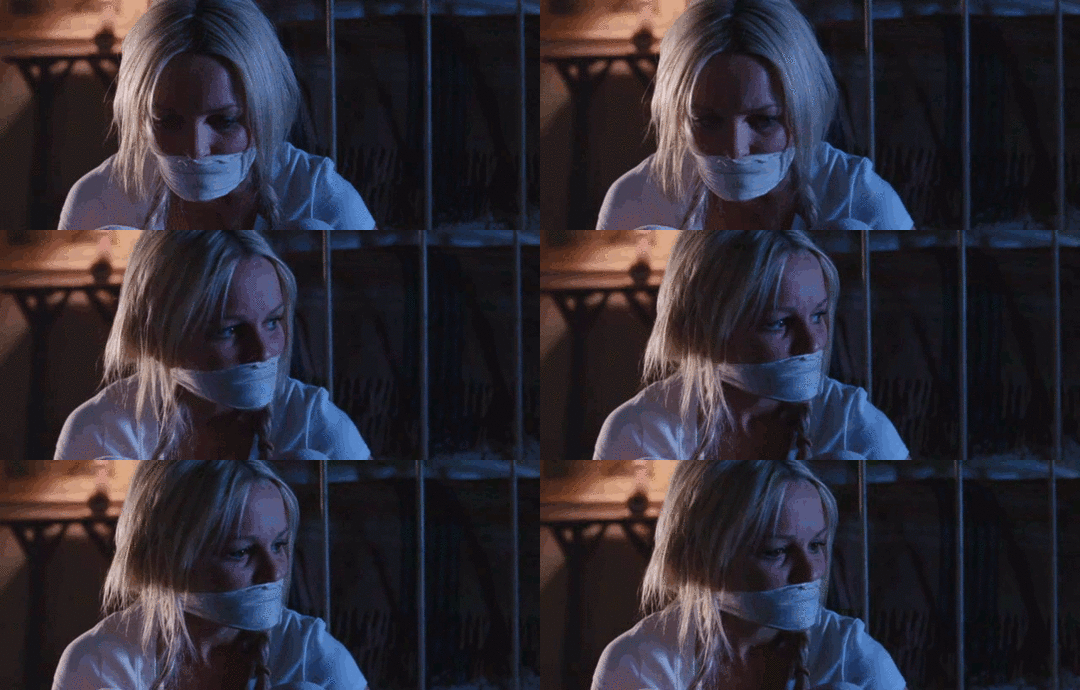
"John, why're you doing this to me?"
"I don't know." He was quiet a long moment.
"We thought it'd be fun, I guess."
"Is it fun, hurting people?"
There was no answer, but the tension in the room tightened still more.
When Dr. and Mrs. Adams go to Paris on a summer vacation, young Bobby and Cindy Adams sneak inside their babysytter Barbara's bedroom in the dark of night to chloroform, tie and gag her.
Next morning their older friends Dianne, Paul and John, came home joining the game in the secluded Adams' mansion.
Things escalate bad fast in one of the most dark, brutal, thrilling and disturbing page-turning, or fast-clicking if you read this on kindle or other e-readers, novels I ever read, a messed up tale inspired, like more famous Jack Ketchum's The girl next door, by 60s Sylvia Likens' chilling murder case.
A morbid wicked ride, some parts of it are going to stay in my mind forever, and probably I'm going to have nightmares this night, but I wanted to read this cult-horror status novel and at last I did it.
Almost five stars for me, but a few reviews here spoilering the ending, lowered for good final vote.
John and Dianne were talking.
"What did you do to her?" Dianne was angry.
John glanced down at Cindy and back again.
"Everything," he said.
Absolutely not for anyone, but if you are not faint-hearted, and wanna read an assured to cult status horror book about "evil kids" and their victim, give it a try.

June 24, 2013
Barbara is a 20 year old college student who likes kids and needed some extra money. She agrees to sit with Bobby and Cindy. Little does she know that these dang kids are the demon reborn. They along with 3 of their friends take Barbara hostage. Torture and rape are on the agenda. These kids see it as playing a game. They are the Freedom Five after all. Little bastards.

This book scared the hell out of me. I can see this happening. Kids live in their own world. Some of them don't see their actions as having consequences. I lived with a 16 year old girl who had some mental issues. Scared shitless I say!
One of the "kids" in this book is 17 years old! That little pyscho just went along with the gang.

This book will stick with you for awhile. Thanks mark for the copy...I adore you. But I do want the book out of my house too! LOL First person to want it (in the USA) gets it!
This book scared the hell out of me. I can see this happening. Kids live in their own world. Some of them don't see their actions as having consequences. I lived with a 16 year old girl who had some mental issues. Scared shitless I say!
One of the "kids" in this book is 17 years old! That little pyscho just went along with the gang.
This book will stick with you for awhile. Thanks mark for the copy...I adore you. But I do want the book out of my house too! LOL First person to want it (in the USA) gets it!

Read
March 9, 2018I imagine if you are reading this review you fall under 1 of 3 categories: 1) You've already read this book, so you are curious about my opinion, 2) you want to read this book, in which case you should stop reading this right now because spoilers lurk ahead, or 3) you have no intention of ever reading this book, and yet you are drawn to my review out of curiosity.
So here's the deal. I needed to read this book for a couple of reasons. First, this book is out of print, and you usually cannot find a paperback copy of it under $100. Trust me, I checked daily for weeks, and only ended up with a copy when a UK seller listed one for $25 including shipping. That's a steal, so I snatched it up. I mean, first editions of this book are listed for almost $2000. Insane.
The second reason I needed to read this book is the controversy around it. Written in 1974, readers were so appalled by Johnson's book, that some claimed they destroyed it immediately after reading it or felt physically ill. Johnson passed away two years after its publication, so he never got to see it achieve cult status, but it sounds like he wasn't very popular before his death. BTW, I got all of this info from Grady Hendrix's fantastic book Paperbacks From Hell. Hendrix revisits a lot of the popular horror fiction of the 70's and 80s', and he gives Let's Go Play at the Adams' an entire 2 page spread. I skipped those pages when I read the book last year, knowing that I would come back to them after reading Johnson's novel. I didn't want anything spoiled for me.
So we have a cult status horror novel that's so despicable people either tore it to pieces or felt like vomiting upon finishing it. It's also incredibly hard to find at a price most people are willing to pay. I was intrigued.
This book often gets compared to Jack Ketchum's novel The Girl Next Door, and while there are obviously similarities, I thinks it's a very different book. Both involve a group of children with a hive mentality, but while Ketchum's novel is about kids acting on base desires and sociopathic instincts that seem OK to them because they have the full approval of an adult, Johnson's novel is about a very different group of kids.
In Let's Go Play at the Adams', Barbara is the unfortunate victim of a game devised by 4 highly intelligent and well to do kids who have been friends for years. I say 4 because the fifth child, Cindy, is only 10 when the novel occurs, and can't really be considered an architect of such a foul plan at that age, although she is involved. The kids range in age from 10 to 17, and Barbara is tasked with babysitting the Adams children, Bobby who is 13 and Cindy, while their parents are in Europe for a week. The enormous house is isolated on the Eastern shore of Maryland, with the closest neighbors being not very close. Those neighbors are the McVeigh's, and their children have been friends with the Adams' for years. Dianne is the oldest at 17, and the natural leader of the group. Her brothers, John who is 16, and mentally unstable Paul who is 13, like Bobby, make up what the children call The Freedom Five. They have been playing games together for years now, and those games have gradually become sadistic in nature. They practice tying each other up, forcing each other to go with out clothes while restrained, and even mild forms of torture. But these children are effluent and clever, and they soon become bored with the games they play with each other that can only go so far. When Barbara arrives, a new idea for a game begins to take shape.
As you can imagine, things go very horribly wrong for Barbara. The children chloroform her one night and bind her to her bed, really just doing it in the beginning to see if they can get away with it. Once they realize they have full control of Barbara, and that she is completely unable to escape, the game escalates, and pretty much goes exactly where you would expect it to.
I have to admit that I held out hope toward the end. Barbara's confinement and torture are a slow burn, and we learn a lot about each of the characters as the children become bolder. This makes the story even harder to read, because we know that Bobby has grown tired of the game, and actually feels bad for Barbara. For a while Cindy even tires of having complete freedom, and considers releasing Barbara out of boredom and because she genuinely likes the young woman. But the McVeigh children threaten them multiple times and have no intention to stop the game until the inevitable ending. John and Dianne are clearly sociopaths, and Dianne is highly intelligent. Paul is barely able to function, and is almost certainly a psychopath. So toward the end, when we dread the obvious outcome, and Bobby actually seems to waver and consider stopping such a monstrous game, the reader grasps desperately at a shred of hope. Alas, The Freedom Five has too much influence on him, and we learn that poor Barbara never really stood a chance.
This book is definitely hard to read and unflinchingly savage. Johnson never allows the reader to turn away, and forces all of the despicable acts that are performed on Barbara to be read in painstaking detail. I cannot say that I enjoyed this book. I read this one so that I could check off a horror cult classic box. I read it just so that I could say I read it and have an opinion about it. I've actually considered selling my copy now. I could probably get a nice sum for it, but I can't decide. The events that occur in this book are so repugnant that I feel sort of dirty making money off of it. It will probably go on my shelf, and become a show piece. A book that I can say I read just for the experience of saying I read it. Like The Girl Next Door, I'm going to avoid giving this a star rating. Johnson has long been in his grave, so he couldn't care less anyway. It's well written and definitely a page turner, but I can't mark this book as something that "I loved" or even "liked" because I didn't. I endured it.
So here's the deal. I needed to read this book for a couple of reasons. First, this book is out of print, and you usually cannot find a paperback copy of it under $100. Trust me, I checked daily for weeks, and only ended up with a copy when a UK seller listed one for $25 including shipping. That's a steal, so I snatched it up. I mean, first editions of this book are listed for almost $2000. Insane.
The second reason I needed to read this book is the controversy around it. Written in 1974, readers were so appalled by Johnson's book, that some claimed they destroyed it immediately after reading it or felt physically ill. Johnson passed away two years after its publication, so he never got to see it achieve cult status, but it sounds like he wasn't very popular before his death. BTW, I got all of this info from Grady Hendrix's fantastic book Paperbacks From Hell. Hendrix revisits a lot of the popular horror fiction of the 70's and 80s', and he gives Let's Go Play at the Adams' an entire 2 page spread. I skipped those pages when I read the book last year, knowing that I would come back to them after reading Johnson's novel. I didn't want anything spoiled for me.
So we have a cult status horror novel that's so despicable people either tore it to pieces or felt like vomiting upon finishing it. It's also incredibly hard to find at a price most people are willing to pay. I was intrigued.
This book often gets compared to Jack Ketchum's novel The Girl Next Door, and while there are obviously similarities, I thinks it's a very different book. Both involve a group of children with a hive mentality, but while Ketchum's novel is about kids acting on base desires and sociopathic instincts that seem OK to them because they have the full approval of an adult, Johnson's novel is about a very different group of kids.
In Let's Go Play at the Adams', Barbara is the unfortunate victim of a game devised by 4 highly intelligent and well to do kids who have been friends for years. I say 4 because the fifth child, Cindy, is only 10 when the novel occurs, and can't really be considered an architect of such a foul plan at that age, although she is involved. The kids range in age from 10 to 17, and Barbara is tasked with babysitting the Adams children, Bobby who is 13 and Cindy, while their parents are in Europe for a week. The enormous house is isolated on the Eastern shore of Maryland, with the closest neighbors being not very close. Those neighbors are the McVeigh's, and their children have been friends with the Adams' for years. Dianne is the oldest at 17, and the natural leader of the group. Her brothers, John who is 16, and mentally unstable Paul who is 13, like Bobby, make up what the children call The Freedom Five. They have been playing games together for years now, and those games have gradually become sadistic in nature. They practice tying each other up, forcing each other to go with out clothes while restrained, and even mild forms of torture. But these children are effluent and clever, and they soon become bored with the games they play with each other that can only go so far. When Barbara arrives, a new idea for a game begins to take shape.
As you can imagine, things go very horribly wrong for Barbara. The children chloroform her one night and bind her to her bed, really just doing it in the beginning to see if they can get away with it. Once they realize they have full control of Barbara, and that she is completely unable to escape, the game escalates, and pretty much goes exactly where you would expect it to.
I have to admit that I held out hope toward the end. Barbara's confinement and torture are a slow burn, and we learn a lot about each of the characters as the children become bolder. This makes the story even harder to read, because we know that Bobby has grown tired of the game, and actually feels bad for Barbara. For a while Cindy even tires of having complete freedom, and considers releasing Barbara out of boredom and because she genuinely likes the young woman. But the McVeigh children threaten them multiple times and have no intention to stop the game until the inevitable ending. John and Dianne are clearly sociopaths, and Dianne is highly intelligent. Paul is barely able to function, and is almost certainly a psychopath. So toward the end, when we dread the obvious outcome, and Bobby actually seems to waver and consider stopping such a monstrous game, the reader grasps desperately at a shred of hope. Alas, The Freedom Five has too much influence on him, and we learn that poor Barbara never really stood a chance.
This book is definitely hard to read and unflinchingly savage. Johnson never allows the reader to turn away, and forces all of the despicable acts that are performed on Barbara to be read in painstaking detail. I cannot say that I enjoyed this book. I read this one so that I could check off a horror cult classic box. I read it just so that I could say I read it and have an opinion about it. I've actually considered selling my copy now. I could probably get a nice sum for it, but I can't decide. The events that occur in this book are so repugnant that I feel sort of dirty making money off of it. It will probably go on my shelf, and become a show piece. A book that I can say I read just for the experience of saying I read it. Like The Girl Next Door, I'm going to avoid giving this a star rating. Johnson has long been in his grave, so he couldn't care less anyway. It's well written and definitely a page turner, but I can't mark this book as something that "I loved" or even "liked" because I didn't. I endured it.

April 20, 2015
Is there anything more scary than evil children? Maybe, but not in my opinion. Children are supposed to be the epitome of innocence and everything that's good in the world so when they do something horrific and psychotic that is something that I just can't comprehend. I know it happens. I know children like that exist, but it's a thought that I usually try to push out of my mind. A book like this shoves it right back. Do I believe that all children are like the ones depicted in this book? No. Do I think that all children are capable of these acts? Well, capable, maybe but definitely not willing to do them. I don't think most children would decide to do the things these children did, but I can't deny that there are some that would (and as an optimist who firmly believes that there is more good in the world then bad, that is a hard thing to admit). There was a case I read about a few years ago, which is quite a well known case in England, which disturbed me and has stayed with me. It was the case of James Bulger. If you don't know that case, first of all, lucky you! Secondly, I'm not going to explain it here as I find it horrific but feel free to look it up. That case was a prime example of what this book portrays.
I gave this book 5 stars in a similar way to how I gave The Girl Next Door 5 stars. I didn't enjoy either. I can say right now, that I will never read either again. They are not favourites of mine and I didn't love them. They are tough to read and definitely not for everybody but they earned 5 stars each for making me feel so strongly and for just how well they were written and portrayed. That's not to say the books are alike. I've seen comparisons and while I can understand some similarities and I understand that they were both based off the same real life case, there are some major differences. First of all, TGND is closer to the real story. TGND also had the children being lead and corrupted by an adult figure. In this book, however, the children are acting completely on their own accord. TGND started slowly and eased into the tension and then gradually unveiled the horror. This book jumps straight in. Seriously. There's a small prologue and then bam! Barbara is tied to the bed (that's not a spoiler, it's in the book description and it is the basic premise). However, once set up it is a tense ride. There isn't non-stop, graphic, torture, in fact, most of the actual torture is very few and far between. The real torture is the waiting. Just as it is for Barbara. The waiting for what's going to come next, the waiting to see how far the kids will take it, the waiting to see how long Barbara has to endure being tied up, waiting to see how they'll next take away some more of her dignity. It's tense and intense. It's genuinely terrifying. The 5 children are genuinely terrifying. They have no empathy. Feel no guilt (except Bobby but it's impossible to feel sorry for him when he started it all). They take pleasure in it. All of it.
We get each characters POV and it makes it all the more disturbing. Seeing each child's reasoning with what they're doing. Seeing what they think and how they feel about it. Barbara's POV is tough to take. We join her in her descent from initial confusion to denial to realisation to terror. The only times I found Barbara a bit frustrating was when she kept blaming herself for everything but then maybe that's a natural reaction. Her thought process was there too. We had insight into the minds of the captors and the captive, and neither was easy to take in.
The book was hard to put down while simultaneously hard to carry on with and the ending left me reeling. I both highly recommend it and also don't because it's a truly excellent piece of horror fiction which has been severely overlooked but it is also not something that I think most people will be able to stomach. It definitely deserves 5 stars and I can definitely say that I will not be forgetting about this book.
I gave this book 5 stars in a similar way to how I gave The Girl Next Door 5 stars. I didn't enjoy either. I can say right now, that I will never read either again. They are not favourites of mine and I didn't love them. They are tough to read and definitely not for everybody but they earned 5 stars each for making me feel so strongly and for just how well they were written and portrayed. That's not to say the books are alike. I've seen comparisons and while I can understand some similarities and I understand that they were both based off the same real life case, there are some major differences. First of all, TGND is closer to the real story. TGND also had the children being lead and corrupted by an adult figure. In this book, however, the children are acting completely on their own accord. TGND started slowly and eased into the tension and then gradually unveiled the horror. This book jumps straight in. Seriously. There's a small prologue and then bam! Barbara is tied to the bed (that's not a spoiler, it's in the book description and it is the basic premise). However, once set up it is a tense ride. There isn't non-stop, graphic, torture, in fact, most of the actual torture is very few and far between. The real torture is the waiting. Just as it is for Barbara. The waiting for what's going to come next, the waiting to see how far the kids will take it, the waiting to see how long Barbara has to endure being tied up, waiting to see how they'll next take away some more of her dignity. It's tense and intense. It's genuinely terrifying. The 5 children are genuinely terrifying. They have no empathy. Feel no guilt (except Bobby but it's impossible to feel sorry for him when he started it all). They take pleasure in it. All of it.
We get each characters POV and it makes it all the more disturbing. Seeing each child's reasoning with what they're doing. Seeing what they think and how they feel about it. Barbara's POV is tough to take. We join her in her descent from initial confusion to denial to realisation to terror. The only times I found Barbara a bit frustrating was when she kept blaming herself for everything but then maybe that's a natural reaction. Her thought process was there too. We had insight into the minds of the captors and the captive, and neither was easy to take in.
The book was hard to put down while simultaneously hard to carry on with and the ending left me reeling. I both highly recommend it and also don't because it's a truly excellent piece of horror fiction which has been severely overlooked but it is also not something that I think most people will be able to stomach. It definitely deserves 5 stars and I can definitely say that I will not be forgetting about this book.

May 14, 2021
3.5 stars. Not what I expected to be honest, but I was still suitably disturbed and unsettled by the end.

November 9, 2022
I’ll be honest: I’m not even sure how to write this review. Spoilers are one thing, but it’s impossible to even say anything about this novel without warning sensitive readers about the numerous triggers in this book. There are graphic depictions of rape, torture, bodily mutilation, and murder. The fact that they are all COMMITTED BY CHILDREN compounds the difficulty. (And, yes, you read that right: the crimes are committed "by" kids, not "against" them.) This is one sick and twisted novel.
“Let’s Go Play at the Adams’” was published in 1974 by Mendal W. Johnson. It was, by all accounts, his first and only novel. He died two years later. I can’t imagine that it arrived on bookstore shelves with any acclaim, although it has, apparently, garnered a somewhat respectable cult following. I can almost see why. Despite the graphic violence and a simple plot, Johnson’s novel is satisfyingly well-written and hides a deeply philosophical worldview on the nature of evil.
Grady Hendrix raved about this novel in his book “Paperbacks From Hell”, and it was reprinted under the PFH line by Valancourt Books. So, we have Grady to thank, or blame, depending on how you take this novel.
The story is simple: beautiful young college co-ed Barbara is a babysitter for the Adams family. The parents are away on a weeks-long trip to Europe, and they have left Barbara in charge of their two children, Bobby and Cindy. On the first day after the parents have left the country, Barbara finds herself knocked out with chloroform and awakens gagged and tied to her bed. Three other neighbor children—-John, Dianne, and Paul—-have arrived at the house. They are all there to play a game. What’s the game? Who the fuck knows!!?? Barbara sure doesn’t.
Johnson slowly builds the tension to an unbelievable level, and the ending is perhaps one of the most vile and unsettling endings of a horror novel I have ever read. It’s the type of ending that will haunt one forever, which perhaps partly explains its cult popularity.

I can’t exactly say that I “liked” this novel. That just seems weird. It’s like saying one “likes” the bubonic plague or having a limb amputated. I certainly didn’t enjoy it, but there is something just under the surface of the novel that Johnson is trying to articulate about humanity’s deep hatred and resentment of true beauty that I find fascinating. Johnson isn’t just satisfied with saying that we are all capable of atrocity. It’s more than that. He’s saying that we are all just giddily waiting—-like children on Christmas Eve—-for the moment when our social niceties and our sense of morality can be flung off like old clothes and we can do whatever the fuck we want. And that’s a pretty terrifying prospect, if you really think about it…
“Let’s Go Play at the Adams’” was published in 1974 by Mendal W. Johnson. It was, by all accounts, his first and only novel. He died two years later. I can’t imagine that it arrived on bookstore shelves with any acclaim, although it has, apparently, garnered a somewhat respectable cult following. I can almost see why. Despite the graphic violence and a simple plot, Johnson’s novel is satisfyingly well-written and hides a deeply philosophical worldview on the nature of evil.
Grady Hendrix raved about this novel in his book “Paperbacks From Hell”, and it was reprinted under the PFH line by Valancourt Books. So, we have Grady to thank, or blame, depending on how you take this novel.
The story is simple: beautiful young college co-ed Barbara is a babysitter for the Adams family. The parents are away on a weeks-long trip to Europe, and they have left Barbara in charge of their two children, Bobby and Cindy. On the first day after the parents have left the country, Barbara finds herself knocked out with chloroform and awakens gagged and tied to her bed. Three other neighbor children—-John, Dianne, and Paul—-have arrived at the house. They are all there to play a game. What’s the game? Who the fuck knows!!?? Barbara sure doesn’t.
Johnson slowly builds the tension to an unbelievable level, and the ending is perhaps one of the most vile and unsettling endings of a horror novel I have ever read. It’s the type of ending that will haunt one forever, which perhaps partly explains its cult popularity.
I can’t exactly say that I “liked” this novel. That just seems weird. It’s like saying one “likes” the bubonic plague or having a limb amputated. I certainly didn’t enjoy it, but there is something just under the surface of the novel that Johnson is trying to articulate about humanity’s deep hatred and resentment of true beauty that I find fascinating. Johnson isn’t just satisfied with saying that we are all capable of atrocity. It’s more than that. He’s saying that we are all just giddily waiting—-like children on Christmas Eve—-for the moment when our social niceties and our sense of morality can be flung off like old clothes and we can do whatever the fuck we want. And that’s a pretty terrifying prospect, if you really think about it…
June 16, 2010
Let's Go Play at the Adams' is a book that is dark, cold, and yet infinitely readable. It stands as a strange and utterly true testament to the uniquely separate mind children have from adults and the dark nature we so quickly forget when we grow out of it. The simple rules we follow as children can seem innocent and wondering to us as adults but we rarely see how that way of thought can be changed and manipulated into being something far darker and very, very, calculating. Forgetting this, then, is the mistake made by Barbara, a college girl hired to care for the young Adams children in their home along a river in rural New England.
Rather than going into the plot (I'd like for people to be able to read this with as few spoilers as possible.) I'd like to express both my admiration for Johnson's writing and for the thought it must have taken to create such a thoroughly dark and cerebral book at a time when this sort of book might have garnered a great deal of trouble for him.
Make no mistake, this book isn't for the reader who prefers lighter reading material, and while in it's most basic classification it seems to be a horror novel, the reality is that it's more of a psychological treatise on children and their interaction with the world. It offers a very real look at the minds of both the children and Barbara in her deteriorating state over the course of the book and how easily things can slip from perfectly normal to being horrific over the course of a single week.
Through the events that take place in the book, we see how little it takes for a small group to divert their thoughts and feelings from the expected path toward a separate more savage one. It also shows exactly how little adults think of this or any other individual aspects of a child's mind. As a whole, many adults truly overlook a child's capacity to understand and interpret the world around them, and in doing so, tend to belittle and diminish that individual view without realizing it. Most kids take this as part of interaction with adults, but some could clearly take it as enough of an offense to take action in the right circumstances, if not to declare a sort of war with that adult. Perhaps this is part of why teens are so aggressive and demanding of privacy?
Johnson's writing expresses the thoughts and feelings of these characters without judgment and with little interruption, giving the story an interestingly isolated feeling, not unlike that found in 50s and 60s family television. This tone, and the darker course of events (mingled as they are), make for a disturbing story that rather than bashing you over the head with the horror (as is the case with Ketchum's similarly dark book The Girl Next Door) gives you a strange window into the scene, completely separate from the events (as with an episode of say The Twilight Zone) for all that you take in.
I wish more people had access to this book and the ability to read it. I feel that it could clearly have been a much more affecting book if it hadn't fallen as it was, published shortly before the horror boom and with it the blossoming careers of such authors as Stephen King, and only two years before the author's untimely death. It offers an interesting angle on the psychology of group thought, children's mental disorders, and the odd separation between childhood and adult thought. Through the course of the story each role is clearly expressed and there are no doubts that these people act based on their own choices and what, to them, is rational thought and reason.
I highly recommend this book to those who can read the book and truly grasp the message of the tale. No one is beyond acting in this manner, NO ONE and it could happen anywhere.
Rather than going into the plot (I'd like for people to be able to read this with as few spoilers as possible.) I'd like to express both my admiration for Johnson's writing and for the thought it must have taken to create such a thoroughly dark and cerebral book at a time when this sort of book might have garnered a great deal of trouble for him.
Make no mistake, this book isn't for the reader who prefers lighter reading material, and while in it's most basic classification it seems to be a horror novel, the reality is that it's more of a psychological treatise on children and their interaction with the world. It offers a very real look at the minds of both the children and Barbara in her deteriorating state over the course of the book and how easily things can slip from perfectly normal to being horrific over the course of a single week.
Through the events that take place in the book, we see how little it takes for a small group to divert their thoughts and feelings from the expected path toward a separate more savage one. It also shows exactly how little adults think of this or any other individual aspects of a child's mind. As a whole, many adults truly overlook a child's capacity to understand and interpret the world around them, and in doing so, tend to belittle and diminish that individual view without realizing it. Most kids take this as part of interaction with adults, but some could clearly take it as enough of an offense to take action in the right circumstances, if not to declare a sort of war with that adult. Perhaps this is part of why teens are so aggressive and demanding of privacy?
Johnson's writing expresses the thoughts and feelings of these characters without judgment and with little interruption, giving the story an interestingly isolated feeling, not unlike that found in 50s and 60s family television. This tone, and the darker course of events (mingled as they are), make for a disturbing story that rather than bashing you over the head with the horror (as is the case with Ketchum's similarly dark book The Girl Next Door) gives you a strange window into the scene, completely separate from the events (as with an episode of say The Twilight Zone) for all that you take in.
I wish more people had access to this book and the ability to read it. I feel that it could clearly have been a much more affecting book if it hadn't fallen as it was, published shortly before the horror boom and with it the blossoming careers of such authors as Stephen King, and only two years before the author's untimely death. It offers an interesting angle on the psychology of group thought, children's mental disorders, and the odd separation between childhood and adult thought. Through the course of the story each role is clearly expressed and there are no doubts that these people act based on their own choices and what, to them, is rational thought and reason.
I highly recommend this book to those who can read the book and truly grasp the message of the tale. No one is beyond acting in this manner, NO ONE and it could happen anywhere.

Read
July 17, 2020DNF.
I tapped out almost exactly halfway through. This was a buddy read with the host of the podcast VOX VOMITUS and we will be sharing our thoughts on this classic horror novel for a whole episode!
https://radiopublic.com/vox-vomitus-8...
Coming soon. I'll update this review after the show with all the reasons why I quit this book.
I tapped out almost exactly halfway through. This was a buddy read with the host of the podcast VOX VOMITUS and we will be sharing our thoughts on this classic horror novel for a whole episode!
https://radiopublic.com/vox-vomitus-8...
Coming soon. I'll update this review after the show with all the reasons why I quit this book.

August 27, 2025
Let's Go Play at the Adams' is better than I expected but not in the same category as its more gruesome counterpart, The Girl Next Door by Jack Ketchum, both being surprisingly well written.
LGPATA is formal, meandering and even quite boring in places.
Even though LGPATA is based on real-life circumstances, The Girl Next Door tells it much closer to what actually happened, as well as being more visceral and hard-hitting in comparison to LGPATA's alternative scenario that dawdles, muses and goes back on itself as seemingly unsure at what it wants to say and even if it dares.
The Girl Next Door makes you feel complicit in committing the crime while unwittingly taking part in it, compelled to watch events whether you like it or not, including the evil mother who eggs on her children and the other kids to behave as abysmally as her depraved personality permits, plus the physical, continuous and descriptive that has no right to be in print, which LGPATA only touches on at times.
In LGPATA you seldom get to feel how Barbara, the victim, actually feels, who's mostly just a sack of tied up potatoes from a reader perspective.
At the this point I rated LGPATA only three stars, but ended up changing my mind because there's something profound and almost beautiful in addressing the importance and pricelessness of life.
It proffers some profound questions on the meaning of existence and whether or not there's a God? After you die the whole world stops, not to others, but from your perspective as everything ends, meaning, logically, that there must be a God, an afterlife, or something, otherwise the universe no longer exists, it's a form of existentialism that surprised me about this book, which doesn't really feel like a work of horror but a story about the mishaps and bad behaviour of a bunch of kids.
It's not often you see things from the perspective of the victim, Barbara, though, which is a shame.
Strangely, I also felt sorry for the kids, the aggressors, for having their innocence forever yanked away in place of an undeserved future of trauma and confusion.
Fortunately, LGPATA did not wimp out in the way I feared it would, which is a big extreme horror literature plus!
Not so fortunately, there's an afterword/epilogue, which is never a good idea when a decent ending will do that tames down the conclusion instead of finishing with a punch, and boy oh boy, does Mendal W. Johnson go on and on at times instead of hitting hard! Rock hammer hard!
Some people may be turned off by the subject material, while others may quit before the end, but don't - there's something intrinsically shocking about this book, especially the needless and self-justified behaviour of kids who do nasty things because it's fun and because why not? Lord of The Flies springs to mind. However, Jack Ketchum got it right in his version, as the kids were egged on by an evil adult!
But this is a surprising read nonetheless, especially the ending and how it ramped up. The book seems lame at various points, but ultimately isn't.
LGPATA is formal, meandering and even quite boring in places.
Even though LGPATA is based on real-life circumstances, The Girl Next Door tells it much closer to what actually happened, as well as being more visceral and hard-hitting in comparison to LGPATA's alternative scenario that dawdles, muses and goes back on itself as seemingly unsure at what it wants to say and even if it dares.
The Girl Next Door makes you feel complicit in committing the crime while unwittingly taking part in it, compelled to watch events whether you like it or not, including the evil mother who eggs on her children and the other kids to behave as abysmally as her depraved personality permits, plus the physical, continuous and descriptive that has no right to be in print, which LGPATA only touches on at times.
In LGPATA you seldom get to feel how Barbara, the victim, actually feels, who's mostly just a sack of tied up potatoes from a reader perspective.
At the this point I rated LGPATA only three stars, but ended up changing my mind because there's something profound and almost beautiful in addressing the importance and pricelessness of life.
It proffers some profound questions on the meaning of existence and whether or not there's a God? After you die the whole world stops, not to others, but from your perspective as everything ends, meaning, logically, that there must be a God, an afterlife, or something, otherwise the universe no longer exists, it's a form of existentialism that surprised me about this book, which doesn't really feel like a work of horror but a story about the mishaps and bad behaviour of a bunch of kids.
It's not often you see things from the perspective of the victim, Barbara, though, which is a shame.
Strangely, I also felt sorry for the kids, the aggressors, for having their innocence forever yanked away in place of an undeserved future of trauma and confusion.
Fortunately, LGPATA did not wimp out in the way I feared it would, which is a big extreme horror literature plus!
Not so fortunately, there's an afterword/epilogue, which is never a good idea when a decent ending will do that tames down the conclusion instead of finishing with a punch, and boy oh boy, does Mendal W. Johnson go on and on at times instead of hitting hard! Rock hammer hard!
Some people may be turned off by the subject material, while others may quit before the end, but don't - there's something intrinsically shocking about this book, especially the needless and self-justified behaviour of kids who do nasty things because it's fun and because why not? Lord of The Flies springs to mind. However, Jack Ketchum got it right in his version, as the kids were egged on by an evil adult!
But this is a surprising read nonetheless, especially the ending and how it ramped up. The book seems lame at various points, but ultimately isn't.

June 1, 2021
A true horror novel.

January 17, 2011
...or let's not!!!
I read this book as a young teenager. I found this to be a disturbing read that has stayed with me to this day!
The thing that gets me every time, is that I repeatedly forget it was based on a real event, until I click on it on Goodreads, and see one of my friend's reviews directly below mine, reminding me of this fact.
I still have my paperback copy, and wonder if one day I will dare to read it again. As I've read a lot of horror and dark psychological thrillers since reading this, I wonder if a re-read will make it seem less scary, but at the same time, I fear the images in the darkest corners of my mind will come flooding back upon reading it again.
So, while I spend probably another decade considering whether I dare read this again, it will sit on my bookshelf where I know it can behave itself. It is one of those books that I thought was very good, but I do not take pleasure in recommending it to others in case it makes them feel how I did as a young girl.
On the back cover, Publishers Weekly state "A horror tale that will harrow you and haunt you long after you have finished it." I see why I was attracted to it in the first place, with loving horrors. However, I don't think I ever expected it would still have such a strong impact on my thoughts and feelings about 25 years later.
I read this book as a young teenager. I found this to be a disturbing read that has stayed with me to this day!
The thing that gets me every time, is that I repeatedly forget it was based on a real event, until I click on it on Goodreads, and see one of my friend's reviews directly below mine, reminding me of this fact.
I still have my paperback copy, and wonder if one day I will dare to read it again. As I've read a lot of horror and dark psychological thrillers since reading this, I wonder if a re-read will make it seem less scary, but at the same time, I fear the images in the darkest corners of my mind will come flooding back upon reading it again.
So, while I spend probably another decade considering whether I dare read this again, it will sit on my bookshelf where I know it can behave itself. It is one of those books that I thought was very good, but I do not take pleasure in recommending it to others in case it makes them feel how I did as a young girl.
On the back cover, Publishers Weekly state "A horror tale that will harrow you and haunt you long after you have finished it." I see why I was attracted to it in the first place, with loving horrors. However, I don't think I ever expected it would still have such a strong impact on my thoughts and feelings about 25 years later.

April 9, 2014
Mark's review reminded me of this notorious book. I remember leafing through it at a bookshop when it came out in the 70s and ending up reading quite a lot of it. I'm trying to recall if I found the story believable or not (Mark doesn't believe it). I was a teen at the time, about as old as the older kids in the book.
I don't think it seemed that implausible. The author appeared to be saying: actually, it's pretty easy for the right social pressures to turn normal kids into psychopaths. Well, why not? You don't have use your imagination to come up with plenty of real-world examples. The Third Reich isn't necessary; as far as I can reconstruct it, I figured I knew kids who would be torturing their babysitter to death if they were reasonably sure they could get away with it. They just didn't have the opportunity.
Maybe today I'd be more skeptical, I don't know.
I don't think it seemed that implausible. The author appeared to be saying: actually, it's pretty easy for the right social pressures to turn normal kids into psychopaths. Well, why not? You don't have use your imagination to come up with plenty of real-world examples. The Third Reich isn't necessary; as far as I can reconstruct it, I figured I knew kids who would be torturing their babysitter to death if they were reasonably sure they could get away with it. They just didn't have the opportunity.
Maybe today I'd be more skeptical, I don't know.


March 16, 2016
Warning, this review is kind-of spoilery.
I’m not even sure where to start with this review… what a disturbing, strange, and violent novel.
I had so many different thoughts running through my head with this novel, that I actually had to start myself a little review notebook where I could put all my thoughts on paper. This is going to be a long review… I can already feel it.
I should start by saying, this book turned out to be nothing like I thought it would be, but that hasn’t let me down. This is a very uncomfortable 4 star read. Where American Psycho was 5 stars because I enjoyed the reading experience and Patrick Bateman’s deranged, dorky character (in the least sadistic way possible), this is the complete opposite. This was an unenjoyable 4 stars because it was just so dark and disturbing… am I making sense?
What struck me about this novel at the beginning was that I disliked our victim, Barbara. She awoke gagged and tied up, and was merely annoyed, if not amused by the children’s “game”. Even later, when she realised that she really was a prisoner, she was snooty and still thought herself better than the children. Obviously, as the torture progressed and got worse, my opinion of her did change, as she changed too.
While this book sounds like it’s going to be a quick, dark story about the kidnapping and torture of a babysitter, it’s actually a lot slower than that and there isn’t a huge amount of the torture in front of our eyes. It goes on behind closed doors and is only hinted towards – this doesn’t make it any less skin crawling, however! This novel is largely focused on the characters and their thoughts throughout the week-long crime.
A lot of people’s reviews mentioned how the characters in this weren’t believable, but I think otherwise. Yes, maybe the idea that 5 kids all come together and mutually agree to kidnap and torture an adult is a little strange, but as individual people, I think it’s easy to assume they all really exist.
The eldest of the group is Dianne, at the age of 17, and I personally think she was the least likable but also least believe character. Her involvement in the kidnapping went no further than “just because” – she was in charge of all the children simply because she was the oldest and she let them do whatever they wanted. She had no motive to want to hurt Barbara, she was simply cruel for cruelty’s sake.
Secondly, there’s John, aged 16, and his involvement in the kidnapping went a lot further and was a lot more controversial. He had a motive, and that was simply lust. A sexually frustrated teenager is definitely easy to imagine and while only a teeny tiny amount go on to commit sex crimes, it’s totally plausible.
Afterwards comes Paul, aged 12, whose presence in the story is very strange. He’s not really got any motive other than his own dark desires. A weirdo 12 year old with violent tendencies is really nothing new – Paul was just a little more over the top!
Next is Bobby, aged 10, the only kid of the bunch who shows any remorse at what they’ve done. I personally feel that Bobby was the subject of peer-pressure. He thought kidnapping an adult would be fun, and as a young child, couldn’t comprehend the consequences of his actions. Other reviewers didn’t feel sorry for Bobby, but in a way, I did.
Lastly is Cindy, the youngest of the group at 9 years old. Cindy doesn’t feature in the novel an awful lot, but when she does she’s simply a bored young girl who doesn’t fully understand the reality of what’s happening. Even at the end, when things are getting more and more violent, Cindy doesn’t care. She’s just going along with the rest of her friends.
As I mentioned before, there isn’t a huge amount of “on screen” torture and violence, but when it is there, it’s grotesque and nightmarish. Johnson really did know how to write horrifying descriptions. Reading bits and pieces got really dark and at times I felt pretty squeamish.
One quick thing to say about the writing is that it really would have been nice to have more paragraph breaks! When the story is so dark and heavy, you need a bit of a breather sometimes, and you didn’t get much of that with this novel.
Right, sorry this review has been a bit of a long, messy ramble! I really wasn’t sure how to go about reviewing this weird, sinister book. If you like horrible books that are going to make you feel uncomfortable, and you can get your hands on this for cheap, I think it’s worth reading – even just to be able to say you’ve read it! But it’s definitely, definitely not for everyone – not even every horror reader.
Thanks to Virginia on Goodreads for lending me her copy to read!
I’m not even sure where to start with this review… what a disturbing, strange, and violent novel.
I had so many different thoughts running through my head with this novel, that I actually had to start myself a little review notebook where I could put all my thoughts on paper. This is going to be a long review… I can already feel it.
I should start by saying, this book turned out to be nothing like I thought it would be, but that hasn’t let me down. This is a very uncomfortable 4 star read. Where American Psycho was 5 stars because I enjoyed the reading experience and Patrick Bateman’s deranged, dorky character (in the least sadistic way possible), this is the complete opposite. This was an unenjoyable 4 stars because it was just so dark and disturbing… am I making sense?
What struck me about this novel at the beginning was that I disliked our victim, Barbara. She awoke gagged and tied up, and was merely annoyed, if not amused by the children’s “game”. Even later, when she realised that she really was a prisoner, she was snooty and still thought herself better than the children. Obviously, as the torture progressed and got worse, my opinion of her did change, as she changed too.
While this book sounds like it’s going to be a quick, dark story about the kidnapping and torture of a babysitter, it’s actually a lot slower than that and there isn’t a huge amount of the torture in front of our eyes. It goes on behind closed doors and is only hinted towards – this doesn’t make it any less skin crawling, however! This novel is largely focused on the characters and their thoughts throughout the week-long crime.
A lot of people’s reviews mentioned how the characters in this weren’t believable, but I think otherwise. Yes, maybe the idea that 5 kids all come together and mutually agree to kidnap and torture an adult is a little strange, but as individual people, I think it’s easy to assume they all really exist.
The eldest of the group is Dianne, at the age of 17, and I personally think she was the least likable but also least believe character. Her involvement in the kidnapping went no further than “just because” – she was in charge of all the children simply because she was the oldest and she let them do whatever they wanted. She had no motive to want to hurt Barbara, she was simply cruel for cruelty’s sake.
Secondly, there’s John, aged 16, and his involvement in the kidnapping went a lot further and was a lot more controversial. He had a motive, and that was simply lust. A sexually frustrated teenager is definitely easy to imagine and while only a teeny tiny amount go on to commit sex crimes, it’s totally plausible.
Afterwards comes Paul, aged 12, whose presence in the story is very strange. He’s not really got any motive other than his own dark desires. A weirdo 12 year old with violent tendencies is really nothing new – Paul was just a little more over the top!
Next is Bobby, aged 10, the only kid of the bunch who shows any remorse at what they’ve done. I personally feel that Bobby was the subject of peer-pressure. He thought kidnapping an adult would be fun, and as a young child, couldn’t comprehend the consequences of his actions. Other reviewers didn’t feel sorry for Bobby, but in a way, I did.
Lastly is Cindy, the youngest of the group at 9 years old. Cindy doesn’t feature in the novel an awful lot, but when she does she’s simply a bored young girl who doesn’t fully understand the reality of what’s happening. Even at the end, when things are getting more and more violent, Cindy doesn’t care. She’s just going along with the rest of her friends.
As I mentioned before, there isn’t a huge amount of “on screen” torture and violence, but when it is there, it’s grotesque and nightmarish. Johnson really did know how to write horrifying descriptions. Reading bits and pieces got really dark and at times I felt pretty squeamish.
One quick thing to say about the writing is that it really would have been nice to have more paragraph breaks! When the story is so dark and heavy, you need a bit of a breather sometimes, and you didn’t get much of that with this novel.
Right, sorry this review has been a bit of a long, messy ramble! I really wasn’t sure how to go about reviewing this weird, sinister book. If you like horrible books that are going to make you feel uncomfortable, and you can get your hands on this for cheap, I think it’s worth reading – even just to be able to say you’ve read it! But it’s definitely, definitely not for everyone – not even every horror reader.
Thanks to Virginia on Goodreads for lending me her copy to read!

January 13, 2012
Out of print '70s cult novel is a fictionalized version of the horrifying Sylvia Likens torture/murder. Literate, merciless, detached, but not quite as disturbing as I'd expected (hoped?) it'd be. Not as graphic as Jack Ketchum's novel about the same case, THE GIRL NEXT DOOR. The "climax," such as it is, burns cold and true. Mostly interesting as a sort of misanthropic political allegory. Definitely worth a read for folks who appreciate lost, forgotten, overlooked unique novels from yesteryear.

June 13, 2010
Barbara was an attractive 20 year old competitive swimmer whose summer job was to baby-sit the Adams’ children, Cindy (age 10) and Bobby (age 13), while their parents are away for 10 days. Efficient and proper, Barbara likes and is liked by everybody, young and old. Barbara’s proper world turned seriously wrong when she woke up one morning to find herself tied to the bed, under the mercy of the Freedom Five. The Freedom Five composes of Cindy and Bobby, John Randall (almost 17), Paul McVeigh (age 13), and his sister Dianne (age 18).
While watching the children for the first four days, prim and proper, beautiful and athletic Barbara became the object of eroticism for the children. They have fallen in love with her, a love that is filled with resentment against Barbara’s assuming of the adult role. They fantasized about the games they would play with her. Games that involved imprisoning and possessing the object of their eroticism, an object that is also a symbol of adult control. After four days, they imprisoned her in a game of their own making. They did it because they wanted to know that it can be done. They wanted to know that it is possible to reverse the adult/child, warden/ward roles, in which the “adult” does the punishing/reward if the “child” behaves accordingly. When Barbara asked Bobby “Why?” did they do it. He answered because “it’d be fun,” in the way young children can answer, unreflecting, unsympathetic and egocentric.
As the children became more powerful and Barbara became more objectified, the children changed in disturbing ways. As Barbara thought:
“OK, I am their new toy. Like Terry said. I walk, I talk when they let me. They can move my arms and legs. They can even dress and undress me if they want. But how do they play with dolls?”
the children planned more destructive ways to play with their toy. As Barbara contemplated the children’s innocent play with their toys, each innocent play became deadly and sinister when she puts herself in the place of their toys. Barbara’s belief in the order of the adult hierarchy slowly unravelled as it became clear that the children were only following rules that are clear to their children minds, as the line between play and real blurs.
As Barbara became further degraded and objectified by the children, she became a different object for each children. She was an object of nurture but became an object of blame for Cindy, a duty for Bobby; an object to study the effect of torture for Paul, an object of lust for John, and an object of jealousy for Dianne. The further Barbara became objectified, the deeper the children transitionned into their cruel roles. Cindy became more vengeful; Bobby became coldly efficient; Paul became sociopathic; John gave in to his lust; and Dianne seized her leadership role like a cold tyrant.
Through this frightening transition, the author never let us lose sight that they are still children, that their cruelties were because of their innocent children’s mind, the reasoning distorted by their children’s fantasies and fancies. This made them deadlier in that they cannot be persuaded by adult logic. The idea of having another person’s life to control and even to kill became a fascination for the children. In their simplified observation of the adult world, they see the killer doing the killing because he could, done to a person who cannot stop it. Seen as a natural order of life, the children discounted any morality involved in the taking of a human life.
In the end, this is nothing more than a game for the children. It is a game in which somebody has to win and somebody has to lose. When the children see that the end result is that the winner be either them or their prisoner Barbara, the children made their decision accordingly.
This disturbing book was written with mastery, like a virtuoso playing a psychological piano. I’m glad I purchased this in hardback. It will go on my shelf as a prized and deeply probing book. I wish Mendal W. Johnson had written more book. I would have liked to read more of his sensitive style of writing.
While watching the children for the first four days, prim and proper, beautiful and athletic Barbara became the object of eroticism for the children. They have fallen in love with her, a love that is filled with resentment against Barbara’s assuming of the adult role. They fantasized about the games they would play with her. Games that involved imprisoning and possessing the object of their eroticism, an object that is also a symbol of adult control. After four days, they imprisoned her in a game of their own making. They did it because they wanted to know that it can be done. They wanted to know that it is possible to reverse the adult/child, warden/ward roles, in which the “adult” does the punishing/reward if the “child” behaves accordingly. When Barbara asked Bobby “Why?” did they do it. He answered because “it’d be fun,” in the way young children can answer, unreflecting, unsympathetic and egocentric.
As the children became more powerful and Barbara became more objectified, the children changed in disturbing ways. As Barbara thought:
“OK, I am their new toy. Like Terry said. I walk, I talk when they let me. They can move my arms and legs. They can even dress and undress me if they want. But how do they play with dolls?”
the children planned more destructive ways to play with their toy. As Barbara contemplated the children’s innocent play with their toys, each innocent play became deadly and sinister when she puts herself in the place of their toys. Barbara’s belief in the order of the adult hierarchy slowly unravelled as it became clear that the children were only following rules that are clear to their children minds, as the line between play and real blurs.
As Barbara became further degraded and objectified by the children, she became a different object for each children. She was an object of nurture but became an object of blame for Cindy, a duty for Bobby; an object to study the effect of torture for Paul, an object of lust for John, and an object of jealousy for Dianne. The further Barbara became objectified, the deeper the children transitionned into their cruel roles. Cindy became more vengeful; Bobby became coldly efficient; Paul became sociopathic; John gave in to his lust; and Dianne seized her leadership role like a cold tyrant.
Through this frightening transition, the author never let us lose sight that they are still children, that their cruelties were because of their innocent children’s mind, the reasoning distorted by their children’s fantasies and fancies. This made them deadlier in that they cannot be persuaded by adult logic. The idea of having another person’s life to control and even to kill became a fascination for the children. In their simplified observation of the adult world, they see the killer doing the killing because he could, done to a person who cannot stop it. Seen as a natural order of life, the children discounted any morality involved in the taking of a human life.
In the end, this is nothing more than a game for the children. It is a game in which somebody has to win and somebody has to lose. When the children see that the end result is that the winner be either them or their prisoner Barbara, the children made their decision accordingly.
This disturbing book was written with mastery, like a virtuoso playing a psychological piano. I’m glad I purchased this in hardback. It will go on my shelf as a prized and deeply probing book. I wish Mendal W. Johnson had written more book. I would have liked to read more of his sensitive style of writing.

January 31, 2025
Books read & reviewed: 1️⃣3️⃣9️⃣🥖4️⃣0️⃣0️⃣
╔⏤⏤⏤╝❀╚⏤⏤⏤╗
4️⃣🌟, cool plot! That's kinda just it tho, its like one of those classics were even though it's horrible it presents a interesting message about social commentary.
——————————————————————
➕➖0️⃣1️⃣2️⃣3️⃣4️⃣5️⃣6️⃣7️⃣8️⃣9️⃣🔟✖️➗
No this novel is a really cool in depth answer to the question that you will probably never here in your entire life existing
" What the fuck you do if you accidentally tied them someone 😆😜😝🫣🫣🫡😳😵💫😵💫🫨"
Because yeah all the first part of the novel where all of them are like "what do you even do in this fucking situation, if you release her 100% chance she will call the police but if you don't release her it will just make your punishment way more and more severe" and when time pressure is pretty much one of the main plot points of this book this really ✨shines✨
Idk how the opposite of child rape works in here, does that exist???? Like my guy is a kid raping the babysitter,. I feel like it should be the opposite but you do you girl. 😐
The character dynamics between all the five 'technically children' are characters that really feels like it's from a Fyodor Dostoevsky book, each of these five is such a representation of the people in the masses that can agree and relate to. The innocent one, the follower, the kind of stupid one, the leader, the horny person, the psychopath the empathetic but is still forced to do it, the oblivious, the guilt tripped one, the passive aggressive one.
✦•······················•✦•······················•✦
Date Read: Thursday, March 27, 2025
Book Length: 93k words: AVERAGE SIZED NOVEL!!!
Disturbingness scale: CAN SOMEONE MAKE THIS A CLASS BOOK out of 1️⃣0️⃣0️⃣ potatoes 🥔: 3️⃣6️⃣
My 53th read of splatterpunk march ✨
✧・゚: *✧・゚:*Pre-Read✧・゚: *✧・゚:*
Innocence with a taste of the most disgusting things you will ever see, is it me or will i see a very meaningful and philosophical novella of innocence and gore.
(I hope it's not disgusting for the sake of disgusting)
╔⏤⏤⏤╝❀╚⏤⏤⏤╗
4️⃣🌟, cool plot! That's kinda just it tho, its like one of those classics were even though it's horrible it presents a interesting message about social commentary.
——————————————————————
➕➖0️⃣1️⃣2️⃣3️⃣4️⃣5️⃣6️⃣7️⃣8️⃣9️⃣🔟✖️➗
No this novel is a really cool in depth answer to the question that you will probably never here in your entire life existing
" What the fuck you do if you accidentally tied them someone 😆😜😝🫣🫣🫡😳😵💫😵💫🫨"
Because yeah all the first part of the novel where all of them are like "what do you even do in this fucking situation, if you release her 100% chance she will call the police but if you don't release her it will just make your punishment way more and more severe" and when time pressure is pretty much one of the main plot points of this book this really ✨shines✨
Idk how the opposite of child rape works in here, does that exist???? Like my guy is a kid raping the babysitter,. I feel like it should be the opposite but you do you girl. 😐
The character dynamics between all the five 'technically children' are characters that really feels like it's from a Fyodor Dostoevsky book, each of these five is such a representation of the people in the masses that can agree and relate to. The innocent one, the follower, the kind of stupid one, the leader, the horny person, the psychopath the empathetic but is still forced to do it, the oblivious, the guilt tripped one, the passive aggressive one.
✦•······················•✦•······················•✦
Date Read: Thursday, March 27, 2025
Book Length: 93k words: AVERAGE SIZED NOVEL!!!
Disturbingness scale: CAN SOMEONE MAKE THIS A CLASS BOOK out of 1️⃣0️⃣0️⃣ potatoes 🥔: 3️⃣6️⃣
My 53th read of splatterpunk march ✨
✧・゚: *✧・゚:*Pre-Read✧・゚: *✧・゚:*
Innocence with a taste of the most disgusting things you will ever see, is it me or will i see a very meaningful and philosophical novella of innocence and gore.
(I hope it's not disgusting for the sake of disgusting)
yes i am looking at you "the girl next door", which i never really found any profound messages or meaning in it

November 2, 2011
And THAT'S why I don't have children. :)

October 4, 2020
My Rating: 3 Stars
Tropes: Horror
Hailed as 𝗢𝗡𝗘 𝗢𝗙 𝗧𝗛𝗘 𝗠𝗢𝗦𝗧 𝗗𝗜𝗦𝗧𝗨𝗥𝗕𝗜𝗡𝗚 𝗕𝗢𝗢𝗞𝗦 𝗢𝗙 𝗜𝗧𝗦 𝗧𝗜𝗠𝗘 I was eager to pick up a copy when Paperbacks from Hell re-released it. Knowing the controversy that surrounded this novel, I thought to myself that it would be the perfect read for the month of October and I still stand with those thoughts. While there were certainly slow points to the book, I enjoyed it for what it was- 𝗔 𝗦𝗔𝗩𝗔𝗚𝗘, 𝗣𝗬𝗦𝗖𝗛𝗢𝗟𝗢𝗚𝗜𝗖𝗔𝗟 𝗛𝗢𝗥𝗥𝗢𝗥. There were moments when I flinched and felt horribly for the characters, moments where I just wanted them to “get on with it” because the slow burn was unrelenting, and moments where I prayed Barbara would finally be free. However, I found my heart hurting as things kept going despite the cries and pleas. Man, these kids are HORRIBLE little creatures. They do unspeakable things just “because they can” (exactly their words). There’s really no rhyme or reason to it other than seeing how far they could go. It was completely shocking to put it mildly!
While the book is a good one (and I understand exactly why people HATED this book in the 70’s) I wish the author gave some insight into what happened to these children in the aftermath. He sort of sums things up but it’s so vague that he could have left the epilogue out. I was really disappointed there.
If you liked this book, I would recommend reading 𝗧𝗛𝗘 𝗚𝗜𝗥𝗟 𝗡𝗘𝗫𝗧 𝗗𝗢𝗢𝗥 𝗕𝗬 𝗝𝗔𝗖𝗞 𝗞𝗘𝗧𝗖𝗛𝗨𝗠 and vice-versa. While this one isn’t as detailed as Jack Ketchum’s novel, it does have the same premise.
𝗠𝗬 𝗥𝗔𝗧𝗜𝗡𝗚: ⭐⭐⭐
Tropes: Horror
Hailed as 𝗢𝗡𝗘 𝗢𝗙 𝗧𝗛𝗘 𝗠𝗢𝗦𝗧 𝗗𝗜𝗦𝗧𝗨𝗥𝗕𝗜𝗡𝗚 𝗕𝗢𝗢𝗞𝗦 𝗢𝗙 𝗜𝗧𝗦 𝗧𝗜𝗠𝗘 I was eager to pick up a copy when Paperbacks from Hell re-released it. Knowing the controversy that surrounded this novel, I thought to myself that it would be the perfect read for the month of October and I still stand with those thoughts. While there were certainly slow points to the book, I enjoyed it for what it was- 𝗔 𝗦𝗔𝗩𝗔𝗚𝗘, 𝗣𝗬𝗦𝗖𝗛𝗢𝗟𝗢𝗚𝗜𝗖𝗔𝗟 𝗛𝗢𝗥𝗥𝗢𝗥. There were moments when I flinched and felt horribly for the characters, moments where I just wanted them to “get on with it” because the slow burn was unrelenting, and moments where I prayed Barbara would finally be free. However, I found my heart hurting as things kept going despite the cries and pleas. Man, these kids are HORRIBLE little creatures. They do unspeakable things just “because they can” (exactly their words). There’s really no rhyme or reason to it other than seeing how far they could go. It was completely shocking to put it mildly!
While the book is a good one (and I understand exactly why people HATED this book in the 70’s) I wish the author gave some insight into what happened to these children in the aftermath. He sort of sums things up but it’s so vague that he could have left the epilogue out. I was really disappointed there.
If you liked this book, I would recommend reading 𝗧𝗛𝗘 𝗚𝗜𝗥𝗟 𝗡𝗘𝗫𝗧 𝗗𝗢𝗢𝗥 𝗕𝗬 𝗝𝗔𝗖𝗞 𝗞𝗘𝗧𝗖𝗛𝗨𝗠 and vice-versa. While this one isn’t as detailed as Jack Ketchum’s novel, it does have the same premise.
𝗠𝗬 𝗥𝗔𝗧𝗜𝗡𝗚: ⭐⭐⭐

April 17, 2024
Um, wow. This was a slow burn, but about halfway through all hell broke loose. I never would have thought a horror novel written in 1974 could be so devastating. I finished this Sunday and it is still bouncing around in my brain. This is part of Brady Hendrix' Paperbacks from Hell collection.

March 21, 2020
Let's Go Play at the Adams' is about a twenty year old babysitter, Barbara, who is taking care of Cindy and Bobby (ten and thirteen) while their parents are away on holiday for two weeks. Three local friends (between ages thirteen and seventeen) are regular visitors to the Adams' home and the six of them are all getting along fine. Until one day Barbara wakes up tied to the bed.
The story is told in the third person from the perspectives of the children involved and also from Barbara's perspective. I thought the character work was excellent and I found every single character realistic and believable. The group dynamic between the children was fascinating, especially as things change over time.
I have read some reviews that say they thought the book was too slow or that it was boring. I will say I did think it got a little repetitive partway through but it was never boring and I found the slow build-up very effective and the ending incredibly powerful. The ending of the book hit me way harder than I had anticipated. This book definitely affected me, it made me cry and I think it's one that will stick with me.
While not as extreme in content as The Girl Next Door by Jack Ketchum, LGPATA does still deal with the disturbing topic of abuse and torture. And that's not to say that it doesn't contain any extreme content, it does, but it's not as frequent as in TGND. In a sense that makes it all the worse when it does happen.
Let's Go Play at the Adams' is a dark, bleak novel. It's an excellently written character study and a chilling story about what one person is capable of doing to another.
The story is told in the third person from the perspectives of the children involved and also from Barbara's perspective. I thought the character work was excellent and I found every single character realistic and believable. The group dynamic between the children was fascinating, especially as things change over time.
I have read some reviews that say they thought the book was too slow or that it was boring. I will say I did think it got a little repetitive partway through but it was never boring and I found the slow build-up very effective and the ending incredibly powerful. The ending of the book hit me way harder than I had anticipated. This book definitely affected me, it made me cry and I think it's one that will stick with me.
While not as extreme in content as The Girl Next Door by Jack Ketchum, LGPATA does still deal with the disturbing topic of abuse and torture. And that's not to say that it doesn't contain any extreme content, it does, but it's not as frequent as in TGND. In a sense that makes it all the worse when it does happen.
Let's Go Play at the Adams' is a dark, bleak novel. It's an excellently written character study and a chilling story about what one person is capable of doing to another.

August 25, 2021
I finished this book yesterday, yet I still don't have enough coherent thoughts about this. So I'm just gonna enumerate some words down below and hopefully, it make sense.
1. Awful. Not the book, but the content.
2. Disturbing and brutal.
3. Psychopath/evil kids. Yes? Yes!
4. Very psychological, but also very suspenseful and graphic.
5. CW/TW: Rape, torture, etc.
6. Not a very satisfying ending.
I still give it a four-star rating, though. Despite its cruel and disturbing subject matter, I still enjoyed it, somehow.
1. Awful. Not the book, but the content.
2. Disturbing and brutal.
3. Psychopath/evil kids. Yes? Yes!
4. Very psychological, but also very suspenseful and graphic.
5. CW/TW: Rape, torture, etc.
6. Not a very satisfying ending.
I still give it a four-star rating, though. Despite its cruel and disturbing subject matter, I still enjoyed it, somehow.
Displaying 1 - 30 of 876 reviews