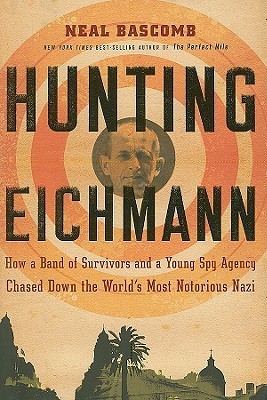
"Hunting Eichmann" is the first complete narrative of a relentless and harrowing international manhunt.
When the Allies stormed Berlin in the last days of the Third Reich, Adolf Eichmann shed his SS uniform and vanished. Following his escape from two American POW camps, his retreat into the mountains and out of Europe, and his path to an anonymous life in Buenos Aires, his pursuers are a bulldog West German prosecutor, a blind Argentinean Jew and his beautiful daughter, and a budding, ragtag spy agency called the Mossad, whose operatives have their own scores to settle (and whose rare surveillance photographs are published here for the first time). The capture of Eichmann and the efforts by Israeli agents to secret him out of Argentina to stand trial is the stunning conclusion to this thrilling historical account, told with the kind of pulse-pounding detail that rivals anything you'd find in great spy fiction.
Neal Bascomb is a national award-winning and New York Times bestselling author of a number of books, all non-fiction narratives, all focused on inspiring stories of adventure or achievement. His work has been translated into over 18 languages, featured in several documentaries, and optioned for major film and television projects.
Born in Colorado and raised in St. Louis, he is the product of public school and lots of time playing hockey. He earned a double degree in Economics and English Literature at Miami University (Ohio), lived in Europe for several years as a journalist (London, Dublin, and Paris), and worked as an editor at St. Martin’s Press (New York). In 2000, he started writing books full time.
His first book HIGHER was selected for the Barnes and Noble Discover Great New Writer award and was featured in a History Channel documentary. His second THE PERFECT MILE was a New York Times bestseller and frequently ranks as one of the top books on running. His third RED MUTINY won the United States Maritime Literature Award and critical acclaim around the world. His fourth HUNTING EICHMANN was an international bestseller and led to a young adult edition called NAZI HUNTERS that was the 2014 winner of the YALSA Award, Sydney Taylor Book Award (Gold Medal), among numerous others. His fifth book THE NEW COOL was optioned by major producer Scott Rudin for film. His sixth ONE MORE STEP, focused on the first man with cerebral palsy to climb Kilimanjaro and finish the Kona Ironman, was a New York Times bestseller as well.
An avid hiker, skier, and coffee drinker, he is happily settled in Seattle, Washington with his family.
“Justice should not only be done, but should manifestly and undoubtedly be seen to be done.” —Lord Chief Justice Gordon Hewart
They searched for him and they found him; they captured him and they smuggled him out of Argentina to Israel, where he was fairly tried and found guilty of organizing the mass deportations and execution of millions of Jews. Until 1960, Eichmann had evaded capture by escaping to Argentina and living under a false name with his family. If you saw him going humbly about his daily life, you wouldn’t have been able to picture him in SS uniform, masterminding and as he put it, following orders to murder millions of innocent souls.
It was the vigilance and perseverance of the Mossad and a team of Holocaust survivors, that led to Eichmann’s detection and capture. This was one satisfying manhunt and an extraordinary achievement in the history of justice and comeuppance.
Part of Attorney General Gideon Hausner’s opening speech at Eichmann’s trial: “When I stand before you here, Judges of Israel, to lead the Prosecution of Adolf Eichmann, I am not standing alone. With me are six million accusers. But they cannot rise to their feet and point an accusing finger towards him who sits in the dock and cry: "I accuse." For their ashes are piled up on the hills of Auschwitz and the fields of Treblinka and are strewn in the forests of Poland. Their graves are scattered throughout the length and breadth of Europe. Their blood cries out, but their voice is not heard. Therefore I will be their spokesman.”
I’ve always had a soft spot in my heart for Israel and love that country dearly. When my husband and I were newlyweds almost 20 years ago, we were channel surfing one night and saw a fabulous documentary on how Eichmann was found and brought to justice. I think it was the first time I really paid any attention to the story.
It was only recently that I heard about this book and I’m so glad that I did. It’s truly well-written and thoroughly researched. Even though I knew how it would all end, I was thinking about the book pretty much during most of my non-reading time, always a sign of a good book for me!
This account of General Eisenhower and General Patton seeing the German atrocities for the first time is one that I will always remember. I’d read it another book also. “Despite the intelligence reports General Eisenhower had read on the German atrocities, he found himself completely unprepared for Ohrdurf. Guided by former inmates, he and his staff saw men in the hospital who had been brutally tortured and were starving, lying shoulder to shoulder, expecting nothing more than death to arrive. In a basement, he saw a gallows where prisoners had been hung by piano wire long enough that their toes touched the floor, delaying death but prolonging the agony that preceded it. In one of the yards, he saw some 40 corpses, riddled with lice, stacked in rows. In an adjoining field, he saw 3,200 more corpses, many with gunshot wounds to the back of the head, next to a pyre of wood clearly intended to destroy all traces of their existence. General Omar Bradley, who accompanied Eisenhower, could not even speak; the hard-nosed General George Patton vomited against a wall. As he left Ohrdurf, Eisenhower told his officers, ‘I want every American unit not actually in the front lines to see this place. We are told that the American soldier does not know what he is fighting for. Now, at least, he will know what he is fighting against.’ Once back at headquarters, the shaken supreme commander sent messages to Washington and London demanding that legislators and newspaper reporters come to Ohrdurf. He wanted these crimes documented.”
One of my favorite quotes: “We will bring Adolf Eichmann to Jerusalem,” Harel said, striking the table, “and perhaps the world will be reminded of its responsibilities. It will be recognized that, as a people, we never forgot. Our memory reaches back through recorded history. The memory book lies open, and the hand still writes.”
We will bring Adolf Eichmann to Jerusalem. It will be recognized that as a people, we will never forget. Our memory reaches back through recorded history. The memory book lies open, and the hand still writes. Isser Harel, Head of the Mossad
This quote was uttered as the Israeli Secret Service (Mossad) began it's journey to Buenos Aires to capture one of the worst Nazi war criminals, Adolf Eichmann, and smuggle him to Israel to stand trial for the horrors he committed during WWII.
It had taken 15 years for Eichmann to be traced to Argentina, a country which was sheltering many Nazis who had escaped justice. Eichmann had been captured twice at the end of the war but had escaped, hid out in the mountains, slipped out of Europe on the ratlines, and was living a low-key and anonymous life in Buenos Aires.
The Mossad had received many tips about his location and finally identified him. And thus begins a hour-by-hour account of the complicated plans to capture him. All of the Mossad agents involved had either been in the death camps or had lost their families in the Holocaust; many of them wanted to kill Eichmann outright but the Prime Minister of Israel, David ben Gurion, forbade it.
The book also covers the trial which is one of the 20th century's most important. This is an outstanding history which almost reads like spy fiction but the author drew on new information and interviews, classified documents and meticulous research. I was enthralled with every page and most highly recommend it. It is a true masterpiece.
This was a great book and worth reading whether you know the story of Eichman or not. To me, it is an example of persistent righteousness in the search for justice. Well written, it reads like a thriller. Despite this, it opens many debates on man's meaning in the world.
The title helpfully explains what this is about. Neal Bascomb does a pretty good job of turning Mossad’s hunt and capture of Eichmann into a pacy thriller. It’s not as smoothly written as a good novel, nor with as much depth as the best non-fiction, but it’s a decent compromise which succeeds because it’s just such a compelling story.
To sum it all up, I must say that I regret nothing. Last words of Adolf Eichmann, the architect of the Final Solution.
This book gives a detailed account on how the Mossad managed to capture and flew one of the most notorious SS criminals out of Argentina. Its subsequent process was a milestone in the history of the Shoah - for the first time the World and the Israeli youth was confronted with the Holocaust.
His involvement in the Final Solution started with his attendance at the Wannsee conference, where the Final Solution (die Endlosung) was discussed. There he prepared the briefings and a country-by-country breakdown of the 11 million Jews targeted for extermination. He was entrusted with coordinating all matters related to the Final Solution.
When the war was over, Eichmann managed to escape. This was partly possible because the Allied Central Registry of War Criminals and Security Suspects (CROWCASS), which managed a list of 70.000 possible war criminals, had not yet identified Adolf Eichmann as a major war criminal. The Allies had yet to learn the degree of his involvement in the Final Solution. It was Tuviah Friedman and Simon Wiesenthal, two Jewish nazi hunters, who laboured night and day to gather survivor testimonials and any evidence that they could find against Eichmann. Their work would lay bare the part that EIchmann had played in the genocide.
The start of the Cold War drained the will and resources of the Allies from pursuing war criminals. It was up to Friedman and Wiesenthal to keep the hunt alive.
Eichmann in the meantime managed to escape to South America and with the help of a former nazi network and the Vatican, reached Argentina where he was welcomed with open arms. Under his new name Ricardo Klement he was ready to live his new life. Later he was joined by his wife and three sons.
It was Wiesenthal who received the first tip that Eichmann was living in Argentina. He approached the Israeli consul, but was told that the Israelis would need more information about Eichmann’s location before engaging in an investigation. He also approached the CIA who responded that they were not in the business of apprehending war criminals.
It was one of his sons, Nick Eichmann, who started the chain of events which would end up in the capture of Eichmann. Nick befriended and dated the daughter of Lothar Hermann, a German who migrated to Argentina before the start of the Second World War. Given the comments that Nick had made about his father’s service and the Jews, Lothar was sure he was Eichmann’s son. Unbeknownst to Nick Eichmann, Lothar Hermann was half Jewish, a fact that he had kept hidden for the German community.
Hermann decided to write a letter to the Frankfurt prosecutors for the West-German nazi trials, which he had read in the paper. The letter ended up at the desk of Fritz Bauer. After reading the letter, Bauer realised that he had in his hands a solid tip as to the location of one of the architects of the Final Solution.
Fritz Bauer requested Interpol to start a search for Eichman, however he was turned down. He also knew that the West-German government would not act. Instead he decided to contact Isser Harel, chief of the Mossad who sent Shaul Darom, to sit with Fritz Bauer. He convinced Isser Harel that the tip seemed solid enough to warrant follow up. However, after some investigation, they were initially convinced that Hermann had the wrong guy and the hunt for Eichmann had come to a halt.
However, when Hermann read a news article claiming that Eichmann was living in Kuwait, he decided to contact again. This time he contacted Friedmann, which directed the information back to the Mossad.
This resulted in the same tip from two independent sources (Fritz Bauer had never disclosed the identity of Lothar Hermann to the Mossad) mentioning the assumed name of Eichmann twice: Ricardo Klement.
It was now that the Israeli’s decided to act. With the approval of Ben-Gurion, they decided to send a Mossad agent, David Aharoni, to further investigate. After some investigation they concluded without any doubt that Richard Klement was in fact Adolf Eichmann.
Aharoni now decided to setup a plan to capture Eichmann and transport him back to Israel. They needed to capture Eichmann alive, without being seen or followed. Then they would have to keep him in a secure location, avoiding detection, for an indeterminate period of time, until the plans for the third part of the mission fell into place — smuggling Eichmann out of Argentina in complete secrecy.
Luckily, an El Al plane was scheduled to land at Argentina for some festivities. This was their chance to smuggle Eichmann out of the country. They also wanted to capture Eichmann as soon as possible, to prevent him from becoming suspicious and fleeing the country. This date for capture was set on May 10, while the plane was scheduled to leave at May 19. This meant that they had to capture and hide Eichmann for a total of 9 days.
Om May 10 they captured Eichmann, outside his house while he was walking back from work. He was taken back to a safe house, where they had to keep him while waiting for the plane to leave.
In the meantime, his wife Vera Eichmann expected the worse: what she had always feared: that those from whom he was running had finally caught up with him. A search by his two sons around Garibaldi Street uncovered Eichmann’s broken glasses, pressed into the mud in the ditch. There was no question now. He had been taken.
They decided to act and ask the German community for help But already it was becoming clear to them that they could not depend on the German community for help. No one of their father’s associates wanted nothing to do with them. As for the police, the two brothers could not get their help without revealing their father’s true identity, which might place him in even more danger than he was already in.
In the meantime, thanks to the efficient and good preparations, Eichmann was flown out of the country and ready to stand trial in Israel. The trial made the world conscious of the evil that was undertaken to the Jewish people. This consciousness, in Israel and throughout the world, is the enduring legacy of the operation to capture Adolf Eichmann.
You may or may not care for the writing style in this book, but history is history and Bascombe has given an honest retelling of Eichmann's escape to S.America and his ultimate capture. If you value truth this book is worth your time to read it. For further information Eichmann's trial was televised from Israel and can be found for viewing on the Internet. If you can stomach looking at the man/monster - go for it.
One very good and fast paced book, even though you know the outcome, the author does a fine job of creating tension. Once wheels were up, I breathed a sigh of relief.. A remarkable book..
Non-fiction about the capture of Adolph Eichmann, the notorious Nazi responsible for transportation of millions of Jews to the death camps during WWII. This book traces the Israeli Mossad’s efforts to locate Eichmann and bring him to justice. Although I knew the basics of the story, I had no idea of the complexity of the task. I was impressed at the author’s ability to maintain a thread of tension and suspense, especially since the outcome is already known. The author also kept the story tightly leashed. It would have been easy to range far afield, since he had to cover enough of Eichmann’s early years, his rise to power in the Nazi SS, and how he escaped after the end of the war. I found it fast-paced and riveting. It reads like a mystery or thriller. The writing is journalistic in style: straight-forward and easily followed. Content includes descriptions of Holocaust atrocities and violence. Recommended to those interested in WWII history, the Holocaust, international espionage, or war crimes.
I don't read nearly as much nonfiction as I would like, but this book just appeared by pure happenstance and sounded too interesting not to check out. As it turns out I'd read a lot more nonfiction, if more nonfiction books were like this. Meticulously researched (notes and the bibliography list goes on and on), terrifically told with all the dynamic pacing and heart pumping excitement and suspense of the best of thrillers, but made so much more interesting and compelling by the fact that it actually happened, this account of hunting down, capturing and bringing to justice the Nazi war criminal responsible for countless torture and death of European Jewish population during World War II (the infamous Final Solution) was an absolutely amazing read. Nowadays everyone's imaginations have been made callous by the unrealistic Hollywood movies where things are all way too easy and are usually handled by a single able bodied unbelievably photogenic action star, but this was an actual step by step account of the logistics and practical realities behind the capture. Absolutely fascinating. And these incredibly dangerous risky plans were executed by sometimes by trained and sometimes by ordinary men and women of extraordinary courage. The author did a great job of really bringing these exceptional human beings to life on the pages, showing their motivations, fears and bravery. Bascomb also excelled at fleshing out Eichmann, who was as close to human evil as it gets, remorseless, pathetic and scary all at the same time. Eichmann's trial and execution had an enormous significance in bringing light to the atrocities of Holocaust, now this book brings to light the heroic efforts behind capturing the man. Edmund Burke said that The only thing necessary for the triumph of evil is for good men to do nothing. This is a story of good men doing something to prevent the triumph of evil, this is how things ought to be. I read this book in one day, it was tough to put down and the ending brought tears to my eyes. It was horrifying at times (even to a seasoned horror genre reader), educational, moving, inspirational even. What more could one ask of a book. Highly recommended.
5.0 Stars Hunting Eichmann, by Neil Bascomb, contains a detailed account of notorious Nazi Adolf Eichmann’s life; from his activities with the SS during WWII and involvement with The Final Solution, thru his postwar paperback thriller-like escape from Germany and his residence and activities in Argentina, and finally, to his capture by Mossad in 1960, his trial & appeals, and his execution in 1962.
Neil Bascomb is a tremendous writer, keeping the narrative moving along, compelling, and fresh. No detail was spared, but at the same time, the book did not get bogged down in irrelevant analyses or philosophical discussion. Thru this well researched volume we learn a lot, not only about Adolf Eichmann, but also about the men who pursued him for well over a decade, determined to bring him to justice for his substantial role in the Holocaust and the extermination of 6 million Jews.
At times horrific, at times as exciting as any spy novel, and at times inspirational, I highly recommend this book to anyone interested in WWII and the Holocaust.
Hunting Eichmann is an edge of the seat tense adventure story, and made all the more exciting when you realize that this is a true account of the life and eventual death of a notorious nazi killer. There is no more greater satisfaction than seeing someone of great evil being made to pay for his crimes and few people in history have been guilty of more crimes than Adolf Eichmann. He was the operational manager of the genocide that saw the dispatch and murder of some six million jews during the second world war. In style and content this is a very easy book to read, absorb and accept, at no time are you bombarded with heavy historical facts that could detract from the readability and boys own story telling of the book. Eichmann escaped from Germany at the end of the war and soon made his way to Argentina where he lived in relative obscurity for a number of years. His wife and sons joined him at a later date and the family were always blind to criticism aimed at Eichmann. For such an evil man Adolf Eichmann presented as an unassuming figure, there is no doubt that part of this was due to the fact that he wished to blend into his new surroundings and not draw attention to this evil past. But he had a price on his head and a team of Mossad agents, when they confirmed that it was indeed Eichmann living in Buenos Aires, masterminded a simple yet ingenious plot to "grab" Eichmann, keep him hostage and then disguised as an El Al official smuggle him on board an Israeli jet bound for Tel Aviv. You can feel the tension from the moment Eichmann is taken and during his long flight back to receive the justice he so richly deserved, the journey home was filled with danger and the flight arrived in Tel Aviv with just moments of fuel to spare...Phew!!! This is a book that deserves to be read by anyone who has a passing interest in the fate of Hitler's most ardent and fanatical supporters...or indeed if you just love a good, exciting and truthful adventure story, you will not be disappointed and indeed may give a little cheer when the El Al flight crew arrive safely with their precious cargo in Tel Aviv...read enjoy and be thankful this genocidal murderer was brought to justice
I haven't read Tom Clancy, so I don't know if the blurb on the back cover is correct.
I wouldn't describe the book as a thriller, though the story is told very well. It makes a good companion piece to the essay in The Norton Reader: An Anthology of Nonfiction written by one of the "hunters". Bascomb doesn't waste words and doesn't waste description. He also is kind enough to presume that his reader has basic background knowledge, so he doesn't give unneeded explanations. Outside of the hunt for Eichmann what is also engrossing is the development of the intelligence agency.
This is an excellent true story that's a gripping read that you can't hardly put down. Author Neal Bascomb tells the story of Adolf Eichmann, who was the operational commander of the Holocaust. "Hunting Eichamnn" tells the incredible story of how Eichmann fled Europe in 1945 and was ultimately brought to justice in 1961.
The reader knows the ultimate outcome of the story at the beginning--Eichmann is captured. But the tale on how it came to be is so incredible as to a great case of "truth is stranger than fiction." Bascomb tells of all the little details that the capture team had to take care of. Every contingency was anticipated and planned for: where they were going to snatch Eichmann, how would they subdue him, what if the car was followed by the police, and so on.
The first part of the book tells of the life and career of Adolf Eichmann and how he came to be the world's most wanted Nazi war criminal. Eichmann was the operational commander of the Holocaust, meaning he handled the day to day decisions in the Nazi program of death. He was guilty as guilty gets. Eichmann could not later claim he "didn't know what was going on" because it was his job to take care of rounding up and transporting Jews to the death camps.
The second part of the book tells of Eichmann's escape from Europe, how he did it, what help he received, and where he ended up in South America. Bascomb tells of Eichmann's life there, along side with the progress of his case in Europe. The man players of who was looking for Eichmann and why are detailed.
The third part of the book details of how Eichmann was found, how he was located in Argentina. As described above, Bascomb writes with great detail of all the little details that had to anticipated and planned for to successfully capture Eichmann. One of the major problems was his pursuers didn't have a good photograph of him. Eichmann was a clever man.
The book was not on the New York Times Bestseller list for some odd reason. I found it to be an excellent and gripping book everyone would enjoy. And if you like it for the bad guy to get it in the end, you'll like this book. Because they was no one more evil than Eichmann.
Very enjoyable book which had a relatively sluggish middle. It outlined Eichmann's life and role in the Holocaust, as well as giving perspectives from multiple individuals who who directly involved in trying to find him (Who also usually had family who perished in the holocaust themselves). Of course, I don't really need to say what this book is about (As it's in the title), but I will say I enjoyed the operational aspect of the book, where they were giving duel aspects; one was the gathering of evidence as to the whereabouts of Eichmann, the second being what was occurring in his life the whole time, so you got to follow both groups of individuals.
An account of the journey to bring Adolf Eichmann to justice that is both emotionally tender to his victims and clinically focused on facts, methods, and the legal/diolomatic quagmire. I was obsessed with every word.
Adolf Eichmann was the model for Hannah Arendt's banality of evil. Kafka could not have written a more bloodless bureaucrat than Eichmann - the Chief Operating Officer of the Final Solution. Although he was manifestly responsible for the deaths of 6 million or more Jews, Communists, prisoners of war, Gypsies, political dissidents, homosexuals, mentally retarded people, and anyone else who had the misfortune to be caught in the wheels of the Nazi system, he never accepted responsibility. He was just following orders. "I never killed anyone ... I was involved in collection and transport."
Hunting Eichmann tells the story of the 15-year hunt for Adolf Eichmann after the War ended. Eichmann had been last seen in Hungary, overseeing the systematic murder of over 430,000 Hungarians before fleeing the country in 1945. Captured by the Americans under a false name in 1946, Eichmann escaped them and eventually made his way to Argentina where a community of expatriate Nazis waited to welcome him.
Bascomb's book is the most comprehensive story of how Eichmann was tracked down yet written. Bascomb had access to extensive written materials all over the world that have recently become declassified. In addition, he was able to interview every major player in the story of the capture. It is clear from reading the book that the US and the Europeans were invested in ignoring the Nazis that were left unprosecuted after Nuremberg because bringing them and their stories to light would have also shed light on the number of prominent ex-Nazis working for the U.S. and various other European governments. By the time WWII ended everyone was primarily concerned with fighting Communism and looked the other way when convenient.
Had it not been for the relentless bravery of Nazi hunters like Simon Wisenthal and Tuviah Friedman the case might have gone cold, but their work along with the work of concentration camp survivors in Argentina identified and located Eichmann. The Israelis were tipped off to his location by a West German prosecutor and the capture was on. This team of a dozen Israelis - over half of whom were concentration camp survivors or who had lost their entire families to the camps - went to Argentina to pick him up. That they did so was pretty amazing. That they managed to hold him for 10 days without murdering him outright, despite how soul sucking being in his presence was, is nothing short of a miracle.
This book reads like the best fictional spy stories you've ever read. The history is fascinating and the writing is gripping. I'm not sure that I enjoyed this, but it was well worth reading.
I rarely rate nonfiction five stars ("What a classic" on my personal rating scale), but Hunting Eichmann deserves this highest accolade in every way.
1. The importance of the subject. Six million people were murdered in Europe during World War II by the German government, under the leadership and direction of Adolf Hitler, at the administrative hand of Adolf Eichmann who crafted and carried out the Final Solution. Multiplying adjectives such as Jewish, refugees, deportees, old, young, infirm, incompetent, all, while in some cases accurate, detract from the bare statement of fact: six million people were murdered in Europe during World War II by the German government, under the leadership and direction of Adolf Hitler, at the administrative hand of Adolf Eichmann who crafted and carried out the Final Solution.
2. The impact of the story. No matter how it is told, Eichmann's escape from Allied camps in the chaotic early post-war days in Germany, his clandestine survival in Europe and then Argentina for 15 more years, his capture and deportation to Israel, and finally his trial and execution, is an amazing story. In Bascomb's hand, it cracks like the best John Le Carre spy novel, only stronger in its impact because of its truth. I was struck by the ability to so easily disappear in a world before surveillance cameras, cell phones, GPS devices, high-resolution satellite photos, long range detection devices, and computer information tracking and matching systems. Conversely, it is also hard to imagine a covert intelligence operation in a foreign country with so many agents going undetected in today's world with all those technologies.
3. The intelligence of the storyteller. Bascomb writes with a spare prose that doesn't distract from the subject or the story. He seldom reaches for lofty wording that diminishes the bare authenticity of the story. His footnotes provide documentation for his occasional third-person omniscient constructions ("He thought that . . . " or "He wished that . . . "). This quality of writing and level of attention to detail is sadly missing too often in today's nonfiction.
Finally, the persistence and planning of the Israeli operatives, driven by their holy burning motivation, is a lesson we must remember in our post-modern world where nothing matters. We may think we live in the world John Lennon "Imagined"--no Heaven, no Hell, nothing worth dieing for, and only today to live for--but we're wrong. Hunting Eichmann is a demonstration of the existence of God and the reach of His justice carried out by the best of men for the best of reasons.
An intense tale of the quest to bring Adolf Eichmann, the operational manager of the Final Solution, to justice.
Made me think of what a great thing it is that Christ will bring the world to justice. All oppressors will be justly dealt with; all innocent suffers will be vindicated.
Contains a powerful quote from Robert Jackson, the lead American prosecutor at the Nuremberg trial. In his opening statement he said:
The privilege of opening the first trial in history for crimes against the peace of the world imposes a grave responsibility. The wrongs, which we seek to condemn and punish, have been so calculated, so malignant, and so devastating, that civilization cannot tolerate their being ignored, because it cannot survive their being repeated. That four great nations, flushed with victory and stung with injury, stay the hand of vengeance and voluntarily submit their captive enemies to the judgment of the law is one of the most significant tributes that power has ever paid to reason.
This is the story of Adolph Eichmann, his raise to power in Nazi Germany, his escape from Europe and his capture 15 years later by Mossad (Israel's Spy agency).
This book read like a thriller. Even though you know the eventual outcome, Bascomb keeps you alert and engaged. Although Eichmann, of course, is the thrust of the story Bascomb covers the birth of Israel's spy network and so much more. His research was excellent and weaved together a well told story, well written book. I especially liked the stories of the men who took part in the take down of this disgusting criminal. Many of them had lost entire families in the Holocaust, and although the subject matter was not easy, there were moments when I felt pure joy for these men. They were unsung heroes who deserve to be remembered.
This was real. No doubt for all the Jewish people who were persecuted , killed , and or exterminated during WWII , capturing Adolf Eichmann symbolized a loud roar of their extinguished voices.
And for those who survived, a closing painful chapter of their identities.
From the very first page to the last page its not only gripping but it also reads like a spy thriller novel. The Israeli Secret Service and its divisions are no joke! Master at what they do, forced by their determination to protect the State of Israel, and to never allow the Jewish suffering anymore.
De schrijver heeft overal aan gedacht, maar daardoor is het boek wel langdradig en gevuld met (in mijn ogen) onnodige details. Foto’s zouden het beter hebben gemaakt. Ook stonden er veel drukfouten in mijn editie. Wel een indrukwekkend verhaal.
Years ago I read a brief description of the operation to kidnap Eichmann and bring him to Israel. With the release of this book I thought I'd take a deeper interest in what happened, how the operation was organized, and the background to the entire event. In the end I think this book delivers. Although the research is there, the book lacks in the usual endnote citations a scholarly work includes. Rather you can follow page numbers in the back and try to see which few words, designating the beginning of a sentence, are followed by a source, which is where the information in that sentence, and perhaps what follows, comes from. This is a bit annoying at times, but better than no endnotes at all.
Bascomb's impressive research is matched by a writing style that makes this narrative read more like a novel than a work of non-fiction. Although we already know the basic details about Eichmann's kidnapping, we are still on the edge of our seats as the author skillfully and suspensefully describes the false starts, glitches, close calls, political complications, subterfuge, and intricate logistics that made this operation so perilous. If any members of the Israeli team were to be captured on Argentinean soil, not only might Eichmann escape, but their failed effort would undoubtedly cause an embarrassing international incident, and the image of the Israeli government would suffer irreparable damage. There was a huge amount at stake, and failure simply was not an option.
There is so much to praise in this book: the effortless, precise, and understated prose; the striking photos showing Eichmann in his youth and shortly before his execution; the ways in which Bascomb places this monumental event in historical and cultural context; and the impressive footnotes, bibliography, and index. Eichmann's trial, with its extensive testimony and documentation about the Final Solution, educated Israeli youth about the tragedy of the Jewish annihilation at the hands of the Nazis. Furthermore, it "rooted the Holocaust in the collective cultural consciousness." The trial "stirred a debate" that led to an "outpouring of survivor memoirs, scholarly works, plays, novels, [and] documentaries" that continues to this day.
Also noteworthy is Bascomb's depiction of Eichmann's twisted personality and delusional thinking. In addition, the author takes the time to explore the backgrounds, traumatic memories, and ultimately, the pride mixed with terror of each Israeli who took part in the abduction and its aftermath. As Isser Harel, the head of the Mossad, tells his men: "You were chosen by destiny to guarantee that one of the worst criminals of all time, who for years has succeeded in evading justice, would be made to stand trial." At last, the Jews had the opportunity to judge their killers. "Hunting Eichmann" is an eye-opening and detailed look at an important chapter in the history of genocide.
What I really appreciated about this text is the fact that you see these Mossad agents for who they are, not supermen, but ordinary human beings with a past (a past that the majority inherited from the Holocaust) and in their humanity can easily complicate any and every perfectly created plan. From beginning to end this was an operation that with one false step could send the entire mission off course with repercussions none could predict for certain; luck, detective work, and a superior work ethic is what made the difference. Also, I found it interesting, and at the same time horrifying, that such a person like Eichmann can exist. To be so entrenched in one's beliefs and removed from his actions is simply beyond reason. Then again, he had fifteen years to convince himself that what he did was simply to follow orders, even if those orders came from a genocidal authoritarian regime. That Mossad agents were able to be around him and come face-to-face with one of Hitler's most ruthlessly efficient bureaucrats is hard to fathom; that they could restrain themselves from doing violence to him after having first hand knowledge of what went on during the Holocaust and the suffering he caused, is commendable. A recommended book that brings a lot of literature, interviews, and primary sources together on the subject.
In 1960 my mother was asked to go back to the Memphis area from NC by her former boss Mr. Herzog. He wanted her to run his business while he and his wife went to Isreal for Eichmann 's trial. I was nine years old at the time and had no knowledge of WWII and the Holocaust. My mother said the Herzog family went to spit on Eichmann because all of their families had been killed in the camps. I couldn't understand why that was so important. It started me on a lifetime of reading all I could on the war and the people affected by a regime that wanted to run the world and be populated only with people they approved of. This story of the hunt and capture of a war criminal filled in years that dedicated agents and civilians gave of themselves to seek justice in a lawful manner. I only wish I had been old enough and aware enough to have talked to the Herzog's about their feelings at the trial when a guilty verdict was given. I think of them every time I read anything about the Holocaust and hope they felt some sense of justice for their fathers and mothers and siblings and their extended families. I hope everyone got a bit of peace and relief in bringing a killer to justice. It is unimaginable that there are people that are willing and able to do horrible things to their fellow human beings. The perseverance of the Israelis is the heart of this story. Knowledge is the power to never let this happen again.
Hunting Eichmann is three books in one. It starts out as a escape story, telling how Eichmann, one of the prime movers of the holocaust, evaded capture, hid his identity, escaped a POW camp, and was able to flee across the Alps and eventually to Argentina with a network of Nazi sympathizers helping him every step of the way. It’s also a great heist story (the heisted item being Eichmann himself), and shows the reader how a courageous group of Mossad agents, some of whom were holocaust survivors and all of whom were deeply impacted by the holocaust, tracked this monster down, snatched him off the street and then spirited him to Israel (international relations with Argentina be damned). And finally, it is also a tiny bit of a legal thriller showing how Eichmann was brought to justice by the people he had tried to exterminate, and how the Jews used the trial to educate the world about the Final Solution.
I loved this book. I found it to be absolutely unputdownable. It’s as gripping as a well written thriller, but more satisfying because the story is true. I’d heard about the kidnapping (and it WAS a kidnapping, what the Mossad did was certainly morally correct, but it was also illegal under Argentine law) of Eichmann before, of course, and knew how things would turn out, but Neal Bascomb kept me on the edge of my seat anyway. The man knows how to tell a thrilling story.
I abandoned the book at first. Perhaps I dislike prologues. Maybe Bascomb did a poor job of yanking me in; maybe I was tired of pleasure.
When I tried again I sat up almost all night and found it - as many other reviewers have - as good as a NYT bestselling thriller.
I marvelled at the sheer chutzpah of wanting to steal such a man. I felt blunted by the banality of his evil (Hannah Arendt). I was lifted by the moments in which it seemed like a Godly hand guided their enterprise while a dark one frustrated it (Vera's nightmare).
I was surprised at the mix of loathing and empathy I felt for Eichmann as fate eventually fell on him.
I was appalled to learn how at least one agency in postwar Germany knew where Eichmann was but failed to act for fear of embarassing Adenauer and the Nazis in his administration.
Yes it's a book about Eichmann, but to me it's a story about the human condition.
This entire review has been hidden because of spoilers.
A non-fiction thriller, this book tells the story of the capture of Adoph Eichmann, one of the most notorius Nazi war criminals, by the Isreali secret service. The details of the planning and actual capture of Eichmann are much like the details of the planning and execution of plans by Gabriel Allon and his team in the Daniel DeSilva novels and just as tension filled. In addition to the planning and actual capture, attention is also given to Eichmann -- how he got to be responsible for carrying out the Final Solution and how he evaded capture post-war and escaped to Argentina. Overall a great read if you are interested in the politics of WWII, the holocast, and the aftermaths. Once started, I could not put it down and everything else went on hold.
I could not stop reading this. I had this as an audiobook, narrated by Paul Hecht. Wow! I lost sleep over this book, but then would wake up early and backtrack a bit. Nail biting suspence. This was like watching an action movie. From beginning to end this book moves at breakneck pace. It helped that I didn't know much about Adolf Eichmann, or how he was apprehended. I didn't have any idea how the story ended. (I basically knew he was in Argentina, and they got him). This was the best book I've read all year. Perfect title since most of the book is about the hunt for Eichmann. The only complaint I have is that it could have been longer. More biographical information would have been great, but the title says it all; Hunting Eichmann. I give this book six stars.