Cora Sandel was the pen name of Sara Cecilia Görvell Fabricius, a Norwegian writer and painter who lived most of her life abroad. Her most famous works are the novels now known as the Alberta Trilogy.
Sara Cecilia Görvell Fabricius was born in Kristiania (now Oslo). Her parents were Jens Schow Fabricius (1839–1910) and Anna Margareta Greger (1858–1903). When she was 12 years old, financial difficulties forced her family to move to Tromsø where her father was appointed a naval commander. She started painting under the tutelage of Harriet Backer, and while still a teenager moved to Paris, where she married the Swedish sculptor Anders Jönsson (1883–1965). In 1921 they returned to Sweden, where she won custody of her son Erik after divorcing Jönsson.
In her youth she tried, without much success, to establish herself as a painter. And it wasn't until she was 46 years old that her debut novel, Alberte and Jakob was published, the first in what became the semi-autobiographical Alberta trilogy. Sandel used many elements from her own life and experiences in her stories, which often centre on the spiritual struggles of inarticulate and isolated women. The Alberta trilogy traced the emotional development of a lethargic and unhappy girl into a self-sufficient woman. These novels earned her an immediate place in the Scandinavian canon, but it was not until the 1960s that Sandel, now living as a recluse in Sweden, was discovered by the English-speaking world.
Despite her great literary success, she remained hidden behind her pseudonym and lived a rather secluded life. She was decorated with the Royal Norwegian Order of St. Olav in 1957. Her home in Tromsø, built in 1838, now houses the Perspektivet Museum.
This reminds me of a Virginia Woolf book. Minimal dialog and introspection. (How am I the first person to review this book on GR?)
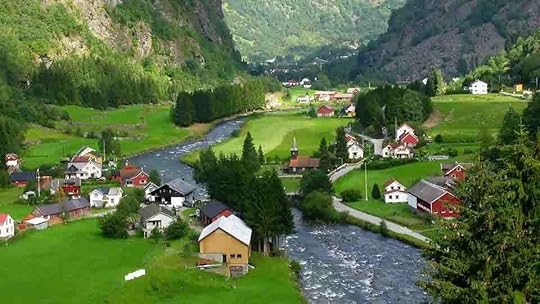
It’s set in far northern coastal Norway in a small town on a fjord. Set in the 1950’s, it’s translated from the Norwegian, and the recent WW II’s shadow touches the story in several ways.
The bulk of the book occurs over a couple of days. It leads up to a showdown between a mother and the daughter-in-law from hell. (Actually the “mother” is an unmarried aunt; the real mother and father died in a boating accident years ago and the aunt raised the two boys, now in their thirties and forties.) Only the younger brother married. The showdown pits the aunt, the older brother and the grandmother, who have had it with the spineless younger son and the two kids, against the daughter-in-law.
The younger son, the one married to the daughter-in-law, is an author of sorts, and to an extent a good part of the book is about his being, or trying to be, a writer. It’s the only occupation he can think of and yet he hates it. He gets writers block, poor reviews, fritters months away with no progress. He had one book published which sold a few copies but that’s it. His mother even provides a cottage for him to get away from the hubbub and write.
Never were two characters more opposite. The aunt is self-sacrificing, proper, and tolerant; never says a word. She is basically supporting the whole family by providing the home and meals and everything for the kids. She and the grandma have no friends as they agree “it’s best not to make acquaintances.” The daughter-in-law is selfish, a lousy mother, lazy, scheming, controlling, a hypochondriac and a drug-addict (“sleeping powders” in those days). The two children are budding juvenile delinquents. Now the money is running out leading us to the showdown and to the conclusion, surprising in several ways.
The physical environment looms large in the story (shades of The Shipping News). There is the short Norwegian summer; boating in sunlight at midnight; the importance of having a house site that gets at least some sun rather than total shade, because the sun is blocked by the mountains. There are a lot of references to the cultural divide in Norway between the hardscrabble northerners and the cosmopolitan big-city southerners (Oslo).
All in all, an excellent read. Sandel (1880-1974) is best known for her “Alberta Trilogy.” I have not read it but according to the blurbs, it has been called “one of the most complete portrayals of a woman’s life that exist in modern fiction.”
I chose to purchase Cora Sandel's The Leech for my Reading the World project, as she is an author whom has been on my radar for an awfully long time, but whose books appear to be few and far between. I had originally thought that I would start with the Alberta trilogy which Sandel is arguably most famous for, but The Leech was the most easily available of her books to me through Abebooks, and so I plumped for it as what I hoped would be a good introduction to her work. The only other person who has reviewed it on Goodreads also compared it to Virginia Woolf, so of course it was almost inevitable that I was going to begin with this one.
The Leech was first published in Norway in 1958, and in the United Kingdom two years later. This particular translation has been wonderfully rendered by Elizabeth Rakkan, and printed by The Women's Press. Interestingly, we do not meet the woman, Dondi, whom the story revolves around until almost the end of the work. She is relatively young, and left her home in southern Norway to head to a small town within the Arctic Circle in order to marry. The Leech begins ten years after Dondi's decision has been made, and things have not turned out quite as she was expecting them to. Her writer husband, Gregor, is less than famous, her twin children Bella and Beppo are rebellious, and she is 'miserable to the point of hysteria'. Added to this, Gregor's extended family see Dondi as the reason why he has not quite realised his full potential as a writer; they believe that she has sapped his talent pool dry.
The Leech takes place over two days in Midsummer, and from the beginning, Sandel sets the scene perfectly: 'The veranda doors were open to the radiant North Norwegian summer: a summer which heaps light upon light, shining and brittle, only to fade too soon'. The majority of the prose takes place within conversations; it opens with Lagerta speaking to her grandmother, who is berating everything modern, from jazz music to motorcycles. She is grimly comic and belligerent, most fulfilled when she has something to complain about, and somebody to argue her points against. She is shrewd, and notices everything, telling her granddaughter the following in the opening passage: '"But you Lagerta, are over-nervous, my dear. You must have something in your hands all the time. You can't rest any more, don't think I haven't noticed it. One can simply get too tired."'
Gregor's brother, Jonas, acts with his aunt Lagerta and his great-grandmother as a voice of reason in the novel. We learn an awful lot about Dondi, and her relationship with Gregor, but our view of her is always through their disapproving eyes until she appears in the flesh. She has very little agency; until she is given a voice of her own, our interpretation of her is negatively biased, and when she is allowed her say, she is forever being fussed over and ordered around somewhat by those around her. Whilst Dondi is always the focus of their speech, the characters do become protagonists in the piece through Sandel's clever and effective prose techniques. Lagerta particularly describes how she has had to live through and adapt to a changing world; she is a thoroughly three-dimensional being, and the most realistic character in the book.
The geographical isolation of the family is best described by Lagerta, when she states: '"Coming up here was a violent experience... I don't know what to compare it with - being killed and slowly coming alive again. I was not myself for a while..."'. The relationships which Sandel draws are complex and interesting, and the homestead in the middle of nowhere exacerbates the fact that they have few other people for company outside of the familial base.
Sadly, and undeservedly, The Leech has fallen by the wayside. Using Goodreads as a marker, it has had only a few ratings, and one review other than mine. There is a marvellous flow to the whole thanks to Rakkan's translation. The Leech is a wonderful read, full of interesting and important points about the state of the world and a woman's place within it, and great writing. If you can get your hands on a copy, it's a book which I would certainly recommend.
this dated and extremely awkwardly translated novel about a 1950s bourgeois Norwegian family arguing over their financial affairs placed a hex on me, such that i sat there with my eyes glued to the page and read it in 2 voracious sittings
Nice and different from what ive read before. A slow-but-fastpaced family drama managing to keep it interesting throughout the whole book. Would've probably not liked it as much if it had been any longer.