This is my first Holland novel, and I am sadly underwhelmed (considering the author’s reputation and the glowing reviews of her fans). To me, Until the Sun Falls seems like the last episode in a TV series in the absence of the series itself. The reader is dropped—without benefit of preparation—in medias (or better, ultimas) res, as Psin, a Merkit Khan, sets off, with the Mongol general, Subutai and assorted others, to conquer Russia and parts west (Europe) ... in what retroactively proves to be the last expansion of the Mongol empire. And I—who have some background on the Mongols—was initially at sea (bestepped?).
This novel is absolutely not what some seem to think it is, an “introduction” to the Mongol conquest, depicting as it does its end, while barely addressing the rich history (and much culture) leading to the action’s start. Temujin was acclaimed Genghis Khan—leader of the Mongol confederation he created by diplomacy and warfare—in 1206. Until the SunFalls takes place two generations later (Batu, son of Ghenghis Khan’s oldest son, is one of the characters), sometime between the late 1230’s and 1241. All that falls between is essentially a void when the novel begins. For example, Subutai was a general under both Genghis Khan’s and his son Ogedei, directing more than twenty campaigns in which he conquered thirty-two nations and won sixty-five pitched battles, conquering more territory than any other commander in history. None of this is even hinted at in the novel; he is just another personage ... important, yet peripheral to Psin. But then, who the heck is Psin himself, the principal character, a Merkit? Who, or what, were Merkits? I could go on ... but the fact is that Until the Sun Falls is a historical novel deeply and sadly lacking in historical context.
And this novel dropped into a historical void scarcely fares better in the matter of culture ... unless you know nothing about Mongols to begin with. Yurts and kumiss are there of course (as well as other essential Mongolian etceteras) but the narrative in no way provides a dense richness of cultural detail—a fact underscored as I am currently revisiting The Once and Future King, which is wonderfully laden, however ironically, with precisely that. And the novel’s cultural poverty is echoed in the language, for Until the Sun Falls has almost no Mongolian in it, other than proper names.... Explanatory apparatus—maybe a preface and maps—would also have helped orient the reader. This novel attempts too much in too little space (an ironic contrast to the Mongolian enterprise itself).
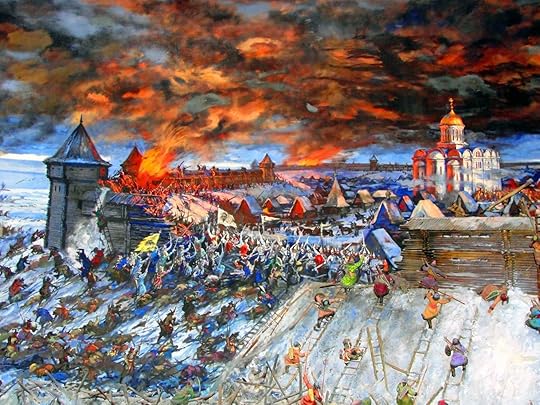
And that little space itself is weirdly chosen. Why, of all the Mongol expansion, did Holland choose the last of that conquest as her single slice of their life...? Personally, I feel that she selected this “sunset” moment (to echo the title) because at that late date—having conquered much of the world—Mongols at last pitted themselves against Europe. The unvarnished truth is, of course, that the Mongols had no more problems galloping roughshod over Russians, Poles and Hungarians than they did over anyone else, and, to her great credit, Holland makes this clear. Also, as the novel is about to end, the Mongols are setting their sights on the Holy Roman Empire, and Holland in no way makes this conquest seem impossible. On the contrary, the irresistible Mongol momentum that comprises the action of her novel underscores that possibility.... At bottom, then, Until the Sun Falls is an exercise in ‘What if? It invites us to envision the imminent conquest of Europe, and a consequent “rewriting” of all modern European history (giving the title further resonance). However, the novel ends as the Mongol forces suddenly withdraw (as historically they did), not in any way defeated, but because Ogedei, the Khan of Khans, has died in distant Karakorum, capital of the empire....
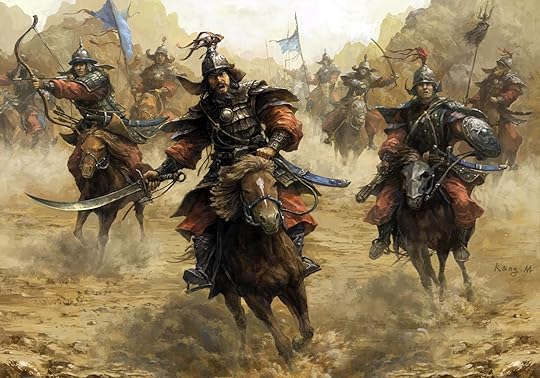
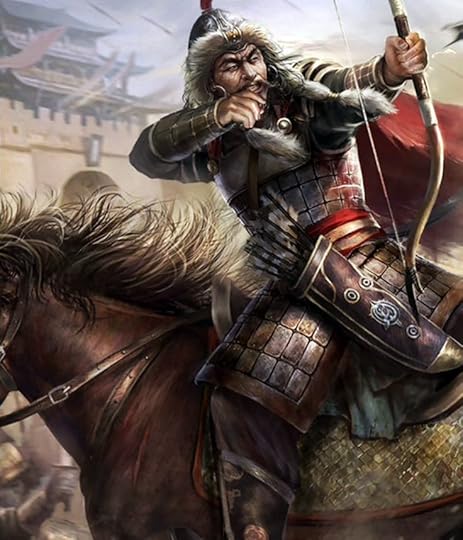
Until the Sun Falls is therefore what the French call a roman a thèse—or say, a novel with an ax to grind. And a fascinating subset of its ‘thesis’ is that at this late date in the Mongol expansion, in Holland’s own words, their “light cavalry” came up against “heavy.” This translates into the fact that Mongols, with their bows and on their hardy ponies at last fought what we (and she), call “knights,” mounted on horses huge enough to bear the weight of their own armor and the cumbrous burden of their noble riders, charging at you with lowered lances. So, since such knights were essentially annihilated by the Mongols at every turn in Russia, Poland and Hungary, the “What If?” of the novel threatens also to destroy a deep and cherished European fantasy enshrined in Le Mort d’Arthur—and in too many other medieval texts to mention—of the noble, invincible “knight” (errant or not). (A Google search unearths this essay of Holland’s: ‘The Death That Saved Europe: The Mongols Turn Back (2000)’, anthologized in a book called—What else?—What If?)
{And Here I digress to praise Holland for portraying European knights as helpless against the Mongols, which is historical. This, in contrast to the Europhilic, knight-enabling fantasy of The Year of the Horsetails, which purports to be historic, yet inverts fact by creating a xenophobic fantasy in which knights manage to crush the dark, slant eyed, faceless Mongolian hordes.}
Bottom line: Despite its transient charms, Until the Sun Falls does not do its immense subject justice. It tells too little, too late ... all for the sake of the essentially Eurocentric question: “What if?”