Jump to ratings and reviews
Rate this book

Theodora: Empress of Byzantium

Rate this book
Theodora's meager beginnings as the daughter of a bear-keeper could not have foretold her astonishing future as the wife of Justinian, the powerful ruler of the Byzantine empire. With a gift for performing, Theodora became an actress in burlesque theater as a young woman. By all accounts, fans of her bawdy act were legion, and she leveraged her popularity in whatever way she could. She eventually caught the attention of Justinian, who was no doubt charmed as much by her beauty as by her cunning.

Justinian and Theodora ruled the empire together from their rich and bustling seat of power in Constantinople, making decisions and strategic maneuvers regarding the fate of their kingdom that would reverberate for years to come: they waged battles against the Goths and Vandals, quelled nationalist unrest in Egypt and the Middle East, and suppressed a rebellion at their doorstep by mercilessly slaughtering 30,000 in Constantinople's stadium. Theodora's wisdom and counsel to the emperor saved Justinian's empire -- and their place in history -- time and time again.

Hailed by European reviewers as "Book of the Year" upon its publication in Italian, Paolo Cesaretti's book gives the reader a balanced portrait of an intriguing figure who, in the face of those who tried to defame her, rose from the ranks of the poor to build an empire at the side of her ambitious husband.

384 pages, Hardcover

First published January 1, 2001

24 people are currently reading
570 people want to read

About the author

Paolo Cesaretti

14 books8 followers
Paolo Cesaretti (Milano, 1957) è uno scrittore e accademico italiano.
E' docente dell'Università degli Studi di Bergamo.

Ratings & Reviews

What do you think?
Rate this book

Friends & Following

Create a free account to discover what your friends think of this book!

Community Reviews

5 stars
39 (24%)
4 stars
63 (38%)
3 stars
45 (27%)
2 stars
12 (7%)
1 star
3 (1%)
Displaying 1 - 24 of 24 reviews
Profile Image for Alexandra.
838 reviews138 followers
March 14, 2016
I'm really conflicted by this book.

On the one hand, how awesome to have a biography of a woman who was so influential in her time and who has continued to be so, intermittently, in art and so on for the last 1500 years! (I know there are other bios.)

On the other hand, Cesaretti has written what would be better described as a "biographical novel" than a strict biography. Partly this is due to necessity - there is little information about Theodora, and much of what we do have comes from a rather prejudiced source; Procopius appears to have despised her. So while I appreciated a lot of the work he did to put Theodora into context, there is a lot of fleshing out that I felt involved a wee bit too much license.

On the plus side, Cesaretti appears to have done a lot of research into what else was going on around the Byzantine empire, and does provide a lot of context for Theodora and her political and religious positions. Obviously this is a woman who cannot be understood without that context, especially around the question of Monophysite v Dyophysite (Christ having one or two natures, versions of which debate wracked the early Christian world for quite a while).

On the negative side, Cesaretti's style sometimes really bugged me. I have no idea whether this is an artefact of translation, either of words or of Italian style, but I found his repetition of words and ideas unnecessary - it made me quite impatient.

Happily, the book itself is a quite lovely object. I have a hardback version and when I took the slip cover off I discovered the cover itself was white with the design shown above. It has a lovely map (at both the front and back - not sure why you'd repeat it) showing how far Theodora's husband, the emperor Justinian, expanded the Byzantine empire, and it has quite a few pictures throughout, many of them specific to Theodor or Justinian.

Sadly, getting back to the Procopius issue, it felt like Cesaretti couldn't quite figure out whether he mostly believed Procopius or not. While Cesaretti keeps pointing out how Procopius denigrates Theodora, especially around her sexuality and her lowly beginnings as an actress (coughprostitutecough, says Procopius), Cesaretti seems to accept the stories of her having sex with lots of men but tries to put a happier spin on it somehow. There's not really a discussion about how maybe these stories were a way of undercutting her power (because how else to decry a powerful woman than to talk about her getting it on with dozens of men). Now maybe there is reason to think she was promiscuous... but Cesaretti doesn't outline that case. He just tries to consider her sexuality in a broader context. Which, fine, maybe she really liked having sex. Whatever. But when the information about that is from someone with an axe to grind? Colour me dubious.

I'm not sad I read this book; I did read the whole thing. I think Theodora is an important woman to understand and my understanding of the Byzantine empire more generally is woeful (did you know they invaded Italy to try and take Rome back from the Goths? Me neither). But I probably wouldn't recommend this to someone who didn't have a fairly hefty dose of skepticism in their bones.
Profile Image for Lauralee.
Author 2 books27 followers
September 7, 2014
The first that I ever came across Empress Theodora was when I was a sophomore in high school, and we read her speech from Procopius's History of the Wars, where she is said to persuade her husband to stay rather than fleeing by saying, “Purple is a noble shroud.” I was then reintroduced to Theodora in my freshman college seminar, where we studied Byzantine art. Because of this, I wanted to find out more about her. Paolo’s Ceasaratti’s Theodora: Empress of Byzantium is a very comprehensive biography of Empress Theodora.

Because I did not know much about her, it was fascinating how she rose up from humble beginnings to become an empress of the Byzantine empire. Theodora was the daughter of a bear trainer and a dancer and an actress. After the death of her father, Theodora had to become the main breadwinner of her family. She then became an actress, and later catches the eye of Justinian, who at the time was heir to the Byzantine Empire. They had to wait until Justinian became emperor because he was not allowed to marry an actress.

There is very little information about the empress. Most of the information we have of Empress Theodora comes from Procopius, who is biased against Theodora and greatly disliked her. However, the author has made a great attempt to write a full biography of her. This author focused on Theodora's rise to become an empress and as a brave, intellectual ruler. For it was her advice that Justinian listened to and followed, when there was a revolt in Constantinople. The author also focused on her contributions to help women’s rights, for example women can divorce and own land. It also showed Empress Theodora as a woman who was deeply religious and pious.

Overall, this book portrays Empress Theodora as a complex but intriguing figure in history. She is shown as a woman that had made great contributions to women’s rights in her empire. She is also a woman that ruled equally with Justinian, and whom Justinian relied on as a partner and for inspiration. Therefore, I believe that Empress Theodora deserve great attention and study, for she is a woman of admirable accomplishments.
Profile Image for Reza Amiri Praramadhan.
611 reviews39 followers
March 3, 2022
Daughter of a bear tamer, the actress (or prostitute, depending on what you believe more), Theodora managed to reach the pinnacle of power in Eastern Roman Empire, being the one part of the legendary power couple of Emperor Justinian ‘The Great’ and Empress Theodora. Being an empress whose exploits were important in the history of Eastern Roman/Byzantine empire, I found it very sad that her most popular depictions were found within the work of one of his detractors, Procopius, whose narration of Theodora’s early life is mostly pornographic in nature (with particular attention paid by him to her backside).

However, even Procopius had to admit that once in power, Theodora played her cards astutely for most of the time. When in tandem with Justinian, her decisiveness and determination to survive complemented Justinian’s far-sightedness and theoretical mind, which rendered him myopic to present predicaments, as proven by her spontaneous speech to embattled Justinian and the courtiers, steeling their resolves to stood their ground against the rebels during Nika Riots.

Other than keeping both Justinian and herself in power, Theodora’s interests include defending her fellow religious monophysites, a sect of orthodox christians whom she found to be a source of inspiration. In the end, her life were taken from her rather abruptly, for maybe it was due to to her oath to God that she would trade her life for Justinian’s when he was ill with the same mysterious affliction that wiped half of the Empire.

In the end, I enjoyed this book, for it gives me an information on Theodora, one of the most powerful empress in Byzantine Empire’s history, whose role helped in taking the empire from antiquity to medieval ages. I was also particularly interested in her effort to ensure her closeness to power, even choosing to die in ‘purple’ rather than be parted with it. Her legendary jealousy of Belisarius’ exploits also interesting to read.
Profile Image for Brent Hightower.
Author 8 books
October 31, 2020
This novel was well researched and clearly written by an author steeped in the deep complexities of the Byzantine Age, but I had a real problem with his apparent intention to "rehabilitate" the reputation of Empress Theodora, regardless of almost any degree of moral ambiguity and contradiction. It seemed as though the author could find no consistent world-view - no clear lens through which to interpret the life of this woman; one of histories trans-formative figures.

In the author's defense he isn't alone in this difficulty. The tremendous moral, political, and cultural complexities of the Byzantine Age often afflict those who attempt to chronicle them with a deep confusion!

Although the dominant perspective of the novel is clearly Catholic/historical and attempts to present Theodora as a defender of the faith, at other points I felt as though the author were presenting her from a modern feminist perspective. At yet other times I felt as if he were defending her from the charge of relentless and single-minded cruelty, of ruthless tyranny, and doing so from the perspective of a purely Machiavellian pragmatism! And these are just the beginning of the unresolved contradictions in the book.

My problem is not that I can't envision a person of that complexity. There is, obviously, virtually no limit to the potential complexities of the human personality. A failure to delve deeply enough into that complexity is, in my opinion, the failing here. The mystery of Theodora, the subject of the book, has defeated him. Her life remains an enigma that simply resists his every attempt to make it conform to some handy modern concept, to put it in some "box" where a modern reader can glance at it, understand it, and turn away content that their essential world-view hasn't been disturbed - because the far deeper truth is that if you look at Theodora's life and you aren't both confounded and deeply disturbed then you simply haven't been paying attention.
Profile Image for Susan.
Author 4 books3 followers
February 28, 2013
Wonderful, although at times fanciful; the only available factual account of this extraordinary woman.
Profile Image for Cheri.
120 reviews5 followers
August 3, 2023
“If you wish to save yourself, my lord, there is no difficulty. We are rich; over there is the sea, and yonder are the ships. Yet reflect for a moment whether, when you have once escaped to a place of security, you would not gladly exchange such safety for death. As for me, I agree with the adage, that "royal purple" is the noblest shroud.”

That was the speech that struck me in my conscience as I learnt about Theodora’s exceptional iron will and her enduring loyalty. After finishing this book I’m thoroughly convinced that we all need Theodora in our life to steel us when hardship punched us in the guts.

First of all, though, this biographical book of Empress Theodora by Paolo Cesaretti is absolutely brilliant. Even though this is the English translation of his original work published in Italian, the writings and the narrative do not feel weird but flow like a novel just as the author intended. It’s good that Cesaretti was able to tackle the extremely biased views of Procopius’ Secret History, unfortunately, the only major source on the life of Theodora.

Both Theodora and her sister, Comito worked in the entertainment industry (to use the modern term). The big difference was: Comito was a talented singer and comely. Theodora, at first, utterly failed in this department but eventually honed her skill to flourish as a mime actress (using her facial expressions, impeccable timing, and most of all, her body). It is this particular skill of Theodora that made her famously controversial. Many Constantinopolitans saw her as promiscuous and salacious. They adored her because of what she was offering on the stage (and in private) but they did not deem her worthy of respectable life (like free women or nobles).

Theodora’s hardship before her fateful meeting with Justinian was what shaped her character. She already possessed it, her own strong will to keep striving upward, but the painful relationship with Hecebolus completed her innate characteristic that made her the way she was. And Hecebolus’ treatment of Theodora was the perfect representative of many people at that time, enjoying the company of courtesans or needing the help provided by slaves but not giving them a respectable demeanor. That they enjoy them but they won’t respect their worth. It was always easy and endurable to show respect towards the daughter of a patrician (despite her dullness) rather than the daughter of a bear keeper.

When Theodora ascended as an Empress, she truly embodied her role. She deeply appreciated the power that she never had. For Theodora, who was born and grew up in the society’s gutter, saw the reality as what it was, that power was the only thing that protected her from being abused, manipulated, and taken advantage of. This power was the tool that she can use not just to protect herself but protect others and obviously, to hurt others as well. Without power, the chance of defending oneself is always diminished.

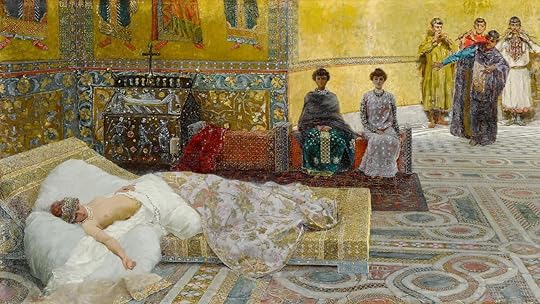
Teodora, painted by Giuseppe de Sanctis. A spacious room, comfortable bed, and attendants guarding her. A far cry from her previous life when she had to live as a mime actress and courtesan. And also when she had to make a rough journey home through the Near East and Anatolia after Hecebolus cast her out.


I can’t stress enough that this book is brilliant. Cesaretti definitely has a way with words and his closing statement on Theodora’s death reflected fully on her character:

“On the day of her death, the Augusta may have recognised the moment her life slipped away; but if so, she probably didn’t grab someone’s hand for comfort, and try to stave off death. She had said it already, sixteen years earlier, in her Nika speech: it is impossible for someone who has seen the light of this world not to die. She did not rebuke life because it was leaving her. Rather, she trusted that she was leaving something of herself to life, for Justinian was surviving her; the prestige of the purple had not been diminished; her power had not been separated from his; her proteges would continue to receive support even in the most remote lands of the empire; and her family could look forward to bright prospects and high ambitions.” ~Her Next Stage, Constantinople, 543-48, page 344.


This has been an immensely enjoyable read.
Profile Image for Douglas Berry.
190 reviews7 followers
July 19, 2023
We need a Netflix series about this woman.

Born into the lowest rung of the social ladder in Constantinople, among the actors and circus workers, Theodora, from an early age, learned to use her talents and looks to rise in society. A scholar in an era when women weren't supposed to do that, she studied theology to support her monophysite beliefs.

She married Petrus Sabbatius Justinianus, nephew of Justin I after he changed the law for them. Once empress, she ran the court while Justinian focused on wars and reconquering the West. Her long experience as a courtesan taught her to have an informer in every bed and kitchen, to control the flow of rumors, and run the Great Palace like a machine. She and her husband conferred on everything, and she even ruled in Justinian's name when he was stricken with the plague.

A remarkable woman, and I've barely scratched the surface. Cesaretti writes this in almost the style of a novel. Events unfold like you are there. Which really helps understand her journey from the side alleys to the throne. What's interesting, and something Cesaretti freely admits, is most of our information about Theodora comes from Procopius of Caesarea and his Secret History, which is an absolute diatribe against Justinian and Theodora, calling them both literal demons.

So using that and then finding the facts was great work. Anyone interested in Roman history or in great women should read this.
Profile Image for J..
Author 5 books5 followers
October 13, 2018
I first heard about Theodora while watching a documentary on the History Channel about the Eastern Roman Empire. I was moderately fascinated by Justinian I. However, as the recounting of his life continued I became more and more intrigued by his wife. I began looking for books about her and information on the web. Almost all of those roads lead to Procopius' histories. Unfortunately his account regarding her were less than objective. In order to get a more complete picture I read whatever I could find about her. This book is the most recent and so far, the best. I doesn't offer anymore information about her than the others but is does offer greater context due to the authors' superior knowledge of the era.

A woman in the sixth century who saved her husband from being deposed as Emperor at least twice. Reformed land ownership laws to include women. Personally saw to the fair treatment of courtesans and prostitutes. And basically shut down trafficking of women. Everyone should read more about this woman. Little is written about her, but what is known, even from the pen of Procopius, it's nothing short of amazing.

It is, at once, great to see such figures as Theodora, Candace of Ethiopia, Amina, and Himiko of Japan, being unearthed. Yet tragic that so much of this history has been buried or blighted with bias.
Profile Image for Rob Bauer.
Author 20 books39 followers
September 29, 2019
My hat is off to the author for trying something very difficult - writing the biography of someone when sources about their early life barely exist. In fact, there is but one source, written by an author with hostile intent toward Theodora. So, especially in the early chapters, the author just had to make his best guess based on things we know about Byzantine society at the time. Some readers might not like that, but there's no other choice in this case, and this part of the book was about as good as it's possible to make it.

The only issue I had is that this sort of informed speculation sometimes appears later in the book when it isn't quite so necessary. Again, perhaps this is unavoidable when the subject of the biography didn't leave us a diary or many other personal records and lived 1,500 years ago, but I didn't enjoy that as much.

Regardless, the entire book is a good read. The author's style in writing is good, especially considering the original was written in Italian and I read a translation. I recommend the book for anyone curious to know more about the life of this extraordinary woman.
Profile Image for Selim Ayari.
3 reviews
July 21, 2025
Conoscevo e ammiravo già abbastanza Teodora e le sua incredibile storia ma questo libro da sia un significato diverso a molte azioni compiute dall'Augusta nell'arco della sua vita e contemporaneamente fornisce una visione completa sulle vicende che precedono l'ascesa alla dignità imperiale.

Non pensavo fosse possibile ma questo libro è riuscito a farmi apprezzare e amare ancora di più una delle personalità, contando anche gli uomini, più interessanti di tutta la storia imperiale romana.
Profile Image for Nikki.
305 reviews19 followers
February 12, 2018
This is an interesting book, Theodora was an interesting, compelling person. But there really isn't much material to work with, so even though there is information it has an educated guess vibe. I get that, and can accept that. The writing come off dry though, almost like reading a long paper. The book was originally written in Italian, so maybe something was lost in translation.
Profile Image for Joseph.
187 reviews2 followers
December 15, 2013
I thought this book was decent. It was not great and it was not bad just decent. The book basically covers the life of the Empress Theodora, as the title pretty much gives that away. Theodora has always been a interesting historical figure and depending on who you ask is either a great woman of history or some one who should be ignored. The people being being Gibbon and Procopius. The main people for her being the author of this book and many others. So with that out of the way I will say that is good about this book and what is bad.

This book tries to paint a fair and balanced picture of Theodora and it does that well. It shows that she was not a whore like many people have made her to be. She started as an actress and had patrons that she was expected to give certain services too. Some of which included sex. That though does not make her a whore, it was just the way the world worked at the time. The author even mentions that she did not have many lovers as some would claim that she did. Which goes against what Procopius says about her. Which is another major positive of this book, he goes against the main source of material on Theodora and finds many other sources that paint a better picture of Theodora.

On the other hand thought he speculates to much. He says Theodora does things not with proof but with what he thinks she would have done. None of which comes from a defentive source which is required for a history book. Which brings to the other issue of the book. Were as in the beginning he tries to disprove Procopius and his claims, later on in the book after Theodora becomes Empress he paints a picture of a woman who is manipulative and petty. There are some sources for this so it may be true to a certain extent but at the same time a lot of it is still speculation. And the speculation is the major issues with this book. If he had just stuck to the sources and left that out it would have been a much better book. The final issues with the book is that at times he seemed to just go off tangent, ignore Theodora, or focus more on Justinian. The last item might be hard to get away from based on the fact that the Justinian and Theodora will always be linked together and many of their accomplishments were done together but more focus still should have been on Theodora.

With all this in mind it is still a decent book. It won't be the last book written about Theodora. Even those who hate her will admit this. Theodora is one of the most interesting historical figures out there. WE may not ever know everything about her life but she will fascinate people for years to come.
Profile Image for Glyn Longden.
51 reviews4 followers
July 25, 2011
Rating: 4/10. Originally in Italian(2001) and translated to English in 2004. The issue I have with this book is not the translation but the concept of fictionalized history in book form. Most of what we know about Theodora is from the Byzantine author Procopius who wrote her biography shortly after her death but kept it secret as many of the details were scurrilous and derogatory. The author has taken the 'facts' from Procipius and written a mainly fictionalized version of Theodora's life. So you read about what Theodora might have said, or might have felt, or might have thought but, of course, there is no proof that she said, felt, or thought anything that Cesaretti ascribes to her. My own opinion is that fictionalized history, while appealing to many people who otherwise would not learn about historical figures, is not really being honest with the reader. In its own way, it's a Hollywood version of historical events. Barbara Tuchman or Margaret Macmillan, I am sure, would NOT approve.
Profile Image for Kirsten.
95 reviews87 followers
November 1, 2012
Wow, where to begin with this book? Theodora is quite a character, and, though this is mostly a work of non-fiction, it's just as, if not more, interesting that a lot of fictional novels out there. The author uses Procopius as his main source, which may or may not be a good idea (Procopius was writing the history of Theodora and Justinian during the time they were in power, but he also had a "Secret History" in which he said a lot of nasty things about the two monarchs). Procopius obviously exaggerated a lot of his information about Theodora, especially about her sex life. Either way, though, it is a very fascinating read, and it helps non-historian readers understand a little more about this infamous empress.
Profile Image for Zachary.
316 reviews9 followers
November 8, 2013
This is one of the odder biographies I have read. The author recreates certain scenes from Theodora's life, and throws a good deal of speculation in to fill in details that are missing from the abundant, yet still rather fractured records of the great, elusive, and mysterious empress' life. The result is a more intimate portrait of Theodora, who nonetheless remains remote. I feel I both do and don't know her better than I did before. I still don't understand her blind hatreds, and how they existed with her great intelligence and drive. All in all, a good book that serves as a necessary sympathetic counterpoint to the venom one encounters in Procopius' works.
Profile Image for Noel.
19 reviews5 followers
January 21, 2013
I really enjoy the story of Theodora and was excited to read this book. It wasn't what I expected. The author jumped all over the place which was confusing. There were so many people named in this book without any explanation so I felt lost at times. But it was still an interesting read and gave a different perspective on how history views women.
Profile Image for Πάνος Τουρλής.
2,695 reviews168 followers
July 22, 2014
Απόλυτα τεκμηριωμένο, λιγότερο κουραστικό από την Άννα του Βυζαντίου του ίδιου εκδοτικού οίκου, μάλλον γιατί υπάρχουν περισσότερες πηγές πάνω στις οποίες μπορεί να βασιστεί ο συγγραφέας. Ανατρεπτικό, φωτογραφίζει τις σκευωρίες του παλατιού και τις συμπτώσεις που οδήγησαν τη Θεοδώρα στον βυζαντινό θρόνο. Ήταν πραγματικα μια έξυπνη και τυχερή γυναίκα.
Profile Image for Teodora.
14 reviews2 followers
May 19, 2008
Just in case you wondered where my name comes from.
And there is no need for H by the way.
35 reviews
April 8, 2009
You almost can't believe this isn't fiction! Theodora is amazing.
Profile Image for Brynn.
301 reviews
December 27, 2013
she's fascinating but the author takes too many liberties, asserting facts we can never know. and the writing is all over the place.
37 reviews31 followers
November 17, 2014
A fascinating book which offers an intimate look into the life of Saint Theodora and Byzantium.
Profile Image for Ruth.
128 reviews2 followers
October 17, 2013
"Theodora" brought Byzantine society alive for me.
Displaying 1 - 24 of 24 reviews

Can't find what you're looking for?

Get help and learn more about the design.