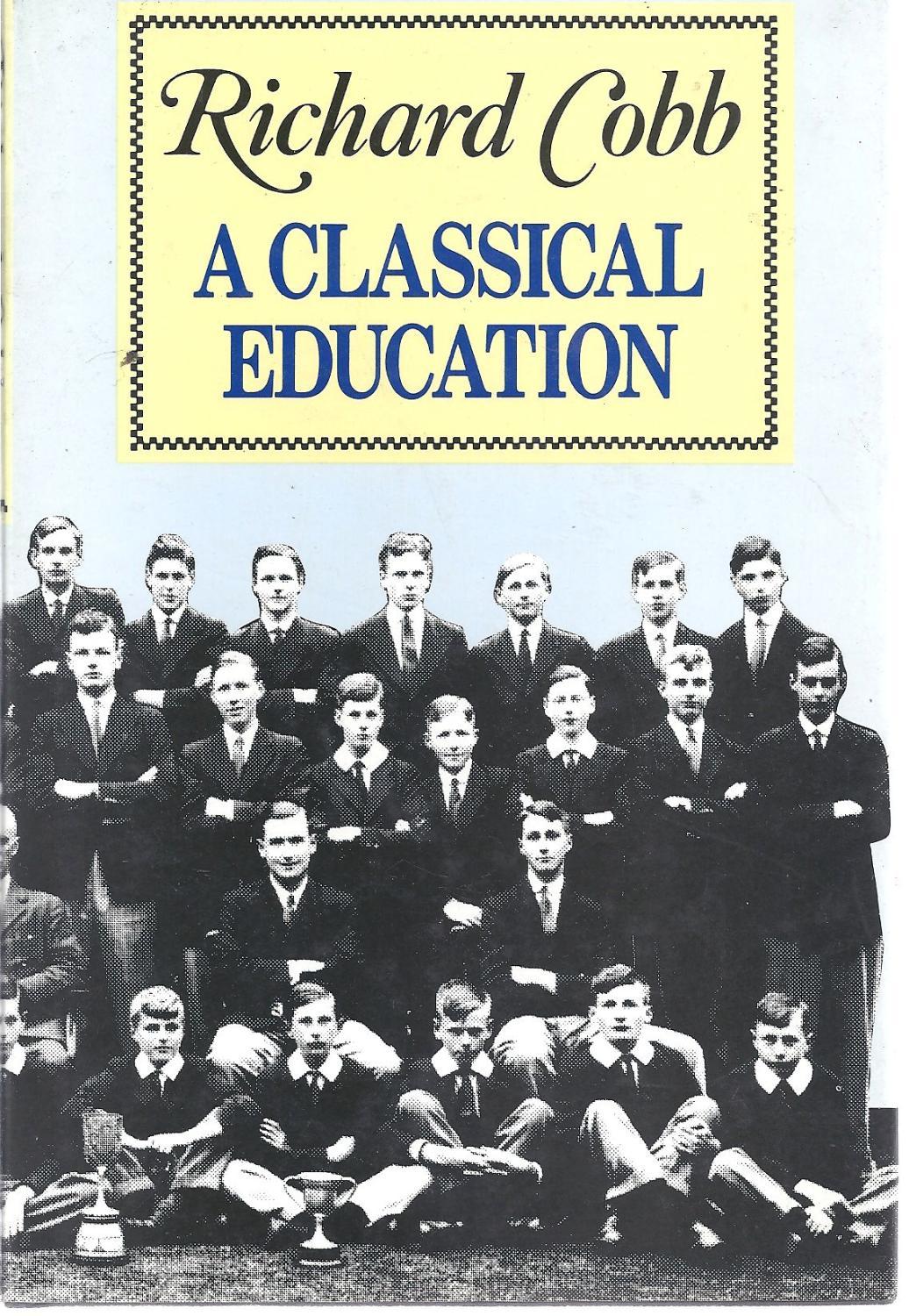
A Classical Education was first published in 1985. It followed immediately after Still Life and is again autobiographical though of a somewhat more macabre hue. At the centre is a murder committed by a school friend of Richard Cobb's. 'What gives A Classical Education its fascination is the author's description of how he himself, a shy and introverted schoolboy from Tunbridge Wells, is drawn into a nightmarish melodrama from which it seems he was lucky to escape... this book is beautifully written'. Richard Ingrams, The Times
Richard Cobb was a British historian. He became Professor of Modern History at the University of Oxford, after an initially unconventional academic career in which he spent a dozen years working as an independent scholar in French archives. His work was recognised in France by the award of membership of the Legion d'Honneur. He is known for his work on the background to the French Revolution, and for his autobiographical writings.
A bizarre but true tale by a famous English historian of French history as he describes a school friend who later murdered his mother in Dublin in 1936.I suppose it’ll only be of interest nowadays to students of private school life in England and those who know Richard Cobb but I enjoyed it as Cobb pieced the story together and tried to make sense of it.
This entire review has been hidden because of spoilers.
“He referred most movingly to the sheer wonderment of his first fortnight of liberty, of the gradually unfolding awareness that he was free to go where he wanted and as far as he liked, that there were no locked doors or high walls with barbed wire along the top; and to the marvellous realization that he could walk to the next crossroads, then to the one after that, that he could follow on foot an avenue of trees to its very end, coming out in the open beyond, that he could enjoy a multiplicity of landscapes, urban and rural, provided for his exclusive enjoyment, that all this visual wealth lay ahead of him, and that all he had to do was to walk through it and enjoy it. He told me that it had been the most momentous fortnight in his whole life, that he found he could not tire of the ever-changing scene, could hardly believe the diversity of images that were being offered him, that, for the first time in thirteen years, the word vista acquired a concrete meaning, and that he could walk towards a constantly changing series of perspectives, as if, like Alice, he had been moving across a monster chessboard. What struck him as the most marvellous gift was this ability all at once to see beyond.”
An interesting autobiography! My copy is the Slightly Foxed Editions No. 64 and it was a beauty to read, just the right size with gorgeous paper. Back to the book; I am not sure what to think of it. It was of interest to me as I live near Shrewsbury and previously lived in Tunbridge Wells (Cobb’s home town). Was it just a re-telling of what happened with his friend Edward, was it to clear up any doubt as to his own (Richard’s) involvement? I am not sure that Richard even liked Edward much, he certainly did not like the Irish or Ireland and he was a massive snob. I have Cobb’s other autobiography Still Life in the SFE too, so it will be interesting to compare.
Great book! It is so funny, surprisingly concerning disturbing events: the murder in cold blood of Cobb’s school friend’s mother by his friend. This is not a spoiler because you find this out at the beginning of the book.
There’s a lot to be said for a classical education, but one thing it doesn’t teach you is how to remove blood from an axe after you’ve murdered someone. That’s the criticism Richard Cobb’s friend Edward has of it, anyway, and he isn’t joking. He really thinks he would have avoided 12 years in an asylum if his school had prepared him better. He doesn’t even realise Richard is making fun of him when he replies, “Really, Edward, you could not have expected the school to have put on axe-washing classes just for your sole benefit; it was not a requirement of the syllabus, even if you had been on the Science side, and you were on the Classical side.”
It’s hard to believe anyone could seriously think like this, but there’s something rather mad about Edward from the beginning. That’s not surprising when you meet his mother, whom Edward calls “Medea”. Here’s an argument between Edward and Medea:
"She hurled the full teapot across the room in the direction of Edward’s head. It was quite a good, a very powerful shot, but it just missed him, shattering against a corner of the mantelpiece, spraying hot tea and tea leaves all over the wallpaper above the shelf and smashing some pretty china figurines below the mirror. This was only the opening shot in a vigorous, and indeed rather joyous exchange, of fire. Edward went with quiet deliberation into the kitchen to put on another kettle, and having, with care, poured himself a fresh cup of tea, he came back unhurriedly into the room and threw the contents of his full cup over his mother’s face which, under the impact of Earl Grey, became even more blotched than usual. It was the solemn slowness of his movement that most impressed me, giving to the exchange a sort of religious gravity. Soon all sorts of objects were hurtling across the drawing-room: the sugar, the sugar-tongs, a jug of cream, a pot of strawberry jam, then one of gooseberry jam, a bttle of ink, a plant in a bowl, a vase with the flowers in it. The fire was so heavily and skilfully sustained on both sides that it was clear that this was not a first performance, that both parties knew the form, and that a great deal of previous practice had gone into perfecting the act. I had noticed, on my arrival, that there were wide stains like huge stars on the wallpaper of both drawing-room and dining-room and that blotches in the hall seemed to offer evidence of the occasional opening out of a second front but I had thought nothing of them at the time, putting them down to Medea’s natural untidiness and to Hibernian national sluttishness…. The place soon looked like a battlefield, the walls and floor were awash."
Richard has always thought Edward’s stories of his peculiar home life are just an entertainment, part of his taste for the outrageous, but when he goes for a visit he’s swept into its madness. At Medea’s urging he gets involved in a farcical attempt to steal her silver from her estranged husband’s house; this leads to a protracted war with Medea who tries to sue him for libel and then writes to all the colleges at Oxford and Cambridge denouncing him as a thief and a burglar, a cheat and a liar, corrupt and utterly immoral and quite unsuited to be admitted to any decent, self-respecting institution. (Richard was later told by one of the dons that this raised their interest in him; they thought he must be rather an unusual young man).
While Edward hurtles towards catastrophe, Richard has a talent for getting out of awkward situations, and the book is as much a candid view of himself as it is of Edward. He describes himself in a school photo as "looking rather sly, like a fox wearing a bib". Where Edward will take on anything outrageous, Richard prefers caution, dissimulation and the advantages of an oblique approach. As schoolboys bent on mischief they’re an effective team, and as grown men they easily fall into schoolboy fooling, even when they’re talking about how Edward murdered his mother. The difference is that Edward is still emotionally a child while Richard has a cool capacity to section off parts of his life, to be the schoolboy prankster with Edward and the adult man with his other friends.
If Grand Guignol can be funny, this is it. Cobb is a celebrated historian of the French Revolution, and the historian’s eye for the peculiarities of human nature, as well as the raconteur’s feel for the shocking detail, is evident. And he writes beautifully. As Julian Barnes says, “furiously alive, furiously observing, extremely easy to read.”
Reading this book was disagreeable at times. I found it hard to sympathize with the author, in whose shoes (public boarding school, Oxford) I have never traveled. Apparently thoroughly conventional, he was befriended in (what we would probably call) a boarding school at the high school level, by someone both unconventional and needy, who was from a difficult Irish family and whose difficulties became the currency of his friendship. The author wastes no time in the book before distancing his own boring middle-class upbringing from that of his friend, lest we should conflate them in any way. To this reader, the author's description of the relationship lacked both charity and loyalty.
The central event of the book concerns a desperate criminal act done by the friend, in Ireland (so the author was not directly involved) and for which his friend spent 14 years in prison (or perhaps an asylum of some kind, it's not perfectly clear). The author suffered through this time as well, being condemned to receive and sort-of read weekly letters from his friend while he was pursuing his studies and later participating in World War II. Oh, the imposition.
The book's redeeming virtue is that it is relatively short, especially as memoirs go. It could have been shorter had not the author a penchant for synonyms and repetitive descriptions. He might throw in a dozen or twenty words of similar meaning when he gets going on a theme, and paragraphs and pages of description which do not seem to me to bring me closer to the experiences he is relating. This book was recommended to me as an example of excellent writing. I did not find it to be so. Your experience may, of course, differ.
The book itself was a bit difficult to find, and I suspect has never been in high demand. It was published in 1985 and may not have gone into a second edition (and I can see why). The copy I finally acquired is in very good shape, hardbound with cover intact, no bent or dogeared pages, and the condition of the pages only slightly foxed. A "first edition" for only $2.99 plus shipping. I'm sure someone at the charity shop where it will end up will treasure it.
Cobbs writes very well; his words feel carefully chosen to express his thoughts or to describe a place or person. They are there because they are apt not as a means to show off; there is no 'palimpsest'.
What seemed darker to me was not the crime of his school friend, but what Cobs relationship with him and interest in the case revealed about his character. He is at pains to tell the reader how he tries to distance himself from Edward, would hardly exert himself to reply to his letters. Explaining that he viewed him as a rarity that he quite enjoyed displaying, and although he continued meet him 'one needed to space them out, otherwise he could become an awful bore'. He complains of Edward's grandiosity at school, that he had no fixed plan of study in prison, the the letters he wrote too him were too long, that his later ones were not descriptive enough and that he started signing off in French. He used Edward as an anecdote in his lectures. Yet he describes him as someone who was his hanger on, who wouldn't leave him alone, and who he does not like. Had Cobb truly found Edward such a bother, nothing would have been easier than not replying to his letters, - of course Cobb mentions how infrequently and with what little attention he corresponded. His choice to reply was a deliberate action, as was his holiday in Dublin trying to get more details out of Edwards friends.
Cobb has a very good recall of the relevant events, sending Christmas cards to the police inspector who interviewed him for years afterwards. I feel like this book was his final 'dining out' on the Edward saga.
The biographical memoir of Edward, who was upper middle class Anglo-Irish and attended Shrewsbury School with Richard Cobb, the author (and an Oxford professor of the French Revolution). The book starts with Richard meeting Edward at the Gare St Lazare in Paris in 1950, following Edward’s release from a mental institution in Ireland for murdering his mother whilst a teenager in 1936. The following chapters recount Richard’s impressions from meeting with Edward in 1932, when both were boarders at Shrewsbury, their rather childish school pranks, Richard’s meeting with Edward’s mother at a school prize giving and subsequent holiday visit to Dublin. Richard then recounts Edward’s recollection of his murder of his mother. I am undecided about the value of this book, as it doesn’t glamourise the events, but nor (for me) did it really allow me to understand Edward’s actions and his mother’s. It does illuminate the seeming ordinariness of their circumstances and perhaps that is the entire reason for telling this rather sad tale.
Let me start by saying I love me a good struggle with the English language.. Since it isn't my 1st language I did find some of the words/sentences difficult to understand/make sense of..
However!! (can never have enough exclamation marks) It was a interesting read of a writer I was not familiar with.. He writes in a light hearted way about heavy matters and we get to experience it all through his own eyes.
Writing this i am actually curious on what more this man has written.. Interesting!
Very compelling but also kind of... horrible? The author seemed to me almost as horrible as his murderer friend, and at least as lacking in self-awareness. Not to mention all the anti-Irish asides. Still, I couldn't put it down.