"An absolute song for an ongoing visit with timelessness." — The New York Times This graphic novel by an Expressionist master offers a stunning depiction of urban Europe between the world wars. First published in Germany in 1925, it presents unforgettable images from the tense and dynamic Weimar period, rendered in 100 woodcuts of remarkable force and beauty. A pacifist during World War I, Belgian-born Frans Masereel (1889-1972) sympathized with the struggles of the working classes and strived to make his art accessible to ordinary people. His evocative woodcuts convey scenes of work and leisure, wealth and deprivation, and joy and loneliness. Banned by the Nazis, Masereel's works were championed in Communist countries; however, the artist steered clear of political affiliations. His clarity of vision transcends any propagandist use of the images, which stand as timeless indictments of oppression and injustice. Thomas Mann described Masereel's works as "so strangely compelling, so deeply felt, so rich in ideas that one never tires of looking at them." Epic and unflinching in its scope, The City continues to influence modern fine and graphic art, while recapturing the mood of a vanished era.
Frans Masereel was a Flemish painter and graphic artist who worked mainly in France. He is known especially for his woodcuts. His greatest work is generally said to be the wordless novel 'Passionate Journey'. He completed over 20 other wordless novels in his career.
His intense, foreboding woodcuts for Oscar Wilde's 'The Ballad of Reading Gaol' add to the drama and feeling of the poem.
This book is a unique and stunning collection of woodcut art by the Expressionist master, Frans Masereel. One hundred plates of his stark black-and-white (no grayscale) woodcuts are presented.
Taken together, "The City," presents an unvarnished picture of urban life in Weimar Germany, i.e., the period in Germany between the two World Wars. Masereel depicts many aspects of life during this unique time and place in history. It's amazing how many deep emotions are conveyed throughout this set of images.
This art is just as powerful now as when it was created in the early 1920s. What struck me the most was the depravity and propensity for violence depicted throughout many of the woodcuts. It's a haunting foreshadowing of the rise of Nazism and World War II. Let this also be a warning for our own times about the need to respect and take care of each other and our world. All in all, a haunting set of images that cannot be forgotten.
Classic...the alienation of the city has never been captured better. The stark images are Kafkaesque and evocative of German expressionistic films. I found myself asking deep questions about how cities form what we become; how we are so often shaped by demographics and availability to resources that we can access when we need help.
The City: A Vision in Woodcuts by the Expressionist master Frans Masereel was published originally in German in 1925. It's wordless, telling the story of a city through a series of 100 connected woodcut images that give a portrait of Weimar Republic Berlin. It's a busy, bustling, working city, where the class struggle becomes evident. And then increasing violence and repression. novel by an Expressionist master offers a stunning depiction of urban Europe between the world wars.One thing I noticed is the range of women depicted here in these powerful--sometimes beautiful, sometimes disturbing--images, seen as "decadent" and banned by the Nazis. There is love and there is abuse. Although the work was embraced by Communists everywhere, he denied political intent, at least publically.
Η πόλη, και ειδικά η μεγαλούπολη, είναι ένα ντελίριο αντιθέσεων. Οποιαδήποτε περιγραφή- λογοτεχνική, ζωγραφική, κινηματογραφική- δεν πάρει το παραπάνω υπόψιν, δίνει μια μικρή ή και στρεβλή εικόνα. Ο μοντερνιστής βέλγος Φρανς Μεζερέελ έφτιαξε την ίδια χρονιά μια- απαράμιλλη- συλλογή εκατό ξυλογραφιών που απεικονίζουν μια μέρα στη γαλλική πρωτεύουσα, ένα εξπρεσσιονιστικό αριστούργημα κατά τη γνώμη μου, που δείχνει τα πάντα. Ό,τι συμβαίνει από την αυγή ως την άλλη αυγή.
Another excellent example of an early graphic novel done with single page wood-cut illustrations. It's billed as a graphic novel, but really it's just 100 illustrations depicting life during the Weimar period of Germany. Post WWI up to when this book was published in 1925. There's a slight progression to the images, but hardly a story.
Masereel was a pacifist and avoided political affiliation but was eventually banned by Nazis and championed by communists.
This was a compelling and rather depressing vision of the Weimar Republic in the 1920s. No words, the pictures speak for themselves of the myriad facets of life in a large city: birth, death, marriage, sex, violence, work, play – and above all overcrowding. There are too few happy faces. Whatever is happening, the people look exhausted, run-down and ground down. The pictures are devoid of colour – accenting the depressive nature of the city. The lines are not fine, the pictures rather blocky and dense, but entirely appropriate for the subjects. Highly recommended
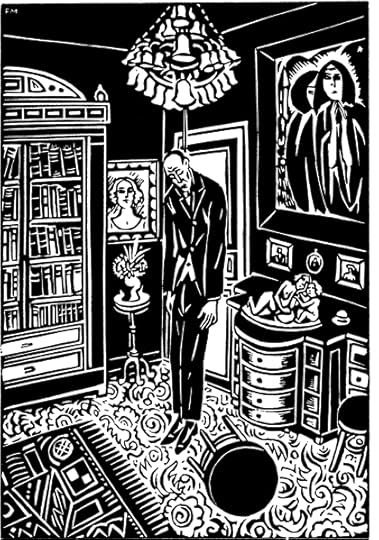
This is a wonderful book of woodcut print reproductions pertaining to the artist´s perception of the city - which in this case, could be any European city in the post WWI era. The book shows the city as a tightly packed conglomeration of industrial plants, billowing black smoke, as the remaining patches of greenery and flowers wistfully are sidelines to the marginal areas. The landscape takes on a devastated darkness because of the onslaught of industry. Railroad locomotives are shown as billowing black and white clouds of steam and smoke, as they thunder along tracks within the urban, claustrophobic landscape. The famous cover illustration of passengers milling at a railroad station platform between two trains, a for the book ¨The Passenger¨ is from this Masereel book; the figures are each individualized and highly detailed. There are images of bowler-wearing financiers rushing to high rises along crowded sidewalks amidst heavy vehicular including tram traffic, with the ever-present ranks of chimney spewing smoke straight up into the air above them. In one print, a man has evidently been struck by a car and is watched by a group of bowler-wearing downtown workers/financiers? who do not however seem to offer any help at all, they just stare down at the body in the street, with sad looks. In this print, thick smoke is rising up from the chimneys of he tightly packed commercial high rises. There's a view of engineers or architects bending over drafting boards side-by-side, as yet another view of industrial buildings with thick smoke billowing from chimneys and smokestacks is shown through the large windows in the drafting room. In a charming ye also sad view of a high rise apartment building, three open windows are shown: In one, a woman looks to be preparing dinner while her birdcage is balanced just outside the open window. Perhaps she is holding her pet since there is no bird visible in the birdcage. In the next window, a man holds his chin in his hands as he leans his elbows on the window ledge and out the window glumly, and in the bottom window, a woman is shown disrobing - possibly preparing to to turn in. Other smaller windows are visible with other mini-scenes; in one, a woman looks blankly out the window, while in the next window, a couple is shown embracing. A downtown street scene with shoppers throninging the sidewalks would seem to be a cheerful enough scene except that the woodcut medium and Masereel´s style lends an air of darkness and menace even, to each print - along with the usual thick clouds of smoke rising up from chimneys into the darkish sky. Mostly female shoppers throning a department store, including glass elevators would seem cheerful enough, except the scene is still a depiction of greed, as they all cluster around bins with sale signs, all reaching for the sale items. Still, the print depicts commercial excitement as shoppers are shown in animated poses. A view of an office interior shows a group of female typiss with their hair bobbed (a la the 1920s) with a nightmarish looking much bigger male boss hovering over them. Finally, a scene without smoke billowing out of chimneys: Although there are plenty of chimneys, no smoke is shown being emitted; it's a scene of a subway entrance with people in an orderly fashion climbing up on the right and descending on the left. Above the sidewalks there is also an elevated train track upon which two packed train cars are shown. A print shows flyers being dropped from a plane on the city. Another shows impresarios thinking up shows, or perhaps it´s a writers´ room at a film production studio. The men are all shown thinking, writing, discussing, etc. A print shows a quadruple amputee, likely a WWI war veteran, on a wagon, around a wagon in a dingy courtyard; kids look at him with dismay. Perhaps he is begging. The next print shows a major funeral procession with throngs of people on the sidewalk and a newsreel photographer on a ladder capturing the procession on film as it goes by. In the next print, a heavy-set man wearing a bowler and carrying a walking stick, has stopped to study the window of a corset shop. In the following print, a horse dragging a large mass of stone, has collapsed on the street. Men in bowlers are angrily yelling at the driver who is kneeling to comfort the stricken horse because he is blocking traffic. Strange billboards are being affixed to walls in the next scene, while there seems to be a run on the banks in the next pring, as customers throng the bank and a greedy, evil-looking man in a bowler watches the scene. A military parade shows people cheering the ranks of soldiers bearing rifles, as a commander sits atop a horse. A stock exchange scene shows unbelievable activity and agitation, as a crash may be underway or some sort of volatility. In another scene, a death bed is shown with the wife kneeling beside the bed with her head in her hands. A scene of a traffic circle is shown, or a town square with bystanders looking up at a statue of a ridiculous man holding a top hat and umbrella, declaiming, while another group looks up at another statue,of an equally ridiculous woman in a robe also bombastically declaiming, as a tour bus goes by with the guide pointing out the male statue. A hospital ward is shown - with a row of sick patients in bed. A wedding procession is shown, as the married couple are exiting the cathedral - one of the sculptured relief figures in the doorway seems to be smiling, although one of them is missing his head. A patriotic wreath-laying ceremony at a graveyard is shown with the central feature bombastically declaim, while a heavily veiled woman - the only woman in the scene, is shown mourning to the side, with ther hands holding her face. Barges billowing smoke along an oily black river are shown passing beneath a double bridge - one for cars and pedestrians, and atop it, another for railroad tracks, upon which a train is being drawn by a locomotive billowing steam. A humble worker´s family is shown - three kids and the man and wife, somehow occupying a very small flat with the ever0-present smokestacks billowing smoke visible through the window. In another print, a rich man has accosted a maid in her tiny attic room - but she is evidently submitting to his amorous attention. Is he her employer? In another print, a group of men have fished a female suicide out of the river, as life - cars, trams, throngs of pedestrians, continues on the bridge from which she jumped. In another print throngs of well-dressed bourgeois types, mostly men, are rushing onto a train - possibly a typical commuting scene. A deserted night street scene shows a group of cats and dogs occupying the space, running and sitting. A scene just outside an outdoor restaurant shows a dejected looking, holding his head in his hand, sitting on a park bench beside a woman nursing a baby as two little kids play close by. He is now a family man and luxuries such as dining at elegant restaurants are no longer possible, because of his financial and family responsibilities. A prosperous fat man with a double chin, smoking a cigar, wearing a top hat and spats, carrying an umbrella, followed by an elegant prancing miniature dog, walks by an emaciated beggar in tatters in a recess of a fancy restaurant, who is accompanied by a skinny emaciated cat. A prisoner in a pitch black cell looks up at moonlight streaming in through a barred window - perhaps he is awaiting execution the next day. Obscene graffiti is on the wall - but also including the French word for death, mort. A scholar is writing at a desk surrounded by stacks of books and papers as well as a portfolio. A tired woman is in bed and pets her black cat. An astronomer feverishly works on a chart with a compass in an observatory cluttered with all sorts of astronomical instruments including a celestial globe as a black cat sits curled up on a chair. A scene of a repulsive fat older man becoming amorously involved with a thin prostitute who has a resigned yet spiritual expression on her face. A woman has given birth at home, and the doctor is shown already fetching his hat from the hallway as he prepares to leave. A man has died in some sort of industrial accident; a crowd of workers stare at him while his wife kneels by him holding her face. An orator holds forth amid a crowd of mostly male faces. A man is shown strangling a woman after a vile struggle as furniture is overturned and curtains are askew on the window. He has a dark, demonic look and she may be a prostitute as she is wearing thigh-high black stockings. A demonstration with chanting people - mostly haggard, fills a street - above them, the usual chimneys and smokestacks billowing dark smoke. A demonstration has turned deadly as police are firing on the demonstrators who are shown running, or staggering away wounded. A poor woman holding an infant is shown with a basket of flowers at the door to an elegant eatery - she is sternly told by the uniformed guard that she cannot enter to sell her flowers. Through the window, the rich are enjoying elegant meals and sophisticated chatter in a room in which tower palm trees. A column of industrial workers looking determined has walked out on strike. A night scene near an industrial complex - in one corner a couple outside the wall of the factory is embracing. A cafe has hardly any customers - the owner is shown holding his head. A nightmarish scene of elegantly clothed rich people arriving at the theater district in cars, while a poor man, thin, wanders on the sidewalk his hands in his pockets. An extremely dejected couple at home in humble apartment. A family lives in one room. They already have three kids - but the entire family must occupy one room. A scene in a bordello - as a fat rich man smoking a cigar and wearing a top hat sizes up four young prostitutes in chemises or naked as the madam looks enouragingingly on, one of the girls is black. A think man has hung himself from the chandelier of his prosperous middle-class home. A couple wanders the streets of the darkened city beneath the moon, while in the corner a homeless old woman is shivering on street in her cloak, tring to keep warm. A white cat slinks down a curving stairway in a darkened home at night. A woman is wandering the darkened city streets at night holding her head in her hands. A major fire has broken out in one part of the densely built up city - crowds are running to either watch the blaze or get away. An evil, sadistic man is sexually assaulting a woman in the street of the darkened city - also choking her. Two drunken men stumble down a street at night singing. A man is being led at night to the guillotine as a priest holds up a cross. Nearby residents appear to be cringing at their windows. At a bordello, a dinner has turned into a riotous orgy, with dancing on the tables by customers and nude prostitutes. All in all this is wonderful, if often disturbing, book of reproductions of woodcut prints, most often showing the struggles of the working class, the callousness of the rich, and the claustrophobia of urban life, with factories and high rises and air pollution crowding out light and air.
“This is the city and I am one of the citizens, Whatever interests the rest interests me….” –Walt Whitman
مطمئن نیستم چطور باید واکنش بدم حقیقتا. تصاویری که هرکدوم جدا داستان خودشونو میگن و درنهایت در کنار همدیگه هم داستان دیگهای میسازن. شاید بهترین توصیف برای تصویرا عمیق باشه، تصاویری که هیچکدوم ثابت نیستن، ادامه پیدا میکنن، سیالن و البته خیلی راحت غرقت میکنن. حتی در خلوتترینشون هم حضور دیگران (گاهی حتی تاکید خاصش بر نبود دیگران باعث میشه بیشتر احساس بشن) و شلوغی و ازدحام موج میزنه. فضاهای خفقان اوری که به سمت درون مچاله شدن، ادمهایی اغلب ناراحت، یا به شکلی مبتذل شاد. انسانهایی که اغلب در جمع های بزرگن و با وجود اینکه جزئیات فوقالعادهای دارن به ندرت فردیت دارن. و وقتی فارغ از این جمع دیده میشن و حضوری بیشتر از اشیای تزئینی دارن، اغلب شکننده، ناشاد، در رنج و تحت قدرت دیده میشند. به نظرم بیشتر از هرچیزی یاداوری کرد بهم که چقدر مفهوم مدرن شهر، به خودی خودش دیستوپیایی و شاید حتی زشته. موجودیت زشتی که خود ما رو میسازه و چیزی جز ما هم نیست. .
furieuse envie de graver des usines, des feux d'artifices, des chemins de fer, des chats qui descendent les escaliers et l'intérieur d'une astronome malicieuse
Imagina Manhattan Transfer o cualquier novela de Dos Passos pero como un cómic donde todo es imagen y el diálogo desaparece por completo. No estaba familiarizado con el trabajo de Masereel y creo que es una de las perlas escondidas del cómic europeo y mundial. El autor realizó esta novela ilustrada en grabados de madera allá por 1925 para retratar la bella, fascinante y monstruosa vida de la Gran Urbe en los años 20: el glamour y la pobreza; la vida obrera y la burguesa; la belleza de la noche en la ciudad y las sombras del crimen y la locura.
Su lectura es parecida a aquellas películas de los años 20 y 30 que surgían con el boom de las sinfonías urbanas al estilo Cine-ojo de Vertov: películas como Chicago: A Metropolitan in the Making y el cine de Walter Ruttmann. No necesitamos la palabra; el poder de la imagen y la fuerza del encuadre son suficientes para radiografiar el corazón y la podredumbre de la ciudad moderna.
In 1920s Germany, there was a genre of city streets films, many of which had no plots or characters to speak of. Frans Masereel's The City belonged to this genre. Unlike the same artist/author's Passionate Journey, what we have is a series of uncaptioned woodcuts showing the city, the rich, the poor, crowds, heavy industry, life, death, seduction, suicide, even poetry, such as the image of a black cat coming down a staircase at night.
The effect is similar to Lynd Ward's work in the United States. I have always loved the woodcut as an art form, as Masereel and Ward both have produced woodcut books without words, but not without effect.
Hace mucho tiempo quería leer esta obra pionera, considerada como los primeros cómics en formas de grabados (xilografías) sin texto. Realizada en 1925, es un profundo y emotivo análisis a la desigualdad de las grandes ciudades, donde cada lámina presenta un agudo contraste entre las clases altas y bajas que viven y malviven en una gran ciudad. Presentando distintas escenas, con gran cantidad de detalles, es una obra que no deja indiferente a nadie y que muestra la preocupación genuina de Masereel por la condición humana en medio de la creciente industrialización. Acá se pueden ver algunos de sus grabados (la música no tiene sentido con los grabados eso sí): https://www.youtube.com/watch?v=0Zm55...
“The City: A Vision in Woodcuts” is a 1926 German expressionist art piece that depicts urban life in Weimar Germany. Through 100 stark black and white woodcuts, we see every aspect of life in the city (with an emphasis on the ugliness and violence): rich people, homeless people, construction workers, prostitutes, a couple getting married, a person getting buried, a couple making love, a woman being raped, a baby being born, a person dying, a hospital, a church, a fire.
This is only my second woodcut reading (my first being “Gods’ Man”) and I’ve got to say I love the medium. I’m shocked at how modern both of these pieces feel and just how graphic they are. I have a stack of other woodcut books that I’m looking forward to “reading.”
“ Ésta es la ciudad y yo soy uno de los ciudadanos / Lo que interesa a los demás me interesa a mí”. Walt Whitman. . Una de las cosas más maravillosas de dejar un tiempo de comprar libros y centrarme en organizar lo que tengo en casa es redescubrir lecturas del pasado que se conectan inmediatamente con el presente. La cita que abre ‘La ciudad’ de Masereel, esa especie de precómic oscuro, expresionista y apocalíptico, no puede ser más pertinente y hay que grabársela en la frente. Sus maravillosas xilografías las podéis descubrir si le echáis un ojo. Tremendo.
This mesmerizing work of art was published a century ago, yet it feels too relatable. It must be inspired by so much and it must have inspired so much.
Fantastic collection. Masereel found a fascinating way to leverage an interesting medium: woodcuts provide only black and white, no grey. He uses the stark maximum contrast to portray scene after scene of exploiter alongside exploited, alienation within crowds, all the wonderful & terrible of city life.
Unlike 'Passionate Journey,' Masereel's novella-in-woodcuts 'The City' offers the reader far more ornamentation in its art, but less of a character-driven narrative to follow. Instead, we are presented with snapshots of life in a German city, though it could really be many cities. While exploring these panels, I was struck by how challenging it was to differentiate between marital sex and sex work. So much of a city runs on the rape of the less privileged, whether that is the wife, the mistress, the adult dancer, or the poor passer-by; Masereel's art conveys this without a single word. But the last frame, which I'll let you discover for yourself, comforts the loneliest among us and assures them that they are not missing out.
no paro quieto y me he puesto a ojear el libro en cuanto lo he visto (no me ha hecho falta ni tomarlo de prestado porque lo he acabado enseguida); haciendo esto, me percato de la exponencialidad del grabado²: un grabado que se graba de nuevo en la memoria (más cuando se trata de un libro que tendrás que devolver a la biblioteca y al que más le vale hacer eso): yo ya no podré olvidar a ese hombre mutilado paseado con trineo, ese asesinato sucedido en una habitación similar a en la que en otro dibujo una pareja de obreros fornicaban, esos gatos que persiguen a señores decimonónicos, esas ciudades de hombres grandes con manos grandes y edificios que parecen tapar el cielo por no soportar el horror del vacío.
Un retrato de una ciudad mediante distintas postales que transmiten diversos momentos, sensaciones, emociones, y todo eso junto refleja el retrato de la ciudad que quiso representar. Podría calificarse de viñetas no sequtir, ya que no tienen secuencia directa pero todas juntas cuentan lo que ocurre en cualquier ciudad del mundo de hoy, de ayer o de mañana. La locura de la ciudad, la muerte, la pena, la vida, el estrés, los adultos, los niñose, lo agitado que es una ciudad todo a traves de distintas postales, donde cada una cuenta una historia por si sola, una capacidad de sintésis de contar una historia en cada viñeta, donde individualmente hay una historia, pero todas colectivamente cuentan una historia más grande. Hay critica social, hay un buen ojo que se dio cuenta todo lo que pasa en su ciudad.
A cidade em 100 imagens negras e silenciosas. Os ricos e os pobres. O nascimento e a morte. O trabalho. A alienação. A solidão e o entretenimento que o tenta curar. A cidade cheia de pessoas. A cidade vazia de emoções... Um trabalho que influenciou vários artistas importantes que se seguiram a Masereel.
An amazing work from 1925 that very beautifully depicts the Industrial Revolution affecting German city life, all depicted in woodcuts. Masereel is an excellent artist and deserves more recognition with this book.