

What do you think?

Pin
Mother was driven by a psychotic compulsion to clean - constantly - everything in sight. Father was consumed by his medical practice and an analytical approach to life.
But he understood the sensual hunger growing inside his children's young bodies. He knew they could help each other answer "The Need".
Father had Science. Father had Reason. And he had Pin.
But he understood the sensual hunger growing inside his children's young bodies. He knew they could help each other answer "The Need".
Father had Science. Father had Reason. And he had Pin.
264 pages, Paperback
First published April 1, 1981
About the author
Andrew Neiderman
67 books403 followersAndrew Neiderman is the author of over 44 thrillers, including six of which have been translated onto film, including the big hit, 'The Devil's Advocate', a story in which he also wrote a libretto for the music-stage adaptation. One of his novels, Tender Loving Care, has been adapted into a CD-Rom interactive movie.
Andrew Neiderman became the ghostwriter for V.C. Andrews following her death in 1986. He was the screenwriter for Rain, a film based on a series of books under Andrews name. Between the novels written under her name and his own, he has published over 100 novels.
Andrew Neiderman became the ghostwriter for V.C. Andrews following her death in 1986. He was the screenwriter for Rain, a film based on a series of books under Andrews name. Between the novels written under her name and his own, he has published over 100 novels.
Ratings & Reviews
Friends & Following
Create a free account to discover what your friends think of this book!
Community Reviews
Displaying 1 - 30 of 199 reviews

December 8, 2017
Oh, my dear, sweet, perverted PIN. You are a marvel.

May 19, 2015
Probably the best psycho-thriller about a brother/ sister/ life-sized anatomy dummy threesome ever.
September 21, 2021
After reading his 1982 novel "Pin," I can certainly see why Andrew Neiderman was chosen to be the ghost writer for V.C. Andrews after she died in 1986. "Pin" is like "Flowers in the Attic" on Viagra. With a creepy doll thrown in for the Ruby Jean Jensen fans of the time.
"Pin" is short for "Pinocchio," the anatomical mannequin used by a physician in his office to educate patients on organ systems and diseases. His children, Ursula and Leon, have grown up lonely in a neurotic household. They call their father "The Doctor," and they are very attached to him despite his cold, aloof, and clinical manner. When their parents die unexpectedly in a car accident, Leon takes Pin home to serve as a surrogate father and playmate for he and his sister. Pin is treated like a regular member of the family, and the trio seem to have a happy, albeit maladaptive and incestuous, relationship. But when Ursula shows signs of wanting to live her own life and get married, Leon and Pin grow jealous and decide to take action...
This is an incredibly creepy tale told from the point of view of a very disturbed mind, and is one of the most disconcerting experiences I've had in literature for some time. The prose is simple but quirky and extremely intelligent. You really believe these are the thoughts of a smart yet emotionally stunted young man who is uncomfortable in his own skin except for that world he has created for himself. The style of the book feels very modern, as though it had been published in the last five years or so. This is not an action-packed yarn, as it focuses on establishing our main characters before building tension in response to a crisis that leads to a satisfying crescendo. Though very little happens, the suspense and twisted psychology keeps the book from ever being boring. Also, though there is no relatable character or hero, everyone is portrayed with sympathy, and the short length of the novel prevents them from outlasting their welcome.
There are some narrative choices that may leave you scratching your head if you think about it too long, such as when Leon makes a plan to buy a ton of insulin from a drug store. I'm pretty sure you needed a prescription to purchase insulin in 1982. And there's another scene where Leon is able to convince his uncle that he is competent in managing his inherited stocks even though he knows nothing about the exchange or trading in the market. That just seemed improbable if not impossible. But overall, I found it easy to invest in this bizarre drama rather than be distracted by stumbles in logic.
Yes, there is plenty of brother/sister incest weirdness to be found here, so if that sort of thing offends you, this is not something you'll want to read. But if you want a good suspenseful thriller or psychological horror, especially on a cold snowy night, this is one of the classics you don't want to miss.
"Pin" is short for "Pinocchio," the anatomical mannequin used by a physician in his office to educate patients on organ systems and diseases. His children, Ursula and Leon, have grown up lonely in a neurotic household. They call their father "The Doctor," and they are very attached to him despite his cold, aloof, and clinical manner. When their parents die unexpectedly in a car accident, Leon takes Pin home to serve as a surrogate father and playmate for he and his sister. Pin is treated like a regular member of the family, and the trio seem to have a happy, albeit maladaptive and incestuous, relationship. But when Ursula shows signs of wanting to live her own life and get married, Leon and Pin grow jealous and decide to take action...
This is an incredibly creepy tale told from the point of view of a very disturbed mind, and is one of the most disconcerting experiences I've had in literature for some time. The prose is simple but quirky and extremely intelligent. You really believe these are the thoughts of a smart yet emotionally stunted young man who is uncomfortable in his own skin except for that world he has created for himself. The style of the book feels very modern, as though it had been published in the last five years or so. This is not an action-packed yarn, as it focuses on establishing our main characters before building tension in response to a crisis that leads to a satisfying crescendo. Though very little happens, the suspense and twisted psychology keeps the book from ever being boring. Also, though there is no relatable character or hero, everyone is portrayed with sympathy, and the short length of the novel prevents them from outlasting their welcome.
There are some narrative choices that may leave you scratching your head if you think about it too long, such as when Leon makes a plan to buy a ton of insulin from a drug store. I'm pretty sure you needed a prescription to purchase insulin in 1982. And there's another scene where Leon is able to convince his uncle that he is competent in managing his inherited stocks even though he knows nothing about the exchange or trading in the market. That just seemed improbable if not impossible. But overall, I found it easy to invest in this bizarre drama rather than be distracted by stumbles in logic.
Yes, there is plenty of brother/sister incest weirdness to be found here, so if that sort of thing offends you, this is not something you'll want to read. But if you want a good suspenseful thriller or psychological horror, especially on a cold snowy night, this is one of the classics you don't want to miss.

June 9, 2018
What a horror novel is is somewhat subjective. Must a horror novel be a tale of the supernatural? Must it feature the inexplicable? How much gore is necessary, and how high must the body count be?
Pin is not what some readers would think of as a horror novel — in fact, it veers more toward being a domestic drama, with some thriller elements throw in. But I say it’s a horror novel; feel free to disagree. The best thing about art is it’s subjective.
This novel deals with mourning, and the utter fragility of the psyche. There are no ghosts here, no vampires. This book is decidedly non-supernatural, and all the bad goings on have a definite explanation. But the process of mourning can be the most horrific thing a person can go through; I’ve been there. Dealing with death is real life horror — pure and simple.
I won’t say much about this novel, except that it’s a tightly wound tale, and that the author successfully pulled the wool over my eyes more than once. Any book that misguides my attention only to put it in the proper place, at the appropriate time, is a winner. Despite some awkward dated language and decided lack of character growth, I had a good time with this little book. And I suspect you will, too. If you’re into vintage horror of the WASP variety, give it a look.
Pin is not what some readers would think of as a horror novel — in fact, it veers more toward being a domestic drama, with some thriller elements throw in. But I say it’s a horror novel; feel free to disagree. The best thing about art is it’s subjective.
This novel deals with mourning, and the utter fragility of the psyche. There are no ghosts here, no vampires. This book is decidedly non-supernatural, and all the bad goings on have a definite explanation. But the process of mourning can be the most horrific thing a person can go through; I’ve been there. Dealing with death is real life horror — pure and simple.
I won’t say much about this novel, except that it’s a tightly wound tale, and that the author successfully pulled the wool over my eyes more than once. Any book that misguides my attention only to put it in the proper place, at the appropriate time, is a winner. Despite some awkward dated language and decided lack of character growth, I had a good time with this little book. And I suspect you will, too. If you’re into vintage horror of the WASP variety, give it a look.

July 1, 2021
Nobody tell my sister I gave this five stars.

February 21, 2022
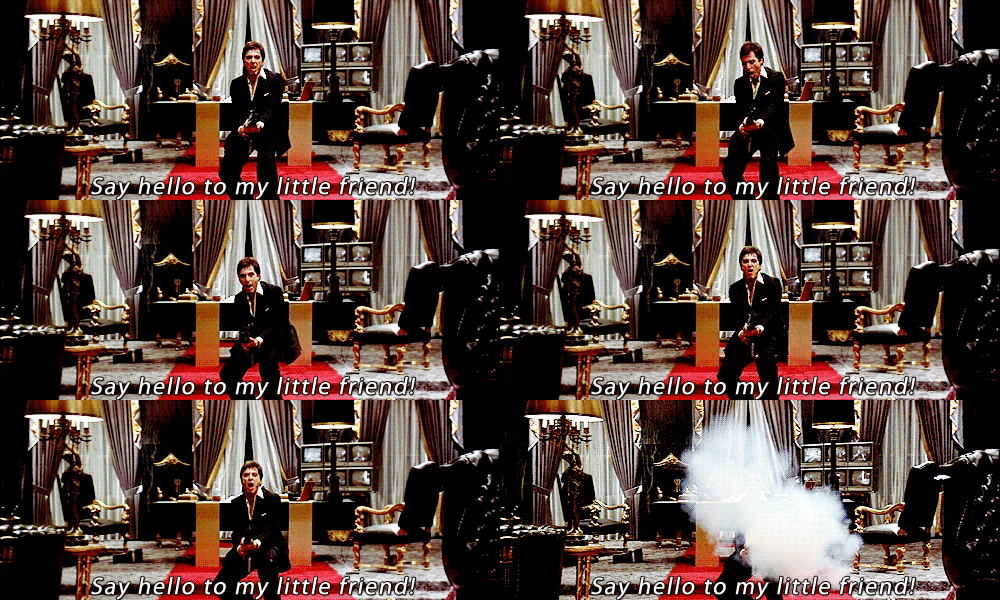
3.5 stars. A plodding but ultimately fairly decent entry in the boy-loves-sister, sister-prefers-someone-who-isn’t-actually-related-to-her, boy-kills-sister’s-more-conventional-object-of-desire, boy-and-girl-somehow-still-don’t-end-up-getting-married-and-having-a-bunch-of-adorable-little-mutant-babies subgenre. Although I definitely prefer De Palma’s “little friend” take on it over this author’s imaginary friend angle.
This entire review has been hidden because of spoilers.

November 4, 2019
Pin is a psychological horror from the decade of decadent depravity - the 1980's; the decade which spawned many of the 'great' paperback horrors sought after on the secondhand market today.
Shout out again goes to Grady Hendrix and the book I just won't stop gushing about; Paperbacks from Hell, because, without this bible of retro horror, I would've never have stumbled upon the captivating and creepy novel, Pin written by Andrew Neiderman.
Pin explores (exploits?) a skewed sibling dynamic seeped in sex, seclusion, and secrecy. Following the untimely death of their parents, Ursula and Leon close the curtains on the outside world and wrap themselves in the comfort of their large home and larger inheritance. Outsiders are frowned upon, unless they're not human... That's where Pin, a plastic body, once their father's (who happened to be a doctor) visual aide in his practice, now, a permanent resident and family member/lover...yeah let that sink in...
Jealousy, possessiveness and a deep longing to want and be wanted are the core themes prominent throughout Pin, yet it's the plastic man himself who steals the show - his 'being' somewhat questionable throughout ... Is he actually real or just real in the minds of the grieving siblings?
Pin is a 'must-read' paperback from hell. I greedily ate up every word and was left feeling satisfied after consuming the final ounce of perversion. I rate Pin a solid 4 (out of 5) stars.
Review first published on my blog: https://justaguywholikes2read.blogspo...
Shout out again goes to Grady Hendrix and the book I just won't stop gushing about; Paperbacks from Hell, because, without this bible of retro horror, I would've never have stumbled upon the captivating and creepy novel, Pin written by Andrew Neiderman.
Pin explores (exploits?) a skewed sibling dynamic seeped in sex, seclusion, and secrecy. Following the untimely death of their parents, Ursula and Leon close the curtains on the outside world and wrap themselves in the comfort of their large home and larger inheritance. Outsiders are frowned upon, unless they're not human... That's where Pin, a plastic body, once their father's (who happened to be a doctor) visual aide in his practice, now, a permanent resident and family member/lover...yeah let that sink in...
Jealousy, possessiveness and a deep longing to want and be wanted are the core themes prominent throughout Pin, yet it's the plastic man himself who steals the show - his 'being' somewhat questionable throughout ... Is he actually real or just real in the minds of the grieving siblings?
Pin is a 'must-read' paperback from hell. I greedily ate up every word and was left feeling satisfied after consuming the final ounce of perversion. I rate Pin a solid 4 (out of 5) stars.
Review first published on my blog: https://justaguywholikes2read.blogspo...
December 3, 2017
Wish I could say this book was more satisfying. Pin seemed so unreal and lacking in characterization as well as being left out of the plot decisions at times that I imagined he wasn’t real. And then he was real. And then he wasn’t. And the sister was real and then she wasn’t. The brother was likewise real and then maybe not. And who was the murderer? What really happened? Was the sister having sex with the brother? Was she having sex with this futuristic mannequin? Who knows...and ultimately I didn’t find that I cared. Just sort of bland.

July 1, 2021
I feel awful about giving this book such a high rating, I really do, but Pin wanted it this way. And it's best not to argue with Pin...
July 28, 2018
First half really drags. This is a slow burn, modern gothic with a lot of incesty overtones that ends open to interpretation (seriously, somebody please explain that ending to meeeeee).
Basically a brother and sister are extremely neglected by their parents developmentally and emotionally so they project their need for a mentor and friend into an anatomical figure from the doctor's office their father owns and call him Pin. That unhealthy imaginary friend phase goes about as well as you'd think when they reach young adulthood.
The story took a little too much time setting up the relatively mundane yet claustrophobic existence of Leon and Ursula in their family home and not enough time effectively building up the creepy atmosphere I had expected. It was an interesting concept and there were a couple of wtf moments, but I feel like this setup could have been way more eerie and suspenseful.
Basically a brother and sister are extremely neglected by their parents developmentally and emotionally so they project their need for a mentor and friend into an anatomical figure from the doctor's office their father owns and call him Pin. That unhealthy imaginary friend phase goes about as well as you'd think when they reach young adulthood.
The story took a little too much time setting up the relatively mundane yet claustrophobic existence of Leon and Ursula in their family home and not enough time effectively building up the creepy atmosphere I had expected. It was an interesting concept and there were a couple of wtf moments, but I feel like this setup could have been way more eerie and suspenseful.

September 12, 2013
I thought this book was brilliant and utterly creepy. It was executed in such a way that was fast, entertaining, and disturbing. I loved it! My only regret is that there wasn't more about the aftermath of the situation. I can't wait to read more from this author!
August 3, 2026
I picked up this novel because I'd previously seen the 1988 film adaptation directed by Sandor Stern. I likely never would have discovered the book otherwise, which is surprising because it turned out to be one of the most disturbing, eerie, and harrowing novels I've ever read.
The story follows siblings Leon and Ursula, who grow up in a deeply complicated and dysfunctional household. After their parents die unexpectedly, they become increasingly dependent on one another. Their codependency has existed since childhood, but their parents' deaths intensify it into something much darker and more unsettling.
Their father, a doctor, used to teach the children science lessons using a life-sized medical anatomy mannequin named Pin. As a teaching tool, their father would pretend Pin was alive, but Leon never grows out of this belief as he grows older, seeing Pin as a human and a companion that him and Ursula grew up with. While Ursula knows Pin isn't a real person, she indulges in Leon’s delusion. At times it’s to humour her brother, but at other times, it’s out of loyalty and fear of disrupting the fragile world they've built together.
Their codependency is threatened when Ursula starts dating and she brings home a man she wants to marry. Leon is afraid this will take Ursula away from him and Pin.
I'm genuinely surprised this book isn't more widely known. Several scenes made me feel physically nauseated, not because they rely on shock value, but because they're written with such psychological precision.
The story follows siblings Leon and Ursula, who grow up in a deeply complicated and dysfunctional household. After their parents die unexpectedly, they become increasingly dependent on one another. Their codependency has existed since childhood, but their parents' deaths intensify it into something much darker and more unsettling.
Their father, a doctor, used to teach the children science lessons using a life-sized medical anatomy mannequin named Pin. As a teaching tool, their father would pretend Pin was alive, but Leon never grows out of this belief as he grows older, seeing Pin as a human and a companion that him and Ursula grew up with. While Ursula knows Pin isn't a real person, she indulges in Leon’s delusion. At times it’s to humour her brother, but at other times, it’s out of loyalty and fear of disrupting the fragile world they've built together.
Their codependency is threatened when Ursula starts dating and she brings home a man she wants to marry. Leon is afraid this will take Ursula away from him and Pin.
I'm genuinely surprised this book isn't more widely known. Several scenes made me feel physically nauseated, not because they rely on shock value, but because they're written with such psychological precision.

July 17, 2019
Brother and sister, Leon and Ursula, had a unique upbringing. Father, the doctor, was obsessed with his work, and Mother was obsessed with cleaning the house. Thankfully there was Pin, the life-size anatomical model who became their friend, confidant, and teacher of 'the birds and the bees'.
This was a brilliant story of psychological horror. Leon is perfectly painted as the loving but overbearing brother. There were some delightfully unsettling moments in this book, and one scene in particular that I found thoroughly disturbing and has stayed with me since reading it. It's difficult to say much more about the plot without giving too much away but I thought this one was excellent and I highly recommend it!
This was a brilliant story of psychological horror. Leon is perfectly painted as the loving but overbearing brother. There were some delightfully unsettling moments in this book, and one scene in particular that I found thoroughly disturbing and has stayed with me since reading it. It's difficult to say much more about the plot without giving too much away but I thought this one was excellent and I highly recommend it!
July 29, 2021
An insane book for insane people. That first third was a little difficult, but when the conflict comes in, it become a high wire act of madness that you just can’t look away. Hits some kind of perverse vein, like a We Have Always Lived in The Castle for sexually possessive older brothers. A real piece of work, that Leon.

January 28, 2022
4 stars--I'm not recommending this book to anyone, but I enjoyed it!
This is one of those old nasty pulp novels, with shocking events and some outdated psychology. It's super dark but well written. The book winks at us, the reader enjoys being shocked, and everyone has a good time.
This is one of those old nasty pulp novels, with shocking events and some outdated psychology. It's super dark but well written. The book winks at us, the reader enjoys being shocked, and everyone has a good time.
December 15, 2021
I just rated a book for star for being unsettling and getting under my skin. And while this did the same it wasn't as an intriguing read. It made me extremely uncomfortable with the sexual themes /rape in this book. It was overall an interesting story but I am not able to like/enjoy a book with sexual assault themes especially if I'm not expecting it. In some books i am but not in this

September 22, 2020
An anatomically correct medical doll is a boy's best friend!
Very creepy. Neiderman's easy prose makes it all go down smoothly.
Very creepy. Neiderman's easy prose makes it all go down smoothly.

October 6, 2022
A solid 4 ⭐ I found this to be a fairly disturbing read but I also found it sad. It reminded me a lot of the movie Magic (1978) and I absolutely loved that film, it's super underrated. I've discovered there's a movie based off of this book and I'll be looking into it; I'm interested in what the differences are. Overall I'm not sure if I would recommend this to people due to the huge incest undertones.
August 19, 2020
You rarely come across a book which holds your attention in such a way that you can't stop thinking about the story, the characters, the journey left for you to explore through the book and where and how the journey would come to an end. Pin is one such book.
I would say you have to be patient with this book. For a good amount of story, you won't really know what's happening, or even if you know, your knowledge will suddenly be challenged by a pivotal point in the story.
All in all, this is one of those stories that is a must, especially for people who are into psychological horror.
I would say you have to be patient with this book. For a good amount of story, you won't really know what's happening, or even if you know, your knowledge will suddenly be challenged by a pivotal point in the story.
All in all, this is one of those stories that is a must, especially for people who are into psychological horror.

October 7, 2019
This is one of the times to reiterate that I grade partly on an idiosyncratic curve determined by author, genre, and an elusive sense of whether or not the book fulfilled its own purpose.
I believe that Pin's purpose is to be 1) disconcerting and 2) weird as shit, and it succeeds on both fronts.
This is the story of Leon and his sister Ursula, children raised by a germophobic mother and a somewhat distant father. Their father, a doctor, had an anatomical model in his office--the children named the model "Pin," after Pinocchio--and used to have faux-conversations with it, basically using Pin to talk to himself. He could throw his voice to have Pin "answer" him, and he also used this trick on occasion with his patients, especially the children, on the theory that children find it reassuring to have a life-sized clear-skinned dummy with visible brain matter, veins, etc. spookily talk to them. Surely a misconception, but one aided by his own children, who are fond of Pin. "Naturally," the good doctor therefore uses Pin's voice to explain the birds and the bees to them, something that will obviously lead to amazing mental stability and sexual health.
The doctor is weird. But he's on the eccentric side of weird. His son, on the other hand, is on the "sit staring at Pin for hours" side of weird, the "I was told to stop talking to this anatomical dummy but I won't" side, the "I believe that I have secret conversations with Pin" side. And unlike his sister, he never grows out of this belief in his semi-imaginary friend. Instead, the belief deepens into a warping fixation; after the early death of their parents, Leon insists on moving Pin to the house, bringing him to their family dinners, making him his own cocktails, etc. He's decidedly troubled by the way his sister wants a life outside of the house and outside of him and Pin--something, he thinks, has to be done about that.
Neiderman does a great unreliable narrator, and Leon's perspective is really chilling in its total insularity, lack of empathy, and disconnect from reality. The appearance of Ursula's boyfriend is welcome to us, if not to him, but what's really great is when you get to actually overhear--via Leon's eavesdropping--a conversation between Ursula and the boyfriend that's not automatically filtered through Leon's skewed view of the world. That much-needed reality hits like cold water, jarring you out of the book's creepy dreaminess. And in general, Ursula's characterization, with her thoughts often clear to us even though they're inaccessible to Leon, is well-done. This is a more successful novel for me than Neiderman's Brain Child, even if the premise isn't as automatically terrifying.
This book is a dark, weird, depressing cocktail of incest, distorted sexuality, and insidious insanity. It's enough to make me have reiterated multiple times over the last few days that when I have conversations with my pets, I don't actually think they're talking back to me. Really. Promise.
I believe that Pin's purpose is to be 1) disconcerting and 2) weird as shit, and it succeeds on both fronts.
This is the story of Leon and his sister Ursula, children raised by a germophobic mother and a somewhat distant father. Their father, a doctor, had an anatomical model in his office--the children named the model "Pin," after Pinocchio--and used to have faux-conversations with it, basically using Pin to talk to himself. He could throw his voice to have Pin "answer" him, and he also used this trick on occasion with his patients, especially the children, on the theory that children find it reassuring to have a life-sized clear-skinned dummy with visible brain matter, veins, etc. spookily talk to them. Surely a misconception, but one aided by his own children, who are fond of Pin. "Naturally," the good doctor therefore uses Pin's voice to explain the birds and the bees to them, something that will obviously lead to amazing mental stability and sexual health.
The doctor is weird. But he's on the eccentric side of weird. His son, on the other hand, is on the "sit staring at Pin for hours" side of weird, the "I was told to stop talking to this anatomical dummy but I won't" side, the "I believe that I have secret conversations with Pin" side. And unlike his sister, he never grows out of this belief in his semi-imaginary friend. Instead, the belief deepens into a warping fixation; after the early death of their parents, Leon insists on moving Pin to the house, bringing him to their family dinners, making him his own cocktails, etc. He's decidedly troubled by the way his sister wants a life outside of the house and outside of him and Pin--something, he thinks, has to be done about that.
Neiderman does a great unreliable narrator, and Leon's perspective is really chilling in its total insularity, lack of empathy, and disconnect from reality. The appearance of Ursula's boyfriend is welcome to us, if not to him, but what's really great is when you get to actually overhear--via Leon's eavesdropping--a conversation between Ursula and the boyfriend that's not automatically filtered through Leon's skewed view of the world. That much-needed reality hits like cold water, jarring you out of the book's creepy dreaminess. And in general, Ursula's characterization, with her thoughts often clear to us even though they're inaccessible to Leon, is well-done. This is a more successful novel for me than Neiderman's Brain Child, even if the premise isn't as automatically terrifying.
This book is a dark, weird, depressing cocktail of incest, distorted sexuality, and insidious insanity. It's enough to make me have reiterated multiple times over the last few days that when I have conversations with my pets, I don't actually think they're talking back to me. Really. Promise.
June 18, 2012
Probably the most effective genre page-turner I've ever read. While not exactly horror, it's creepier elements induce plenty of squirming. After reading, I looked up author, Neiderman, and found that he became V.C. Andrews' ghost writer after she died. They had been friends. This makes sense after reading "Pin," whose trashy trappings -- incest, family secrets, insanity, perversion, etc. -- all make the book read like the best V.C. Andrews novel she never wrote. Slightly stilted dialogue actually adds to the dreamy unease rather than detract from it. It's the best kind of marriage between pulpy melodrama and original storytelling. I've never read anything quite like "Pin" but intend to seek out more of Neiderman's novels based on the compulsion this title inspired in me. Books like "Pin" give genre books a good name.

January 14, 2021
I recently added a coworker to my GoodReads friends list and I really hope they are not seeing the books I'm adding and reviewing because whew boy am I starting my 2021 with the weirdest, horniest trash I can find.
This soothes an itch that VC Andrews started in my youth when my father made the mistake of buying me one of those foil-cover mass market reprints of Flowers in the Attic. It was a formative time for me, so, bad move on his part. It started me on a journey of depravity that has lead me here, to Pin. Not very far I guess, because it turns out Neiderman wrote like 70 VC Andrews books. But at least I'm on brand I guess?
Anyway, this one is for folks who want their thrillers to include anatomical dummies, quasi-incest and uncomfortably precise language!
This soothes an itch that VC Andrews started in my youth when my father made the mistake of buying me one of those foil-cover mass market reprints of Flowers in the Attic. It was a formative time for me, so, bad move on his part. It started me on a journey of depravity that has lead me here, to Pin. Not very far I guess, because it turns out Neiderman wrote like 70 VC Andrews books. But at least I'm on brand I guess?
Anyway, this one is for folks who want their thrillers to include anatomical dummies, quasi-incest and uncomfortably precise language!

April 15, 2012
Did Ursula actually destroy Leon, or was it really and truly Pin?

April 19, 2023
This one gets 5 stars for me just on how twisted and original a story plot it was for me.
Well written, fast paced this one is a shocker from moment to moment.
Well written, fast paced this one is a shocker from moment to moment.

July 2, 2021
“Brother, Sister, Madness, Sin, Now the Terror Will Begin…” Probably the most accurate tag line I’ve ever read on a book. This is a 5 star read in terms of compelling storytelling, but be warned that this “paperback from hell” is filled with total depravity. If you’re someone who wouldn’t read a book due to something you read in a content warning, skip this one. This isn’t gatekeeping, seriously, it’s got every kind of immoral, objectionable, inappropriate, and triggering content I can think of. It’s weird and gross, but also kind of good…? About this book penned in 1981 by Andrew Neiderman (an author who also wrote numerous books under the pseudonym V.C. Andrews), Grady Hendrix says: “If you’re a completely insane lunatic shut-in with ice water in your veins and screaming bats inside your skull, this would be paradise” (Paperbacks from Hell 143). I can’t put it any better than that. While I might recommend readers pick up one of Hendrix’s books instead of this revolting story, those who are determined to read PIN may find it expertly paced and even delightfully suspenseful toward the end. Frankly I enjoyed this book, even if I’m ashamed of the fact that I did. Although my initial impulse was to rate this 3/5 due to the content, after discussing this book with others in a book club with the Howl Society I decided to elevate my rating to ⭐️⭐️⭐️⭐️⭐️. While much of the content made me uncomfortable and was genuinely disturbing and gross, this was likely the author’s intention and I don’t want to poorly rate a book for effectively doing what it set out to do. The protagonist is an interesting character, even if the choices he makes in this horror novel are, well…horrifying. I had fun reading this book, even if it’s not the kind of thing I usually read and wouldn’t readily recommend it to others unless I knew they were into paperbacks from hell.
***This book should only be read by readers 18 years of age or older.***
***This book should only be read by readers 18 years of age or older.***
This entire review has been hidden because of spoilers.

November 12, 2024
Recomendado por Grady Hendrix. Una gran historia de amor, odio, perversidad y destrucción. Clásico instantáneo
January 12, 2025
Hahaha so sleazy, you can’t look away! Nothing beats these classic pulpy 80s paperbacks. I’ve sat through too many new “acclaimed” horror novels with nothing unique to say for 400 pages. This creepy puppet got the job done.
June 16, 2013
Excellently trashy. Incest and transparent anatomical dummies? One-legged paramours? A general feeling of ew? This is your book. Easily done in half an afternoon.
February 19, 2018
Very weird!

Did Not Finish
January 24, 2023Got to page 49. I can’t do it anymore.
Displaying 1 - 30 of 199 reviews