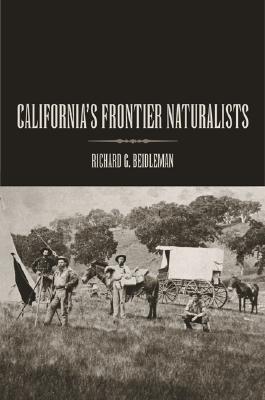
This book chronicles the fascinating story of the enthusiastic, stalwart, and talented naturalists who were drawn to California’s spectacular natural bounty over the decades from 1786, when the La Pérouse Expedition arrived at Monterey, to the Death Valley expedition in 1890–91, the proclaimed “end” of the American frontier. Richard G. Beidleman’s engaging and marvelously detailed narrative describes these botanists, zoologists, geologists, paleontologists, astronomers, and ethnologists as they camped under stars and faced blizzards, made discoveries and amassed collections, kept journals and lost valuables, sketched flowers and landscapes, recorded comets and native languages. He weaves together the stories of their lives, their demanding fieldwork, their contributions to science, and their exciting adventures against the backdrop of California and world history.
California's Frontier Naturalists covers all the major expeditions to California as well as individual and institutional explorations, introducing naturalists who accompanied boundary surveys, joined federal railroad parties, traveled with river topographical expeditions, accompanied troops involved with the Mexican War, and made up California’s own geological survey. Among these early naturalists are famous names―David Douglas, Thomas Nuttall, John Charles Fremont, William Brewer―as well as those who are less well-known, including Paolo Botta, Richard Hinds, and Sara Lemmon.
Pretty much a series of chronologies littered with amusing anecdotes. Definitely a botanical bias, almost no attention paid to invertebrates, though that might be because many of CA's inverts were described after 1900. Certainly not recommended for those not interested in California's flora and fauna, and I even hesitate to recommend it to anyone who isn't fairly well acquainted the scientific names of said beasts, because half the fun is finally learning who Cooper or Eschscholtz were. Despite that, I actually felt like the author left out a lot of important names, often relying on common names, some of which were ... possibly wrong, or perhaps way outdated (the Giant Marbled Salamander of p. 59 was pretty obviously a CA Giant Salamander, never heard the "Giant Marbled" name).
Notes
Thaddieus Haenke, bassoonist, sailed to South America to join a botanical expedition, his ship sank but he swam to shore saving only his copy of Linnaeus's Genera Plantarum, hiked across the continent over the Andes to meet his party in Santiago, Chile. Amazing. (p. 19)
Archibald Menzies (surgeon and naturalist) was once described as "The Red faced man who cut off the limbs of men and gathered grass." I want that on my gravestone. (p. 41)
Speaking of epitaphs, David Douglas was gored to death by a bull in Hawaii. His stone read Victimia scientia. (p. 124)
Botta's description of Anna's Hummingbird was perfect: "... a little ball of glowing iron throwing off rays of sparks. When several of them light on the same branch, the Arabian amateur of marvels might take it for a bough covered with precious stones, as in a dream from The Thousand and One Nights." (p. 84)
Audubon had a crush on Heermann's mom. (p. 239)
Apparently San Franciscans used to eat soup made from Western Pond Turtles (Clemmys marmorata). (p. 243)