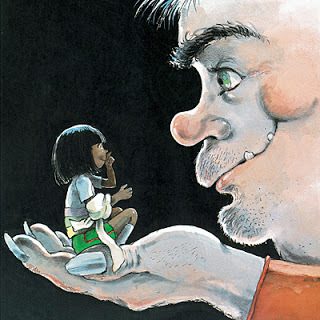
Julie thinks her new neighbors must be very scary because all the stuff being moved into their house is enormous. Then she meets David and finds out that he's just a normal, regular boy. But when David's father calls him for supper the sound makes Julie jump in the air, run in a circle three times, run home and lock herself in her room until it is time for breakfast the next day. Could David's father be a giant?
A newly designed Classic Munsch picture book introduces this tall tale about facing your fears to a new generation of young readers.
Robert Munsch was born in Pittsburgh, Pennsylvania. He graduated from Fordham University in 1969 with a Bachelor of Arts degree in history and from Boston University in 1971 with a Master of Arts degree in anthropology.
He studied to become a Jesuit priest, but decided he would rather work with children after jobs at orphanages and daycare centers. In 1973, he received a Master of Education in Child Studies from Tufts University. In 1975 he moved to Canada to work at the preschool at the University of Guelph in Guelph, Ontario. He also taught in the Department of Family Studies at the University of Guelph as a lecturer and as an assistant professor. In Guelph he was encouraged to publish the many stories he made up for the children he worked with.
Munsch's wife delivered two stillborn babies in 1979 and 1980. Out of the tragedy, he produced one of his best-known books, Love You Forever. This book was listed fourth on the 2001 Publishers Weekly All-Time Best selling Children's Books list for paperbacks at 6,970,000 copies (not including the 1,049,000 hardcover copies). The Munsches have since become adoptive parents of Julie, Andrew and Tyya (see them all in Something Good!)
Munsch has obsessive-compulsive disorder and has also suffered from manic depression. In August 2008, Munsch suffered a stroke that affected his ability to speak in normal sentences. He has recovered enough that he is able to perform live, but has put his writing career on hold until he is fully recovered.
Gosh, this is an oldie. I know I read this as a kid, and I remembered that David's father was a giant, but I didn't recall much more than that. It's actually a really nice story about overcoming fear of people who are different than you.
When David's family moves into the neighbourhood, Julie sees the giant utensils and freaks out. Then she meets David, who looks like a regular boy. She finds out that his father is a giant. Reluctantly, she accepts a dinner invitation (but only after finding out they'll be having cheeseburgers and milkshakes). It turns out that David's father, even though he eats octopus and chocolate-covered bricks for dinner, is actually a pretty nice guy... and his mere presence turns out to be quite handy when the kids encounter some bullies from school.
Julie admits that David has a nice father, and even though she still thinks he's a little scary, she doesn't seem inclined to throw away her newfound friendship. I like the message of this one (and the ending is pretty funny, too).
There's a reason this one is a classic. The themes have held up quite well and are still relevant, more than 35 years after it was first published.
When Julie sees movers carrying enormous silverware into a house in her neighborhood, she concludes that giants are moving in, and runs away in fright. The next day she meets David, a perfectly normal boy, and the two become friends. It turns out that it is David's father who is the giant, and that the young boy is adopted. When Julie asks David if he likes his father, he shares with her the many wonderful things his gargantuan parent can do...
The eleventh picture-book I have read from celebrated (and prolific!) Canadian author/illustrator team Robert Munsch and Michael Martchenko, David's Father offers an entertaining exploration of the question of adoption. Apparently inspired by Munsch's own adopted daughter Julie's questions about fathers and children who look differently from one another, the story and artwork here displays the usual zany humor and madcap sense of adventure to be found in this team's work. Recommended to Munsch/Martchenko fans, and to anyone looking for quirky, somewhat offbeat stories about adoption.
David's dad is such a good dad he's as big as the worlds. He protects and loves him from everything. Real family has nothing to do with biology. True family is love. 🎈❤🤍
There is never an end to the fun with Robert Munsch! This is yet another story of friendship and childhood antics. The imagination of children should forever be enjoyed and it’s always celebrated in these favorite books of ours.
David doesn't look much like his father- after all, he is adopted. But Julie soon finds out all the advantages to having a father who is well...different (He is a giant!). A very silly approach, but could be used to talk about different kinds of families and adoption.
Julie met David who had just moved into the neighbourhood. When David asked her to come over to play Julie met his father who was unusual and VERY big. Funny story with funny illustrations.
Reading a bunch of Munsch in a row is interesting because he has such a distinct pattern to his stories, but the girls liked that a lot. Particularly that the last page was usually a picture joke.
Es una historia infantil súper rápida de leer, lo haces en una pasada, (como ocurrió en mi caso). Te reirás de las ocurrencias de Julia y querrás tener un papi como el David.
David's father had a big knife, spoon and fork. there was friends. She and David ate hamburgers. There was a big stomp stomp stomp. David's father stomped and sat at the big table. He ate all of his supper. David and his friend had milkshakes. All the cars forgot their tires. They walked down the street and David's father got the store people to give the kids cookies and chips. He scared the kids out of their clothes. His dad picked her up and put her in his hand. Wait till you see my grandmother David said.
David's Father by Robert N. Munsch, illustrated by Michael Martchenko, is another bizzare, quickly-paced story. It plays on the childhhod fantasy of having a protector. Themes include friendship and the acceptance of differences. Martchenko's illustrations seem a bit darker than usual at times, but still feature frenetic action at times.
For ages 3-7 and fans of Robert N. Munsch and Michael Martchenko.