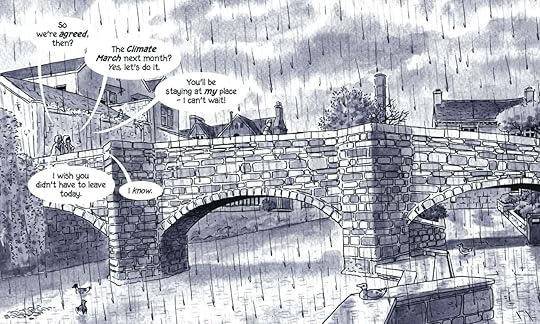
From acclaimed writer/historian Mary M Talbot and graphic-novel pioneer Bryan Talbot comes Rain, a chronicle of the growing relationship of two young women, one an environmental activist, set against the backdrop of the disastrous 2015 floods in northern England.
The wild Brontë moorlands are being criminally mismanaged as crops are being poisoned, and birds and animals are being slaughtered. While the characters are fictional, the tragedy is shockingly real.
Rain is the fourth graphic-novel collaboration between Mary M Talbot and husband Bryan Talbot, a partnership that has produced the award winning Dotter of Her Father's Eyes, Sally Suffragette (with Kate Charlesworth), and The Red Virgin and the Vision of Utopia.
Dr Mary Talbot is the author of the graphic novel Dotter of her Father’s Eyes (Jonathan Cape 2012), illustrated by her husband, award winning comic artist Bryan Talbot. She is an internationally acclaimed scholar who has published widely on language, gender and power, particularly in relation to media and consumer culture. Dotter is the first work she has undertaken in the graphic novel format. It went on to win the Costa Biography Award in January 2013.
Mary’s recent academic work includes a second edition of Language and Gender (Polity 2010), a book that continues to be popular with university lecturers and students worldwide. However, she’s probably still best known for her critical investigation of the “synthetic sisterhood” offered by teen magazines.
She has held academic posts in higher education for over twenty-five years, mostly in England, but also in Wales and Denmark. In 2004 she was invited as Visiting Professor to Sun Yat-Sen University in Guangzhou, China. She has also done extensive consultancy work, including for the Arts and Humanities Research Council and the Quality Assurance Agency.
Born in Wigan in 1954, Mary married Bryan and moved to Preston in 1972, where she brought up two sons, wrote poetry and short stories. She studied English Literature and Linguistics at Preston Polytechnic as a mature student, graduating in 1982 with a first class BA in Combined Studies. She later went on to study at Lancaster University, completing with a PhD on Critical Discourse Analysis in 1990. Employment as Reader in Language and Culture took her to Sunderland in 1997. She still lives in Sunderland, but has been a freelance writer since 2009.
Her second graphic novel, Sally Heathcote, Suffragette, is illustrated by Kate Charlesworth and Bryan and due for publication by Jonathan Cape in May 2014. It follows the fortunes of a maid-of-all-work as she is swept up the feminist activism of Edwardian England.
I picked up Rain not knowing much about it other than the fact that it was by Mary M. Talbot and Bryan Talbot, a lesser-spotted graphic novel power couple, and was set in Yorkshire. Soon enough I realised I was in for a thoroughgoing education.
Within a matter of pages the Talbots had schooled me in rising water tables, heather burning, and the lengths to which upperclass shooters will go to keep the grouse population in Yorkshire high just so they can be wasted by lead. While I can't say I am a militant environmentalist just yet, I have certainly had my eyes opened much like Cath, the outsider from London. Her growing love for Mitch draws her into this world of preserving the land though, inevitably, she still gets things wrong. While I can't say Mitch's passion is always endearing, Cath's concerted effort certainly is.
There are obvious heroes and villains in this story but they ultimately draw attention away from the core function of Rain which is to communicate just why flooding will get worse in lowland areas while also not removing anything from the sequential art style. If anything Bryan Talbot's depiction of the devastation wrought in towns like Hebden Bridge and Mytholmroyd shows just how much of a master of the art form he really is. Also Mary Talbot clearly has a brilliant knack for embedding fact into fiction.
While this wasn't quite as fascinating as Dotter of Her Father's Eyes, I did enjoy Rain and its startling geography lessons. I recommend this book to those with serious concerns about flooding and trying to fit into the eye-opening lifestyle of a loved one.
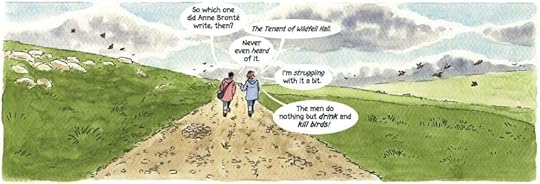
The general gist was good and some of the art was very nice on the eyes. I especially like the Yorkshire landscapes.
It's shortcomings were mainly in the clunky storytelling of having characters say things like, "But does environmentalism REALLY matter?" for the purpose of other characters explaining to them why it does. I also find it uncompelling that two women are in a relationship with each other for three years where one of them basically doesn't care all that much about the environment while the other one, it's her lifeblood. That ideological disconnect is not how lesbian relationships work in my experience.
Another thing that stuck out to me, despite it being a throwaway bit of nothing, was when main character Mitch the Enlightened (who is given the platform of explaining the world to Cath the Uninformed for most of the book) was saying why a pesticide was bad and listed diseases it could cause, of which one of the diseases was autism. That gets a big autistic side-eye from me. I mean, just because you're woke on one thing doesn't mean you're going to be woke across the board, I get that. But can an environmentalist also be in step with anti-vaxx-esque, ableist fables about what causes that terrible 'disease' autism? I sincerely hope not.
So yeah. Some bones were here and they were good bones. But the weak storytelling and simplistic characters brought the book tumbling down for me.
A powerful and moving glimpse into the world of environmental campaigners and the reasons why they do what they do all tied together through a nascent relationship. Brian's artwork is clean and simple but very evocative and Mary's writing is economical and moving. I enjoyed this a lot, hence the five stars, mainly because I learnt a lot about managing the countryside and how it's exploited by rich landowners through activities like grouse shooting. The environmental impact from grouse shooting is considerable and contributed to the serious flooding in Yorkshire over recent years around places such as Hebden Bridge which is where I think the fictional town is based upon.
Easily readable in a few hours but a book you'll want to go back to.
El mensaje, muy necesario, actual y expresado con gran claridad. Pero la intención didáctica está muy descompensada y se acaba comiendo todo lo demás. No me gustan estos engendros entre la ficción y la propaganda, nunca me han gustado.
This was a deeply moving graphic novel about the perils of environmental degradation and the effects of that degradation on people, wildlife and dirt itself. Beautifully painted by Bryan Talbot in an appropriately earthy, realistic style, this book focuses on one small region of England and the problems they face with the destruction of bogs, the hunting of quail, and the cutting down of trees.
In doing so, the Talbots take their small story as a microcosm of the greater problems our world is facing. They also place the story in a specific, grounded reality far from the world of super-hero comics. Indeed, unlike super-hero comics, Rain presents a world with few simple solutions and of people with morally complex worldviews.
A story of the last lot of big floods, or maybe the ones before those; it's so hard to keep track these days. It looks great; Bryan Talbot has always been especially good when he's working on the big skies and louring storms of the north. But equally, his collaborations with Mary Talbot have sometimes been held back by undigested research. Dotter Of Her Father's Eyes, the first and best of them, got around this by the simple expedient of never pretending to be a naturalistic piece of fiction. This, though, has the same clunking, issue-led tone as a well-reviewed play or 'must-see' drama. Characters declaim lists of side-effects and outrageous statistics at each other, mangle or forget words they'd obviously know so that the other one can reply with clarification and maintain the semblance of dialogue. I agree entirely with the book's fury at mismanagement of moorland, fracking, unchecked use of toxic chemicals and the rest. But that's not enough for me to think it succeeds as a piece of art. Which said, there are two fabulous ironies, at least one intentional. The other is that a comic railing against the use of government funding to wreck moorland for the sake of the grouse-industrial complex should itself have received Lottery and Arts Council money, so the government was paying to slag itself off. The deliberate and entirely crushing one is the moment where our impeccably progressive leads look forward cheerfully to 2016.
Rain depicts the budding relationship of two women amidst the 2015-16 floods in the UK. Cath, a Londoner, visits Mitch in the fictional rural town of Thrushcross, a picturesque little town built of stone set amidst the rolling countryside hills. But while Cath is hoping to just enjoy some time away from the denseness of the city, she finds that Mitch is more interested in campaigning against the various pollutants that are threatening the local environment around Thrushcross. Though initially exasperated by Mitch's heavy insistence on fighting against the corporations behind the plastics, herbicides and waterway pollution, Cath comes into her own political awakening here. It's a quaint story of environmentalism amidst a developing romantic relationship, and all gorgeously rendered in the lush designs by Bryan Talbot.
Unfortunately the story is rather a bit too affixed on its political diatribe and less so on the characters. Cath and Mitch often come across as vessels for the Talbots to get their message across, and it unfortunately reads as overly preachy to me. The lack of subtlety is really what drags this book down a bit since the other aspects of it are quite well done. It's clear that the Talbots feel strongly about these issues (and I mean, why shouldn't they?), but it doesn't really lend towards an affecting story in my opinion.
Rain tells the story of the efforts of a group of activists in Yorkshire trying to stop the mismanagement for the Bronte moorlands for grouse farming. The story centers around the relationship between a young journalist from London and her environmental activist lover. Their relationship develops as the journalist visits the activist and slowly gets drawn to environmental enlightenment. The art is just beautiful, from tiny creatures in the soil to the birds of pray from the blanket bog to the chili peppers everything is drawn and colored with exquisite detail. The love story is a bit underdeveloped. It's hard to imagine these two women getting married when their affection is limited to awkwardly timed hugs and sleeping together in the same bed and a few kisses. It does seem like the love story is there to serve the purpose of showing the slow enlightenment of the journalist. Nevertheless, the story manages to pack a lot of history and fact and opinion in along with some key events like the massive flooding in December 2015 in the North of England, the climate summit in Paris, and some local (potentially fictional, yet certainly believable) minor victories, like a gamekeeper who's trapping birds of prey being caught. Recommended for those who like chili peppers, rain, more rain, and inevitably, mud.
oh the irony of a book about environmentalism containing the sentence "2016 is going to be a great year!" I wonder if that was intentional... probably, they even mention the cheeto president. God, we were so naive in 2015. So hopefully ignorant of the infinity of human egotism and stupidity.
Wow - this story has everything I hold dear to my heart: queer environmental activists with hand drawn illustrations. Set in England but as stated climate change affects us all; highly recommend everyone read this.
Engaging graphic novel with characters from different backgrounds and perspectives staring climate change and environmental degradation in the face. I particularly liked the endpieces which tell of Humbolt's journeys and learnings so many years ago.
"Lo dejó escrito el polímata y Humanista Alexander Von Humboldt: la deforestación, la irrigacion indiscriminada y las grandes masas de vapor y gas que producen los centros industriales son las tres maneras en que la especie humana afecta al clima.
Dos siglos después seguimos siendo gran parte del problema.
La tendenciosa gestión de las administraciones en cuanto a las leyes de caza, el envenenamiento persistente de los cultivos por parte de granjeros sin escrúpulos, las emisiones crecientes de carbono... "
El gran acierto del libro es realizar la ambientación de un problema mundial a escala local y en Europa, donde pareciera que estamos al margen de una crisis ecológica, o que esta se alimenta tan lentamente que no nos afectaran las grandes catástrofes ambientales. Todo lo contrario. La tierra, nuestro suelo, lleva maltratado siglos, ya sea por los grandes cultivos, el envenenamiento, o esa "tradición" a la que refieren y que se ha transformado en una costumbre que acaba lentamente con los lugares en que vivimos.
Lluvia es un libro imprescindible. Debiera ser de obligada lectura en institutos. Su lenguaje, temática, protagonistas, lo hace totalmente accesible a los estudiantes de secundaria. No quiero contar más, puesto que destriparía totalmente la novela. Pero, aunque estamos rodeados de los avisos de que vamos malamente encaminados, se expone de una forma TAN clara, que es imposible no verlo.
I saw a reference to this somewhere on social media - I forget exactly where as doom scrolling can become a bit of a blur after a while.
As you would expect from a graphic novel it's a quick read - digested in an hour or so - but a fun one. The production values are very good in a solidly satisfying hardcover landscape oriented book with well drawn illustrations that complement and augment the narrative. The book has that kind of "intrinsically pleasant artefact" feel to it that would appeal to the book-tok community.
Which is important because one issue with cli-fi (climate change fiction) is its urgent need to extend its reach and its message into wider audiences. There is a deluge of misinformation pushed by the fossil fuel oligarchs and the petrostates all fostering confusion, apathy, and a careless acceleration on our fossil fuel consumption. Against that in as many small and great ways as we can, we need to tell stories - to spread truth through stories. As Ursula le Guin put it in 2014
"We live in capitalism, its power seems inescapable — but then, so did the divine right of kings. Any human power can be resisted and changed by human beings. Resistance and change often begin in art. Very often in our art, the art of words."
Or in the case of Mary and Bryan Talbot's work - the art of words and pictures.
Rain is inspired by the Yorkshire Boxing day floods of 2015 and - with its ten year old setting - it does inevitably engender some nostalgia for a more hopeful time, a time before Trump was ever president and when we could expect the EU to effectively harangue our government for nit abiding by environmental water standards.
The story follows two women, Cathy living in London for world and her girlfriend Mitch (Heather Mitchell) living in a small village in Yorkshire. When Cath visits Mitch they go on various environmental related excursions into the locality, particularly looking at the mossy waterlogged blanket-bog on the high ground, providing not just a means to absorb and hold rainwater, but to offer a varied habitat for a marvelously complex ecosystem.
The story charts the impact on that ecosystem of industrialised grouse-shoot farming, with the monoculture heather for the grouse to feed on ending up drying out the bog. The narrative also gives a nuanced view of the complexities of environmental activism, the conflicts of interest that enable people with power to avoid regulation, and all in an entertaining and absorbing tale of two women.
I have read George Monbiot's book Regenesis which offers an insightful education into issues like soil health, the dangers of industrialised monoculture based agriculture and the need for rewilding.
Talbot delivers similar insights in a more oblique fashion through the medium of story - and a story that's based in so many facts.
There were several panels that caught my eye, but one thought resonated in particular, when a character said
"Saving the planet? I prefer to think of it as saving grandchildren"
It is that impetus to be a good ancestor that Rain fosters, exemplifies and illustrates.
This is a fine alternative perspective on the climate crisis and the human role in exacerbating or ameliorating it!
I’m giving this two stars because it’s enormously well meaning and the intentions are nothing but good. But still… this is one of the most tin-eared, frustratingly didactic and annoyingly obvious books I have ever read. It’s horrible, because it kind of gives me a glimpse into how people like myself must be viewed by the other people in the Calder valley: self important, ignorant of local customs and full of ourselves. It feels like the sort of thing Rik from the Young Ones would write
A little untangling. Despite trying to hide the locale of the story as Thrushcross (and renaming Haworth Gimmerton, like in Wuthering Heights unless it was meant as a joke) this is absolutely set in Hebden Bridge (weirdly, the Talbots thank Tony and Mandy of 2 Tone comics by name except they call Tony Tom and rename the shop 2 Times whilst letting Muse Music next door keep their name) which is the next door town to me. I was there for the floods of Boxing Day 2015, with the main road to Burnley just off our street becoming a flowing river. So I know this shit incredibly well. I’ve witnessed it close up. And this book manages to tell one very facile tale of a local tragedy, whilst completely unaware of how facile it’s being
Because our heroes, with their marches and protests and organic food and whatnot, are entirely the sort of incomers to the valley (called offcumdens by the locals, because my wife and I are also very much these) who have skewed the local economy towards an upper middle class metropolitan type at the cost of people who have grown up here all their lives. We are very aware that we are part of the problem to some degree, but this book never seems to see that there’s a hefty irony in a bunch of incomers telling landowners how to live. Sure, the landowners and their grouse shooting has been one of the root causes of the levels of flooding and the book is right to blame them. But there’s a lot more to this story. For all the incomers who become staunch defenders of the landscape around them, a bunch of less engaged people have followed them and added to the problem. This is a lot for a book to tackle, but I think if you’ve focused your story entirely on those incomers at the expense of the locals you’re not telling the full story
The floods have been awful and they’re not going to stop anytime soon. Anything that raises awareness of what has contributed to those floods is a good thing. But to bog that down with a false reading of the actual story and a bunch of straw men standing in for actual characters does that story a disservice. The book is right to tackle this story but it certainly isn’t right in doing so this clumsily and awkwardly, and I would suggest that in many ways it kind of negates the purpose of it: this is a book aimed at the characters within it. And as such it’s a failure at reaching a wider audience, merely confirming the worldview of a select few
Two stars for being well meaning. Zero stars for being enjoyable
'Rain' is a lovely graphic novel to get you thinking and that nourishes the soul. This was a really enjoyable read for the most part; perhaps a little stilted dialogue-wise and underdeveloped, but well worth picking up for its wholesome depiction of community strength and gorgeous artwork.
That being said, it does have some downsides: for one thing, it's lacking some nuance and realism when it comes to depicting Cath's motley group of environmentalist friends. Half the time they give very simplistic textbook answers when asked for their views on the flooding and mismanagement of the moors, which I have to say took me out of it. Where was the emotional connection? I wanted more!
In my opinion, it's even fair to say that many felt like walking plot devices, only there to provide a springboard for another character to explain the impact of a particular aspect of the environmental damage and in schoolteacher-like fashion. The most frustrating part about this is that there's so much potential for the story to dig deeper into the intersections, contradictions and nuances of "waking up" to the realities of climate change.
This would've been a 4-star read if it weren't for one main pitfall besides these. Unfortunately, the book has a line that's pretty ableist as one of the characters discusses pesticides and "all the diseases it probably causes", one listed being autism... This left a really bad taste in my mouth and for that, I had to deduct points from my review.
So overall, a bit of a rollercoaster. Optimistic and encouraging to see such a moving depiction of community solidarity, but I couldn't help feeling let down and disappointed by all the avenues that were left untouched and the lack of character development. 3/5
Interesting graphic novel about how climate change is affecting England or more specifically Yorkshire. The area is much more prone to flooding now because the bogs have been burned and drainage added to make a better habitat for grouse. This was done by the landowner for better grouse hunting which generates a lot of money. These changes on the bogs mean they don't absorb water as well so rain doesn't soak in and unprecedented flooding occurs. The novel also covers soil contamination from overuse of chemicals.
The drawings are quite good and the characters are believable. The main characters are a lesbian couple, Cath and Mitch, and though their relationship is part of the story, it isn't a main part. Mostly Mitch is teaching Cath about the local environmental issues and about the dangers of pesticides and other chemicals. Mitch is very concerned about chemicals in food and the soil and about the increase in flooding which affects her personally. She attends some protests locally and works with a group to plant trees and to work on other flood reducing methods. Cath lives in London so she isn't aware of how bad things have gotten in Yorkshire with flooding.
In some ways, I wish this novel had been longer because there are snippets in the story of groups of radical environmental activists who look like they are going to play more of a role, but it's actually tiny. I wish those were fleshed out a bit. Overall I liked the story, but it has threads even with Mitch and Cath that I would like to see expanded on or for there to be a volume 2.
"Lluvia" es una novela gráfica protagonizada por Mitch y Cath, la primera vive en un pueblo de Yorkshire cerca de un páramo y está muy concienciada sobre ecología y medioambiente, mientras que Cath, que vive en Londres y la visita a menudo, es más escéptica. A medida que pasa el tiempo la relación entre ellas se fortalece y también evoluciona el pensamiento de Cath sobre estos temas. La trama se alarga durante varios años y, con ejemplos concretos y mostrando también diversos tipos de activismo, nos conciencia sobre la importancia de la acción humana sobre el medioambiente y sus efectos colaterales, cómo cada pequeña acción u omisión afecta a nuestro planeta. Las ilustraciones a color de Bryan Talbot son bonitas, sencillas y realistas. La única pega, en mi opinión, es que el texto de las viñetas es un pelín demasiado pequeño y dificulta la lectura. Personalmente me han encantado las referencias puntuales que aparecen a “Cumbres Borrascosas” (una de mis novelas preferidas) y a sus protagonistas. Es una historia que he ido disfrutando "in crescendo" a medida que avanzaba en la trama y me sumergía en ella. Resulta impactante la parte final de la inundación, que según se indica en el epílogo se inspiró en la que golpeó el norte de Inglaterra la Navidad de 2015. A mí me recordó totalmente a las imágenes de las devastadoras inundaciones de la dana de octubre de 2024 en Valencia. En resumen, una interesante novela gráfica, divulgativa pero a la vez entretenida.
A very interesting piece of fiction set against a backdrop of real environmental issues in the world, specifically the destruction of a natural moor ecosystem in Yorkshire to profit off grouse season at the expense of the local wildlife, ecology and the local towns and people. 'Rains' refers to the flooding that occurred in the north of England on Boxing Day 2015 as a direct result of the work done to change the landscape of the moors to better support more birds for the shooting season.
I also appreciated that there was an added LGBQT angle that was never overtly pointed out, just a natural part of the relationship of our two main characters and I think this was a respectful nod to another important issue to address in our lifetime. Respectful in that they present the relationship as a normal part of our society and not something that needs to be reacted to, as it should be.
This book doesn't come across as overly preachy, instead allowing you to take what messages you will from the tale. The artwork was well done, nothing out of the ordinary but the panels were well designed and assisted the story-telling. I enjoyed the book and learned something hence the 4 stars.
This was a pretty good. It is absolutely different from what I imagined (pretty sure I misread the description a while ago), but it is still pretty good. There are, tho, a couple of jokes about "It will only get better from here" about 2015. Lovely book tho with a hopeful ending, which is pretty uplifting for a book about climate change.
Reading notes:
The dad is such a dick about the main character's friends.
The girlfriend is so deep into the illnesses caused by stuff, you might thing that she is about to tell you that your headache is due to cancer.
Scam the rich hunter dudes out of their money, do it.
Dad has a lot of belief in the politicians.
The girlfriend is real harsh about mistakes, that were made by an accident/due to lack of knowledge.
Lil uncomfy about how people who do attacks that do not harm anyone are portrayed as villains and terorrists.
I didn't know much about this book when I picked it out and I think if I could go back, I would spend time previewing the text more before reading. I think the clues I could have picked up from previewing would have helped me to enjoy the book more..or atleast read the back of the cover again...! A young lesbian couple in the UK, circa 2015, who are environmental activists and fighting against environmental degradation. I really enjoyed the artistic style of the graphic novel and the use of colors throughout to carry different moods and convey different emotions.
I pretty much agree with all the other reviews on here about how bad the story-telling is and how appalling it is that they claim pesticides cause autism. So I shall focus my review on how bizarre it is that this couple have absolutely nothing in common and live at opposite ends of the country and are still together, and continue to be together... and then move in with each other. Bizarre. Also, Mitch has some serious anger management problems, that is she refuses to manage her anger in any other way than screaming at Cathy. I guess the art was good.
I hadn't known a lot of the factual information, so based on that, it was informative and eye-opening. The story and characters could have almost been left out, as it made the story convoluted and confusing, with memories and present time intermingling freely. I might have just preferred a straight nonfiction presentation of the moorland situation.
A graphic novel that's as much an explanation of and campaign against climate change and all the environmental issues contributing to it as it is the story of the developing relationship between two young women.It's not saying anything new but it's saying it simply, loudly and clearly with some lovely artwork by Bryan Talbot too.