

What do you think?
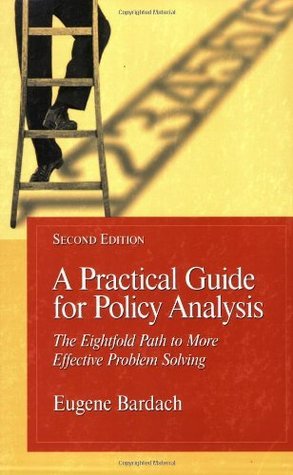
A Practical Guide For Policy Analysis: The Eightfold Path To More Effective Problem Solving
What do the Twenty-Dollar Bill Test and the Grandma Bessie Test have in common? Both are excellent, easily implemented strategies for producing high quality policy analysis. In his gem of a reference book, Eugene Bardach presents dozens of concrete tips, interesting case studies, and step-by-step strategies for the budding analyst as well as the seasoned professional. Readers learn how
This edition s appendices include a sample document of real world policy analysis, a primer in how to talk the talk of policy analysis, and a cheat sheet of strategies for solving a host of policy problems. Used in the Berkeley policy program for more than twenty years, A Practical Guide for Policy Analysis has also become part of many a practitioner s permanent library.
This edition s appendices include a sample document of real world policy analysis, a primer in how to talk the talk of policy analysis, and a cheat sheet of strategies for solving a host of policy problems. Used in the Berkeley policy program for more than twenty years, A Practical Guide for Policy Analysis has also become part of many a practitioner s permanent library.
149 pages, Paperback
First published January 1, 2000
Ratings & Reviews
Friends & Following
Create a free account to discover what your friends think of this book!
Community Reviews
Displaying 1 - 30 of 56 reviews

January 22, 2012
Had to read this for a class on Policy Analysis, was pleasantly surprised.
Bardach has a writing style that is easy to follow and uses relatively clear logic. The book gives the impression he is a seasoned policy analyst. This "Eightfold Path" guide to comparing and judging policy alternatives will give you an excellent base of (to be followed loosely) steps in which to approach problems in public, nonprofit sector policy as well as private organizations, although the focus is on the former two.
The author also gives you what you want to know, examples, ideas, and "semantic tricks" to thinking out any of the steps he outlines, for instance: semantic tips for deciding what criteria to judge alternatives (variations on a solution).
If, to give any negative critique of the book, the author dissassembles his method too much sometimes - which leaves you confused as to which step you are referring to. To give credit though, not all types of analysis (and if you read the book you will know) are straightforward "Identify Problem, Identify Alternatives to solve it, Identify criteria to rank alternatives, and then choose" and depend on the context, as well as those funding your "analysis" and work.
Further, to credit Bardach, there are many pointers as well in other problem areas which are helpful, such as general project management, or even ways of structuring final reports and recommendations.
All in all, this is a quick read which isn't padded with useless information, and isn't lacking in terms of advice and pointers, to the effect of having things such as appendices of "work governments do" useful to not just borrow ideas, but stimulate the thinking process.
This one makes it to my top shelf, at least.
Bardach has a writing style that is easy to follow and uses relatively clear logic. The book gives the impression he is a seasoned policy analyst. This "Eightfold Path" guide to comparing and judging policy alternatives will give you an excellent base of (to be followed loosely) steps in which to approach problems in public, nonprofit sector policy as well as private organizations, although the focus is on the former two.
The author also gives you what you want to know, examples, ideas, and "semantic tricks" to thinking out any of the steps he outlines, for instance: semantic tips for deciding what criteria to judge alternatives (variations on a solution).
If, to give any negative critique of the book, the author dissassembles his method too much sometimes - which leaves you confused as to which step you are referring to. To give credit though, not all types of analysis (and if you read the book you will know) are straightforward "Identify Problem, Identify Alternatives to solve it, Identify criteria to rank alternatives, and then choose" and depend on the context, as well as those funding your "analysis" and work.
Further, to credit Bardach, there are many pointers as well in other problem areas which are helpful, such as general project management, or even ways of structuring final reports and recommendations.
All in all, this is a quick read which isn't padded with useless information, and isn't lacking in terms of advice and pointers, to the effect of having things such as appendices of "work governments do" useful to not just borrow ideas, but stimulate the thinking process.
This one makes it to my top shelf, at least.

Read
December 1, 2024oh yeah, I also finished this for class. I mean, the title says it all. what a blast.

July 6, 2014
This book is not dry. Yes, it is an instruction book for analyzing public policy but it's so much more! With a bit of candor, and creativity one can apply these rules broader scoped problems, personal conundrums and understanding any kind of complexity of organizations, families or tribes. I love it and will refer to it indefinitely.

February 8, 2018
This maybe a premature review. But I think my opinion about it, is set in stone: IT IS AWESOME.
Going to be a bible for the next 10000 years. Read it if youre in any way interested in policy analysis and problem-solving.
Also, it is going to be memorable because my first MOOC is based on this book. #achievementunlocked
Going to be a bible for the next 10000 years. Read it if youre in any way interested in policy analysis and problem-solving.
Also, it is going to be memorable because my first MOOC is based on this book. #achievementunlocked

April 6, 2020
This book was a recommended reading for a policy analysis paper. It's helpful and readable content for novices.
Update: February 2022
I need to refresh my memory.
Update: February 2022
I need to refresh my memory.

January 1, 2023
Indispensable
August 10, 2026
this should've just been a pamphlet. i would've gained everything taught in this book in a whole lot less time just by reading the "Eightfold path (policy analysis)" Wikipedia page

Read
May 15, 2020My reaction to re-reading this book is difficult to describe. My first introduction to it was during a particularly difficult semester of my graduate poly sci/public affairs program, and this slim volume was our primary text to choosing, launching, finishing, and presenting a capstone project to a local nonprofit organization.
Reading it now, having fled far, far away from my prior designs of working in public policy analysis professionally - I see it as a solid guide to producing persuasive secondary research. It’s so frankly non-academic to be refreshing, but it will crush your soul to reveal of how little importance a solid analytical piece is in the face of the political wind. Still, that reality is acknowledged, as is the strange alchemy that is policy analysis.
Tl;dr: I can’t rate this book fairly because it gives me heart palpitations and reawakens the crunch of my capstone semester during grad school. Despite that, it’s a solid slim guide to producing persuasive analysis.
Reading it now, having fled far, far away from my prior designs of working in public policy analysis professionally - I see it as a solid guide to producing persuasive secondary research. It’s so frankly non-academic to be refreshing, but it will crush your soul to reveal of how little importance a solid analytical piece is in the face of the political wind. Still, that reality is acknowledged, as is the strange alchemy that is policy analysis.
Tl;dr: I can’t rate this book fairly because it gives me heart palpitations and reawakens the crunch of my capstone semester during grad school. Despite that, it’s a solid slim guide to producing persuasive analysis.

June 9, 2020
When I first read this book last year, I skimmed through it and generally felt it was just another book on a basic problem solving process. However now reading the new edition and having spent a couple years teaching policy students, I am looking at it with a different eye. I am a designer, and have worked in lots of fields, and this book is putting the problem-solving process through the lens of a policy student which they might call the rational process. Public policy doesn't seem to have a strong vernacular like some of the other disciplines but they still have a way of looking at the world. that's what this book is doing, using examples to put this in the language of policy. I especially liked the section at the end talking about design. This is how I approach all policy problems. I appreciated this. Definitely a book worth using.
July 11, 2022
A lot of reviewers point out that the writing style of this book is less dry than other text books might be. I get it but this is what put me off. This book could have gotten its ideas across in far fewer pages if it wasn’t trying to be conversational. Totally get this style is appealing to people but it felt a bit like rambling to me- especially in the beginning when I was just getting into the topic.

June 21, 2010
A brief introduction to policy analysis. Well respected author Eugene Bardach lays out what he calls "the eightfold path to more effective problem solving." This involved steps in the policy analysis process including: defining the proble,m, assembling evidence, constructing alternatives, selecting criteria, projecting outcomes, confronting treade-offs, deciding, and telling your story.
This is a brief book, but serves nicely as a "quick and dirty" introduction to policy analysis.
This is a brief book, but serves nicely as a "quick and dirty" introduction to policy analysis.

January 23, 2013
When I hear eightfold I expect it to be a path with eight simultaneous aspects. This is more like an eight-step path.
Aside from quibbling about the name, the method is sound and this book is well-written with effective examples. I don't really know how often I'll refer to it in my professional life, but I'll keep it in my back pocket just in case.
Aside from quibbling about the name, the method is sound and this book is well-written with effective examples. I don't really know how often I'll refer to it in my professional life, but I'll keep it in my back pocket just in case.

June 12, 2018
This book cuts out all narrative senarios to give you a concise usable 100 page reference. The utility of the book in application of Policy analysis is surpassed only by its readability. I would be remiss if I didn't mention that there are other policy analysis frameworks of equal or greater value. However, none as concisely and briefly stated as the eight fold path.
July 22, 2012
A thorough, yet brief, overview of policy analysis. It started out a bit dry and slow, but as the textbook moved along, it opened up and became a bit more interesting. It's a good starter book on the subject matter.

August 19, 2021
The unevenness of the prose and what I consider poor formatting choices detract from some good insights, practical advice on pitfalls and pluses to approaches to policy analysis, and an even treatment of policy development.

July 2, 2007
blah blah blah...............

July 2, 2009
Boring. Public policy is just not my thing. I had to read this for school. I'm sure to a public policy devotee the book would be great.

May 1, 2017
Easy to read and easy to understand for someone coming to Public Policy with no prior background - used this in my MPA program. Very helpful for basic problem analysis case studies.

June 25, 2018
I was excited to read this book, but the structure and development overall is poor. I was not engaged though I am interested in policy development and analysis.

May 28, 2020
I felt most of what was said was common sense. There were a lot of good examples, but anyone with and professional relationship experience will know most of the book's details.

May 29, 2021
Not exactly groundbreaking but it does give you a good outline to organize your own initiatives and plans

February 21, 2019
I think this one is a fairly good tool book.
The biggest merit will be to equip readers with a analytical mindset. The higlight is the case study (I believe it's part III) of comparing the absolute and additive cost-effectiveness of three different approaches to reduce cocaine assumption. And that's just one part of the metric from the "economy" side. It is also enlightening to see another metric proposed from the perspective of social benefits - the number of cocain related crimes.
Another pleasant surprise is to see the political experience being taught, like how to leverage the intricacies of psychology to deal with defensive informants, how to navigate through a bureaucracy, alongside with appendices illustrating different sorts of policies and metrics to probe into an organisation. Many books in the politics genre actually just talks about history, so it is interesting to see an analytical book demonstrating the art of politics.
Surely not all the passages are rich and juicy stuff - part I and II can be a bit too generic, but overall the book is a valuable source of information.
The biggest merit will be to equip readers with a analytical mindset. The higlight is the case study (I believe it's part III) of comparing the absolute and additive cost-effectiveness of three different approaches to reduce cocaine assumption. And that's just one part of the metric from the "economy" side. It is also enlightening to see another metric proposed from the perspective of social benefits - the number of cocain related crimes.
Another pleasant surprise is to see the political experience being taught, like how to leverage the intricacies of psychology to deal with defensive informants, how to navigate through a bureaucracy, alongside with appendices illustrating different sorts of policies and metrics to probe into an organisation. Many books in the politics genre actually just talks about history, so it is interesting to see an analytical book demonstrating the art of politics.
Surely not all the passages are rich and juicy stuff - part I and II can be a bit too generic, but overall the book is a valuable source of information.

December 24, 2019
Clear, concise, and a useful practical guide for policy analysis. I was surprised at how willing the author was to acknowledge the various constraints on policy analysis; for example, he didn't flinch from describing the likelihood that some parties involved with a policy would likely take a "CYA" approach to questions, and that could be positive or negative for the analysis depending on what aspect of the policy you're studying. He also explains some ways to avoid research pitfalls, especially the difficulties associated with obtaining the right data in an organization that may not value transparency. A worthwhile read for anyone who wants to do real, valuable policy analysis.

September 20, 2022
Overall, it is a solid book for someone who intends to understand policy analysis. As many other reviewers pointed out here, I do enjoy the author Eugene Bardach's writing style. I did find it less mentally taxing to read as compared to some other reading materials on the same topic. I personally find some of the examples are less suitable for someone from developing countries that tend to face constraints in available resources and bureaucratic systems to craft a sound policy. That said, the book does offer some ways to navigate limitations, which I find quite useful when thinking about societal challenges.

December 4, 2018
It's a textbook and I can't say that I read the entire thing word for word, but I did read a majority of it and took classes where it was the focus text.
It's a foundational book in public policy, in that it provides the framework for a Master's Degree in Public Policy from the UC Berkeley Goldman School of Public Policy, the top ranked public policy school in the country.
The book itself is well written, fairly easy to read and insightful. It's largely for practitioners, but anyone who is interested in problem solving, in general may find it useful.
It's a foundational book in public policy, in that it provides the framework for a Master's Degree in Public Policy from the UC Berkeley Goldman School of Public Policy, the top ranked public policy school in the country.
The book itself is well written, fairly easy to read and insightful. It's largely for practitioners, but anyone who is interested in problem solving, in general may find it useful.

June 29, 2021
It offers a lot useful advice for tackling policy creation and problem-solving, but it is dull as dirt to get through. I see this being a lot more useful and interesting if I was actively trying to research and create policy, but since I'm not, I struggled to get through it. It has good step-by-step processes and can help people create more wholistic and comprehensive policy though. A good read if it can apply to you.

November 11, 2022
Had to read this for a Policy Analysis course and while I initially found it to be a bit dry, once I got past the intro & first chapter, it was very well laid out and honestly an interesting read! I've also ended up referring back to it a lot more than I thought I would in later coursework. A worthy read, in my opinion.

January 22, 2019
The first two parts are a good read of the do’s and don’ts of policy development and writing. But I see the appendices of checklists and writing advice as a place I’ll refer to over and over again in my career (and next semester’s workshop policy writing class).
January 10, 2025
A good primer that, at least for the first part, borrows heavily from more comprehensive works like Weimer and Vining. But the emphasis there is on the word "primer".
It's a strong overview that should be helpful as a supplement to lecture and discussion, which I believe is the intended use.
It's a strong overview that should be helpful as a supplement to lecture and discussion, which I believe is the intended use.

February 11, 2018
A basic, broad overview for for new policy students.
Displaying 1 - 30 of 56 reviews