How do you escape Cesare Borgia, the most feared man in Europe? After double-crossing Borgia, The Subtlest Soul’s Matteo da Fermo is sent to Paris on a secret mission, disguised as a friar in one of the strictest religious orders of Renaissance Europe. From there, following a series of improbable adventures, Matteo makes his way to the glittering and treacherous French court at Blois, and then back to Italy, where he resumes his breakneck career of intrigue and subterfuge, and his convoluted, star-crossed love life. The Peril continues the gripping narrative of The Subtlest Soul, while broadening its historical canvas from Italy to Northern Europe, and dramatizing the prehistory of the Protestant Reformation and the story of the spread of Italian Renaissance culture north of the Alps. Praise for The Subtlest Soul "Hypnotically readable ... A remarkable achievement, highly recommended." - The Historical Novel Society Review (Editor's Choice) "The characterization is stunning ... I sincerely hope that Virginia Cox is writing a sequel." - Elizabeth Chadwick (The Summer Queen) "The best novel ever written about the Italian Renaissance." - "The Art of the Tale" blog
Virginia Cox was born in England and educated at Cambridge University, where she received her PhD in Italian literature in 1990. She taught at the universities of Edinburgh, UCL, and Cambridge before moving to the Department of Italian Studies at New York University in 2003. Her fields of specialism are Italian Renaissance literature and intellectual history and the history of rhetoric. She lives in New York and London.
I had been dead for about three months when I arrived at the gates of Paris.
Thus opens this second volume of "The Merchant of Secrets" series. As I had read the first volume, The Subtlest Soul, about five years ago, and as I have visited more places in Italy and have read more about the Renaissance, I decided that it made sense to reread it before proceeding straightaway with this second volume. I could appreciate a lot more this second time round and the shocking first sentence did not shock me too much then. But it did grip my attention immediately. As the series subtitle of "The Merchant of Secrets" has been added now, I hope it indicates that there will be at least one more volume. That would really please me.
This second novel follows the thick plot of the previous volume. Should I say ‘plot’? May be not. Rather than a literary plot, Cox proposes a narrative that links the very complex and intricate real happenings in Italy during roughly the first decade of the sixteenth century, when Cardinal Giuliano della Rovere (1443-1513) became Pope Julius II. The complexities are in this period of Italy's history . And as other powers, mainly France and Spain, interfered with Italy’s fragmented geography and politics, in this volume we set off from Italy and visit first France and then Navarre (a kingdom seated on both sides of the Western Pyrenees).
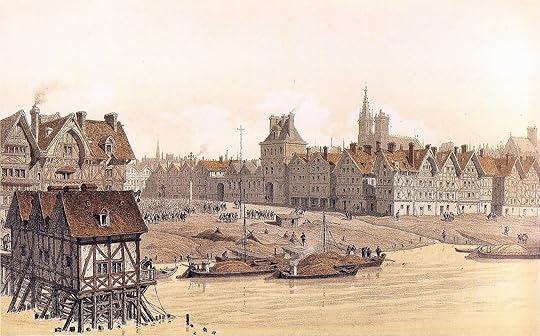
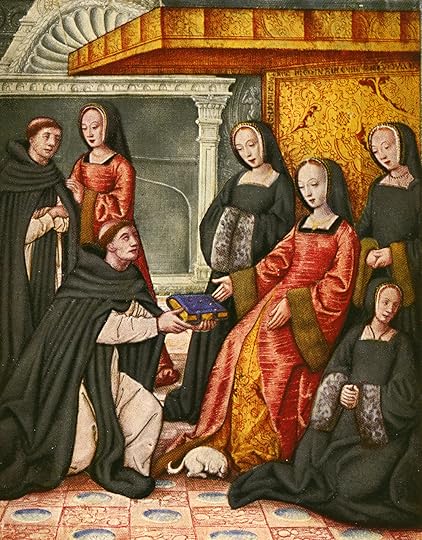
In France we visit Paris, but not a glamorous section of the city and instead an extra austere monastery that belongs to the Minims order. And Cox gives us at the end of her book, in her very welcomed Historical Afterword, a clarification of this very peculiar Order. We also visit the Sorbonne, where an erudite Dutchman, a certain Gherardus who liked to go by the lovelier epithet of Desiderius Erasmus is attending lectures as a student. But the reader can’t leave France having visited only such a stern setting, and the tale takes us to the Loire region, where we can visit the court of the fascinating Anne of Bretagne (1477-1514), twice Queen of France (first as the wife of the doomed Charles VIII, and then as the more accidental Louis XII).
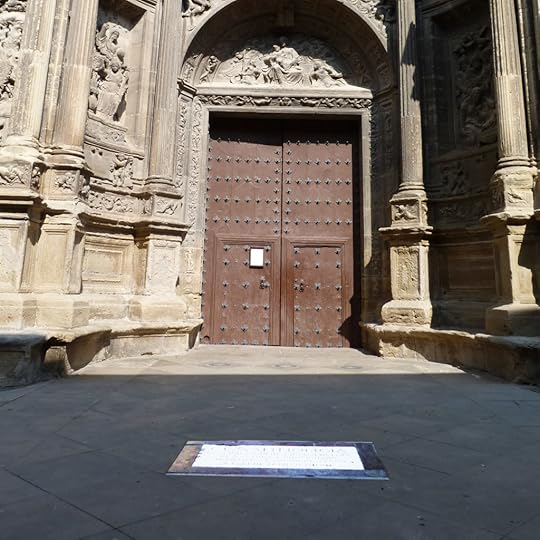
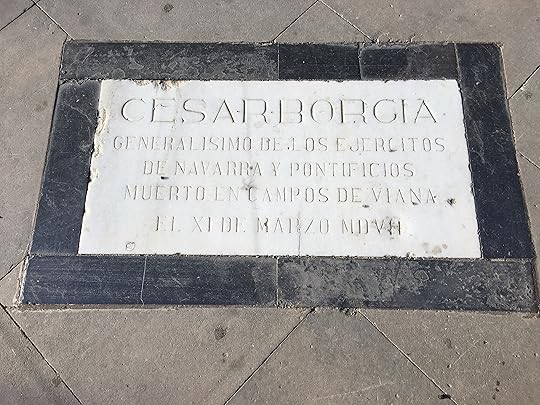
As Cesare Borgia (1475-1507) seems to be the motor moving the narrative from the previous novel, we then follow him to Navarre, where Cesare has negotiated himself, ever so adroitly, a new position of power. And there, Cox proposes a very engaging account of how Cesare met his end, one of history’s riddles. I was particularly glued to this proposition since I visited the town of Viana a few years ago and where, by chance, at the entrance of the church of Santa Maria we saw the plaque that has been placed over Cesare's remains after he was assassinated. Cox's version of what happened is convincing.
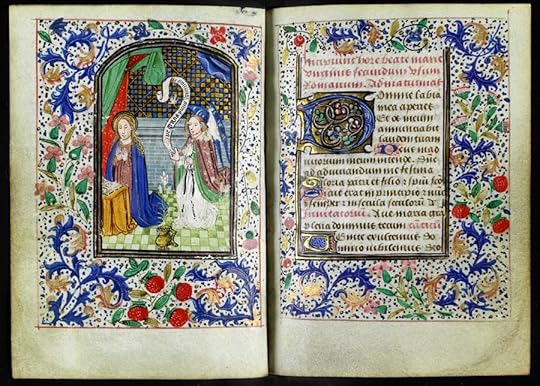
Apart from the intricacies of history and of the story, I enjoyed being transported to a recreated Renaissance world. And this is where Cox absolutely excels. The novel has a texture, like a tapestry, that few historical novels succeed in recreating. Her acumen as a literature historian and analyst, specialized in the Italian Renaissance, filters through into her writing of fiction. In the Sorbonne, the scholars engage in barren scholastic debates; predellas narrate stories almost as well as her text does; extravagant objects such as desiccated lizards with garnets set for its eyes make their way into the novel ; the technical innovation of forks are used in tables; nobles entertain themselves playing pallacorda; rooms are decorated with tapestries that are shot with gold and silver; we witness the fashion for cagnolini, the tiny dogs . I was particularly stricken when a book of hours bound in black leather and sealed with a silver clasp is mentioned. This section I read a couple of days after I visited the exhibition on the Libro de horas de Carlos V that had belonged to Emperor Charles V
But apart from all these elements that weave a representation of the Renaissance, there is also the hue, the tones. And these are provided by Cox enveloping her characters with the essentially religious frame of mind that was part and parcel of the period. Yes, the Renaissance stands out for us now as the time when the individual emerged from the social context, but this individual was a firm believer, and these believes ruled his/her life and world. Christian morals and miracles fuse the setting and add to the 'vraisemblance'.
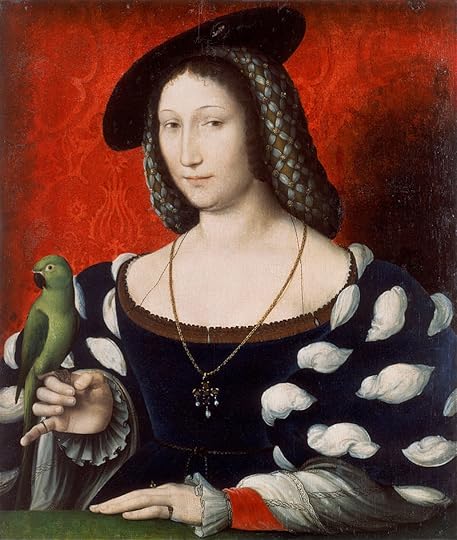
The Peril also pleased me because apart from presenting personalities which I already found fascinating, such as Cesare Borgia, Felice della Rovere (1483-1536)--the illegitimate daughter of Julius II, and Marguerite of Angoulême (1492-1549)-- the writer and sister of later king François I, it presented new ones to me to keep in mind. These were Cardinal Georges d’Amboise (1460-1510), Cardinal Galeotto della Rovere (1471-1507) and Fra Giovanni Giocondo (1433-1515).
What is very appealing in this second volume is that the protagonist, Matteo da Fermo, whom I had pinpointed as a Google peg-man in my review of the previous volume, here becomes a fully fleshed character. And a very alluring one. He is a youth with a quick mind, capable of guile and deception, as well as a sporadic vassal to his passions and flaws. But he retains a candidness and a sense of justice that endears him to the reader. His multifaceted mind makes him the perfect vehicle for us to visit this multifaceted period in history.
After finishing this novel I am left very eager to hold in my hands the sequel. Those Secrets Matteo is the Merchant of, allure me.
Author Virginia Cox* knows her Renaissance history. This sequel to her previous historical novel, The Subtlest Soul**, is again well researched and executed.
This time the spy, Matteo da Fermo, appears in the guise of Fra Giovanni, a Minim friar (the Minims being a particularly strict order). Poor Matteo, I mean Fra Giovanni, has to struggle his way through many a herb broth whilst drooling at the thought of roast meat. The action has shifted to France where Matteo’s employer, the Pope, has new tasks for him and where he hopes to keep Matteo safe from vengeful pursuers, the most vengeful of these being the fearsome Valentino (Césare Borgia) and his murderous henchman Don Michelotto (Micheletto Corella). However, as a result of some pesky “miracles” and a chance encounter Giovanni/Matteo’s ruse is soon discovered and he has to move on. And so, back to Italy where it just so happens . What can go wrong?
Travel across France and Italy with Matteo and friends (???), and expect to experience adventures and intrigue aplenty. Matteo is a fictional character but many of the characters were real people (the characterisation is excellent). Along the way you'll encounter the famous and infamous, the pious and the ribald, as well as sumptious castles and austere convents. A laugh or two are also part of the deal as well as a smidgen of romance, with a liberal dose of history administered in an entertaining manner (the author has a way with words!).
# There is a Plot Summary of The Subtlest Soul as well as a List of Historical Characters at the end of the book, and be sure to read the author's very interesting Historical Afterword.
# *Virginia Cox was born in England and educated at Cambridge University, where she received her PhD in Italian literature in 1990. She taught at the universities of Edinburgh, UCL, and Cambridge before moving to the Department of Italian Studies at New York University in 2003. She specialises in Italian Renaissance literature and has written several academic books on that subject. One of her works is a short overview of the Italian Renaissance: A Short History of the Italian Renaissance (my review)
From the striking opening words: "I had been dead for around three months when I arrived at the gates of Paris”, this wonderful continuation of the adventures of Matteo da Fermo is an exhilarating read. It follows the vicissitudes of its swashbuckling hero and spy, now undercover in a strict religious order in Paris (the Minims) and takes him from virtual imprisonment in this austere intellectual environment, via the refined French Court at Blois, the siege warfare besetting the strategic kingdom of Navarre and back to the brothels and dark underbelly of Rome. It's a thrilling journey full of extraordinary detail (the writer is a renowned Renaissance scholar) that moves at a great pace with plenty of diversions. The writing is vivid and full of passing observations that flesh out the world in a way that makes it feel utterly convincing and contemporary. We understand how the characters are formed by religious conviction, as well as by love, duty and ambition. The extensive cast takes in many real people, famous in the Renaissance world (including Erasmus, Machiavelli and Leonardo da Vinci), as well as invented characters that are as well rounded and nuanced. We learn about intriguing contemporary parallels, such as the fashion for tiny lapdogs, as well as the privations of the Minims strict vegan diet. There is promise of a final instalment of this trilogy, but meanwhile if you enjoy historical thrillers and appreciate fine writing and scholarly detail, I thoroughly recommend devouring this volume.
This book was entered in The Wishing Shelf Book Awards. This is what our readers thought: Title: The Peril Author: Virginia Cox
Star Rating: 5 Stars Number of Readers: 16 Stats Editing: 9/10 Writing Style: 8/10 Content: 8/10 Cover: 7/10 Of the 16 readers: 14 would read another book by this author. 12 thought the cover was good or excellent. 13 felt it was easy to follow. 15 would recommend this book to another reader to try. Of all the readers, 5 felt the author’s strongest skill was ‘plotting a story’. Of all the readers, 7 felt the author’s strongest skill was ‘developing the characters’. Of all the readers, 4 felt the author’s strongest skill was ‘writing style’. 16 felt the pacing was good or excellent. 15 thought the author understood the readership and what they wanted.
Readers’ Comments “This is a fantastically written historical novel with strong characterization. The author obviously knows the French/Italian setting and the history of that time very well, and this shows in the depth of the writing. Very enjoyable!” Female reader, age 48 “It's so easy with historical novels to overwhelm the reader with too much information. But this author is wise to this, integrating the setting into the story in a seamless way. The plot is cleverly constructed and the characters, even the secondary, jump off the page.” Male reader, age 61 “What a wonderful novel! When I saw it was the second book, I stopped reading and went back and read the first. I'm glad I did. I'm now twiddling my fingers wondering when the third book will be out. I very much enjoyed the writing style of the book, as it has much better pacing than many historical novels. Also, it feels very character-led (although the plot is interesting too), the author wanting the reader to get to know her central character as much as possible. Plenty of intrigue and plenty of twists and turns.” Female reader, age 40 “A solid historical novel packed full of clever plot twists and charismatic, fully-formed characters.” Male reader, age 29
To Sum It Up: ‘A superbly crafted historical novel populated with intriguing characters. A FINALIST and highly recommended!’ The Wishing Shelf Book Awards
If The Peril was a restaurant, it would have at least one Michelin star. This novel has flair, charm, style, great attention to detail and a very welcome dash of wit.
It’s also an immersive page turner, the fast-moving narrative taking the reader from 16th century Paris down through Blois to Navarre and on to Rome via treachery, murder, shipwreck, plots, imprisonment, love interest. There are also a few ‘miracles’ along the way!
The cast of characters, although quite large, is not overwhelming, and always interesting and well-drawn. The Peril mixes the fictional with the factual very successfully. It’s a very polished formula.
Perhaps the Peril’s real secret sauce is its main character, Matteo. Always a clear strong voice from the first pages of Cox’s first novel in the series, The Subtlest Soul, it’s very interesting to see how Matteo develops in the sequel. No longer is he the sometimes callow though engaging youth, the handsome but often hapless bystander to whom fascinating things just, somehow, seem to happen. Now we see him becoming a person who starts to shape events. We see him becoming effective, we witness the birth of an operator.
The ending of The Peril hints that there is more to come in this series, which Cox has called The Merchant of Secrets. It ought to be snapped up by a clever TV producer because it would make compulsive box set viewing. There’s an excellent screenplay here already, hiding in plain sight.
The second in The Merchant of Secrets series, following the adventures of Matteo, a young man who finds himself acting as a spy for Pope Julius II at the time of the Protestant Reformation and the Italian Rennaisance. Disguised as a Friar he’s sent to Paris on a secret mission and then travels through France and back to Italy, with nice cameo parts for well known Renaissance figures like Erasmus and Machiavelli. The novel is clearly underpinned by substantial research, and the period detail, which rarely intrudes, is superb. The author really seemed to know her stuff, and the style is consistent and well-written. An accomplished piece of work.