

What do you think?

The Best of Jules de Grandin: 20 Classic Occult Detective Stories
"Hercule Poirot meets Fox Mulder . . . raises genuine shivers. "— Kirkus Reviews
A collection of the 20 greatest tales of Jules de Grandin, the supernatural detective made famous in the classic pulp magazine Weird Tales .
Today the names of H. P. Lovecraft, Robert E. Howard, August Derleth, and Clark Ashton Smith, all regular contributors to the pulp magazine Weird Tales during the first half of the twentieth century, are recognizable even to casual readers of the bizarre and fantastic. And yet despite being more popular than them all during the golden era of genre pulp fiction, there is another author whose name and work have fallen into Seabury Quinn.
Quinn’s short stories were featured in well more than half of Weird Tales ’s original publication run. His most famous character, the supernatural French detective Dr. Jules de Grandin, investigated cases involving monsters, devil worshippers, serial killers, and spirits from beyond the grave, often set in the small town of Harrisonville, New Jersey. In de Grandin there are familiar shades of both Arthur Conan Doyle’s Sherlock Holmes and Agatha Christie’s Hercule Poirot, and alongside his assistant, Dr. Samuel Trowbridge, de Grandin’s knack for solving mysteries—and his outbursts of peculiar French-isms ( grand Dieu! )—captivated readers for nearly three decades.
The Best of Jules de Grandin , edited by George Vanderburgh, presents twenty of the greatest published works featuring the supernatural detective. Presented in chronological order with stories from the 1920s through the 1940s, this collection contains the most incredible of Jules de Grandin's many awe-inspiring adventures.
A collection of the 20 greatest tales of Jules de Grandin, the supernatural detective made famous in the classic pulp magazine Weird Tales .
Today the names of H. P. Lovecraft, Robert E. Howard, August Derleth, and Clark Ashton Smith, all regular contributors to the pulp magazine Weird Tales during the first half of the twentieth century, are recognizable even to casual readers of the bizarre and fantastic. And yet despite being more popular than them all during the golden era of genre pulp fiction, there is another author whose name and work have fallen into Seabury Quinn.
Quinn’s short stories were featured in well more than half of Weird Tales ’s original publication run. His most famous character, the supernatural French detective Dr. Jules de Grandin, investigated cases involving monsters, devil worshippers, serial killers, and spirits from beyond the grave, often set in the small town of Harrisonville, New Jersey. In de Grandin there are familiar shades of both Arthur Conan Doyle’s Sherlock Holmes and Agatha Christie’s Hercule Poirot, and alongside his assistant, Dr. Samuel Trowbridge, de Grandin’s knack for solving mysteries—and his outbursts of peculiar French-isms ( grand Dieu! )—captivated readers for nearly three decades.
The Best of Jules de Grandin , edited by George Vanderburgh, presents twenty of the greatest published works featuring the supernatural detective. Presented in chronological order with stories from the 1920s through the 1940s, this collection contains the most incredible of Jules de Grandin's many awe-inspiring adventures.
560 pages, Hardcover
Published June 30, 2020
About the author
Seabury Quinn
294 books60 followersBest know as an American pulp author for Weird Tales, for which he wrote a series of stories about occult detective Jules de Grandin. He was the author of non-fiction legal and medical texts and editor of Casket & Sunnyside, a trade journal for mortuary jurisprudence. He also published fiction for Embalming Magazine, another mortuary periodical.
Ratings & Reviews
Friends & Following
Create a free account to discover what your friends think of this book!
Community Reviews
Displaying 1 - 7 of 7 reviews

May 12, 2021
Vigilante Sherlock Holmes who believes in the supernatural. Complete with a Doctor Watson equivalent (but more aggressive and willfully idiotic). You definitely have to spread the stories out over a period of time because, exactly as the foreword points out, these were written for pulp magazines at an astonishing rate where word count = $$ so you get a certain level of florid prose and repetition. (Seriously, I can't figure out the narrator's (aka Dr Trowbridge's) obsession with de Grandin's various "womanish" physical attributes. Some GREAT description of fashion, though!) Products of their time so there are threads of racism and superiority throughout and some of the "accents" are damn near unintelligible but less so than other pieces from this period that I've read. The pragmatism and forthright-ness of de Grandin is refreshing. Unlike Holmes, he is not willing to let the cops sort out the reward of evil-doers. Partially because what he faces would not fly so well in front of a jury, whoops. The grotesque is definitely well-painted and you better brace yourself for it.

May 22, 2023
This edition was published in 2020 but these are old stories from 1920 onwards and are pulp fiction classics.
Think of him like Holmes but de Grandin believes in the supernatural and has a good bit of Van Helsing in him. His Watson, Dr Trowbridge is not nearly as useful, often locking himself in rooms, and mostly seeming to supply his friend with brandy and someone to expostulate to.
Yikes - boneless girls in the basement - this is Saw.
Wow, he let the young lovers with heart issues and vampirism have a night together… dawww
Pirate treasure maps drawn on vellum made of human skin. And I must say he lampshades a thing I have often wondered about; he has a trap that resets itself automatically.
Oh boy, he really has a thing about surgical torture … it is a common theme.
It took me quite some time to get through all of them, a mixed lot but some of them were fun.
3 stars
Think of him like Holmes but de Grandin believes in the supernatural and has a good bit of Van Helsing in him. His Watson, Dr Trowbridge is not nearly as useful, often locking himself in rooms, and mostly seeming to supply his friend with brandy and someone to expostulate to.
Yikes - boneless girls in the basement - this is Saw.
Wow, he let the young lovers with heart issues and vampirism have a night together… dawww
Pirate treasure maps drawn on vellum made of human skin. And I must say he lampshades a thing I have often wondered about; he has a trap that resets itself automatically.
Oh boy, he really has a thing about surgical torture … it is a common theme.
It took me quite some time to get through all of them, a mixed lot but some of them were fun.
3 stars

July 28, 2020
I loved these stories and I'm happy I read them because I discovered a new to me author.
Great world building and characters, stories that are gripping and entertaining.
Highly recommended.
Many thanks to the publisher and Edelweiss for this ARC, all opinions are mine
Great world building and characters, stories that are gripping and entertaining.
Highly recommended.
Many thanks to the publisher and Edelweiss for this ARC, all opinions are mine
October 22, 2020
Enjoyable short stories
This reminds me of Sherlock Holmes with a supernatural twist! Jules and his sidekick, the good doctor, was very similar to Holmes and Watson without Sherlock's minute attention to detail!
This reminds me of Sherlock Holmes with a supernatural twist! Jules and his sidekick, the good doctor, was very similar to Holmes and Watson without Sherlock's minute attention to detail!

April 10, 2024
The stories never transcend their pulp origins, but is that really a complaint?
The highlight of all the stories was clearly when de Grandin used a vacuum cleaner to suck up an incubus in "The Red Gauntlets of Czerni."
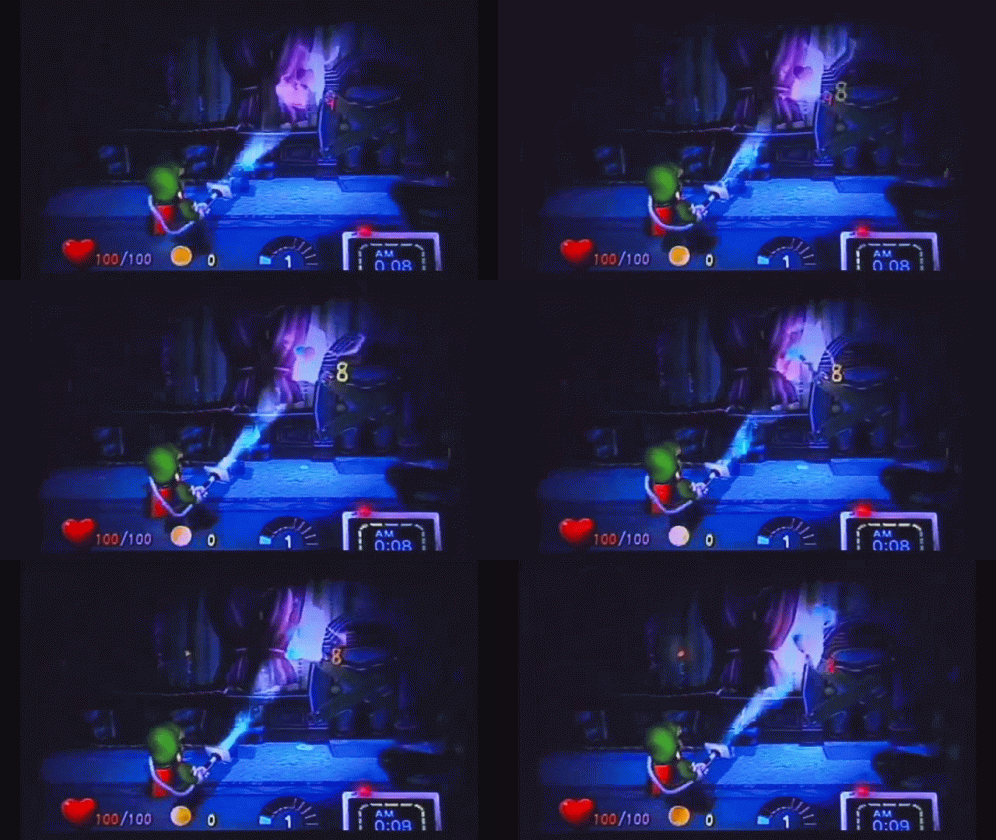
The highlight of all the stories was clearly when de Grandin used a vacuum cleaner to suck up an incubus in "The Red Gauntlets of Czerni."

May 6, 2020
good times with deliciously amusing and often skin-crawlingly violent classics from a master. leave your presentism at home (always, please) and enjoy this fun collection. a must for genre fans.

August 28, 2022
An entertaining collection of 20 supernatural detective stories (more than 700 pages) by Seabury Quinn, a lawyer who specialized in mortuary law. These stories were originally published between 1926 and 1945. During that period, Quinn became the highest paid writer for Weird Tales, and his prolific output practically saved the magazine.
The two protagonists in these stories are French occultist and doctor Jules de Grandin and his friend Dr. Samuel Trowbridge, who are both semi-retired and live together (!) in the fictional town of Harrisonville, NJ. Think X Files but set during the Great Depression. The stories check all the supernatural tropes: witches, warlocks, satanists, cannibals, mad scientists, apes, werewolves, and mummies.
Although Quinn's stories were immensely popular when they were published, he's since faded into obscurity. His characterization was weak, his plots were lurid and hackneyed, his dialogue was awkward, and his exposition was tiresome. The writing is also prone to the bigotry and misogyny typical of pulp fiction of the period. Female characters are often weak and submissive, and Quinn "was careful to always feature a scene that could translate to appropriately salacious artwork" for the cover. In describing de Grandin, Quinn frequently cites his effeminate qualities: wheat-blond hair; small, womanishly slender hands; and a diminutive blond mustache. The biggest weakness of the stories is the underdeveloped relationship between de Grandin and Trowbridge, which never achieves the depth of the Holmes/Watson relationship in Conan Doyle's stories.
But we shouldn't be too critical. Quinn's flaws as a writer come with the territory. After all, he was one of the most successful pulp writers and his prose was superior to H.P. Lovecraft's. Read these stories for what they are: excellent examples of pulp horror tales that entertained millions of people when money was scarce. They inspired countless other horror writers and B-movie screenwriters.
The two protagonists in these stories are French occultist and doctor Jules de Grandin and his friend Dr. Samuel Trowbridge, who are both semi-retired and live together (!) in the fictional town of Harrisonville, NJ. Think X Files but set during the Great Depression. The stories check all the supernatural tropes: witches, warlocks, satanists, cannibals, mad scientists, apes, werewolves, and mummies.
Although Quinn's stories were immensely popular when they were published, he's since faded into obscurity. His characterization was weak, his plots were lurid and hackneyed, his dialogue was awkward, and his exposition was tiresome. The writing is also prone to the bigotry and misogyny typical of pulp fiction of the period. Female characters are often weak and submissive, and Quinn "was careful to always feature a scene that could translate to appropriately salacious artwork" for the cover. In describing de Grandin, Quinn frequently cites his effeminate qualities: wheat-blond hair; small, womanishly slender hands; and a diminutive blond mustache. The biggest weakness of the stories is the underdeveloped relationship between de Grandin and Trowbridge, which never achieves the depth of the Holmes/Watson relationship in Conan Doyle's stories.
But we shouldn't be too critical. Quinn's flaws as a writer come with the territory. After all, he was one of the most successful pulp writers and his prose was superior to H.P. Lovecraft's. Read these stories for what they are: excellent examples of pulp horror tales that entertained millions of people when money was scarce. They inspired countless other horror writers and B-movie screenwriters.
Displaying 1 - 7 of 7 reviews