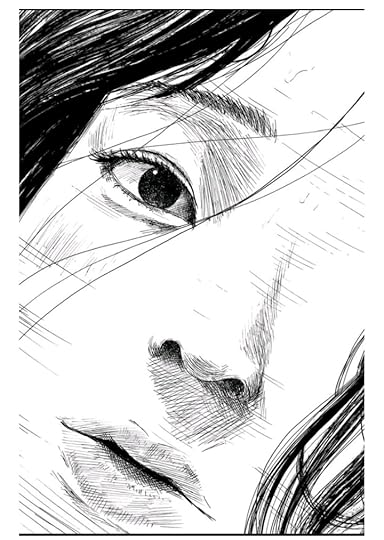
Shuzo Oshimi (押見修造, Oshimi Shūzō) is a Japanese manga creator. Drawn in a realistic art style, his comics tend to be psychological dramas exploring the difficulties in human relationships and often touching on disturbing situations and perversions. Oshimi debuted in 2001 with the manga series Avant-Garde Yumeko, appeared in Kodansha's 'Monthly Shōnen Magazine.' Most of his works since then have been published by Kodansha and Futabasha. Among his first successes the single volume manga Sweet Poolside (2004), later adapted into a live-action film, and the series Drifting Net Café (2008–2011), also adapted for TV. Oshimi reached international acclaims with The Flowers of Evil (2009–2014) and Inside Mari (2012–2016), both adapted into successful anime. Other notable works are Blood on the Tracks (2017–2023) and Welcome Back, Alice (2020-2023) .
Yoooooo! Y’all can’t tell me this shit isn’t wild!!!! That ending!!! Wow! Okay, so it’s clear that Seii is completely and totally broken. His mother accomplished her goal. He won’t do anything but defend her. And it’s clear from his outbursts at school that he’s not really in touch with reality. I just loathe the way she manipulates him. There are definitely some heavy content warnings for this series. The behaviors that his mother is exhibiting are definitely indicators of child abuse and I’m getting the feeling that other adults are beginning to pick up on it. But that ending….y’all I’m still mind blown. She really doesn’t give a f***. And I promise you, it’s going to make Seii probably do something wild in the next volume.
"The Manga that breaks people". This was the title of a YouTube video I came across a couple of days back. I just watched the first few minutes of the video and I was intrigued by the premise and I just stopped the video and I thought of trying the manga once I finish a couple of books I was already reading at the time. Started reading the manga today morning and oh boy, was I in for a mindfuck? Dark and convoluted as the plot goes, I was completely absorbed; I just sat and read all morning, scrolling through the manga pages on my phone. Usually when I read, I have the habit of pacing up and down my room with the book in my hand to keep my mind from wandering. Also, I can never finish a book within a day with so short a span of attention. But this manga though, it kept me in one corner of the room the whole day, completely engrossed.
The manga's unfinished and I can't wait for the next volume. I'll just share the link to the video that persuaded me to read the manga. All I can say is, "See for yourself".
wow shit hit the fan!!!! after 8 volumes it finally got elevated for me! i was gonna give up on the whole series but that's not a possibility now! i gotta know what comes next! this woman is batshit crazy damn!
Mommy continues to murmur in Seiichi's ear and wrap him in her arms, but the tension in their relationship causes him to act out at school. And the persistent questioning of his suspicious aunt starts to drag out some foggy memories about something Mommy did when Seiichi was only three.
Things happen, but the pacing seems a step off and this volume feels a bit like a placeholder until the final pages. The next one can't come fast enough.
Another extremely fucked up volume. I love this series.
Basically the boy kid is broken. Only doing or thinking what his mom would say or do. He'll protect her to the very end. He's broken inside, and it is easy to see why. His mother is a ultimate manipulator. On top of that he gets into a huge fight, leading to badly injuring a kid and breaking the rest of his relationships, friends or whatever he had, up even more.
The ending is sudden, and now I'm extremely intrigued where the hell we go from here.
That's bullying? They're doing an amazing job with his hair damn.
The teacher is a mood when she said are you kidding me?
"Seiichan is the victim here" YEAH, BECAUSE OF YOU
The mother altered his memory with the cat all those years ago, like she altered his memory with his cousin's incident. I think she killed the cat that day.
I'm happy that the auntie, unlike the father, took the signs and is now doing something about it.
Bueno, bueno, bueno, bueno... lo que se presumía inevitable ya está sobre la mesa y el tebeo termina con un nuevo cliffhanger que te invita a coger el siguiente tomo ipso facto. El morbo del mal rollo se ve aquí acrecentado por el curso hacia la locura del pobre chaval que promete nuevas simas en los siguientes números.
Non so come fa, ma Oshimi riesce sempre a suscitarmi qualcosa con Tracce di Sangue. Ogni volta che lo leggo mi provoca angoscia, tensione, turbamento... seppur con tavole che hanno pochi dialoghi. Anche questo volume - divorato come se non ci fosse un domani - è splendido. Inoltre: finale shock!
OMG, I had no memory of the manipulation tactics that Seiko and Sei pull in smearing Fukiishi's name. It was chilling to encounter and so sinister.
~~~~~~~~~~~~~~~~~~~~~~~~~~~~~~~~~~~~~~~ 5 stars. I continue to be a fan of this series. I am curious about how long it will go on because it seems as though it cannot go on forever. However, this ending pushes the narrative further and promises for nine to have more action. This one explores Seiichi's slow deterioration into violence. Kid is messed up and Mama is messed up, too. Full review to come.
I almost dropped this series because the subject matter makes me feel pretty icky. However, even though I wouldn’t say I enjoy it, it’s like a car wreck that I can’t turn away from. The artwork is so visceral!
Four and a half. This is a review of chapters 48 to 65, which will probably fall in the previous volume and this one, although this one hasn't been released yet. For some reason I thought this series had finished, but it has plenty to offer yet. I don't give a shit to put on spoilers at this point. If you are reading this for some reason (don't know why), you either have read these chapters already, or want to know what happens without reading them yourself, you lazy fuck.
We left our protagonist kneeling outside his parents' home after his mother threw him out for having been defiled by a female classmate instead of his mother. The scene didn't end there, and in fact it ended up becoming one of my favorites of the series so far. He pleads for her to let him in: he says that he understands now the pain she was in, how much she hates pretty much everyone, and that he'll start hating them all as well. Surprisingly, she asks if he didn't hate them all from the beginning. An interesting opening into the depths of her psyche: she probably grew so attached to her kid because she identified in him the same dark center, and now for a moment she doubted her judgement. In any case, the kid assures her that he hated them from the beginning. He ends up promising her that he'll never get close to his female classmate again. The mother half opens the door to extend an arm and formalize their agreement with a pinky promise. He obliges, and once he sees his mother's bloody nail, where she bit herself to the bone out of frustration, he lovingly kisses it almost as if it were a nipple of hers. Very powerful image.
The cucked husband comes back home suddenly to find his wife and son kneeling in the entrance half-hugging. Happily he announces that the cousin has woken up from his coma of sorts, and that they'll visit him the next day. This fool seems to believe that his broken marriage is due to her worrying about the health of the dumb kid she almost murdered. Most interestingly, the protagonist's mother becomes cheerful, genuinely so. The protagonist stares at her carefully at different times to ascertain whether or not she was lying when she assured him that the cousin fell off the cliff by himself, despite the protagonist's recollection. At this point I thought that she was delusional, that she had such flimsy connection with reality that she had made herself believe that the cousin fell off after clowning on the edge. Of course, the author could pull off a twist and make it so the cousin had actually fallen by himself all along.
Next day, the cousin is indeed awake, but barely coherent. Severe brain damage, an entire arm paralyzed, etc. He doesn't recognize his extended family, despite the protagonist's mother's suicidal insistence. Later on, the protagonist's family go eat at a restaurant to celebrate. The father's joy turns to bafflement again when he realizes that his wife is in an even worse mood now. "What does it matter that he's awake if he doesn't even remember us?" When pressed for a real reason for her dark mood, she opens up way too much: "As long as [the cousin] doesn't remember, I don't have a way out." Her husband, frustrated, presses her further. She says, "I want it all to break." So she did push the cousin off the cliff, of course, and fascinatingly, she wants to be found out, for an outside force to finally dislodge her from her life, and maybe from life entirely.
The mother falls into a deep depression and doesn't leave the bed. The house becomes a pigsty; a strong visual symbol of the woman's mental state. The protagonist approaches her and tries to comfort her, but she rejects him coldly, in a similar way she treats her poor husband. Even though the protagonist had gone as far as telling his girlfriend at school that he hates her now, and to never speak to him again, the mother doesn't accept this sacrifice.
One day he comes back from from school to find his mother in a daze, surrounded by garbage in the living room. She says they'll have to visit the cousin again. During the bus ride, she opens up, "I hate this. Why do we have to go out of our way to visit him? As if there's anything we can do. They're treating us like some rehabilitation equipment. Even though he got released from the hospital, nothing actually changed, did it?". The protagonist, desperate to connect with his mother, asks what can he do to make her feel better. She looks at him with cold disdain. "What on Earth can you do, Sei, honey? You're making a face just like your father's". When they arrive at the cousin's home, she flips into a practiced cheerful state. The cousin seems to be recovering to a certain degree, but can't connect the dots of what happened to him. However, during a moment when he's left alone with the protagonist, he wanders off and trips. The protagonist catches him, and repeats pretty much the same thing his mother said when she briefly stopped the cousin at the edge of the cliff before pushing him off. That sparks the memory in the cousin's mind, who then breaks down. With everyone gathered, he stares at his auntie with terror while pointing a finger at her and mumbling in an accusatory way that makes even his clueless mother demand from her sister-in-law to tell what exactly happened that day in the woods. The protagonist's mother looks horrified, suddenly pushed down by the weight of what's going to happen to her, but then the protagonist courageously steps in and pushes his aunt. In a rage he orders her to shut the fuck up. How dares she speak to his mother like that. "What do you think she's been thinking all this time that she had to spend with you people!? She hated it! Every single week you came over to our house! Kept telling her she was overprotective! Treated her like she's stupid! [The cousin] fell on his own, and he had it coming!". His mother embraces him from behind, and with her face breaking, in tears, she pretends to be appalled at having been accused of such a terrible thing. They leave.
In the bus back home, she cries out of happiness. "I'm sorry I told you you're like your father." She's found someone who genuinely understands her and will defend her darkness against the world. They hug the rest of the way. Back home, she feeds him while acting like a teenage in love. Her husband bursts in; he's been to his sister's only to have been told that his wife had fucked up again. When he asks for an explanation, the wife tells him to go drink something somewhere else. Astonished, the husband looks to his kid for support, only to be stared down silently, as if told "why are you interrupting this, old man?". This salaryman, in a sudden burst of rage, states that he's had enough of this place, and storms off. The happy couple loves this development. After a few days of this, she stares at her son lovingly and says, "let's stay like this, just the two of us, forever." With what money?
Back in school, the protagonist finds himself in the bathroom, facing his image in the mirror. He can't help but smile. He's then accosted by his "friends", a group of nerd bullies more idiotic than anything, the kind that annoy you to death and believe it to be "just playing around". The protagonist's perspective shifts. He recognizes in their stupid laughter the cosmic joke of existence, and in a powerful image we see all the people in the protagonist's life, except his mother, turn into dead cats with human faces, the same dead cat he found as a toddler and that became his first memory; a being whose sudden passing he couldn't comprehend. Everybody is dead already, and all this is just an illusion. As if controlled by that epiphany, he beats his "friend" savagely. A teacher stops him. In detention, the protagonist asks why he beat this kid up. The teacher is baffled. "Are you kidding me? You should know why you hit him!". His "friend" and his mom come in. The protagonist refuses to explain himself until his own mother comes, and won't apologize. When mommy dearest makes an entrance, it's an act of the perfect "mother who is sorry she didn't raise her son better", but when she glances at her son, you can tell she doesn't give a shit he beat some kid up. When pressed to explain himself, the protagonist opens up way too much. He says that he realized other people were illusions, pure trash, and that everybody was dead. That's why he hit him. His mother is stunned, clearly recognizing herself. She interjects saying that it's all the protagonist's girlfriend's fault. "She seduced my son. She even dragged him home. She did weird things to my Sei. Dirty things... She defiled him. That's why he's stressed." Her son agrees. The teacher ends the reunion and is quick to send the protagonist and his mother away, but glancing back, the protagonist sees in them the reality to come: they know that his mother is dangerously nuts and that he's troublesome by extension, and something will have to be done about it.
Walking back home, he apologizes for troubling his mother, but she says he should be just more careful from now on. As in, you'll inevitably hurt others when you get the chance, just do it in a way that won't cause too much trouble for yourself. She says that when she was his age she thought the same way, and could have said the same stuff. "I understand how you feel, mom", he says, and she looks as if she has butterflies in her stomach. She takes him on a little detour to a quiet place in the woods from where she used to look down at the entire town. "Nauseating, isn't it? In every one of these lights, there's a family in there. All of them live their own lives." He remembers having come here as a toddler. He starts crying. He doesn't understand why, but he finds it too sad. She agrees, and they embrace.
Next day at school, he finds himself paranoid: they seem to look at him as if he were a foreign element to exile. He looks over at his former girlfriend, who is burying her face in her forearms, and seems to have been punched; probably the school contacted her father to ask about that whole defilement business. The protagonist finds a note in his desk where they mock him about fucking his girlfriend (if coming in his pants counts), and how he'll beat up anyone who gets in the way. His "friends" must be suicidal, because this kid looks as if he might shoot up the place. Later on he can't help but spy on his former girlfriend as she stares into space like an abandoned puppy. The kid our protagonist beat up appears, honeys up the girl by saying that it's all the protagonist's fault she got punched by her father. The bastard goes as far as kissing her. The protagonist doesn't like this.
As he gets out of school he's interrupted by her aunt, who smiles far too widely and suggests he gets on her car to carrying him home. He declines, but she insists. That's where the last published chapter ends. I suppose that she's trying to separate the kid from his mother, and extract a confession about his mother's murder attempt.
This series finally reveals itself for what it is: a more mature, even more bitter version of this author's previous series "The Flowers of Evil". The general concept, beyond the change in characters, is almost identical (and some mild spoilers for the general idea for that other series): it's about a withdrawn boy, paralyzed by the pressure of normalcy, finding his true self by courting through hate and mayhem his dark god, incarnated as a female. In "The Flowers of Evil", that female was a sociopathic classmate of the protagonist, and in this case it's his mother, who cares very little for societal boundaries beyond those needed for self-protection. A very atypical and refreshing pairing if you ask me. You could have taken Sawa Nakamura, the dark goddess from the aforementioned series, in her final mental state, add around 15 years of despair and settling and having a kid to try to survive, and you'd end up with almost the same person as the mother in this story: someone who puts on a mask of cheerfulness to hide her utter disdain for human beings and all the systems they build, knowing full well that she'd be hunted down if she were to express herself. Hiding like that, she inevitably grew lonely beyond measure, and despaired. Now that she has found in her son someone who genuinely understands her, she's not only opening up her dark center to him, which is lovely in a disturbing way, but unfortunately for her she's letting her guard down and allowing the commoners in her life (her husband, her sister-in-law, her son's teachers) to peer into her dark world, which could easily end with her behind bars or dead. It's not like she doesn't deserve it, but she's like an agent from an alien civilization who spawned in this planet due to some cosmic mistake, and has found herself amongst savages she's forced to coddle up to in order to endure. She's one of the best realized disturbed characters I've ever experienced in fiction; there were several instances in which I was sure what she was thinking, only for her to surprise me completely with some internally consistent alternative perspective. The biggest ones that I remember were when she had thrown her son out of her house and he's pleading for her to let him in, assuring her that he'd "start hating everybody as well". She seems surprised and says "didn't you hate them all already?"; she had grown attracted to her son both in mind and body in a significant part because she had identified, maybe wrongly, the same dark core in him from the beginning. The other instance was when they visit the cousin, who had woken up from his semi-coma; the mother had gone all cheerful, but when the cousin doesn't remember who they are, she falls into a deeper despair, as she had wished to be released from her involuntary effort of living in its many versions.
What a great series. The author has grown a lot; despite the occasional fucked up hand or distorted arm (he has been known to drawn those from time to time), many of his panels are very creatively and expressively done. I wish I had the rest of the story already. It has become by second favorite of his.
Some images, now that I can look them up without spoiling myself:
A Trail of Blood es la historia de la familia Osabe, una familia que por fuera puede parecer un poco extraña y poco convencional pero que al ver de cerca, se nota que algo no está bien.
Seiichi Osabe está entrando en la pubertad, cada día se acerca más a ser un adolescente, y con este paso de madurez también florecen nuevas emociones. Básicamente, el manga muestra el día a día de Sei, dejándonos conocer a sus amigos, su interés romántico, su vida escolar, etc... pero al llegar a casa, conocemos también a su madre.
Seiko es una persona bastante peculiar. Por supuesto, como madre, ama a su hijo y haría lo que sea para verlo bien, pero tal vez lo ama demasiado, y literalmente haría lo que sea para verlo bien, sin importar lo que conlleve.
Todo va bien en casa hasta que un día Seiichi ve la verdadera cara de su madre y las cosas comienzan a darse vuelta.
A Trail of Blood es un manga muy psicológico, incluso se lo podría catalogar como terror psicológico por los temas que toca. Muy por encima, una madre sobreprotectora no parece ser material de pesadillas, pero Shuzo Oshimi logra hacer sentir todo lo que sienten los personajes como si fuera algo propio, y todo gracias a sus trazos.
Oshimi tiene una capacidad impresionante de ilustrar emociones, desde las más naturales hasta las completamente retorcidas y se nota que es un maestro en lo que hace. En una misma página puede mostrar la calma del punto de vista de Seiko y la fragmentación de la estabilidad de Sei sólo con un cambio de trazo.
El ambiente del manga es opresivo en todo momento y no da respiro, hace que la toma más normal parezca algo salido de una película de terror; incluso las escenas más "coloridas" o iluminadas parecen estar mal, descolocadas, como si algo fueran algo que no debería estar ahí.
El terror que toca es uno muy personal, que apela directamente a las emociones, que no necesita de elementos paranormales para asustar porque el miedo que provoca está ahí, plausible, en el desconocer si el protagonista va a poder pasar un día en paz o si su salud y estabilidad mental va a resquebrajarse un poco más.
Seiko es una mujer con problemas mentales muy severos, que no está en condiciones de llevar en sus hombros una familia. Cada capítulo que pasa es el descenso más y más profundo en la locura de una mujer con trastorno bipolar, depresión y probablemente muchas otras enfermedades que no podría mencionar por puro desconocimiento. Aún así, es una mujer increíblemente inteligente y manipuladora, que sabe qué decir en todo momento para salirse con la suya y conseguir lo que quiere de los demás.
Lo peor es que quien tiene que soportar eso es su hijo, porque Seiichi es el ancla de Seiko, llegando al punto en el que su "amor" por él no se debe a que sea su hijo, sino a que es una razón por la cual no morir. Todo esto deriva en miles de problemas psicológicos en Sei, quien está en una etapa primordial de crecimiento, dando una relación entre abusador/abusado en la que él busca constantemente su aprobación, incluso si eso significa que tenga que abandonar todo lo que alguna vez le hizo bien.
Mi mayor problema es la trama, razón por la que no se si voy a volver a leerlo una vez que se continúen publicando los volúmenes. Al ser una historia enfocada en los personajes y su "evolución", la historia no avanza mucho, y pueden haber capítulos enteros en los que no pasa absolutamente nada, sino que se da vueltas siempre sobre lo mismo, y tal vez lo único que mueve las ganas de dar vuelta la página es la curiosidad de qué irá a ser de Seiko y Seiichi.
Seiichi se debate constantemente entre ser su propia persona y ser el hijo que su madre quiere, y lo único que podemos hacer como lectores es desear que las cosas salgan bien para él, que tenga un minuto de descanso y un montón de ayuda psicológica. Esa impotencia al no poder hacer nada también termina cansando, al ver que todo es una espiral que siempre termina en un mismo lugar.
Aún así, la tensión que maneja el autor es sublime, mantiene al lector pegado a la historia hasta que no puede seguir de puro agotamiento, y más de una vez me encontré bajando el teléfono para respirar profundo porque me hacía pasarla mal, de hecho estoy segura que en algún momento llegué a estar al borde de las lágrimas porque de una forma u otra, te rompe.
Te rompe porque es lo triste del terror realista, que no necesita de bestias, fantasmas o demonios. Con un personaje alcanza para demostrar que estás cosas pasan, que estos personajes podrán ser una exageración (o no) pero que en la vida real hay familias sufriendo de relaciones así de tóxicas por enfermedades y trastornos mentales no tratados debidamente, con chicos que caen en una vida miserable y crecen sin amor porque sus padres son incapaces de sentirlo, y Oshimi nos pone en primera persona cómo se siente...